Body language affects how others see us, but it may also change how we see ourselves

Body language affects how others see us, but it may also change how we see ourselves

The Secret Conversation You’re Having With Yourself

Ever notice how crossing your arms makes you feel more defensive, not just look it? Or how standing tall actually makes you braver? Turns out, body language isn’t just about signalling to others—it’s a direct hotline to your own brain. This article explores the fascinating two-way street between your posture and your psychology, complete with a cringe-worthy (then triumphant) story about a woman who discovered that changing how she stood literally changed her life. If you’ve ever wondered whether “fake it till you make it” has scientific backing, keep reading.

Five Key Takeaways

  1. Your body language doesn’t just communicate outwardly—it fundamentally shapes your internal emotional state and self-perception.
  2. Power poses and open postures can biochemically reduce stress hormones and increase confidence within minutes.
  3. Closed, defensive body language creates a feedback loop that reinforces anxiety and self-doubt.
  4. Conscious body language shifts during challenging moments can create immediate psychological transformation.
  5. Practising intentional posture in safe environments (like storytelling circles or walking retreats) builds lasting confidence for real-world situations.

Introduction: The Body Knows Before the Mind Admits

Here’s something peculiar: your body is having a conversation with your brain, and you’re not invited.

Well, you are invited—you’re just not consciously listening. Whilst you’re busy thinking thoughts and making decisions and wondering whether you remembered to lock the door, your shoulders are hunched forward whispering to your amygdala, “Danger, danger, make yourself small.” Your clenched jaw is texting your nervous system: “Stay alert, trust nothing.” Your crossed arms are sending a memo to your confidence: “We’re not ready for this.”

And here’s the truly extraordinary bit: your brain believes every word.

We’ve long understood that body language affects how others perceive us—that standing tall communicates confidence, that eye contact builds trust, that open gestures invite connection. But the revelation that’s transforming how we understand human psychology is this: body language doesn’t just change how the world sees us; it fundamentally rewrites how we see ourselves.

Your posture isn’t merely a reflection of your emotional state. It’s an active participant in creating it.

This isn’t mystical thinking or positive-psychology fluff. It’s neuroscience. When you adopt a confident posture, your body produces less cortisol (the stress hormone) and more testosterone (associated with confidence and risk-taking). When you make yourself small, the opposite occurs. Your body language is literally changing your brain chemistry, which changes your thoughts, which changes your behaviour, which changes your life.

The question isn’t whether this happens. The question is: are you going to use this knowledge intentionally, or let your body continue having conversations behind your back?

Nadia’s Story: The Woman Who Couldn’t Look Up

The first time I met Nadia Lewis, she was apologising.

Not for anything specific—just a general, ambient apology that seemed to hover around her like midges on a summer evening. “Sorry, is this seat taken?” “Sorry, could I just squeeze past?” “Sorry, I’m probably in the wrong place.”

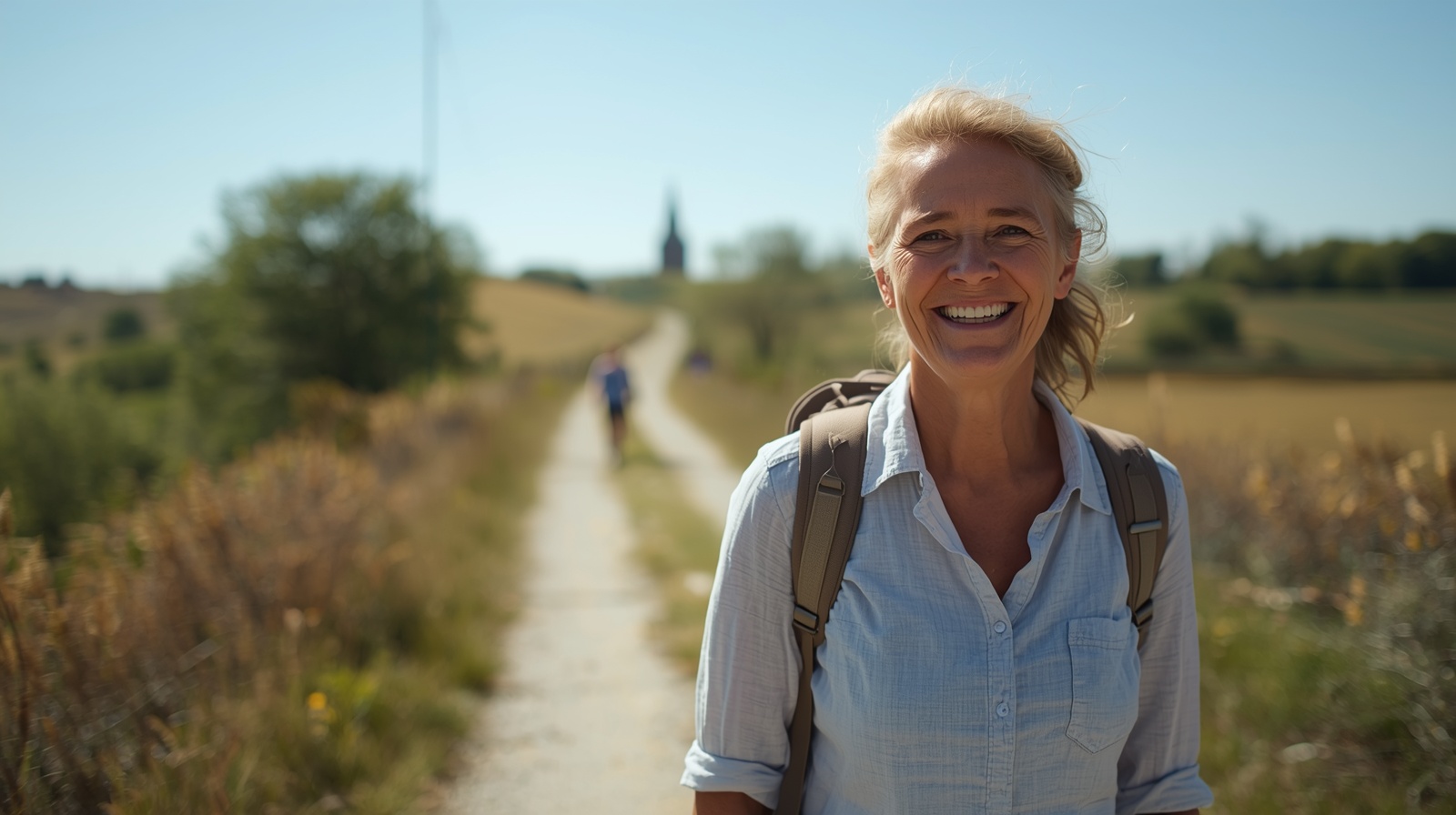
She’d joined our Camino de Santiago walking retreat near Eauze, and within the first hour, I’d counted seventeen unnecessary sorries. Her shoulders curved forward as though protecting something fragile. Her gaze rarely lifted above chest height. When she spoke, her voice emerged quietly, almost as if hoping not to be heard.

During our opening circle that evening, when I invited each guest to share what brought them to the Camino, Nadia’s hands twisted in her lap like wrung-out dishcloths. “I’m Nadia,” she said to the ground. “I’m here because I’m tired of being invisible.”

The irony, of course, was that her body language was a masterclass in making herself disappear.

On our first morning’s walk, I positioned myself beside her. The path stretched before us, golden with late sunlight, the air thick with the scent of wild thyme and warm earth. Other walkers chatted easily, their voices carrying across the fields, but Nadia walked as though treading on ice—careful, contracted, every muscle held tight.

“What do you notice about how you’re walking?” I asked.

She glanced at me, startled. “I… I don’t know. Normal?”

“Look at your hands.”

She did. They were clenched into fists, white-knuckled, as though preparing for impact.

“Now look at Sarah up ahead.”

Sarah, one of our returners, strode along with her arms swinging loosely, head up, practically conducting an orchestra with her enthusiasm for the landscape.

“I could never walk like that,” Nadia said immediately. “That’s just not who I am.”

“Or it’s not who you’ve been practising being,” I suggested.

Over the next few days, I watched Nadia wrestle with this idea. During our morning meditation sessions, I’d catch her peeking at how others sat—spines straight but relaxed, chins level, hands open on their knees. She’d try to mirror the posture, then within minutes fold back into her habitual hunch.

The breakthrough came on day four, during our storytelling circle.

For those unfamiliar with how we work, our storytelling circles are simple but profound: we sit in a circle (revolutionary, I know), and each person shares a story from their life—no workshopping, no critique, just witnessing and being witnessed. The only rule is that you must stand to tell your story.

When Nadia’s turn came, she stood reluctantly, eyes fixed on her feet. She began speaking about her mother, and how she’d learned early that taking up space was dangerous, that being noticed meant being criticised. Her voice was barely audible, her body curled inward like a fern frond.

Then something shifted.

Perhaps it was the safety of being truly heard without judgment. Perhaps it was the fourth day’s accumulated courage. Perhaps it was simply that her story demanded more breath than her constricted chest could provide. Whatever the catalyst, I watched her spine slowly lengthen. Her shoulders rolled back. Her chin lifted.

And her voice changed.

It wasn’t dramatic—she didn’t suddenly boom like a Shakespearean actor. But there was a clarity, a resonance that hadn’t been there before. She made eye contact with someone across the circle. Then another person. Her hands, which had been clutched together, opened and began to gesture, sketching her story in the air.

When she finished, there was a moment of profound silence—the kind that holds respect and recognition. Then the circle erupted in appreciation, and I saw Nadia’s face transform. Not with pride, exactly, but with a dawning wonder, as though she’d discovered she could fly and had simply never tried before.

Later that evening, she found me watching the sunset from the garden. “I felt different,” she said, sitting beside me. “When I stood up straighter, I felt… I felt like my story mattered more. Like I mattered more. Does that sound ridiculous?”

“Not remotely,” I said. “Your body was telling your brain a different story about who you are.”

She sat with that for a moment, then laughed—a real laugh, unguarded. “So I’ve been lying to my brain for forty-three years?”

“Not lying. Just telling it a very old, very outdated story.”

By the final day of the retreat, Nadia walked differently. Not with false bravado or forced confidence, but with something quieter and more sustainable: a sense of rightful presence. Her gaze met the horizon. Her stride had lengthened. When she spoke, there was no ambient apology, no preemptive shrinking.

At our closing circle, she stood to speak—really stood, grounded and open—and said simply: “I came here invisible. I’m leaving visible. Not to everyone else. To myself.”

I’ve stayed in touch with Nadia since that retreat. She tells me she now teaches an art class at her local community centre, something she’d dreamed about for years but never dared try. “I practise the posture every morning,” she wrote in a recent email. “I stand the way I stood when I told my story in your circle. And then I go teach. It sounds simple, but it’s changed everything.”

It does sound simple. That’s because it is.

And that’s precisely why it’s so powerful.

The Science Behind the Stance: Why Body Language Rewires Your Brain

The relationship between body language and self-perception isn’t metaphorical—it’s measurable, observable, and rooted in how our nervous system processes information.

Consider the work of social psychologist Amy Cuddy, whose research on “power posing” sparked both enthusiasm and controversy in the scientific community. While some aspects of her original findings have been debated, the core insight remains robust: adopting expansive, open postures—even for brief periods—correlates with reduced stress and increased feelings of power.

But why? How can simply changing your physical configuration change your mental state?

The answer lies in something called “proprioceptive feedback”—the constant stream of information your body sends to your brain about its position in space. Your brain uses this information not just to coordinate movement, but to assess your emotional state and your relationship to your environment.

When you adopt a closed, protective posture—shoulders hunched, arms crossed, gaze down—your brain interprets these signals as: “I’m in a threatening situation. I need to protect myself. I’m not safe.” It responds by triggering your stress response: cortisol rises, your thinking becomes more rigid and defensive, your perception narrows to focus on threats.

Conversely, when you adopt an open, expansive posture—shoulders back, chest open, head up—your brain receives different information: “I’m safe. I have space. I can engage with my environment.” The stress response diminishes, cognitive flexibility increases, and your perception broadens to notice opportunities rather than just threats.

This isn’t about positive thinking or visualisation. This is about your body literally telling your brain what to feel, and your brain listening.

The implications are profound, particularly for women. We’re often socialised from girlhood to make ourselves smaller—to sit with knees together, to not take up too much space, to soften our presence. These learned behaviours aren’t just social performance; they’re shaping our internal sense of self-worth and capability.

In my storytelling circles, I’ve watched this pattern play out many times. Women arrive practised in self-minimisation—crossing their legs tightly, tucking their elbows in, tilting their heads in perpetual listening mode. When invited to stand and share their stories, they initially maintain these protective patterns. But storytelling demands breath, and breath demands space, and space demands a body that’s open rather than closed.

As they speak—particularly when they speak about moments of strength or joy or righteous anger—their bodies naturally expand. Shoulders drop and widen. Chests lift. Gestures become broader. And you can see, in real-time, their relationship to their own narrative changing. The story they’re telling shifts from something that happened to them to something they survived, chose, or created.

This is embodied cognition at work: the recognition that our thinking doesn’t happen in isolation in our brains, but emerges from the dynamic interaction between our minds, bodies, and environments.

Your body isn’t a vehicle for your mind to get around in. Your body is part of your mind. And when you change one, you inevitably change the other.

Practical Applications: Rewiring Through Intentional Posture

Understanding the theory is one thing. Applying it in your daily life is where the magic happens—and where most people stumble.

The challenge isn’t complexity; it’s consistency. Changing habitual body language requires the same patient attention as changing any deeply ingrained pattern. Here’s how to begin:

Start with awareness, not correction. For one week, simply notice your default postures throughout the day. How do you sit at your desk? Stand in queues? Position yourself in meetings? Hold your body during difficult conversations? Notice without judgment—you’re gathering data, not criticising yourself.

Identify your “stress signature.” Everyone has characteristic ways their body responds to stress. Some people clench their jaws. Others raise their shoulders. Some collapse their chests or cross their arms. What’s your pattern? Once you can recognise it, you have the power to interrupt it.

Create “posture anchors.” Choose specific moments in your day to consciously check in with your body language. Perhaps every time you walk through a doorway, or before you send an email, or when you first wake up. These anchors help build new neural pathways without requiring constant vigilance.

Practise power postures in private. Before challenging situations—a difficult conversation, a presentation, a social event that intimidates you—spend two minutes in a private space adopting an expansive posture. Stand with your feet hip-width apart, hands on hips or raised in a V shape, chest open, chin level. It feels absurd. It also works.

Use breath as a bridge. Your breath is intimately connected to your posture. Shallow breathing reinforces stress; full breathing requires an open chest and relaxed shoulders. When you notice closed body language, don’t try to force your posture to change—simply take three deep breaths. Your body will naturally reorganise around the breath.

Seek environments that support openness. This is why walking retreats and storytelling circles are so powerful: they create safe containers where practising new ways of being doesn’t feel risky. You need spaces where you can experiment with confidence without fear of judgment or consequence.

The goal isn’t to maintain perfect posture every moment. The goal is to develop flexibility—to have access to open, confident body language when you need it, rather than being trapped in habitual patterns of self-protection that no longer serve you.

Further Reading: Three Unconventional Books on Body Language

1. “The Body Keeps the Score” by Bessel van der Kolk

While not specifically about body language, this groundbreaking work on trauma explains why our bodies hold memories and patterns that our conscious minds may have forgotten. Van der Kolk demonstrates how trauma literally lives in our posture, our breathing, our muscular tension—and why talk therapy alone often can’t shift these embodied patterns. I chose this book because it illuminates why changing body language isn’t superficial; it’s a profound intervention in how we process our life experiences. If you’ve ever wondered why you can intellectually know you’re safe but still feel anxious, this book explains the disconnect between mind and body.

2. “How to Do Nothing: Resisting the Attention Economy” by Jenny Odell

An unexpected choice for body language, perhaps, but Odell’s exploration of presence and attention is fundamentally about embodiment. She argues that our constant distraction isn’t just mental—it’s physical, manifesting in hunched postures over screens, shallow breathing, and disconnection from our sensory experience. The book offers no specific body language techniques, but it reframes the entire question: instead of asking “How should I hold my body?” it asks “How do I become present enough to inhabit my body at all?” In our overstimulated age, this is the necessary first question.

3. “Reclaiming Conversation” by Sherry Turkle

Turkle’s examination of how technology has changed human connection includes fascinating insights about body language in the digital age. She explores how our device-dominated lives have literally changed our posture (the “iHunch”), reduced our ability to read others’ non-verbal cues, and diminished our capacity for the vulnerable eye contact that builds intimacy. I included this because understanding body language isn’t just about individual transformation—it’s about maintaining our human capacity for genuine connection in an increasingly mediated world.

What Others Have Discovered

“I’d spent so long making myself small that I didn’t realise how much energy it took. On Dr Montagu’s retreat, during one of the meditation sessions, she invited us to simply sit with an open chest and relaxed shoulders. I felt this wave of emotion—almost grief—for all the years I’d held myself so tightly. By the end of the week, walking those beautiful Camino paths, I noticed I was taking up space without apologising for it. It sounds small, but it’s changed how I move through the world. I’m not invisible anymore, and that’s both terrifying and liberating.”
Claire Thompson, Camino de Santiago Walking Retreat

“Joining the storytelling circle was the first time I’d travelled alone, and I was convinced everyone would see right through me—see how nervous I was, how I didn’t belong. But something about standing to tell my story, seeing other women’s faces really listening, not judging—it shifted something. Dr Montagu creates this space where you can be vulnerable without feeling weak. I went home and booked a solo trip to Iceland. My friends were shocked, but I wasn’t. I’d practised being brave in that circle, and my body remembered how.”
Amara Singh, Storytelling Circle Member

Five Frequently Asked Questions

Q: Isn’t changing my body language just another form of “fake it till you make it,” which feels inauthentic?

Not quite. “Fake it till you make it” suggests pretending to be something you’re not. Shifting your body language is more like removing the costume you’ve been wearing—the protective slouch, the apologetic hunch—that was never really you in the first place. You’re not faking confidence; you’re removing the physical barriers to the confidence that’s already there. Authenticity isn’t about maintaining patterns that feel familiar. It’s about aligning your outer expression with your true capacity.

Q: I’ve had anxiety for years. Can simply standing differently really make a meaningful difference?

Body language work isn’t a replacement for therapy, medication, or other treatments for clinical anxiety. But it can be a powerful complementary tool. Anxiety often manifests in protective postures—hunched shoulders, shallow breathing, closed-off stances—that then signal danger back to your brain, creating a feedback loop. Interrupting that loop through intentional posture can help break the cycle. Think of it as one tool in your wellbeing toolkit, not a miracle cure.

Q: What if adopting confident body language makes me seem arrogant or aggressive?

This is a particular concern for women, who are often punished socially for displaying confidence. But there’s a vast territory between shrinking yourself and being overbearing. Confident body language doesn’t mean puffing yourself up or dominating space aggressively. It means standing with dignity, making appropriate eye contact, and allowing your body to occupy the space it naturally requires. If others perceive your basic self-respect as arrogance, that says more about their expectations than your behaviour.

Q: How long does it take to change ingrained body language patterns?

There’s no fixed timeline—some people notice shifts within days; others need months of consistent practice. The key is approaching it as a practice rather than a project with an end date. You’re not trying to achieve perfect posture and then maintain it forever. You’re developing awareness and flexibility, so you can choose how you hold yourself depending on the situation. The changes compound over time, and one day you’ll realise the open posture that once required conscious effort has become your new default.

Q: Can I practise this on my own, or do I need a group setting?

Both are valuable. Solo practice—checking in with your posture throughout the day, doing power poses before challenging moments—builds personal awareness and capability. But group settings like storytelling circles or walking retreats offer something irreplaceable: the experience of being witnessed in your new posture by others, and the safety of practising vulnerability in a supportive community. If possible, combine both: daily personal practice supplemented by periodic immersion in a group that supports your growth.

Conclusion: Stand In Your Story

Here’s the truth that no one tells you: the person you’re becoming has been waiting patiently inside the person you’ve been pretending to be.

Your body has been trying to tell you this for years, but you’ve been too busy apologising, shrinking, and making yourself smaller to hear it. Every time you hunched your shoulders, you were having a conversation with your brain: “I’m not important enough to take up space.” Every time you avoided eye contact, you were confirming: “I’m not worthy of being seen.”

And your brain, bless it, believed every word.

But here’s the equally important truth: you can start a different conversation. Right now. This moment.

Not by becoming someone else. Not by pretending or performing or achieving some impossible standard of confidence. Simply by standing as though you have the right to exist fully in your own skin—because you do.

The path to becoming yourself isn’t complicated. It doesn’t require years of therapy or radical life changes or waiting until you feel ready. It requires standing up straight and telling your brain a truer story about who you are.

Your body and your mind aren’t separate entities. They’re in constant dialogue, shaping each other, creating each other. When you change the conversation your body is having with your brain, you change everything.

So stand. Breathe. Take up the space you’ve been given. Not aggressively, not apologetically, but with the quiet certainty that you deserve to be here, fully present and fully yourself.

Your body has been waiting for permission. Consider this it.

Walk Your Way to Confidence: Camino de Santiago Retreat

Imagine walking ancient pilgrimage paths through the sun-soaked landscapes of south-west France, each step loosening the tension you’ve carried for years. Imagine sitting in circle with others who understand the exhaustion of making yourself small, sharing stories that matter in voices that grow stronger with each telling. Imagine discovering that confidence isn’t something you achieve—it’s something you already have, waiting to be uncovered beneath layers of learned self-protection.

My Camino de Santiago walking retreats near Eauze offer exactly this: a week of gentle walking, mindfulness meditation, and storytelling circles designed specifically for women ready to reconnect with their bodies and reclaim their presence. This isn’t boot camp or therapy or performance. It’s simply creating space—physical, emotional, and spiritual—for you to remember who you are when you’re not trying to be smaller.

Each day includes morning meditation to ground you in your body, walks through stunning countryside that invite you to breathe deeply and move freely, and evening storytelling circles where you practise being witnessed without judgment. The meditation and mindfulness exercises specifically target stress management, helping you recognise and release the physical patterns of anxiety and self-protection you’ve been carrying.

The retreat is limited to small groups, ensuring everyone receives personal attention and the intimacy necessary for real transformation. You’ll stay in comfortable accommodations, enjoy nourishing meals, and spend a week doing something radical: inhabiting your body as though you have the right to exist fully.

If you’re tired of apologising for taking up space, if you’re ready to stand in your own story, if you’re curious about what might emerge when you finally let your shoulders drop and your chest open, come walk with us.

Learn more and make a reservation

Recommended TED talk – lasts 20 minutes

I got the idea for this post from this TED talk.

Wednesday was International Women’s Day – a celebration of the social, economic, cultural, and political achievements of women. The day also marks a call to action for accelerating women’s equality – and also, March is Women’s History Month.

In this month’s recommended TED talk, social psychologist Amy Cuddy argues that using body language, ex “power posing” -standing in a posture of confidence, even when we don’t feel confident – can make us feel more confident.

In the comments on Youtube, Maggie says “I watched this for one of my classes and sometimes, I admit, I only half pay attention to required videos but this one completely captivated me. When she told her personal story I literally started to cry because I used to be that girl she was describing.”

During myretreats, I show my guests how horses communicate with remarkable accuracy using posture, gesture and breath to express their needs, wishes and emotions to each other. By discovering how effectively horses can communicate using body language, we can become more aware of how we communicate using body language ourselves. This TED talk, with practical examples, will help you adjust your body language so that you can communicate more confidently, intensionally and accurately. Especially if you are a woman.

This TED talk is one of the most powerful that I have ever watched. Incidentally, it reflects the subject I address in my latest LinkedIn article: Fight/Flight or Connect/Encourage?

My Burnout to Breakthrough – A Road Map to Resilience Online Course is now accessible. Please go and have a look and tell anyone you may know who already suffers from burnout already or teetering on the edge, about it. I want to help as many people as possible with this, my first ever online course, while earning enough to keep the Friesian mares in the style they have come to expect!

I wanted to reach out and let you know how impressed I am with the Burnout to Breakthrough course you’ve created. It’s such an important topic, and I think the way you’ve approached it is really insightful and helpful. In particular, I appreciate how you’ve focused not just on the emotional and mental aspects of burnout, but also on the physical symptoms that can come along with it. I also wanted to tell you that I’ve learned so much from the course already. Your explanations of what burnout is and how it can happen were really eye-opening for me, and I’ve already started to recognise some of the signs of burnout in my own life. The strategies you’ve shared for preventing and managing burnout are also really practical and useful. I found the guided meditation particularly engaging. Overall, I just wanted to say a huge thank you for creating this course. I think it has the potential to help so many people, and I’m really excited to continue learning from it. Keep up the great work! D.S. 2023

Author Bio: Dr Margaretha Montagu – described as a “game changer”, “gifted healer”, “guiding light” and “life-enriching author” – is an experienced medical doctor, a certified NLP practitioner, a medical hypnotherapist, an equine-assisted psychotherapist (EAGALAcertified) and a transformational retreat leader who guides her clients through life transitions – virtually, or with the assistance of her Friesian and Falabella horses, at their home in the southwest of France.

Why Would You Go on a Wellness Retreat?

Why Would You Go on a Wellness Retreat?

A Comprehensive Guide

People go on a wellness retreat to step away from their daily routines and create space for growth, healing, rest, or connection. In our constantly connected, fast-paced world, retreats offer a sanctuary where you can focus on specific aspects of your wellbeing, development, or interests without the usual distractions and demands of everyday life.

A Variety of Reasons

Yoga and Mindfulness Retreats

Yogis and those interested in deepening their yoga practice often choose yoga retreats as a way to immerse themselves fully in the discipline. These retreats typically feature daily yoga classes at various levels, guided meditation sessions, pranayama (breathing exercises), and workshops on yoga philosophy. Participants enjoy healthy, often vegetarian or plant-based meals that support their practice, along with ample time for relaxation and personal reflection. Many modern yoga retreats incorporate specialised practices like Yoga Nidra—a form of guided meditation that promotes deep relaxation. Yoga Nidra can be particularly transformative, helping clients achieve restful sleep from the very first night, which sets a foundation for deeper healing and practice throughout your stay.

Spiritual and Faith-Based Retreats

People of various faiths attend spiritual retreats to deepen their relationship with their beliefs and connect with a community of like-minded individuals. These retreats might be held at monasteries, convents, ashrams, or retreat centres affiliated with specific religious traditions. Activities typically include communal prayer or worship, scripture study, silent contemplation, and conversations with spiritual directors or teachers. Participants often seek clarity, renewal of their faith, or answers to spiritual questions they’re grappling with. The intentional separation from worldly concerns allows for a more profound focus on the sacred and transcendent aspects of life.

Transformational and Life-Transition Retreats

When people find themselves at crossroads—whether facing career changes, relationship transitions, midlife questions, or simply feeling stuck—transformational retreats offer a supportive container for change. These experiences are specifically designed to facilitate personal growth through a combination of self-reflection exercises, coaching or therapy sessions, group sharing, and sometimes challenging physical activities that push participants beyond their comfort zones. The retreat environment provides both the safety and the catalyst needed for you to examine your lives honestly, identify what needs to change, and develop concrete plans for moving forward. Many participants leave these retreats with renewed clarity about their purpose and direction.

Health and Wellness Retreats

Those seeking to improve their physical, mental, or emotional health often turn to wellness retreats. These comprehensive programs address wellbeing from multiple angles, incorporating activities such as meditation and mindfulness training, therapeutic massage and bodywork, nutritious meals designed to nourish and heal, various forms of exercise from gentle movement to more vigorous activities, and educational workshops on topics like stress management, sleep hygiene, or emotional regulation. Some wellness retreats specialise in specific areas such as weight loss, addiction recovery, or managing chronic conditions. The retreat setting removes participants from environments and habits that may be contributing to their health challenges, while providing new tools and perspectives they can bring home.

Creative and Artistic Retreats

Artists, writers, musicians, and other creative individuals often seek out creative retreats when they need dedicated time and space to focus on their work. These retreats provide a distraction-free environment, often in inspiring natural settings, where creatives can fully immerse themselves in their craft. Whether it’s a writing retreat where authors work on their novels, a painting retreat in a scenic location, or a music composition retreat, the key element is uninterrupted time for creative work. Many creative retreats also include workshops, critiques from peers or mentors, and opportunities to share work in progress. The combination of solitude for deep work and community for feedback and inspiration makes these retreats particularly valuable for artists looking to complete projects or breakthrough creative blocks.

Corporate and Team-Building Retreats

Companies send their employees on corporate retreats with the goal of strengthening team dynamics, developing leadership capabilities, and boosting overall productivity. Unlike typical work days, these retreats take employees out of the office environment and into settings that encourage fresh thinking and genuine connection. Activities might include team-building exercises and challenges, leadership development workshops, strategic planning sessions, outdoor adventures that require collaboration, and social activities that help colleagues see each other as whole people rather than just coworkers. When well-designed, corporate retreats can break down silos between departments, improve communication, address workplace conflicts, and reignite employees’ enthusiasm for their work and company mission.

Regardless of the specific type, all retreats share certain core elements: they provide a break from routine, create space for focused attention on what matters, offer a supportive or inspiring environment, and facilitate connection—whether with oneself, others, nature, creativity, or the divine. In essence, people go on retreats because they recognise the need to pause, reset, and intentionally invest in some aspect of their lives that deserves more attention than daily life typically allows.

What Do Walking Retreats Have That Other Retreats May Lack?

My guests want to find solutions to their problems, and walking the Camino empowers them to do so, by offering an undisturbed and uninterrupted opportunity for:

Contemplation, Reflection, and Introspection in Motion

There’s something profoundly transformative about walking that sets it apart from sitting still. The rhythmic, repetitive nature of walking creates a meditative state that allows thoughts to flow more freely and insights to emerge organically. Walking retreats, like Camino experiences, encourage participants to become more self-aware and connect with their authentic selves as they move through the landscape. The physical act of walking forward becomes a powerful metaphor for moving forward in life, helping people gain clarity about their life direction and identify areas where they would like to grow and change.

Unlike the sometimes overwhelming intensity of sitting meditation, walking provides a gentle container for introspection. The body is occupied with movement, which paradoxically allows the mind to relax its usual grip and defences. Many participants find that answers to questions they’ve been struggling with simply arise during a walk, without the forced effort that often characterises our usual problem-solving attempts. The changing scenery provides fresh perspectives, both literally and metaphorically, helping people see their lives from new angles.

Community and Connection on the Path

Walking retreats offer a unique form of community building. There’s something about walking alongside others—sometimes in conversation, sometimes in companionable silence—that creates bonds difficult to forge in other settings. The shared experience of covering distance together, facing physical challenges, witnessing beautiful or difficult moments side by side, creates a deep sense of camaraderie.

Walking wellness retreats provide non-judgmental support from retreat leaders who walk with participants, available for guidance without the formality of scheduled sessions. This organic accessibility allows for conversations to unfold naturally when participants are ready. Additionally, participants gain access to a supportive community of like-minded individuals who are on similar journeys of personal growth and transformation. This creates a safe and nurturing environment where individuals can share their experiences, receive feedback, and gain support during evening gatherings or meals after the day’s walk.

Many people who meet during walking retreats form friendships that endure long after the retreat ends. Having walked through both literal and metaphorical terrain together creates a bond that transcends typical retreat connections. These ongoing relationships can lead to increased confidence, more supportive relationships, and a greater sense of purpose and direction in life, as friends continue to support each other’s growth journeys.

Mind-Body Reconnection Through Movement

Modern life often creates a disconnect between our minds and bodies—we spend hours at desks, in cars, or on screens, essentially living from the neck up. Walking retreats specifically address this disconnection by making the body an active participant in the transformational process. The simple act of walking—feeling your feet on the ground, your breath moving in and out, your muscles working—brings awareness back into the body in a way that seated practices alone cannot.

Transformational walking retreats often incorporate complementary practices that deepen this mind-body connection. For instance, equine-guided mindfulness exercises combine the awareness cultivated during walking with the powerful presence of horses, who are extraordinarily sensitive to human emotional states. These mindfulness practices have been shown to reduce stress, improve mood, and promote overall wellbeing. The physical demands of walking—while manageable for most fitness levels—also ensure that participants are truly embodied throughout their experience, not just intellectually engaged.

Processing Through Movement

Walking has a unique capacity to help people process difficult emotions and experiences. Trauma therapists have long recognised that bilateral movement (the alternating left-right pattern of walking) can help the brain process and integrate challenging material. People dealing with grief, major life transitions, or past trauma often find that walking retreats allow them to metabolise these experiences in a way that purely verbal or seated practices don’t facilitate. The forward momentum of walking can help people feel less stuck in their emotional patterns.

Digital Detox and Sensory Reawakening

Walking retreats, particularly those in nature, provide a much-needed break from screens and digital overwhelm. Without the constant ping of notifications, participants report that their senses become more acute—they notice the quality of light, hear birds they wouldn’t normally attend to, smell the earth after rain, feel the sun or wind on their skin. This sensory reawakening is both grounding and enlivening, reminding people of the rich, textured reality that exists beyond their devices. Many participants discover they’ve been living in a kind of sensory deprivation without realising it.

Pilgrimage and Sacred Purpose

For some, walking retreats connect to ancient traditions of pilgrimage—the idea of journeying to a sacred place or journeying for sacred purposes. Even for those without specific religious beliefs, there’s something inherently meaningful about undertaking a journey on foot. It feels significant in a way that arriving by car or plane doesn’t. The effort required, the time invested, and the embodied nature of the journey all contribute to a sense that this is more than just tourism—it’s a quest for something deeper. The Camino de Santiago and similar pilgrimage routes attract people from all spiritual backgrounds who are seeking meaning, answers, or transformation.

Simplification and Perspective

Walking retreats strip life down to essentials. You carry what you need, you walk, you eat, you rest, you repeat. This simplification helps participants recognise what truly matters and what’s merely noise in their regular lives. When your daily concerns are reduced to finding the next marker, staying hydrated, and taking care of your feet, the problems that seemed overwhelming at home often shrink to a manageable size. People frequently return from walking retreats with a clearer sense of priorities and a determination to simplify their lives.

Achievement and Empowerment

There’s profound satisfaction in completing a walking retreat, particularly one covering significant distance. Many participants choose walking retreats specifically because they want to prove something to themselves—that they’re capable of more than they believed, that they can persevere through difficulty, that their bodies are stronger than they realised. This sense of achievement often catalyses change in other areas of life. If you can walk the Camino, what else might you be capable of?

Natural Rhythms and Slower Living

Walking retreats operate at the pace of the human body, not the speed of technology or modern transportation. This enforced slowing down helps participants recalibrate their internal rhythms. They begin to notice when they’re truly hungry versus eating from habit, when they’re genuinely tired versus just bored, when they need solitude versus companionship. This attunement to natural rhythms and bodily wisdom is something many people have lost in their busy lives, and walking retreats provide an opportunity to recover it.

Integration and Lasting Change

The extended nature of most walking retreats—often a week or more—provides time for insights to deepen and integrate. Unlike a weekend workshop where revelations might fade by Tuesday, the daily practice of walking, reflecting, and connecting over an extended period allows new patterns to begin taking root. The physical memory of the journey—the ache in your muscles, the feeling of arrival each day—becomes anchored to the psychological and spiritual insights, making them more durable and accessible after returning home.

The Transformational Power of Walking Retreats

A transformational walking retreat represents a powerful tool for personal growth precisely because it engages the whole person—body, mind, emotions, and spirit. By creating a supportive environment, offering opportunities for personal development through both structured activities and unstructured walking time, and promoting mind-body connection through movement and complementary practices, these retreats help individuals gain new insights and perspectives that might remain inaccessible through other means.

The combination of physical challenge, natural beauty, supportive community, and dedicated time for reflection creates conditions uniquely suited to breakthrough and transformation. For many, a walking retreat becomes a pivotal experience they reference for years afterward—a time when they reconnected with themselves, discovered inner resources they didn’t know they possessed, and charted a new course for their lives.

A transformational retreat can be a powerful tool for personal growth. By creating a supportive environment, offering opportunities for personal development, and promoting mind-body connection, transformational retreats can help individuals gain new insights and perspectives.

Walking retreats have become increasingly popular as people discover the unique combination of physical movement, mental clarity, and spiritual connection that comes from putting one foot in front of the other with intention. Unlike stationary retreats, walking retreats harness the natural rhythm of walking to facilitate deeper transformation and insight.

If you need more immediate help, you can register for my «Survive The Storm Protocol»

What Life Lessons Can You Learn While Walking the Camino de Santiago? a free guide filled with 10 not just “quaint anecdotes” or Instagram-worthy moments (though there are plenty of those) but real transformations from real people who walked this insight-giving trail – Subscribe to my monthly newsletter to Download the Guide

Research about the Benefits of Wellness Retreats

Substantial research shows wellness retreats offer a broad range of benefits, including improved physical and mental health, greater stress reduction, and lasting enhancements in well-being that often persist for weeks or months after participation.

Physical and Psychological Health Benefits

Multiple longitudinal and systematic studies indicate that residential wellness retreats can produce significant improvements in weight, blood pressure, sleep quality, and mood. For instance, a study of a one-week retreat found meaningful reductions in abdominal girth, weight, and both systolic and diastolic pressure, alongside improvements in psychological measures such as stress, depression, and sleep. These health benefits are observed across diverse populations, including those with chronic conditions like multiple sclerosis and cancer.

Cognitive and Emotional Well-Being

Retreats focusing on meditation and mindfulness yield enduring benefits in emotional regulation, attention, and cognitive function. Research reports sustained improvements in stress resiliency, reduced anxiety and depression, as well as enhancement in sustained attention and telomere length, which is linked to healthy ageing. These cognitive and emotional gains generally exceed those seen in traditional vacations.

Long-Term Impact and Lifestyle Change

Evidence suggests that the effects of wellness retreats are not limited to the duration of the experience; improvements in well-being, stress management, and symptom severity often persist for weeks or months post-retreat. Many retreat participants report lasting changes in health symptoms, daily mindfulness practice, and overall life satisfaction. Retreats serve as catalysts for behavioural change by offering opportunities for reflection, skill-building, and deep rest, setting the stage for healthier habits once home.

Nature-Based and Holistic Approaches

Nature-based wellness retreats, specifically, have been shown to significantly lower stress levels, blood pressure, and improve mood, attributed to time spent in natural environments and participation in structured, enjoyable activities. The holistic approach of wellness retreats, which combines healthy eating, physical activity, therapies, and relaxation, underpins their uniquely transformative effect.

Evidence-Based Therapies and Preventive Health

Many wellness retreats now integrate evidence-based therapies such as cognitive behavioural therapy (CBT), personalised treatment plans, and mindfulness-based interventions, further boosting outcomes related to both mental and physical health. Improvements are found in inflammatory and metabolic markers, immune function, and chronic stress management, suggesting a role for retreats in preventive healthcare.

Research Limitations

While the evidence base is growing, researchers note a need for further studies involving larger populations, objective biomarkers, and economic impact assessments, to fully understand the mechanisms and value proposition of wellness retreats for healthcare practitioners and insurers.

References

  • Naidoo D et al. (2018) “The health impact of residential retreats: a systematic review” BMC Complement Altern Med. 2018 Jan 10;18(1):8.
  • Giridharan S et al. (2024) “Residential Meditation Retreats: A Promise of Sustainable Wellness” Cureus. 2024 Nov 9;16(11):e73326.

“I am an experienced medical doctor – MBChB, MRCGP, NLP master pract cert, Transformational Life Coach (dip.) Life Story Coach (cert.) Stress Counselling (cert.) Med Hypnotherapy (dip.) and EAGALA (cert.) I may have an impressive number of letters after my name, and more than three decades of professional experience, but what qualifies me to excel at what I do is my intuitive understanding of my clients’ difficulties and my extensive personal experience of managing major life changes using strategies I developed over many years.” Dr M Montagu

Burnout Destroys Creativity

Burnout destroys creativity. Woman in straw hat surrounded by plants.

Recommended TED-talk of the Month duration 5 minutes

Early this morning, when I should have been getting out of bed to go and feed the horses, the -3°C reading on the thermometer and crackling frost on the fields was so discouraging that I resisted my coffee cravings to watch one more TED talk: Rahaf Harfoush’s talk “Burnout makes us less creative. “

I am in the process of creating an online course called Burnout to Breakthrough/Road Map to Resilience, so I read everything I can lay my hands on about “burnout.” I actually hadn’t thought about the effect that burnout has on our creativity, but I should have because the more creative we are, the greater our ability to problem-solve. I reflected on my own experience and realised just how detrimental an effect burnout has on my own creativity – when I am stressed, I write to reduce stress, but burnout gives me complete writer’s block.

I thought I would share this talk with you here. It’s excellent, if you have 5 minutes, I recommend you watch it. Twice, if you have time, it makes so much sense. According to Rahaf Harfoush, a digital anthropologist (that sounds like an amazing job,) “Our obsession with productivity — to-do lists, life hacks, morning routines — is making us less productive. We need to redesign our workday around creativity – not just efficiency. She says the average American takes only half of their allocated leave…

Burnout Inhibits Creativity: When Your Inner Fire Burns Out, So Does Your Spark

Burnout doesn’t just make you tired—it murders your creativity, strangles your innovation, and leaves you staring at blank pages, wondering where your brilliance went. As a medical doctor who’s been there, survived it, and now guides others through it on Camino retreats, I’m sharing why your brain stops producing when you’re running on fumes, and more importantly, how to get your creative mojo back. If you’ve ever felt like a shell of your former imaginative self, keep reading.

5 Key Takeaways

  1. Burnout literally rewires your brain’s creative centres: Chronic stress shrinks the prefrontal cortex (your innovation hub) whilst enlarging the amygdala (your fear centre). You’re not lazy—you’re neurologically compromised.
  2. Rest isn’t optional; it’s the prerequisite for creativity: Your best ideas don’t come from pushing harder—they emerge in the spaces between effort. Walking, silence, and doing “nothing” are actually doing everything.
  3. Storytelling rewires burnt-out brains: Sharing narratives in safe circles activates different neural pathways than analytical thinking, offering your exhausted executive functions a genuine break whilst reconnecting you to meaning.
  4. Physical movement unlocks mental movement: Rhythmic walking (especially pilgrimage-style) synchronises both brain hemispheres, creating the conditions where creative insights spontaneously arise.
  5. Community heals what isolation destroyed: Burnout thrives in loneliness. Creativity flourishes in connection. You cannot think your way out of burnout—you must walk, talk, and feel your way through it with others.

Introduction: Empty is Expensive

Burnout doesn’t just steal your energy. It pickpockets your imagination, burgles your curiosity, and leaves you holding an empty bag where your creativity used to live.

I know because I’ve lived it. As a medical doctor, I spent years believing that exhaustion was simply the price of excellence, that running on empty was a badge of honour, and that my worth was measured in productivity. Then one morning, I sat down to write a simple patient letter and couldn’t find the words. Not medical jargon—I had plenty of that. But the connecting tissue, the creative phrasing, the human touch that makes medicine an art as much as a science? Gone.

That’s when I realised: burnout doesn’t just dim your light. It fundamentally alters how your brain processes possibility itself.

The relationship between burnout and creativity isn’t just correlation—it’s causation. When your nervous system is perpetually flooded with cortisol, when your prefrontal cortex is starved of resources because your amygdala is screaming danger signals, when every ounce of cognitive energy is devoted to simply surviving the next email, the next meeting, the next demand… there’s nothing left for imagination.

Creativity requires spaciousness. Burnout is the ultimate space invader.

But here’s the good news I discovered walking the Camino de Santiago: creativity isn’t dead. It’s dormant. And with the right conditions—movement, community, story, and rest—it comes roaring back to life.

Tina’s Story: The Marketing Director Who Lost Her Spark

Tina Pyper arrived at a Camino de Santiago Crossroads Retreat carrying a leather portfolio she never opened and a smartphone she checked every seven minutes. Her fingers twitched constantly, as though typing invisible emails on invisible keyboards. When I asked what brought her to the Camino, she laughed—a brittle, humourless sound like ice cracking.

“I used to be brilliant,” she said, staring at the limestone path stretching ahead. “Now I’m just… functional.”

Tina had spent fifteen years building her reputation as the creative director everyone wanted on their team. The woman who could walk into a room and spin three campaign concepts before coffee arrived. Who dreamed in metaphors and saw connections nobody else noticed. Who made clients weep with the beauty of her brand stories.

Then came the promotion. More responsibility, more budget, more visibility. And with it, more meetings, more stakeholders, more nights working until 2 AM because someone in New York had “just one quick question.” More mornings waking with her heart already racing, mentally triaging the day’s disasters before her feet touched the floor.

The first sign was small: she stopped noticing things. The way autumn light slanted through her office window. The smell of rain on hot pavement. The particular green of new leaves in spring. Details that used to spark ideas now barely registered. Her world had narrowed to screens and deadlines.

Then the ideas stopped coming. She’d sit in brainstorming sessions, her team looking at her expectantly, and find… nothing. Just a vast, echoing blankness where her imagination used to live. She’d panic, reach for old formulas, and regurgitate what worked last year. Nobody complained—her execution was still flawless. But Tina knew. The magic was gone.

“I felt like a fraud,” she told me on our second day walking, her voice barely audible above the crunch of gravel beneath our boots. “Like everyone would eventually realise I was empty inside. Just going through the motions.”

On the third morning, during our storytelling circle, I asked each person to share a childhood memory—nothing work-related, no lessons, just pure recollection. The group sat in the dappled shade of an ancient oak, and when Tina’s turn came, she hesitated so long I thought she might refuse.

Then she began: “I was seven. My grandmother had this garden…”

Her voice changed as she spoke—softened, warmed, came alive. She described the weight of tomatoes in her small palms, sun-warm and heavy. The sharp, green smell of tomato leaves that stuck to her fingers. Her grandmother’s soil-stained hands guiding hers, teaching her to pinch off suckers. The taste of cherry tomatoes eaten straight from the vine, still hot from the sun, bursting sweet and acid on her tongue.

As she spoke, I watched the others lean forward. Watched their faces soften. And I watched something shift in Tina’s eyes—a light flickering back on after a long darkness.

“I’d forgotten,” she whispered when she finished. “I’d completely forgotten how that felt. How alive everything was.”

That evening, she borrowed paper from my notebook. Not to make lists or plans—she’d been doing that compulsively since arrival—but to write. Just to see what came. She sat on a stone wall overlooking the valley as the sun set, and her hand moved across the page in a way I recognised: the unselfconscious flow of someone reconnecting with a lost part of themselves.

Later, in our final storytelling circle, she shared what she’d written: a piece about gardens and grandmothers and the particular quality of light through tomato leaves. It wasn’t marketing copy. It wasn’t strategic or targeted or optimised for anything. It was simply beautiful. Several people cried.

“I thought creativity was something I did,” Tina said, her eyes bright with tears and laughter both. “But it’s something I am. I just needed to remember how to be quiet enough to hear it again.”

She left the retreat with her portfolio still unopened and her phone notifications permanently silenced. Six months later, she sent me a message: she’d taken a sabbatical, was consulting part-time, and had started writing again—not for clients, but for herself. “The ideas are back,” she wrote. “Better than before. Because I’m back.”

In my storytelling circles, I’ve witnessed this resurrection countless times. When we create space for people to share without agenda, without performance, without the pressure to be productive—something fundamental shifts. The stories we tell reconnect us to the stories we’re living. And in that reconnection, creativity doesn’t just return. It transforms.

The Neuroscience of Burnout and Creativity: Why Your Brain Can’t Do Both

Let’s talk about what’s actually happening in your brain when burnout and creativity collide. This isn’t woolliness—it’s biology.

Your prefrontal cortex, the sophisticated CEO of your brain, handles executive functions: planning, problem-solving, and creative thinking. It’s where innovation lives, where you make unexpected connections, where your best ideas emerge. But here’s the catch: it’s an energy hog. When resources are scarce, your brain has to make choices.

Enter burnout. Chronic stress floods your system with cortisol, triggering your amygdala—your brain’s alarm system—into overdrive. Your amygdala doesn’t care about your brilliant marketing campaign or your novel’s plot twist. It cares about survival. And when it’s screaming “danger!” your brain diverts resources away from that expensive prefrontal cortex and towards immediate threat response.

Studies using brain imaging have shown that chronic stress literally shrinks the prefrontal cortex whilst enlarging the amygdala. You’re not imagining it—your creative capacity is being structurally diminished.

But there’s more. Creativity requires what neuroscientists call the “default mode network”—the mental state you enter when you’re not focused on external tasks. It’s the wandering mind, the daydreaming state, the shower-thoughts phenomenon. This is where your brain makes those unexpected connections that feel like genius.

Burnout kills the default mode network. When you’re in constant fight-or-flight, your brain never gets to wander. You’re always on task, always vigilant, always scanning for the next threat (email, deadline, criticism). There’s no mental space for the mind to meander, to play, to stumble upon something new.

This is why forcing creativity when you’re burnt out is like trying to grow tomatoes in concrete. It’s not about willpower or discipline. Your brain literally lacks the conditions necessary for creative thought to emerge.

The Creativity-Burnout Cycle

Here’s where it gets particularly cruel: for many professionals—entrepreneurs, leaders, creatives—your creativity is your livelihood. Losing it isn’t just personally devastating; it’s professionally catastrophic. So what do you do? You work harder. You push more. You try to force the ideas to come.

Which, of course, worsens the burnout. Which further inhibits creativity. Which increases panic. Which drives you to work harder still.

I see this cycle constantly in the corporate professionals and entrepreneurs who come to my retreats. They arrive believing they need to “fix” themselves quickly so they can get back to producing. They’re treating their burnout like a software glitch—reboot and resume.

But burnout isn’t a glitch. It’s a message. Your nervous system is essentially staging an intervention, saying: “We cannot continue like this.”

Why Rest Isn’t Enough (But It’s Essential)

“Just rest” sounds simple. And yes, sleep matters enormously—the glymphatic system that clears metabolic waste from your brain works primarily during deep sleep. But here’s what I’ve learned both personally and professionally: passive rest alone doesn’t restore creativity.

You need active recovery. You need experiences that engage your senses, that connect you to something beyond your inbox, that remind your nervous system what safety and pleasure feel like.

This is where walking comes in. Rhythmic bilateral movement—the left-right, left-right of walking—has been shown to integrate both brain hemispheres and reduce amygdala activation. There’s a reason so many philosophers and writers throughout history were dedicated walkers. The physical rhythm creates a mental rhythm. Ideas don’t come from thinking harder; they emerge from the steady pace of feet on earth.

Pilgrimage-style walking—walking with intention but without rigid destination—adds another layer. You’re moving, but you’re not rushing. You’re going somewhere, but you’re fully present to where you are. This paradox is precisely what burnt-out brains need: forward momentum without pressure, purpose without performance.

The Power of Sensory Awakening

Remember Tina’s tomatoes? That wasn’t nostalgia—it was neurological rehabilitation.

Burnout narrows our sensory aperture. We stop noticing. Everything becomes instrumental—this thing to get through to reach that thing. Food becomes fuel. Walks become transportation. Conversations become transactions.

Creativity requires the opposite: a wide-open sensory engagement with the world. When you truly taste your food, feel the sun on your skin, smell the particular scent of pine after rain—you’re not just being mindful. You’re giving your prefrontal cortex novel sensory data to play with. You’re reminding your brain that the world is full of interesting inputs worth paying attention to.

In our Camino retreats, I watch this awakening happen gradually. Day one, people barely notice their surroundings—they’re too busy managing their anxiety about being away from work. By day three, someone stops the group to point out a spider’s web jewelled with dew. By day five, we’re pausing to taste wild blackberries, to press our palms against sun-warmed stone, to listen to the specific quality of birdsong at dusk.

This isn’t frivolous. This is medicine. You’re retraining your nervous system to perceive abundance instead of scarcity, wonder instead of threat. And from that shifted state, creativity doesn’t have to be forced. It simply bubbles up, natural as breathing.

Storytelling Circles: The Unexpected Antidote

One of the most powerful tools I’ve discovered for healing burnout and restoring creativity is also one of the oldest: storytelling in community.

In my storytelling circles, there’s no agenda. No workshopping. No critique. Just humans sharing stories and other humans listening intently. It’s deceptively simple. And profoundly transformative.

Here’s why it works: storytelling engages completely different neural pathways than the analytical, problem-solving thinking that dominates most professional environments. When you tell a story, you’re not in your prefrontal cortex trying to optimise and strategise. You’re in a more embodied, emotional, intuitive space.

Moreover, storytelling is fundamentally creative. Even if you’re sharing something that “really happened,” you’re making creative choices: where to begin, which details matter, how to convey emotion, what the story means. You’re exercising your creativity without the pressure of it having to be “useful.”

And here’s the magic: when you tell your story and someone truly listens—not to respond, not to fix, but simply to receive—something in you relaxes. You remember that you matter beyond your productivity. That your experiences have value beyond their professional utility. That you are interesting simply because you are human.

For women especially—and I see this repeatedly in my circles—this permission to take up space, to be heard without having to prove value, to share without apologising, is revolutionary. So many professional women have internalised the message that their worth equals their output. Storytelling circles disrupt that equation.

One member of my circles, Sarah, shared this insight: “For the first time in years, I experienced something without immediately thinking about how to monetise it or what it could teach me. I just… experienced it. And then I shared it. And people cared. Not because it was useful. Because it was true.”

That shift—from instrumental to intrinsic, from performing to being—is where creativity lives.

Your Body Keeps the Score

There’s a reason burnout recovery requires physical intervention, not just cognitive reframing. Your body has kept meticulous records of every threat, every stressor, every time you overrode your needs for productivity. Those records are stored in your nervous system, your muscles, your fascia.

You cannot think your way out of burnout because burnout isn’t just a thought problem. It’s a whole-body experience of depletion and dysregulation.

This is why our Camino retreats combine walking with mindfulness and meditation practices specifically designed for stress management. We’re not trying to relax your mind whilst your body remains clenched. We’re helping your entire nervous system recalibrate.

The walking provides bilateral stimulation and rhythmic regulation. The mindfulness practices teach interoception—the ability to notice and interpret bodily signals. The meditation cultivates the parasympathetic “rest and digest” response. Together, they create the conditions for genuine recovery.

And here’s what happens when your nervous system finally feels safe: creativity returns. Not as something you have to chase, but as something that simply emerges. Ideas arise on the walk. Insights appear during meditation. Connections spark in conversation.

Because creativity was never gone. It was just waiting for you to come home to yourself.

Further Reading: Three Unconventional Books

1. The Body Keeps the Score by Bessel van der Kolk

Why this book: Van der Kolk’s groundbreaking work on trauma provides the neurological framework for understanding why burnout can’t be resolved through positive thinking alone. His research on how trauma (and chronic stress) physically reshapes the brain and nervous system validates what burnout sufferers intuitively know: this isn’t “all in your head.” More importantly, his exploration of body-based healing modalities—from theatre to yoga to EMDR—offers concrete pathways to recovery. For creative professionals, his chapter on how trauma silences the “watching” part of the brain (the area that notices and creates meaning) is particularly illuminating.

2. Women Who Run with the Wolves by Clarissa Pinkola Estés

Why this book: Estés, a Jungian analyst and storyteller, explores how women’s creative lives are destroyed not by lack of talent but by the systematic severing of their connection to their wild, instinctual selves. Her analysis of fairy tales reveals archetypal patterns of how women lose themselves to overwork, perfectionism, and the demands of others—and how they find their way back through story, ritual, and reconnection to their deeper knowing. For burnt-out professional women who’ve sacrificed their creativity on the altar of success, this book is both mirror and map. It’s not a business book, which is precisely why it’s essential reading for anyone whose business has consumed them.

3. Braiding Sweetgrass by Robin Wall Kimmerer

Why this book: Kimmerer, a botanist and member of the Citizen Potawatha Nation, weaves together indigenous wisdom and scientific knowledge to explore humanity’s relationship with the natural world. Her central thesis—that reciprocity, not extraction, is the basis of sustainable relationship—applies as much to our relationship with our own creative energy as it does to the earth. For those recovering from burnout, her writing models a different way of being: attentive, grateful, reciprocal, and deeply creative. Reading her prose is itself a lesson in how creativity emerges not from forcing but from careful attention to what’s already present. Every page reminds you that abundance, not scarcity, is the truth of things—you just have to slow down enough to notice.

Real Voices: Testimonials from the Path

From a First-Time Camino Walker

“I came to Dr Montagu’s Crossroads Retreat in pieces. I’d spent three years building my startup, convinced that burnout was just weakness I needed to push through. I couldn’t remember the last time I’d had an original idea—I was just recycling the same strategies, hoping something would stick. The concept that I needed to stop working to start creating again felt dangerous, even irresponsible.

Walking the Camino changed everything. Not instantly—I spent the first two days mentally composing emails I couldn’t send. But something about the rhythm of walking, the mindfulness practices, the complete absence of wifi and demands… my brain finally exhaled. By day four, I was noticing things: bird patterns, stone walls, the way light moved through leaves. By day six, I was having ideas again. Not forced, not strained. They just… appeared.

The mindfulness and meditation exercises Dr Montagu taught us weren’t fluffy nonsense—they were practical tools for regulating my nervous system. And the storytelling circles showed me that I’d become so focused on strategic messaging I’d forgotten how to simply share a human experience. I left with more than rest. I left with a completely different relationship to my work, my creativity, and my worth as a human beyond what I produce.

Six months later, I’m still walking every morning. My business is thriving—not because I’m working harder, but because I’m finally creative again.” — Emma R., Tech Entrepreneur

From a Storytelling Circle Member

“Joining Dr Montagu’s storytelling circle was terrifying. I’d never travelled alone before, never put myself in a space where I had to speak without a professional reason. As a corporate consultant, I was used to having all the answers, being the expert in the room. The idea of just… sharing a personal story with strangers? Vulnerable doesn’t begin to describe it.

But that vulnerability was exactly what I needed. In the circle, nobody wanted my expertise. They just wanted me. My actual experiences, my real reactions, my honest struggles. For the first time in my professional life, I wasn’t performing. I was just being.

What surprised me was how this transformed my confidence about travelling alone. When you’ve sat in a circle and shared something true and been met with genuine attention and care—not judgement, not critique, just presence—something shifts. You realise you’re not as fragile as you thought. That connection is possible even with strangers. That you have intrinsic worth beyond your utility.

Now I travel alone regularly. And I’ve started writing again—not reports, but actual creative writing. The circle didn’t just help me overcome travel anxiety. It helped me remember I’m more than my job title. That the stories I have to tell matter simply because they’re mine.” — Patricia L., Strategy Consultant

FAQs: Your Burning Questions Answered

Q: Can’t I just take a holiday and recover from burnout that way?

No, and here’s why: burnout isn’t simple exhaustion that resets with time off. It’s a profound dysregulation of your nervous system that requires active intervention. A typical holiday—especially one where you’re still checking emails, planning the itinerary, managing logistics—keeps you in the same hypervigilant state. Recovery requires experiences that fundamentally shift your nervous system from sympathetic (fight-or-flight) to parasympathetic (rest-and-digest) activation. The combination of pilgrimage-style walking, mindfulness practices, storytelling, and genuine disconnection creates conditions a beach holiday simply cannot.

Q: How do I know if I’m burnt out or just tired?

Fatigue responds to rest. Burnout doesn’t. If you’re burnt out, you’ll notice: emotional exhaustion that sleep doesn’t fix, cynicism or detachment from work you once cared about, reduced sense of accomplishment despite working harder, inability to concentrate or create, physical symptoms like insomnia or tension, and feeling trapped with no way out. Most tellingly, if creative tasks that used to energise you now feel impossible, you’re likely beyond simple tiredness into genuine burnout territory.

Q: I can’t afford to take time off work. What then?

I understand this fear intimately—I felt it myself as a doctor. But here’s the harder truth: if you don’t take time off to recover now, burnout will eventually take the choice away from you through illness, breakdown, or such profound performance decline you’re forced to stop. Burnout is expensive—to your health, your relationships, your career longevity, and yes, your creativity. The question isn’t whether you can afford time off; it’s whether you can afford not to recover. Even a long weekend retreat can provide the reset that prevents months of dysfunction.

Q: Does walking really make that much difference to creativity?

Yes, and the research backs this up. Stanford University studies found that walking increases creative output by an average of 60%. The bilateral movement synchronises both brain hemispheres, reduces amygdala activation, and allows the default mode network to engage—precisely the conditions creativity requires. But not all walking is equal: walking in nature, at a comfortable pace, without screens or podcasts, provides maximum benefit. The Camino’s pilgrimage context adds another dimension: you’re walking with intention but without the pressure of productivity, which is exactly the paradox burnt-out brains need.

Q: I’m not naturally creative. Is this still relevant to me?

Absolutely. Creativity isn’t just for artists—it’s fundamental to problem-solving, strategic thinking, relationship-building, and finding meaning in your life. If you’re an entrepreneur, you need creativity to innovate and adapt. If you’re a leader, you need it to inspire and navigate complexity. And as a human, you need it to craft a life worth living. Burnout steals creativity from everyone, regardless of job title. And everyone, regardless of profession, deserves to get it back.

Conclusion: The Fire You Tend, Not the One You Smother

Burnout doesn’t just inhibit creativity—it fundamentally severs your connection to the part of yourself that imagines, innovates, and dreams. But here’s what I’ve learned from walking hundreds of kilometres on the Camino, from sharing stories in circles, from guiding others through recovery, and from my own journey back from the edge: creativity isn’t something you lost. It’s something that’s been waiting, patiently, for you to create the conditions where it can return.

You cannot force creativity any more than you can force a seed to grow by shouting at it. But you can tend the soil. You can provide water, sunlight, and space. You can remove the rocks choking its roots. You can wait, with faith, for the green shoots to emerge.

That’s what genuine recovery from burnout looks like: not a quick fix, but a fundamental reorientation towards what makes you human. Rest, yes. But also movement. Connection. Story. Sensation. Beauty. The permission to exist beyond your productivity.

Your creativity isn’t gone. It’s dormant. And winter, as any gardener knows, is not death—it’s preparation for spring.

The fire that creates, that imagines, that makes meaning from chaos? It’s still in you. It’s just waiting for you to stop adding fuel to the wrong flames—the flames of pressure, perfectionism, and endless productivity—and instead tend the quiet ember of your essential self.

That ember is enough. Given the right conditions, it will become a blaze again.

But first, you must stop. You must walk. You must remember. You must come home to yourself.

And then? Then the creating thing happens on its own.

Begin Your Journey Back to Yourself

If these words resonated in your chest like a bell that’s been silent too long, perhaps it’s time to consider something radical: actually stopping.

Not collapsing. Not failing. Stopping with intention.

My Camino de Santiago Crossroads Retreats in the beautiful south-west of France aren’t your typical hiking holidays. They’re carefully designed recovery experiences for burnt-out professionals and entrepreneurs who’ve forgotten they’re human beings, not human doings.

Picture this: walking ancient pilgrimage paths through landscapes that have witnessed countless journeys of transformation. Not the full Camino—these are carefully curated sections chosen for their beauty, significance, and capacity to restore. The rolling hills of Gers, the medieval villages where time moves differently, the paths through oak forests where the only sound is your footsteps and birdsong.

Each day combines mindful walking with meditation and mindfulness practices specifically designed for stress management—not the kind that feels like another task on your to-do list, but embodied practices that help your nervous system remember what safety feels like. We move slowly enough to actually notice things: the quality of light, the scent of wild herbs, the feeling of your feet on earth.

In our evening storytelling circles, you’ll discover what happens when you share your experience without having to prove anything, fix anything, or turn it into a professional development opportunity. Just stories. Just listening. Just the profound recognition that your life—exactly as it is, with all its contradictions and complexities—matters.

These retreats are small by design. Intimate enough that you’re genuinely seen, large enough that you’re not carrying the social weight of one-on-one intensity. You’ll walk with others who understand what it means to have given everything to your work and found yourself empty. And you’ll discover that you’re not alone in this—not in the struggle, and not in the journey back.

The south-west of France offers spaciousness. The villages are quiet. The paths are uncrowded. The pace of life itself is different here—slower, richer, more sensual. The food is extraordinary (because recovery also requires pleasure). The sunlight has a particular golden quality that makes everything feel like a painting.

But more than the location or the practices, what makes these retreats transformative is this: they’re led by someone who’s been where you are. I understand the particular exhaustion of high-functioning professionals. I know what it’s like to believe rest is weakness and pushing through is strength. I’ve experienced firsthand what happens when your body finally forces you to stop. And I’ve found my way back—not to who I was before, but to someone more whole, more creative, more alive.

You don’t need to walk the full Camino to experience transformation. You just need to begin. To take a few days away from the noise and remember what your own voice sounds like. To walk without destination and discover that you have everything you need already within you.

Your stories matter.

What Life Lessons Can You Learn While Walking the Camino de Santiago? a free guide filled with 10 not just “quaint anecdotes” or Instagram-worthy moments (though there are plenty of those) but real transformations from real people who walked this insight-giving trail – Subscribe to my monthly newsletter to Download the Guide

“I am an experienced medical doctor – MBChB, MRCGP, NLP master pract cert, Transformational Life Coach (dip.) Life Story Coach (cert.) Stress Counselling (cert.) Med Hypnotherapy (dip.) and EAGALA (cert.) I may have an impressive number of letters after my name, and more than three decades of professional experience, but what qualifies me to excel at what I do is my intuitive understanding of my clients’ difficulties and my extensive personal experience of managing major life changes using strategies I developed over many years.” Dr M Montagu

Mindful Travel: Making the most of your next Travel Opportunity

Exploring nature with a mindful travel approach.

Sitting at home, during the pandemic, thinking of all the places I wish I could travel to, I amuse myself by making lists of the places I would like to visit, as soon as it is possible again.

I think about mindful travelling rather a lot (no doubt because I desperately yearn to escape the lockdown.) My dearest wish is to go to the beach, only 90 minutes from here, and watch the sun go down over the sea.

Whenever I get the chance to go to the beach again, I intend to make the most of the experience by travelling mindfully, a subject that I find myself blogging about frequently since the pandemic started.

What is Mindful Travel?

Mindful travel is the practice of being fully present and intentional while journeying, focusing on appreciating each moment, engaging deeply with one’s surroundings, and cultivating awareness of the impact on both self and environment. It involves slowing down, observing details with curiosity, feeling gratitude for experiences, and making choices that promote sustainable and respectful interactions with local cultures and ecosystems.

  • Mindful travel means paying attention to the present moment during travel, noticing sights, sounds, flavours, and sensations without judgment or distraction.
  • It encourages reflection, self-discovery, and learning by immersing in the local culture and landscape rather than rushing through itineraries or seeking constant entertainment.
  • Mindful travel often emphasises actions that are purposeful, such as sustainable choices, supporting local communities, and respecting traditions and the environment.

Update at the end of 2025

How we missed travelling during those long, quiet months of the pandemic. The hum of airports, the clink of coffee cups in little cafés, the thrill of waking up somewhere unfamiliar—all suddenly replaced by stillness and the same four walls. We missed the feeling of possibility that lives inside a packed bag, the way new landscapes stretch the mind and soften the heart. More than anything, we missed the way travel makes us feel alive—curious, open, and connected. When the world paused, we realised that it wasn’t just about seeing new places—it was about rediscovering parts of ourselves that only awaken when we step beyond the known.

Now that we can travel again, every journey feels like a gift we no longer take for granted. The simple act of stepping onto a train, breathing in the air of a new place, or sharing a smile with a stranger feels almost sacred. We travel more slowly now, more mindfully—lingering longer, listening deeper, savouring the quiet moments between destinations. It’s not about collecting stamps in a passport anymore; it’s about collecting moments that make us feel whole. Each trip reminds us how resilient and wonder-filled the world truly is—and how, in finding new paths, we often find our way back to ourselves.

How I am going to make the most of my first chance to travel again:

Join the Read to Your Heart’s Content Reading Club
[swpm_protected for="7-8" format_protected_msg="1"]

1) I will plan my trip carefully – I have nothing against leaving for unexplored shore at the drop of a hat, but since I have loads of time, I will research my destination in detail, to find out more about the people who live there and to get a feeling for the geography of the place so that I will lose less time getting my bearings. A quick Google search will reveal the destination’s top attractions and its must-sees. From these I will choose one or two, to visit in-depth, and I will research these in detail.

2) To get a feeling for the place I want to travel to, I will read some books and blog posts, watch a couple of documentaries and even, if I have time, a few films set in the region which will strengthen my connection with the people living there, and give me a deeper appreciation of their culture. A few words of the local language will come in handy too.

3) To make the most of the experience, I will decide beforehand what I want to get from my trip. I know myself. Going to all the big tourist attractions just for a photo opportunity is not my thing. I love sitting at a café with a coffee in front of me and watching the world go by. I love talking to people about what is important to them, whether they are locals or fellow travellers. I love exploring vintage markets and shops. I love running, early in the morning, through a sleeping city, or on a deserted beach. So I will plan my trip to ensure that I can do as many of these things as possible.

4) I will make the trip there part of my travel experience. I will choose travel options less damaging to the environment when possible, by taking the train instead of a plane, for example, and use local communal transport once I get there. Whenever I can, I’ll walk – it’s good exercise and gives me time to take in the sights. I will aim to stay off the beaten path so that I will experience the emotions that travel is meant to be about: discovering, exploring and navigating unknown territory.  I would like to visit less famous sites and support those communities that need it more.

5) If at all possible, I choose to travel in the off-season when there are fewer people about because the other thing I love is to wander aimlessly, on foot, and explore the place I am visiting in my own time. What greater travel luxury is there than that? Staying in an impersonal hotel occasionally appeals to me when I am looking for anonymity, but I by far prefer to stay in a local guesthouse, where I can talk to the owners about their region and maybe even make a new friend or two. They will also be able to direct me to interesting (to me) local events, festivals and concerts. Getting involved in local activities will enable me to connect with the local community, learn from its people and make my trip unique and unforgettable.

6) I rarely buy souvenirs. I prefer to buy something that I will use once I get home. If I do buy something, it will be from a local producer or artist. Instead of buying several small things, I will often buy one item, even if it is a bit more expensive, and if possible, chat to the person who made/produced it. If it is a vintage item, I will want to know its origin. I want to support the local producers and artisans and they can only survive if we put our money where our values are.

7) I will keep a travel journal. This is something I so far have not been able to do. I might start a travel journal with good intentions, but I get so involved in my experiences that I have soon forgotten this noble intention of mine. It’s difficult enough for me to remember to take a couple of pictures. Travelling, while being fully present has got a lot going for it, but now, on the other side of 50, I feel the need to commemorate my travel experiences so that I can fondly look back on them during any future lockdowns. Making a few notes each day also allows me to process the experience, so I think putting aside 30 minutes every morning to remember and reflect on the previous day’s events would be of great benefit and might even give me a few surprising insights about myself.

8) As I mentioned, remembering to take pictures does not come naturally to me, but I do tend to waste time on my phone. Won’t be doing that next time I travel. I might take a couple of pictures, less so of the places I visit than of the people I meet, but otherwise, my phone will rest undisturbed in my rucksack until I get back to my lodgings in the evenings. I am going to aim for a digital detox, on my next holiday. Texts and e-mails will have to wait till the next morning when I usually answer them at home because I tend to stick to certain of my routines while travelling. Having said that, sharing my travelling experiences with the people I care about greatly enriches travelling for me, so I will get up a bit earlier every day to connect to friends and family. And to Facebook. And Pinterest, probably, for last-minute research. And I’ll post a couple of photos on Instagram. But that will be all. So if you need me urgently while I’m travelling, phone me and leave a message if I don’t answer.

9) While travelling back, I will make time to reflect on what I have learned about the places I visited and the people I met, as well as what I discovered about myself. I will adjust the way I do things accordingly. Maybe I took a watercolour painting class and discovered a hidden talent, so I’ll look around for lessons where I live. Maybe I discovered I like a dish that I never thought I would like, or I made a friend that I want to stay in contact with or I made a travelling mistake that I never intend to make again. All these valuable lessons I will consciously incorporate into my life once back home.

These will be my guidelines, whenever I get the opportunity to travel again. I call them mindful guidelines, not rules because I want to remain flexible while travelling so that I can focus on the experience, rather than the objectives I have created for myself.

Choosing to come to one of my retreats here in the south of France would be a great idea if you would like to put your own guidelines of making the most of your next travel opportunity into practice.

Mindful Travel FAQs

1. What is mindful travel?

Mindful travel is the practice of being fully present and intentional during your journeys. It means travelling with awareness, respect for local cultures and environments, and a focus on meaningful experiences rather than just ticking off tourist attractions. Mindful travelers pay attention to their impact on destinations, engage deeply with local communities, and approach travel as an opportunity for personal growth and connection.

2. How is mindful travel different from regular tourism?

While traditional tourism often emphasises seeing as many sights as possible in a short time, mindful travel prioritises quality over quantity. It involves slower-paced itineraries, deeper engagement with local culture, conscious choices about where your money goes, and consideration of your environmental and social impact. Mindful travellers seek authentic experiences and meaningful connections rather than superficial encounters.

3. What are some practical ways to practice mindfulness while travelling?

Start each day with intention-setting or meditation, even just for five minutes. Put away your phone regularly to fully absorb your surroundings. Engage all your senses—notice smells, sounds, textures, and tastes. Take time to journal about your experiences. Practice gratitude for the opportunity to travel. Walk slowly through neighbourhoods, sit in local cafés to observe daily life, and have genuine conversations with locals rather than rushing from landmark to landmark.

4. How can I reduce my environmental impact as a mindful traveller?

Choose slower, lower-carbon transportation options when possible, such as trains over flights. Stay longer in fewer places rather than hopping between many destinations. Support accommodations with eco-certifications or sustainable practices. Bring reusable water bottles, bags, and utensils. Respect wildlife by maintaining distance and never supporting exploitative animal tourism. Offset your carbon emissions, reduce water usage, and leave no trace in natural areas.

5. What does it mean to travel respectfully and ethically?

Respectful travel means honouring local customs, dress codes, and social norms. It involves learning basic phrases in the local language, asking permission before photographing people, and understanding cultural sensitivities. Ethical travel includes supporting locally-owned businesses, paying fair prices for goods and services, avoiding exploitative tourism (like orphanage tourism or unethical animal encounters), and ensuring your presence benefits rather than burdens local communities.

6. How can I have more authentic cultural experiences?

Stay in locally-owned accommodations, eat at neighborhood restaurants frequented by residents, and shop at local markets. Take classes taught by locals—cooking, crafts, or language lessons. Use local guides who can provide insider perspectives. Attend community events, festivals, or performances. Be genuinely curious and ask questions with humility. Most importantly, approach cultural differences with openness rather than judgment.

7. Can I practice mindful travel on a budget?

Absolutely. Mindful travel isn’t about luxury—it’s about intention. Budget-friendly mindful practices include staying in homestays or guesthouses to connect with locals, walking or cycling instead of taking taxis, cooking your own meals with local ingredients, and choosing free activities like hiking, beach visits, or exploring neighbourhoods. In fact, travelling more slowly and simply often aligns perfectly with mindful principles and saves money.

8. How do I balance taking photos with being present?

Set boundaries for device usage—perhaps designate specific photo times or limit yourself to a certain number of pictures per day. When you arrive somewhere beautiful, spend the first few minutes simply experiencing it without your camera. Practice taking mental snapshots by consciously absorbing details. When you do take photos, do so intentionally rather than compulsively. Remember that the goal is to enhance memories, not replace the actual experience.

9. What should I do if I feel overwhelmed or exhausted while travelling?

Listen to your body and mind. It’s okay to slow down, skip an activity, or spend a day resting. Build downtime into your itinerary from the start. Find quiet spaces like parks, gardens, or cafés where you can recharge. Maintain routines that ground you, such as morning meditation, exercise, or journaling. Remember that rest is part of the journey, not a waste of time. Mindful travel means honouring your needs rather than pushing through exhaustion.

10. How can mindful travel practices benefit me beyond the trip?

Mindful travel cultivates skills that enhance daily life: presence, adaptability, cultural sensitivity, gratitude, and the ability to find joy in simple moments. It often reduces anxiety by teaching you to focus on the present rather than worrying about the future. The practice of slowing down and noticing details can carry over into your routine at home. Many travellers find that mindful approaches to exploring the world help them appreciate their own communities more deeply and live more intentionally overall.

5 Essential Books on Mindful Travel

1. “The Art of Travel” by Alain de Botton

A philosophical exploration of why we travel and what we seek from our journeys. De Botton weaves together personal travel experiences with insights from writers, artists, and thinkers throughout history. This book encourages readers to look beyond the surface of destinations and examine the deeper motivations and meanings behind travel, making it perfect for anyone wanting to approach their journeys more thoughtfully.

2. “Vagabonding: An Uncommon Guide to the Art of Long-Term World Travel” by Rolf Potts

While focused on extended travel, this book’s philosophy applies to any journey length. Potts emphasises simplicity, presence, and the importance of experiences over itineraries. He challenges conventional notions of success and encourages readers to prioritise time and experience over material wealth. It’s an inspiring guide to travelling with intention and embracing the transformative aspects of being on the road.

3. “The Snow Leopard” by Peter Matthiessen

A beautifully written account of Matthiessen’s trek through the Himalayas that blends travel narrative with Zen philosophy and personal reflection. As he searches for the elusive snow leopard, the journey becomes a meditation on grief, impermanence, and spiritual awakening. This classic demonstrates how travel can be a vehicle for profound inner exploration and mindfulness practice.

4. “Pilgrim at Tinker Creek” by Annie Dillard

Though not about traveling far from home, this Pulitzer Prize-winning book exemplifies mindful observation and deep attention to one’s surroundings. Dillard spends a year exploring the area around Tinker Creek in Virginia, noticing the extraordinary in the ordinary. It’s a masterclass in how to truly see and experience a place, offering lessons that transform how you approach any destination.

5. “A Year of Living Danishly: Uncovering the Secrets of the World’s Happiest Country” by Helen Russell

A humorous yet insightful account of an outsider’s immersion into Danish culture and the concept of “hygge.” Russell’s journey illustrates the value of slow travel, cultural integration, and learning from different ways of life. The book shows how mindful engagement with a culture—rather than surface-level tourism—can lead to genuine understanding and personal growth.

[/swpm_protected]

What Life Lessons Can You Learn While Walking the Camino de Santiago? a free guide filled with 10 not just “quaint anecdotes” or Instagram-worthy moments (though there are plenty of those) but real transformations from real people who walked this insight-giving trail – Subscribe to my monthly newsletter to Download the Guide

Author Bio: Dr Margaretha Montagu – described as a “game changer”, “gifted healer”, “guiding light” and “life-enriching author” – is an experienced medical doctor, a certified NLP practitioner, a medical hypnotherapist, an equine-assisted psychotherapist (EAGALAcertified) and a transformational retreat leader who guides her clients through life transitions – virtually, or with the assistance of her Friesian and Falabella horses, at their home in the southwest of France.
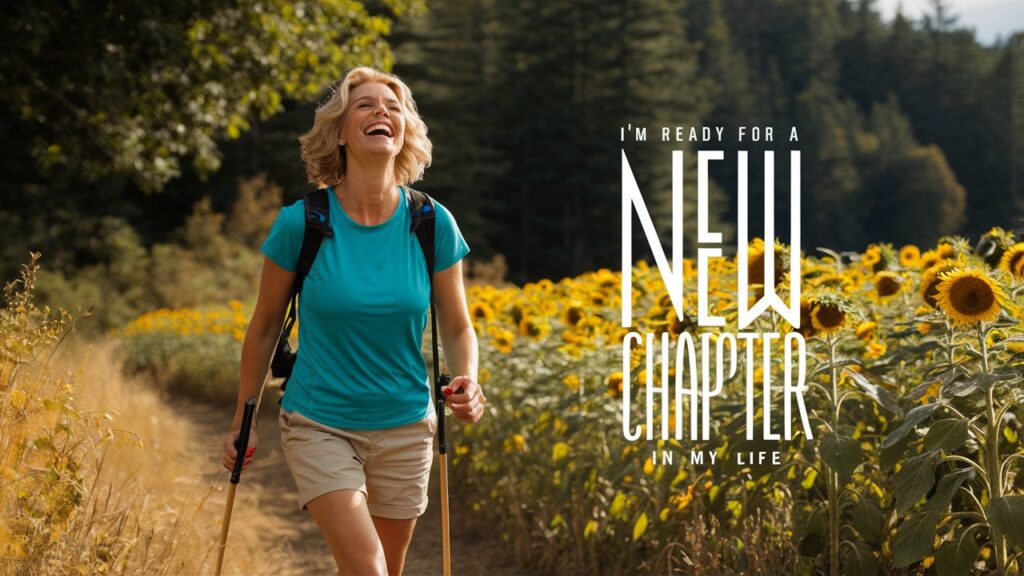
Solo Slow Travel: Best Option for Introverts

Solo Slow Travel: Best Option for Introverts

What is Slow Travel?

As the third wave of the pandemic starts to flatten here in France, I come across more and more articles about Solo Slow Travel.

Slow travel is a mindset that encourages travellers to take their time, savouring the experience of a place rather than rushing through a packed itinerary. It emphasises connecting with local culture, engaging deeply with the environment, and embracing the journey as much as the destination. This approach often involves staying in one location for an extended period, reducing the stress of constant movement, and allowing for a more meaningful connection with people, customs, and the natural surroundings. The benefits of slow travel include fostering a deeper sense of relaxation, reducing travel fatigue, and promoting sustainability by minimising frequent transportation and supporting local economies. Additionally, it allows travellers to cultivate mindfulness, making the experience more enriching and fulfilling.

Slow travel has evolved from being a quiet, niche idea to a well-studied and well-loved approach to exploring the world. Researchers have looked at it from every angle—psychological, social, economic, and environmental—and the evidence is pretty compelling. Whether through systematic literature reviews, conceptual models, or on-the-ground studies, slow travel keeps showing up as a powerful way to boost personal well-being, support local communities, and travel more sustainably.

Why Slow Travel Matters

People who travel slowly tend to experience more self-discovery, revitalisation, and overall satisfaction than those who rush from one tourist hotspot to another. When we stay longer in one place and take the time to really connect—with locals, with the landscape, and with the rhythm of daily life—we don’t just see a destination; we experience it.

Studies even suggest that this kind of travel can sharpen our minds. Travellers who take extended trips—like long cruises or month-long stays—often report improved memory and clearer reasoning afterwards.

There’s also an economic ripple effect. Slow travellers usually spend more in local communities—about 60% more, in fact—because they tend to eat at neighbourhood cafés, stay in small guesthouses, and buy from local artisans rather than big chains.

From an environmental point of view, slow travel helps reduce our carbon footprint. By choosing sustainable transport options and staying longer in each place, we naturally counter the negative effects of overtourism.

What Drives the Desire to Travel Slowly

Why do some people choose to travel this way? Research points to a mix of personal and social factors. Intrinsic motivation—like the desire for meaningful experiences and authentic connections—plays a huge role. So does cultural curiosity and, increasingly, a concern for the environment. When travellers care deeply about sustainability, they’re more likely to embrace slow travel, which in turn helps shape positive, eco-conscious travel norms and even enhances a destination’s reputation.

Of course, researchers note that there’s still work to be done. There’s a need for clearer, unified definitions of what “slow travel” really means and more long-term comparative studies. But despite these gaps, the evidence consistently highlights how powerful slow travel can be—for our personal well-being and for sustainable destination development.

Defining the Movement

At its core, slow travel is all about taking your time. It means longer stays, slower modes of transportation, and genuine engagement with the places you visit. And it’s not just a niche movement anymore. Global travel data—like average trip lengths and traveller surveys—show a clear trend toward slower, more mindful travel, especially since the COVID-19 pandemic started.

slow travel

Solo Slow Travel in the Southwest of France

I have been asking myself what Solo Slow travel would mean for people who come to the south of France on a residential retreat. As I understand it, Slow Travel is the opposite of the Monday-Amsterdam, Tuesday-Paris, and Wednesday-Lisbon trips that were so popular in the past. The idea is that less is more and that quality is better than quantity. A Slow Travel trip is meant to educate and have an emotional impact, in the present moment and for the future, while remaining sustainable for local communities and the environment.

Slow travel allows us to relax and reflect, to connect with and integrate our experiences.

It seems to me that Slow Travel to a retreat here in the southwest of France has to begin with the trip here, by making the trip part of the retreat experience by travelling slower, maybe by taking the train instead of taking the plane, by stopping on the way to investigate a famous city, like Bordeaux or Toulouse, by using travel time to educate oneself about this region and by talking to other travellers, etc.

At the moment, my Camino de Santiago Crossroads retreats are the most popular, possibly because they represent the slow travel idea so perfectly:

  • walking the Camino de Santiago de Compostela always has an emotional impact, no one who walks the Camino comes away unchanged.
  • Gascony, the region in France where the retreats are held is the perfect host for slow travel. To discover why, Click Here.
  • during the walk, there is ample time for interaction with other pilgrims and for supporting small local businesses on the way.
  • staying in one place during the whole retreat, you’ll get more of an opportunity to interact with local people in a meaningful way.
  • it’s not only healthier for the environment (my take on sustainable tourism,) it’s also healthier for you.

Slow travel is less stressful, which is the whole objective of going on a retreat, so take your time to travel here and make the most of each moment you are here, even if it is just relaxing in a deckchair while watching the sun go down with a glass of local Rosé, is not only of benefit to you but also to the local community.

As for myself, I have always preferred Slow Travel to rushing around and seeing as many different places in as short a time as possible. I am still, after 11 years of living in this part of France, slowly travelling through my glorious region. When I drive here, I stop frequently to admire the majestic Pyrennées mountain range, explore a small farmer’s market, or check on a friend who lives in the middle of nowhere, on the way to a favourite restaurant. Here you’ll find me discussing the menu for 15 minutes or longer with the chef, asking about his family and his business, and then indulging in a lunch that takes…as long as it takes. After the meal, I linger to watch the world go by…

Solo Slow Travel – I highly recommend it.

The Bottom Line

The research is unanimous: slow travel benefits everyone involved. It nourishes travelers on a psychological and emotional level, strengthens communities economically, and supports the planet environmentally. In many ways, it’s becoming a model for what sustainable tourism should look like in the years ahead.

FAQ

There’s something quietly magical about walking the Camino at a slower pace. It’s not just travel — it’s a gentle exhale. A way to step out of the noise of everyday life and into a rhythm that lets you actually feel where you are. Slow travel on the Camino isn’t about how many kilometres you cover or how many landmarks you tick off a list. It’s about the morning light spilling over the path, the conversations with strangers who feel like old friends, the scent of wildflowers, the weight of your backpack easing as your heart lightens. It’s about allowing the journey to unfold — and letting it change you in ways you didn’t expect.

1. What does “slow travel” mean on the Camino?

On the Camino, slow travel isn’t just about walking at a gentle pace — it’s about giving yourself the gift of time. Instead of rushing to “get somewhere,” you allow each step, each village, and each conversation to become part of your story. It’s travel that’s felt, not just seen.

2. How is this different from a regular holiday?

Most holidays are about cramming in as much as possible — landmarks, tours, restaurants, photos. A Camino walking retreat is the opposite. It invites you to unplug, breathe, and simply be present. You’re not racing to a finish line; you’re arriving to yourself, one step at a time.

3. Do I need weeks or months to travel slowly on the Camino?

Not at all. Even a few days can be deeply meaningful when you approach the journey with presence. My retreats are designed so that in just five days, you can drop into a slower rhythm, connect with nature, and walk away feeling more grounded and alive.

4. What are the benefits of walking the Camino slowly?

So many. People often talk about how the Camino:

  • Clears their mind and calms their nervous system
  • Helps them reconnect with themselves during life transitions
  • Boosts their mental clarity and emotional resilience
  • Inspires a sense of belonging — with nature, others, and something bigger
  • Feels more like a soulful reset than a holiday

5. How does slow travel help the environment here?

Walking is one of the most sustainable ways to travel. By choosing to explore on foot, stay in local accommodations, and linger in villages instead of rushing through, you help keep the Camino’s natural and cultural heritage alive. Every slower step leaves a lighter footprint.

6. Is the Camino only for solo travellers?

Absolutely not. Many people walk alone, yes — but plenty come with a partner, a friend, or even a small group. What makes slow travel on the Camino special is the shared humanity you encounter along the way. Whether you crave quiet solitude or gentle connection, there’s space for both.

7. What kind of transportation fits the spirit of the Camino?

Your feet are your main mode of transport. But trains, local buses, and the occasional taxi help keep things flexible. The idea isn’t to rush from point A to B — it’s to let the journey unfold at its own pace.

8. Can I still travel slowly if I only have a short holiday?

Yes — in fact, that’s what my retreats are designed for. Instead of trying to walk the entire Camino in record time, you can sink into one beautiful stretch, fully experience it, and return home feeling rested and inspired rather than exhausted.

9. Does this kind of travel really make a difference to local communities?

It does — in a big way. When you walk slowly, stay in family-run gîtes, eat at local cafés, and linger in village shops, your presence supports the people who keep this route vibrant and alive. Slow travellers contribute around 60% more to local economies than fast-moving tourists.

10. How do I begin my slow travel journey on the Camino?

Start with a simple intention: to walk, breathe, and be present. You don’t need to plan every detail or prove anything. Just bring your curiosity, your walking shoes, and an open heart. The Camino has a way of meeting you exactly where you are — and gently guiding you toward where you need to be.

If you would like to read more about Slow Travel, here is the Slow Travel Guide Book

What Life Lessons Can You Learn While Walking the Camino de Santiago? a free guide filled with 10 not just “quaint anecdotes” or Instagram-worthy moments (though there are plenty of those) but real transformations from real people who walked this insight-giving trail – Subscribe to my monthly newsletter to Download the Guide

“I am an experienced medical doctor – MBChB, MRCGP, NLP master pract cert, Transformational Life Coach (dip.) Life Story Coach (cert.) Stress Counselling (cert.) Med Hypnotherapy (dip.) and EAGALA (cert.) I may have an impressive number of letters after my name, and more than three decades of professional experience, but what qualifies me to excel at what I do is my intuitive understanding of my clients’ difficulties and my extensive personal experience of managing major life changes using strategies I developed over many years.” Dr M Montagu

All content of this website is copyrighted. You cannot copy the content of this page