
Author: Victor Davich
Rating: ⭐⭐⭐⭐ (4 out of 5 stars)
Read if: You’re meditation-curious but allergic to incense, chanting, and books that assume you have unlimited free time and zero scepticism.
The Backbone of the Book
According to Victor Davich, you’re exactly eight minutes away from inner peace, reduced anxiety, and the kind of mental clarity that makes you feel like you’ve had three cups of coffee without the jitters. Eight minutes a day.
For me, this is where it all started, in 1998.
The premise is refreshingly simple: meditation doesn’t require you to become a different person, adopt new beliefs, or sit in painful positions while contemplating the universe. You just need eight minutes a day and a willingness to show up. Davich presents meditation as a skill anyone can learn—not a mystical practice reserved for monks, yogis, or people who own meditation cushions that cost more than your monthly grocery bill.
The book is structured as an eight-week program, with each week introducing a different meditation technique. Week one focuses on breath counting. Week two explores following the breath. By week eight, you’re working with thoughts and emotions in a way that feels surprisingly manageable. Each daily session literally takes eight minutes, which Davich chose deliberately because it’s short enough that you can’t reasonably claim you don’t have time, but long enough to actually experience a change.
What makes this book stand out in the crowded meditation-industrial complex is Davich’s tone. He’s not a guru. He’s not promising enlightenment. He’s a regular person who found meditation helpful and wants to strip away all the cultural baggage, spiritual requirements, and intimidation factors that keep people from trying it. His approach is secular, practical, and almost comically unpretentious. There’s no Sanskrit terminology, no discussion of chakras, and minimal talk of “energy.” Just: here’s how to sit, here’s what to do with your mind, here’s why it might help.
Useful Take-aways
The “One Breath at a Time” Foundation: Davich’s first-week technique—simply counting breaths from one to ten—sounds almost insultingly simple until you try it. Most people can’t get to ten without their mind wandering to their grocery list, that embarrassing thing they said in 2012, or whether they left the stove on. This immediate encounter with your own mental chaos is both humbling and illuminating. The genius here is that Davich doesn’t frame a wandering mind as failure; he frames it as the whole point. Noticing your mind wandered and bringing it back is the meditation. This reframing alone is worth the price of the book, because it transforms what feels like constant failure into actual success. You’re not trying to achieve a blank mind—you’re building the muscle of noticing and returning. That’s a skill that translates directly to daily life, whether you’re trying to focus on work, listen better in conversations, or not spiral into anxiety about things you can’t control.
The Progressive Structure That Actually Works: Unlike books that throw you into the deep end or offer fifty different techniques you’ll never use, Davich builds one skill on top of another. Each week’s meditation is slightly more complex than the last, but in a way that feels natural rather than overwhelming. You spend a week just watching your breath before you try to follow it through your whole body. You get comfortable with physical sensations before you tackle thoughts and emotions. This progression respects the reality that meditation is genuinely difficult at first, and your attention span has the staying power of a goldfish on espresso. By the time you reach the more advanced techniques, you’ve built enough fundamental skill that they’re actually accessible. It’s the difference between being asked to run a marathon on day one versus following a couch-to-5K program.
The “No Special Circumstances Required” Philosophy: Davich obliterates every excuse before you can make it. You don’t need a quiet space (traffic noise is fine). You don’t need to sit on the floor (a chair works perfectly). You don’t need any particular time of day (whenever works is the right time). You don’t need to believe anything (sceptics welcome). You don’t need special equipment, apps, or guidance beyond this book. This radical accessibility is both the book’s greatest strength and a legitimate insight: the things we think are necessary for meditation are usually just barriers we construct to avoid the actual challenge, which is sitting with our own minds for eight minutes. Davich’s approach strips meditation down to its absolute essence, proving that the practice itself is what matters, not the aesthetics surrounding it.
Less Useful Suggestions
The book’s main weakness is that it’s almost too stripped down. Davich is so committed to making meditation accessible and non-intimidating that he sometimes undersells the actual difficulty of maintaining a daily practice. Eight minutes isn’t long, true, but finding those eight minutes every single day—or more accurately, finding the motivation to use those eight minutes for meditation instead of scrolling your phone—is genuinely challenging. The book would benefit from more troubleshooting for the inevitable days when you don’t want to meditate, when it feels pointless, or when you’ve missed a week and feel too guilty to restart.
There’s also a somewhat dated quality to the writing (the book was originally published in 1998, though it’s been updated). Some of the research Davich cites is decades old, and while the basic techniques remain sound, the understanding of meditation’s effects on the brain has evolved significantly. Readers coming from a more modern neuroscience perspective might find themselves wanting more current scientific backing for the claims.
Additionally, while Davich insists you don’t need any particular circumstances to meditate, the book does assume a level of privacy and control over your environment that not everyone has. His casual “just find eight minutes” doesn’t fully address parents of young children, people with chronic pain that makes sitting uncomfortable, those dealing with severe anxiety or trauma (for whom meditation can actually be triggering), or anyone whose living situation doesn’t allow for even brief periods of being undisturbed. The accessibility is real, but it’s not quite as universal as he suggests.
The week-by-week structure, while helpful, is also somewhat rigid. Davich strongly encourages you to stick with each week’s technique for the full seven days before moving on, but some readers might find certain techniques click immediately while others never quite work for them. There’s limited guidance on customising the program to your own responses or mixing techniques once you’ve completed the eight weeks.
Who The 8 Minute Meditation Book Is For
Perfect for you if:
- You’ve been meaning to try meditation but every book you’ve picked up felt too woo-woo, too religious, or too demanding
- You’re a natural sceptic who needs things explained practically rather than mystically
- You can commit to eight minutes a day, but genuinely don’t have time for longer practices
- You appreciate clear, step-by-step instructions without flowery language or vague concepts
- You’ve tried meditation apps and found them either too cluttered or too simplistic
- You want to understand why you’re doing what you’re doing, not just follow commands from a soothing voice
Maybe skip it if:
- You’re looking for meditation as a spiritual practice connected to Buddhism, Hinduism, or other traditions (this is aggressively secular)
- You already have an established meditation practice and want to deepen it (this is strictly for beginners)
- You need extensive troubleshooting, community support, or guided audio to stay consistent
- You’re dealing with serious mental health challenges that require more than a basic self-help book can provide
- You prefer learning through apps, videos, or in-person instruction rather than books
The One Thing You’ll Remember in Six Months
You probably won’t remember the specific differences between “following the breath” and “sweeping the breath,” and you might not stick with the full eight-week program. But you’ll definitely remember that meditation is just noticing when your mind wanders and bringing it back—over and over, without judgment—and that eight minutes is genuinely enough to make a difference. The demystification sticks with you even if the daily practice doesn’t.
Quotable Moments
“Meditation is not about getting anywhere else. It is about being where you are and knowing it.”
“The goal of meditation is not to get rid of thoughts or emotions. The goal is to become more aware of your thoughts and emotions and to learn how to move through them without getting stuck.”
“You don’t meditate to become a better meditator. You meditate to become better at life.”
Bottom Line
This is the book to hand someone who insists they “can’t meditate” or that they’ve tried it and it “didn’t work.” Davich’s no-nonsense approach and genuinely doable time commitment make meditation accessible without dumbing it down. It won’t change your life overnight, but it might change how you relate to your own mind, which is arguably more valuable.
Recommendation: Buy it – the expanded 2014 version – if you’re a meditation beginner (support an author! we need all the help we can get) or download it – the original version – if you’re meditation-curious but uncommitted.
Personal Note about the original 8 Minute Meditation Book
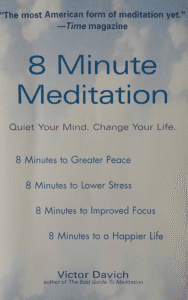
I picked this up more than 2 decades ago, after years of failed attempts with meditation apps that always felt like they were trying to sell me something or guide me to enlightenment I didn’t ask for. What surprised me most was how liberating the simplicity felt. No soothing voices, no nature sounds, no achievement badges—just you, your breath, and eight minutes. The first week, I spent most of each session thinking about how bad I was at meditation, which Davich would probably say means I was doing it exactly right. I didn’t experience any dramatic transformations, but I did notice I was slightly less reactive when my inbox exploded or when I got stuck in traffic. That small shift—from immediate frustration to a brief pause where I could choose my response—made the whole thing worthwhile. I still don’t meditate every day, which probably makes me a meditation failure by most standards, but I do it enough that it’s become a tool I can reach for when I need it. And honestly, that’s exactly what Davich promises: not perfection, just practice.
Latest Blogposts:
- Our Desperate Need to Keep Up (Even When We’re Supposed to Be on Holiday)
 You set off after breakfast, intending to enjoy an inspiring walk on the Camino de Santiago through the Gascon countryside. The sun is shining. The birds are making a perfectly respectable effort at a glorious morning chorus. Somewhere in the distance, a tractor is roaring up a hill. The path winds between vineyards and flowering …
Continue reading “Our Desperate Need to Keep Up (Even When We’re Supposed to Be on Holiday)”
- Why do I need to know what my Life Purpose is?
 Why bother figuring out your life purpose at all? Because a life without one runs on autopilot. Every decision, from which job to take to how to spend a Tuesday, starts to feel arbitrary, and that’s exhausting in a way that’s hard to pinpoint. You end up making the same choices over and over, not …
Continue reading “Why do I need to know what my Life Purpose is?”
- Walking Retreat vs Walking Holiday: What’s the Difference?
 If you love walking, you may have come across the term walking retreat and wondered how on earth it differs from an organised walking holiday. After all, both involve beautiful countryside, well-worn walking shoes, fresh air and a few days away from everyday life. There may even be a backpack involved, although hopefully not one …
Continue reading “Walking Retreat vs Walking Holiday: What’s the Difference?”
- AI Can Create a Course in Seconds. So Why Are People Still Buying Mine?
 AI has revolutionised online learning in ways we could never have imagined. These days, you can ask AI to create a course on almost anything—from astrophysics to how to keep your houseplants alive—and it will hand you a neatly structured programme in seconds. Want six modules? No problem. Learning objectives, worksheets, quizzes, reflection questions and …
Continue reading “AI Can Create a Course in Seconds. So Why Are People Still Buying Mine?”
- The Day I asked my Guests for Silence and got Performance Anxiety instead
 . I assumed, in the early days, when I was still walking the Camino with my guests, that silence was simply the absence of talking — that if I stopped scheduling activities and left enough open space in the day, quiet would arrive on its own, the way it does when you finally turn off …
Continue reading “The Day I asked my Guests for Silence and got Performance Anxiety instead”
- I was Surprised to Discover that my Co-Host Doesn’t Want a Salary
 . For years, I planned reflection exercises the way I imagine a nervous conference organiser plans icebreakers — carefully, a little anxiously, with a backup in case the first one fell flat. A guided journaling prompt after brunch. A short silent walk with a question to chew on. A candle, occasionally, if I’m honest, which …
Continue reading “I was Surprised to Discover that my Co-Host Doesn’t Want a Salary”
- What Years of Farmhouse Hospitality Taught Me About What Actually Matters to Guests
 . For the first year or two of hosting Camino de Santiago walking retreats, I worried about the wrong things. I fretted over the towels. I agonised slightly over whether the guest rooms felt “smart” enough, whether the breakfast presentation looked sufficiently considered, whether I measured up to the polished retreat centres with their infinity …
 - It’s Easier to Talk, Facing Forward, Walking Side by Side
 . I used to believe the most meaningful conversations happened at dinner. Good food, candlelight, everyone finally relaxed after a day’s walking — surely that was where people opened up. Sometimes, it is. But not always. Sometimes, the real conversations, the ones guests still mention to me months later, don’t happen at the table. They …
Continue reading “It’s Easier to Talk, Facing Forward, Walking Side by Side”
Book Review Disclaimer
These book reviews represent my personal reading experience and interpretation. Your mileage may vary—and that’s not only okay, it’s expected.
What these reviews are:
- One reader’s honest take on books that made me think, feel, or occasionally throw things across the room
- A blend of summary, analysis, and subjective response
- An attempt to help you decide if a book is worth your time and money
- Written with warmth, wit, and the occasional tangent
What these reviews are not:
- Professional literary criticism or academic analysis
- Comprehensive summaries of every concept in the book
- A substitute for reading the actual book (though sometimes they might save you the trouble)
- Sponsored content—I buy my own books and all opinions are genuinely mine
On Self-Help Books Specifically
Important context:
- These reviews discuss psychological concepts as they appear in books, not as professional advice
- If you’re struggling with mental health issues, please seek support from qualified professionals
- Books can be powerful tools for self-reflection, but they’re not replacements for therapy
- I bring my own background, experiences, and biases to every book I read. I do my best to recognise when my perspective might limit my understanding, but I’m sure I miss things. If you notice gaps in my perspective or feel I’ve misrepresented something, I’m always open to thoughtful discussion.
About recommendations:
- When I suggest a book might help with certain issues, I’m sharing what resonated with me—not making clinical recommendations
- Everyone’s healing journey is different; what works for one person may not work for another
- Some books can be triggering or emotionally difficult—please practice self-care in your reading choices
I don’t use affiliate links.
Copyright and Fair Use
Reviews may include brief descriptions of concepts and ideas from books, but I never reproduce substantial excerpts or copyrighted material. All paraphrasing is in my own words. If you’re the author or publisher and have concerns about a review, please contact me at margarethamontagu@gmail.com
The Bottom Line
These reviews are written in good faith to foster conversation about books and ideas. Take what resonates, leave what doesn’t, and always apply your own judgment about what you choose to read.
Happy reading!