
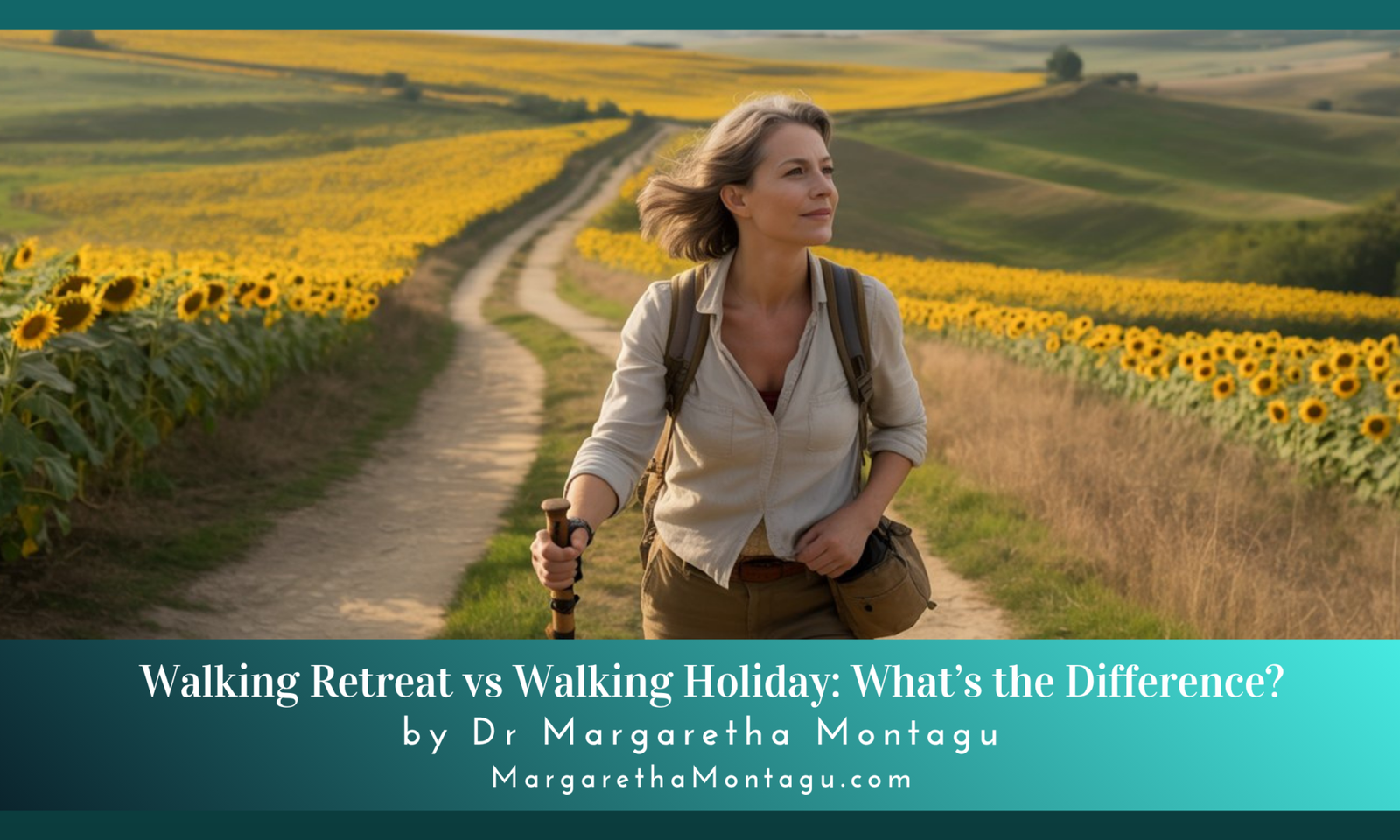
If you love walking, you may have come across the term walking retreat and wondered how on earth it differs from an organised walking holiday. After all, both involve beautiful countryside, well-worn walking shoes, fresh air and a few days away from everyday life. There may even be a backpack involved, although hopefully not one containing the entire contents of your bathroom cabinet.
So what is the difference?
The simplest answer is this: an organised walking holiday is primarily about the walking, while a walking retreat is about what the walking gives you the opportunity to discover.
A walking holiday might take you through spectacular landscapes, historic villages or famous long-distance trails. You may have a carefully planned itinerary, a guide, a group of fellow walkers and a target number of kilometres to cover each day.
A walking retreat can include some of those things, but its purpose is different. The walking becomes a way of slowing down, creating mental space and reconnecting with yourself.
And sometimes, when life has become complicated, that is exactly what you need.
What is a walking retreat?
A walking retreat combines walking with time for rest, reflection and personal renewal. Rather than simply travelling somewhere because you want to walk through a beautiful landscape, you are deliberately stepping away from your normal routine to create some time for yourself.
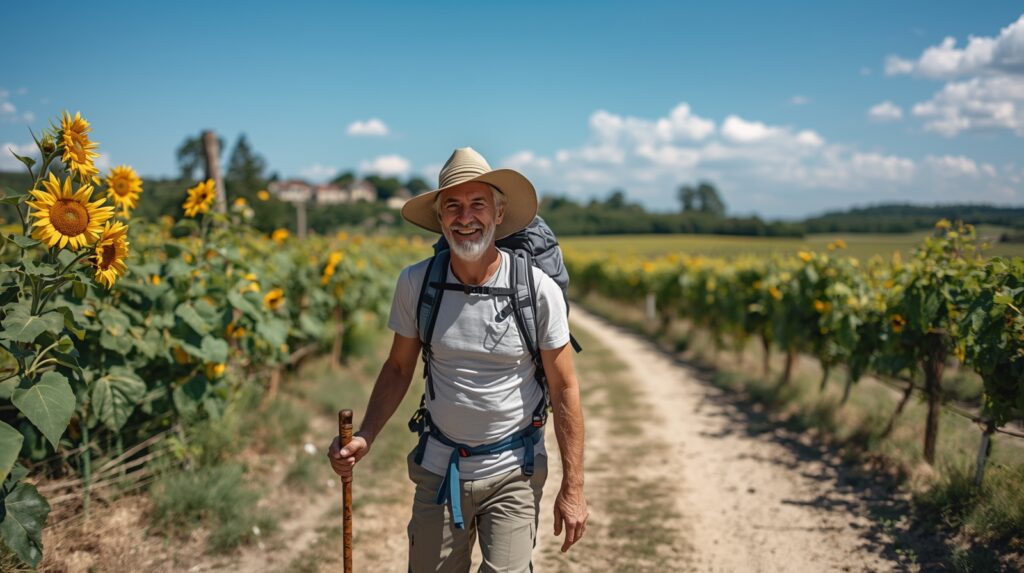
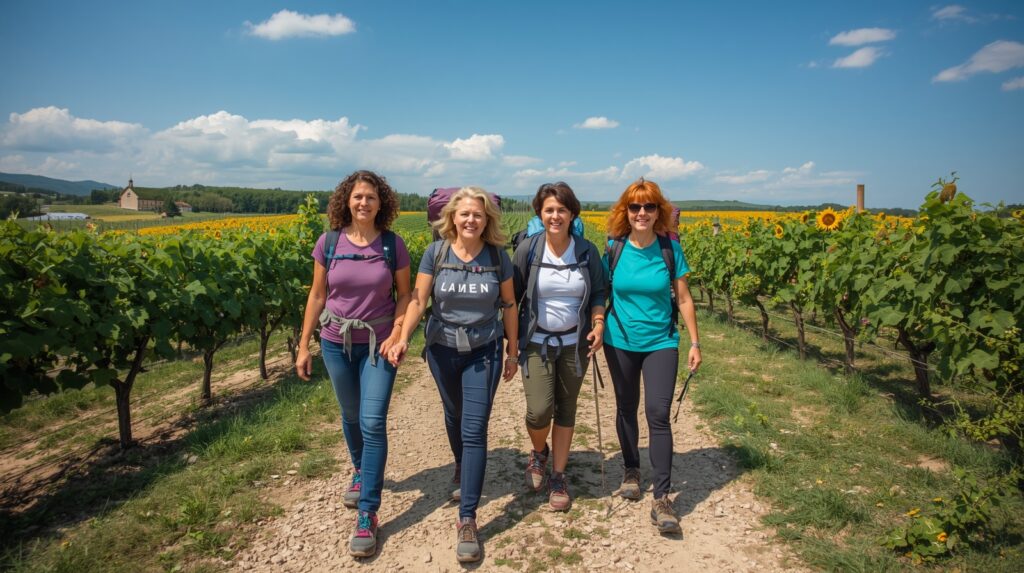
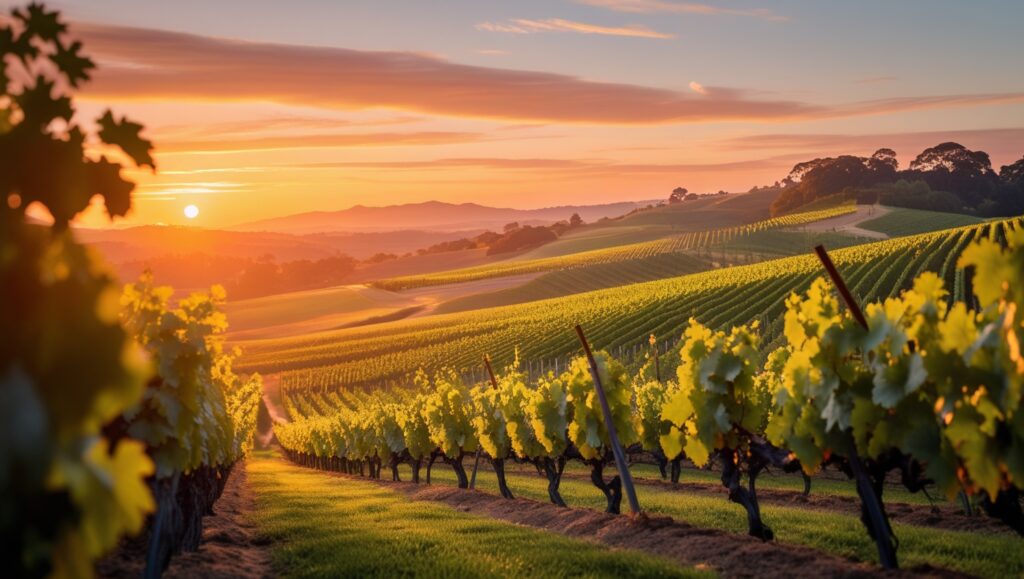
That might mean walking through vineyards and woodland in southwest France, following a section of the Camino de Santiago, practising walking meditation, journaling, reading, sitting quietly or simply allowing your mind to wander.
There is no requirement to arrive with a five-year plan for your life. You don’t need to have a dramatic crisis, either. And you certainly don’t have to leave as a completely transformed human being who has discovered their life’s purpose somewhere between lunch and afternoon tea.
A walking retreat can be much quieter than that.
You might simply need time to think. Time to breathe. Time to sleep. Time to make a decision. Or simply time to hear yourself think without somebody asking what you’re doing next.
If you’re wondering whether a walking retreat might be the kind of pause you need, you may also find my article on why a retreat can be particularly valuable during a major life transition of use.
What is an organised walking holiday?
An organised walking holiday is usually designed around the experience of walking through a particular destination. The route and the places you visit are often the main attraction.
You might walk part of the Camino de Santiago, explore the French countryside, hike in the mountains or follow a coastal trail. Depending on the type of walking holiday you choose, your accommodation, meals, luggage transfers, transport and walking routes may all be organised for you.
There may be a guide or a group of other walkers, and there may be a satisfying sense of achievement involved in completing each day’s walk.
The emphasis is generally on exploring, experiencing and walking.
And there is absolutely nothing wrong with that. If your idea of bliss is discovering a new landscape, challenging yourself physically, completing a particular route or sharing an adventure with other people, an organised walking holiday could be exactly what you’re looking for.
A walking retreat simply has a different intention.
Walking holiday or walking retreat: which one is right for you?
The difference becomes much clearer when you think about what you actually want from your time away.
On an organised walking holiday, you may be thinking about the route, the destination and how many kilometres you are going to cover. On a walking retreat, the questions may be rather different: How am I feeling? What have I been avoiding thinking about? What do I actually want now? Why have I been saying yes to things I really want to say no to? And when did I last have a whole afternoon without somebody needing something from me?
One experience is not better than the other. They simply answer different needs.
- If you want adventure, exploration and the satisfaction of covering a beautiful route, a walking holiday may be perfect.
- If you are looking for rest, reflection and a little breathing room in which to work out what comes next, a walking retreat may be what you need.
Sometimes the difficulty is that we don’t realise which one we need until we arrive.
What if you don’t want to walk in a group?
This is one of the questions people sometimes hesitate to ask. Can you go on a walking retreat without having to interact with others?
Absolutely.
For some people, the idea of joining a walking group sounds delightful. They enjoy the conversation, the camaraderie and the shared experience.
For others, it sounds suspiciously like work.
They don’t want to spend five days making conversation with strangers. They don’t want to walk at somebody else’s pace. They don’t want to feel guilty because they’d rather eat their lunch quietly than participate in a lively discussion about where everyone comes from and what they did before breakfast.
And there is nothing wrong with that.
A solo walking retreat can offer something that is surprisingly difficult to find in ordinary life: genuine solitude.
You can walk alone. You can stop when you want. You can take photographs, sit beneath a tree, write in your journal, have a coffee, or simply stare at the landscape for ten minutes without feeling that you ought to be doing something more productive.
There can still be companionship and conversation when you want it. But solitude isn’t treated as a problem that needs fixing.
For many people, that is precisely what they came for.
I’ve written more about the unexpected ways walking can create connection and conversation in “Difficult Conversation Coming Up? Talk While Walking Together”.
Why walking is so good for reflection
There is something about walking that makes thinking easier.
Perhaps it’s the rhythm. One foot follows the other. The landscape changes slowly. Your breathing settles. Your attention gradually moves away from the endless stream of emails, notifications, responsibilities and decisions.
You aren’t sitting at a desk trying desperately to solve your life. You’re walking.
And somehow, thoughts that have been stubbornly stuck can begin to move.
You may start thinking about a conversation you’ve been avoiding, a decision you’ve been postponing, a career that no longer feels right or what you actually want now that your children have left home. You might be wondering what retirement is going to mean, what comes after divorce, how to begin again after bereavement or simply why your life no longer feels quite like yours.
That feeling of suddenly not recognising the person you’ve become can be particularly powerful during a major life transition. I explore this in more depth in “Paralysed by an Identity Crisis in Times of Transition”.
Sometimes an answer comes immediately.
More often, it doesn’t.
And that’s perfectly fine.
A retreat isn’t a machine for producing answers. It is an opportunity to create enough space for the questions to become clearer.
Walking meditation: when the journey becomes the practice
Walking retreats can also incorporate mindful walking or walking meditation.
Unlike traditional meditation, you aren’t required to sit cross-legged in perfect stillness while attempting to empty your mind of every thought you’ve had since 1987.
You simply walk.
You notice your feet, your breathing, the movement of your body, the sounds around you, the landscape and the changing light. You notice the sensation of being outdoors. And when your mind wanders, you notice that too.
The point isn’t to stop thinking. It is to become more aware of what is happening while you are thinking.
That makes walking particularly valuable when you are feeling overwhelmed or when life has become so busy that you’ve lost touch with yourself.
There is something wonderfully simple about it. You don’t need special equipment, an app, a subscription or a mat that costs more than your first car.
You just need to walk.
Alistair thought he was coming on a walking holiday
One of my favourite examples of the difference between a walking holiday and a walking retreat came from a guest who arrived at the farmhouse thinking he was coming on a walking holiday.
He liked walking. He liked the idea of being in the French countryside. He liked the idea of several days away from home. So when he booked, that’s how he thought of it.
A walking holiday.
He was slightly surprised when I explained that he would be walking alone. He had a route, he had everything he needed, and he could stop whenever he liked. He could take as long as he wanted. There was no group waiting for him at the next turning and nobody keeping track of his progress.
He looked at me as though I had perhaps omitted a fairly important part of the itinerary.
“So I’m really walking on my own?”
“Yes.”
“For the whole walk?”
“Yes.”
And off he went.
When he returned several hours later, he was noticeably different. Not dramatically transformed. He hadn’t discovered the secret of eternal happiness somewhere between two French villages. He had simply had several hours without anyone asking anything of him.
Apparently, that was exactly what he needed.
Over the next few days, the walking became less important than the space it created. He thought. He noticed things. He considered decisions he had been putting off. He began to think about what he wanted the next chapter of his life to look like.
Towards the end of his stay, he laughed and admitted that he had arrived expecting a walking holiday.
He now realised that he hadn’t really come for the walking.
He had come for the thinking.
And that, in a nutshell, is the difference.
If you’d like to hear some of the other things guests have discovered while walking the Camino, I’ve collected them in “10 Powerful Life Lessons My Retreat Guests Learned While Walking the Camino de Santiago”. It’s a rather good introduction to what can happen when you put one foot in front of the other and give yourself permission to think.
You don’t have to come for a life-changing experience
There is another misconception about retreats worth clearing up.
You don’t have to want to change your entire life. You don’t have to have a five-year plan. You don’t have to discover your purpose. You don’t have to make any major decisions at all.
Perhaps you simply need a few days away from your normal environment.
Perhaps you’re exhausted.
Perhaps you’ve spent years looking after everyone else and have forgotten what you actually enjoy.
Perhaps you’re approaching retirement and aren’t sure what comes next. Perhaps your children have left home and the house suddenly feels strangely quiet. Perhaps you’ve been through a divorce or another major life change and need some breathing space.
Or perhaps nothing is particularly wrong. You just know that something needs to be different.
A walking retreat gives you permission to explore that without pressure.
You don’t have to fix yourself.
You aren’t a broken appliance.
You simply need some time and space to listen to yourself again.
A walking retreat isn’t about how many kilometres you walk
One of the biggest differences between a walking holiday and a walking retreat is the relationship with achievement.
On a walking holiday, there can be a satisfying sense of accomplishment in completing a route. Ten kilometres. Fifteen kilometres. Twenty kilometres. Another stage completed. Another destination reached.
On a retreat, the number of kilometres may matter much less.
Perhaps you walk ten kilometres. Perhaps you stop halfway because you’ve found a beautiful place to sit. Perhaps you spend twenty minutes looking at a field of sunflowers. Perhaps you become absorbed in your thoughts and take a completely unhurried lunch.
The point isn’t to prove anything.
The point is to give yourself time.
Time that isn’t measured in emails answered, appointments attended, tasks completed or kilometres walked.
That can be the ultimate luxury.
You may not return transformed. You may simply return clearer.
I rather like the idea that a retreat doesn’t necessarily have to transform you.
Transformation is a rather grand word.
Sometimes clarity is enough.
You might return home knowing what you need to do next. Or knowing what you don’t want to do. You might realise that you need to say no more often. You might remember something you used to love. You might finally acknowledge that you’re tired.
You might make peace with the fact that you don’t yet know what comes next.
Or you might simply feel rested.
Sometimes that’s more valuable than another ten-point plan for reinventing your life.
So, what is the difference between a walking retreat and a walking holiday?
Ultimately, it comes down to intention.
A walking holiday asks:
Where shall we walk?
A walking retreat asks:
What might become possible if I give myself time to think while I walk?
A walking holiday takes you somewhere.
A walking retreat can help you find your way again.
And that can be particularly powerful when you are standing at one of life’s crossroads.
Perhaps you’re asking yourself, What now?
Perhaps the old version of your life no longer fits, but the new one hasn’t quite taken shape yet. Perhaps you don’t need advice. Perhaps you don’t need another book, podcast, productivity system or inspirational quote telling you to become the best version of yourself by Tuesday.
Perhaps you need to get away from the noise.
Put on your walking shoes.
Step outside.
And walk.
Not to escape your life. Not necessarily to change it. Just far enough away from the noise to see it clearly.
Because sometimes, somewhere between one footstep and the next, you begin to hear something you’ve been unable to hear for a very long time:
your own voice.
And perhaps that is what a walking retreat is really for.
Not to take you away from your life, but to give you enough space to decide where you want to take it next.
Ready to find your way again?
If you’re beginning to suspect that what you need isn’t another ordinary holiday but a few days in which to slow down, walk, think and reconnect with yourself, you may be ready for a different kind of Camino experience.
My Camino de Santiago Walking Retreats in southwest France combine sections of this ancient pilgrimage route with time and space for reflection, rest and perspective. They are deliberately small and intimate, with no forced bonding, no pressure to have a breakthrough and no requirement to prove how many kilometres you can conquer.
Just beautiful countryside, a little time away from ordinary life, and the opportunity to discover what becomes clearer when you stop rushing.
Explore the Camino de Santiago Walking Retreat in southwest France →

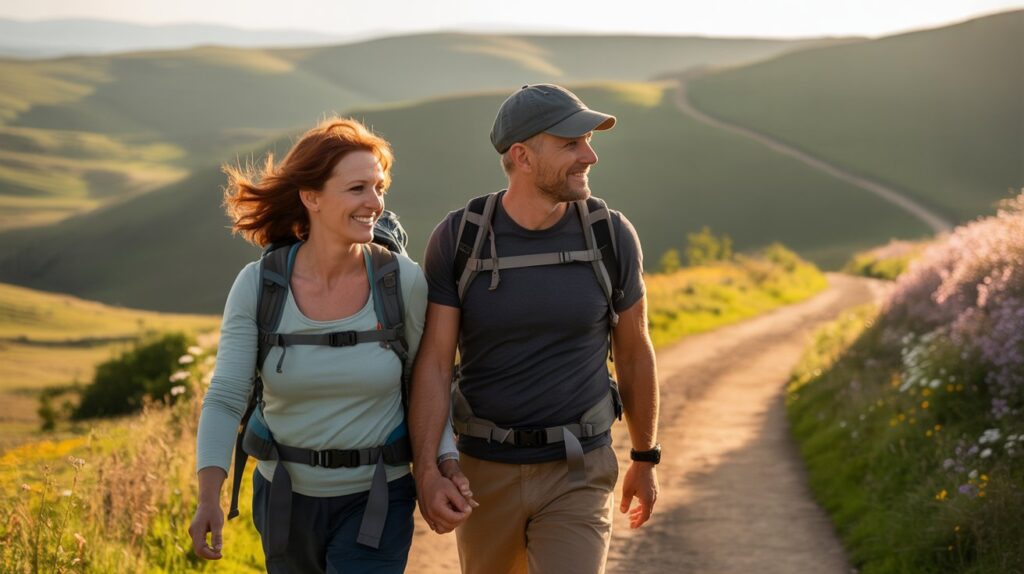
Perhaps you don’t need to walk all the way to Santiago.
Perhaps you simply need to walk far enough to find yourself again.
Do you dream of escaping your stressful life to raise a herd of goats or grow sunflowers in the south of France? Then you may be ready for an Esprit Meraki retreat. Get access to this “very serious” quiz to help you figure out how urgent your need for a change of scenery is, when you subscribe to my monthly newsletter.

“I am an experienced medical doctor – MBChB, MRCGP, NLP master pract cert, Transformational Life Coach (dip.) Life Story Coach (cert.) Stress Counselling (cert.) Med Hypnotherapy (dip.) and EAGALA (cert.) I may have an impressive number of letters after my name, and more than three decades of professional experience, but what qualifies me to excel at what I do is my intuitive understanding of my clients’ difficulties and my extensive personal experience of managing major life changes using strategies I developed over many years.” Dr M Montagu