Dr Margaretha Montagu – described as a “game changer”, “gifted healer”, “guiding light” and “life-enriching author” – is a certified transformational retreat leader who guides her clients towards their most meaningful and fulfilling lives, particularly when navigating life transitions – virtually, or with the assistance of her Friesian Horses, at their home in the southwest of France.
Every Tuesday evening, my Camino de Santiago retreat guests and I go to a local bistro to support the still-flagging local economy, post-Covid. Most of the options on the menu include duck, in some form or another, but the most popular choice invariably is a HAMBURGER, done à point.
I have often heard, “How to order a Hamburger in France?”
Take Sandra’s predicament as an example. Sandra NEEDED a hamburger. Not a symbolic hamburger. Not a “trust the process” hamburger. A real one. Warm. Squishy. Comforting. Ideally smelling faintly of familiarity and poor life choices.
She pushed open the heavy wooden door of a small village café. It creaked like it had opinions. Inside, the air was thick with the smell of espresso, garlic, and something slow-cooked that had clearly been simmering since breakfast—or possibly since Easter. A radio hummed softly in the background, interrupted only by the clink of cutlery and the occasional sigh of contentment.
“I would like a hamburger,” Sandra announced brightly.
Her words landed with a thud.
The café fell silent. You could hear the faint hiss of fat sizzling in the kitchen. A fly stopped mid-flight. Somewhere, a chair creaked in judgment.
The waiter squinted at her, head tilted, as if trying to hear the word differently.
“Un… Gascon?” he asked cautiously.
“No, no,” Sandra said, smiling harder now. She drew a circle in the air with her hands. “Ham-bur-ger.” She added a hopeful chewing motion. Mmm. Confidence tasted like optimism.
The waiter inhaled deeply. A woman at the bar paused mid-sip, the aroma of red wine hanging in the air like a warning. Someone muttered something that sounded suspiciously like a prayer.
After a heated exchange in rapid Gascon—full of shrugs, sighs, and the unmistakable sound of culinary pride being challenged—the waiter nodded gravely and vanished into the kitchen.
Time stretched.
Sandra listened to the crackle of a pan, the rhythmic chop of a knife, the low murmur of debate. The smells intensified: buttery potatoes, cured meat, eggs meeting hot oil. Her stomach growled, traitorously loud.
Finally, the waiter returned.
He placed a plate in front of her with a flourish.
On it sat:
one thick slice of magret de canard, glossy and fragrant
a slab of bread with a crust so hard it had opinions
a fried egg, edges crisp, yolk trembling like it knew its destiny
a wilted green thing that had once been lettuce
and potatoes—golden, sizzling, audibly proud—fried in duck fat, butter, and at least three generations of family tradition
“This,” the waiter said, voice rich with authority, “is our hamburger.”
Sandra stared.
The plate radiated heat. The smell was intoxicating—salty, rich, deeply comforting. She touched the bread. It was warm. Serious. Unapologetic.
She took a bite.
The crunch of crust. The silkiness of yolk. The deep, savoury hum of ham. The potatoes crackled softly as she chewed, whispering promises of naps and forgiveness.
It was magnificent.
Sandra learned two things that day:
In Gascony, ordering a hamburger is not a request—it is a philosophical question.
You never argue with people who can make potatoes taste like love and history.
She never ordered a mere hamburger again.
She ordered a Gascon hamburger and whatever else is good today—and let the smells, sounds, and flavours of Gascony take care of the rest.
You may be surprised to hear that the humble hamburger is so popular in Gascony – a region renowned for its stunning Atlantic coastline, charming villages, and delectable Cuisine Gascon – but this part of France has always been a melting pot of culinary influences. The region has always embraced a variety of flavours and ingredients. The hamburger, adaptable and versatile, fits perfectly into this environment.
In recent years, there has been a global trend towards gourmet burgers, and culinary innovative Gascony is no exception. High-quality ingredients, artisanal buns, and creative toppings have elevated the humble hamburger to gourmet status. Local chefs have embraced this trend, offering gourmet burgers that appeal to both locals and visitors. These burgers often feature regional specialities such as truffle mayonnaise, caramelised onions, and even foie gras.
Our brilliant chefs have even invented a Burger Gascon, which consists of a magret de canard with a slab of foie gras on top smothered in a sweet fig sauce (confit de figue.)
How to order a hamburger here in southwest France?
Firstly, I explain they need to drop the “H,” and ask for an AMBURGER. It usually comes with frites (fries) but you may want to make sure, and add “avec frites.” Next, you will be asked how you want the meat done. Do not make the mistake of thinking that all hamburger patties will, by definition, be well-cooked. No so. Unless you specifically specify “bien cuit”, or even “très bien cuit, s’il vous plait”, you end up with a nearly raw, definitely bleeding hamburger, done “saignant.” Opt for “à point,” if you want something in between.
Next, you choose ze cheese and ze sauce. A slice of local cheese is always a good choice, or maybe a mushroom sauce. Cèpes? Yes, great, get yourself some of our favourite mushrooms in your sauce. Raw egg? Uhm, no, rather not. Their very best made-fresh-today mayonnaise? Bon d’accord, you might well want to try that.
The good news is that many of the younger generation speak quite a bit of English these days, so as long as you keep your questions simple and speak slowly, how to order a hamburger in France should be fairly straightforward. Or you can use an app to translate the menu for you, and even to communicate directly with your friendly – this is the Gascony, not Paris, we mostly welcome tourists here – rugby-playing waiter.
One thing that hasn’t changed though, is the fact that Gascons tend to shun soft drinks, and prefer, in addition to the tap water/eau plate already on the table, a bottle of wine, a Cotes de Gascogne – a dry, white or a fruity rosé or even a feisty Madiran. The easiest is to opt for a “quart” (250ml) or a “demi” (500ml) carafe of vin de table/du pays.
When you’re ready to leave, ask for the bill by saying, “L’addition, s’il vous plaît.” You may pay at the table or be shown your table number and be directed towards the counter. Tipping is not obligatory in France, but it is appreciated. Leaving a few euros or rounding up the bill is a much appreciated gesture. At our local bistros, prices vary from 11-15 euros, including toppings and frites. Adding foie gras will double the price. Most of our local bistros make their own patties with high-quality mince meat, bought from local farmers, that tastes quite different from those of the fast-food outlets. Most restaurants around here now specify exactly where they buy their meat.
The dining culture in Gascony is laid-back and casual, especially during the long, warm summers. Hamburgers blend seamlessly with the region’s rich culinary traditions and vibrant lifestyle. Whether it’s the influence of tourism, the allure of gourmet ingredients, or the casual dining culture, burgers have become a beloved part of the southwest of France’s food scene. So, next time you find yourself in this picturesque region, don’t be surprised to find a delicious, locally-inspired hamburger on the menu. Now you know how to order a hamburger in France, so all that’s left is to wish you Bon appétit!
In addition to the Camino de Santiago retreats that I host at my little French farm southwest of Bordeaux, I have also created 7 online courses, ex.The Purpose Protocols, The Roadmap to Resilience – from Burnout to Brilliance Protocol and The Change Careers without Starting from Scratch – each course is available with or without one-to-one support. To stay in contact, I invite you to subscribe to my newsletter, you’ll get immediate access to my free life crisis quiz.
Strategies for Women Rebuilding Their Lives During Major Life Events
I felt a bit of a fraud when I started writing this article. Who am I to give others advice about financial independence? I was going through a major life upheaval though, and I needed to get my finances sorted, or at least in better order. So I did a lot of research, and I’m sharing what I found useful with you in this article, hoping it will be useful to you too.
Imagine waking up one day to find that your financial stability has been destroyed overnight. Whether due to a divorce, the sudden loss of a partner, or an unexpected job loss, the journey to reclaim your financial independence can be both challenging and empowering. This is the story of Susan, who faced such a transition and emerged stronger, using practical strategies to gradually create a stable financial future for herself.
Susan, a 52-year-old marketing executive, had dedicated her life to her career and her family. After 25 years of marriage, her world was turned upside down when she and her husband decided to get divorced. Suddenly, Susan found herself single and solely responsible for her financial future. She felt completely overwhelmed by mortgage payments, college tuition for her two children, and looming everyday expenses.
Instead of succumbing to fear, Susan chose to take control. She sought advice from a financial planner, who helped her develop a clear plan. Susan began by reassessing her budget, cutting unnecessary expenses, and prioritising her financial goals. She took a course on financial literacy, empowering herself with the knowledge to make informed decisions. Within a year, Susan had not only stabilised her finances but also started saving for her retirement.
Susan’s story demonstrates that with determination and a few well-chosen strategies, rebuilding financial independence is achievable at any stage of life.
When I first read Susan’s story, I laughed, it sounded as unrealistic as a fairy tale! Susan and I clearly had NOTHING in common. Each time I decided to organise my finances, I came down with a debilitating attack of procrastinitis.
What got me out of the seemingly inescapable swamp, was setting an hour aside each day to try to get my financial ducks in a row, and gradually the situation went from drastic and desperate to…slightly better.
My 7 steps to a more prosperous financial future:
1. Assessing My Financial Situation:
Had to start here, however depressing it was. I needed a clear picture of my current financial status, so I listed all my assets (very short list), liabilities (long, scary list), income (even shorter list), and expenses (endless list). This helped me identify the areas that needed immediate attention.
2. Creating a Realistic Budget:
I had to force myself to do this, because, apparently, «A budget is a powerful tool for managing your finances.» So I tracked my spending and prioritised essential expenses like housing, utilities, groceries etc, and identified areas where I could cut back. The app YNAB (You Need a Budget) simplified this process and made it (slightly) more bearable.
3. Exploring Income Opportunities:
One thing I realised is that identifying a variety of income streams is essential. You know the saying, «Don’t put all your eggs in the same basket.» In the current financial climate, I think this should be an ongoing exercise, for all of us. It could involve consulting through platforms like Upwork and Fiverr, starting a small business selling products online via Etsy and Shopify, or doing part-time work offering local services. Teaching online courses, writing e-books, and creating digital content can also generate revenue, as can renting out property, equipment, or vehicles. Investing in education and acquiring high-demand skills can enhance one’s earning potential, while passive income from dividends, royalties, and affiliate marketing offers long-term financial benefits.
4. Investing in My Financial Education:
I agree that knowledge is power, especially when it comes to managing money, so I invested time in courses on personal finance, I joined suitable Facebook groups, subcribed to e-mail lists, and followed reputable financial blogs. I discovered that investment options, retirement planning, and debt management can significantly impact one’s financial future.
5. Building an Emergency Fund:
Got to be kidding, I thought. I’m fully aware now that life is unpredictable, and I realise that having an emergency fund can provide a financial safety net. Starting small, my aim is to save three to six months’ worth of living expenses. Eventually.
6. Seeking Professional Advice:
As soon as you can afford it, I recommend doing this. A financial advisor can provide personalised guidance tailored to one’s situation, help develop a long-term financial plan, manage investments, and advise on retirement funding options.
7. Cultivating an Empowering Mindset:
I am convinced that by fostering an informed and proactive mindset, you can empower yourself to make sound financial decisions and achieve long-term financial stability and independence. During my Camino de Santiago Crossroads retreats, I discuss mindset in depth, as I feel that without the right mindset, any attempt to improve your financial situation is doomed before you even start.
Financial Independence FAQ: Navigating Life Transitions
1. Help! I’m going through a major life change. Should I panic about money now or later?
How about neither? While life transitions (divorce, career change, relocation, retirement) can feel like financial free-falls, panic is actually a terrible financial advisor. Instead, take a deep breath and give yourself permission to assess before you stress. Start with the basics: What’s coming in? What’s going out? What absolutely needs to happen in the next three months? Think of this as your financial triage moment. You’re not trying to solve everything today—you’re just getting your bearings. And here’s a little secret: most people going through transitions discover they’re more resourceful than they thought. You’ve got this, even if it doesn’t feel like it yet.
2. I’ve always relied on someone else financially. Where do I even start building independence?
First off, acknowledging this is already a huge step, so give yourself credit. Start by gathering information like you’re a detective investigating your own life. Get copies of all financial documents, understand what accounts exist, and figure out your actual monthly expenses (yes, including that streaming service you forgot about). Open a bank account in your name alone if you don’t have one. Then, create what I call a “financial identity checklist”: credit report, credit card in your name, and understanding of your income sources. The goal isn’t to become a finance guru overnight—it’s to move from passenger to driver, one small action at a time. And remember, every financial expert started by learning what a budget was, so you’re in good company.
3. Should I be making big financial decisions right now, or waiting until the dust settles?
Ah, the eternal question of transition timing. Generally speaking, unless something is time-sensitive (like you need to sign divorce papers or your lease is up), give yourself at least a few months before making irreversible big moves. Your emotional state during transitions can make that “investment opportunity” or impulse home purchase seem more appealing than it actually is. That said, some decisions can’t wait—and that’s okay. The key is to distinguish between “needs immediate attention” (finding housing, securing income) and “feels urgent but isn’t” (completely overhauling your investment strategy at 2 AM). When in doubt, consult with a financial advisor or trusted friend who isn’t in the middle of their own chaos. They’ll help you see clearly when everything feels foggy.
4. How much of an emergency fund do I need when everything feels like an emergency?
During life transitions, the standard “three to six months of expenses” advice can feel laughably inadequate or impossibly ambitious. Here’s a more realistic approach: aim for one month first, then three, then six. If you’re in the thick of transition and can scrape together $1,000, you’re already ahead of half the country. Focus on building what I call a “sleep-at-night fund”—whatever amount lets you stop lying awake, catastrophizing about the washing machine breaking. For some that’s $500, for others it’s $5,000. The magic number is less important than the momentum. Every dollar you set aside is a small vote of confidence in your future self. And yes, it counts even if you’re saving it in a regular savings account while you figure out the fancy high-yield options.
5. I feel guilty about prioritising my financial independence. Is that normal?
Incredibly normal, and also worth examining. Many people, especially those leaving relationships or caregiving roles, feel selfish for focusing on their own financial security. But here’s the truth: taking care of your finances isn’t selfish—it’s responsible. You can’t pour from an empty cup, fund from an empty account, or help others from a place of financial desperation. Think of it like the aeroplane oxygen mask rule: secure your own first. Plus, financial independence doesn’t mean financial isolation. You can still be generous, collaborative, and supportive while also making sure you’re not one emergency away from crisis. The guilt often fades as you start feeling more secure and realize that your stability actually allows you to show up better for the people you care about. So be kind to yourself as you build this new foundation—you deserve financial security just as much as anyone else.
Recommended Reading: 5 Books about Creating Financial Independence
1. “The Financial Diet” by Chelsea Fagan
I chose this one because it’s refreshingly honest about the emotional and psychological aspects of money, especially for people who feel like they’re starting from scratch. Fagan writes with humour and zero judgment about building financial literacy when you’ve been winging it or relying on others. It’s particularly great for transitions because it addresses the identity shift that comes with taking control of your finances. Plus, it doesn’t assume you have a trust fund or a finance degree—just a desire to figure things out.
2. “Your Money or Your Life” by Vicki Robin and Joe Dominguez
This classic makes the list because life transitions force us to reconsider what we actually value, and this book is all about aligning your money with your values. It’s not just about budgeting—it’s about rethinking your entire relationship with money and work. During transitions, when you’re rebuilding anyway, it’s the perfect time to ask yourself the big questions this book poses. The nine-step program helps you see money as life energy, which can be particularly powerful when you’re redefining what your life looks like.
3. “I Will Teach You to Be Rich” by Ramit Sethi
Despite the clickbait-y title, this is actually a solid, no-nonsense guide to automating your finances and building wealth without obsessing over every latte. I included it because during life transitions, you need systems that work even when you’re emotionally exhausted. Sethi’s approach to setting up automatic transfers, investing, and negotiating is perfect for people who need their money to behave while they figure out everything else. It’s also refreshingly honest about the fact that you don’t need to live like a monk to build financial security.
4. “The Single Woman’s Guide to Retirement” by Jan Cullinane
Even if you’re not near retirement, I chose this book because it addresses the unique financial challenges of going it alone—something many people face during major transitions. Cullinane covers everything from healthcare to housing to building community, all without a partner’s income or support. The practical advice about creating multiple income streams and planning for long-term security is valuable at any age, and her tone is encouraging rather than fear-mongering. It’s particularly helpful for those leaving long-term relationships.
5. “Transitions: Making Sense of Life’s Changes” by William Bridges
This isn’t strictly a finance book, but I’m including it because you can’t separate the money stuff from the emotional journey of transition. Bridges explains the three phases of transition (ending, neutral zone, new beginning) in a way that helps you understand why everything feels so hard right now—including making financial decisions. Understanding where you are in the transition process can help you be more patient with yourself and make better choices about when to act and when to wait. Sometimes the best financial advice is knowing that confusion and uncertainty are normal parts of the process, not signs you’re doing it wrong.
“Your economic security does not lie in your job; it lies in your own power to produce – to think, to learn, to create, to adapt. That’s true financial independence. It’s not having wealth; it’s having the power to produce wealth.” – Stephen Covey
It is never too late to take control of your financial future and plant the seeds for a prosperous, purposeful and independent life.
In addition to the Camino de Santiago retreats that I host at my little French farm southwest of Bordeaux, I have also created 7 online courses, ex.The Purpose Protocols, The Roadmap to Resilience – from Burnout to Brilliance Protocol and The Change Careers without Starting from Scratch – each course is available with or without one-to-one support. To stay in contact, I invite you to subscribe to my newsletter, you’ll get immediate access to my free life crisis quiz.
Did you know that nearly half of successful people reconsider their career paths after a major life event? In an age of transformation, discover how personal stories of triumph over adversity are reshaping our understanding of true achievement.
As you may know, I am in the process of redesigning my retreats, combining my variously themed 5-day retreats into one 7-day retreat focusing on life changes, challenges and transitions coaching, and incorporating the mindfulness meditation with my horses, walking a section of the Camino de Santiago and explorative and experiential writing and reading.
Redefining the Definition of Success as I Create a Transformational Retreat
Obviously, I want it to be a transformational experience for my guests, whether it is their first, second or twentieth retreat. This has made me think about success, in general, and more specifically about how I will know whether my new retreats are successful in transforming my guests’ lives.
Success has long been synonymous with wealth, status, and power. Yet, in an evolving world marked by shifting values and unforeseen challenges, I think it is time that the definition of success is re-examined. This redefinition is often initiated by life transitions, changes or challenges that force people to reassess their priorities.
The reason my new retreat is focused on assisting my guests through life changes is not only because I have lived through several of these myself, more than once, but also because the majority of my guests attend retreats here while going through life transitions themselves.
I suspect it’s the call of the Camino de Santiago that draws them here.
Redefining Success
Success has become an increasingly complex and personalised concept, far removed from the one-dimensional definitions of previous generations. Where once success might have been simply measured by a stable job, a house, and a family, today’s landscape presents us with a multitude of competing values, opportunities, and pressures that make defining success both more challenging and more essential than ever before.
A Shifting Paradigm
In contemporary society, success has evolved from a fixed destination to a fluid journey. The traditional markers—climbing the corporate ladder, accumulating wealth, achieving status—still hold weight for many, but they’re no longer the only benchmarks that matter. Today’s definition encompasses a broader spectrum of human experience, including mental health, work-life balance, personal fulfillment, and meaningful relationships. This shift reflects a growing understanding that a life focused solely on external achievements often comes at the cost of internal wellbeing.
The Digital Age Paradox
The digital revolution has fundamentally altered how we perceive and pursue success. Social media platforms create a constant stream of others’ accomplishments, curated highlight reels that can make our own progress feel inadequate by comparison. This phenomenon has given rise to what many psychologists call “compare and despair” syndrome. Yet paradoxically, the same technology that fuels comparison anxiety also provides unprecedented access to diverse definitions of success. We can now witness people thriving in unconventional careers, living nomadic lifestyles, or finding fulfillment in minimalism—paths that challenge conventional narratives and expand our understanding of what a successful life might look like.
Aligned Success
Perhaps the most significant evolution in modern success thinking is the emphasis on alignment between values and actions. Today’s most satisfied individuals often describe success not as achieving specific milestones, but as living in accordance with their authentic values. This might mean prioritising time with family over a promotion, choosing a lower-paying job that offers greater purpose, or declining opportunities that don’t align with personal ethics. This values-based approach recognises that success without authenticity often feels hollow, regardless of how impressive it appears from the outside.
The Health Revolution
Modern definitions of success increasingly incorporate holistic wellbeing. Mental health awareness has brought emotional intelligence, stress management, and psychological resilience into the conversation about what it means to thrive. Physical health, once taken for granted in the pursuit of career goals, is now recognised as foundational to sustainable success. People are asking not just “Am I successful?” but “Am I healthy, happy, and whole?” This integration acknowledges that achievements built on burnout and sacrifice are ultimately unsustainable and unfulfilling.
Impactful Success
Another defining characteristic of modern success is the emphasis on contribution and impact. Younger generations particularly are redefining success to include positive influence on their communities and the world at large. This might manifest as environmental consciousness in business decisions, choosing careers in social impact sectors, or leveraging skills for volunteer work. Success, in this framework, isn’t just about personal gain but about leaving things better than you found them. This shift represents a maturation of our collective understanding—recognising that individual success exists within larger social and environmental contexts.
Linda the Corporate Lawyer’s Story
Consider the journey of my guest Linda, a corporate lawyer who spent a decade climbing the ladder in a prestigious firm. Her high-paying job and impressive title painted a picture of success. However, the long hours and constant pressure left her feeling unfulfilled. Linda’s turning point came when she faced a severe health scare, prompting a reassessment of her life’s direction. She volunteered at a local legal aid clinic, where helping individuals navigate their legal troubles brought her a deep sense of purpose. The gratitude of those she helped contrasted sharply with the impersonal nature of corporate law. After her retreat, Linda left her lucrative job to work full-time in public interest law. Her new career path, while not as financially rewarding, brought her profound satisfaction and a sense of accomplishment. Linda’s story suggests that success is not merely about external achievements but about finding work that resonates with one’s values, especially when life’s challenges push us to reconsider our paths.
Sylvie, the Successful Entrepreneur’s Story
“Success is not the key to happiness. Happiness is the key to success. If you love what you are doing, you will be successful,” said Albert Schweitzer. This quote mirrors the experience of Sylvie, an entrepreneur who founded a tech startup in her twenties. Initially, Sylvie’s measure of success was revenue and market share. Her startup grew rapidly, but the relentless pursuit of growth soon led to burnout and seriously strained relationships. As her marriage started to disintegrate, Sylvie attended a retreat here and, during the retreat, decided to reassess her priorities. She began to focus on creating a work culture that valued mental well-being and personal growth. Sylvie’s company started offering flexible work hours, mental health support, and opportunities for employees to pursue their own dreams. This shift resulted not only in a happier, more productive team but also in sustainable business growth. Sylvie is now convinced that success lies in nurturing a fulfilling work environment.
Lila, the Committed High School Teacher’s Story
Lila’s story further illustrates this redefinition. As a high school teacher, she found joy in inspiring her students. Despite pressure from her partner to pursue higher-paying jobs, Lila remained committed to teaching. A significant life transition occurred when her mother fell ill, requiring Lila to balance caregiving with her professional responsibilities. This period of dual roles underscored the importance of her impact on young minds and the lasting influence she had on their lives. Exhausted from her caregiving duties, Lila attended a retreat here. She realised that she does not measure success in monetary terms but in the pride she felt in her students’ achievements and the positive changes she brought to their lives. Her story demonstrates that success can be found in dedication to one’s calling and the positive change one brings to others, particularly when life’s challenges demand a deeper commitment to one’s true calling.
Essential Reading: Five Books on Modern Success
1. “The Success Myth” by Emma Gannon
I chose this book because Gannon directly confronts the outdated narratives around success that many of us inherited. She explores how the traditional career ladder has crumbled in the digital age and why that’s actually liberating. Through interviews with diverse professionals who’ve redefined success on their own terms, she provides practical frameworks for questioning inherited assumptions and building a personalized vision of achievement. Her writing resonates particularly with those feeling the pressure of conventional expectations while sensing there might be alternative paths worth exploring.
2. “Four Thousand Weeks: Time Management for Mortals” by Oliver Burkeman
Burkeman’s book makes the list because it fundamentally challenges productivity-obsessed definitions of success. By confronting the reality that we have roughly four thousand weeks in a human lifetime, he shifts the conversation from doing more to choosing wisely. This book addresses the modern epidemic of busyness mistaken for success and offers a philosophical yet practical approach to prioritisation. It’s essential reading for anyone who’s achieved traditional markers of success but still feels unfulfilled, helping readers understand that limitations aren’t obstacles to success but the very context that makes meaningful success possible.
3. “The Second Mountain” by David Brooks
Brooks distinguishes between first-mountain success (career, wealth, status) and second-mountain success (relationships, community, moral commitment). I included this because it captures the journey many people experience—achieving conventional success only to realise something crucial is missing. His framework helps readers understand why traditional achievement often feels hollow and provides language for the deeper fulfillment that comes from contribution and connection. This book is particularly valuable for those in mid-life or mid-career transitions, questioning whether there’s more to success than they’ve been pursuing.
4. “Designing Your Life” by Bill Burnett and Dave Evans
This book applies design thinking principles to life planning, which makes it invaluable for modern success seekers. Rather than prescribing what success should look like, Burnett and Evans provide tools for prototyping different versions of your life and testing what truly brings satisfaction. I chose it because it acknowledges that success isn’t one-size-fits-all and provides actionable methods for discovering your unique definition. The emphasis on iteration and experimentation reflects the reality that our definition of success may evolve throughout our lives, and that’s not only normal but healthy.
5. “Range: Why Generalists Triumph in a Specialised World” by David Epstein
Epstein’s book challenges the conventional wisdom that early specialization leads to success. I included it because it validates diverse career paths, career changes, and interdisciplinary thinking—all increasingly common in modern professional life. In an era where people are expected to have clear, linear career trajectories, Range provides evidence that wandering paths often lead to more innovation, satisfaction, and ultimately success. It’s particularly relevant for those who feel behind because they haven’t followed a traditional route, or for anyone considering a significant career pivot. The book reframes what might look like detours as actually being competitive advantages in our complex, rapidly changing world.
The definition of success in modern life is ultimately personal, contextual, and ever-evolving. It requires each person to look inward, identify their core values, and build a life that reflects those priorities. While this lack of a universal standard can feel overwhelming, it also offers unprecedented freedom. We’re no longer confined to following predetermined paths but can instead craft definitions of success that honour our unique gifts, circumstances, and aspirations. The question is no longer “Am I successful?” but rather “Am I successful on my own terms?”
A New Definition of Success
Reflecting on these stories, it became clear to me that success today is a multi-dimensional concept, deeply personal and often unquantifiable. It is about fulfilment, purpose, and the well-being of oneself and others. Ralph Waldo Emerson aptly stated, “To laugh often and much; to win the respect of intelligent people and the affection of children; to earn the appreciation of honest critics and endure the betrayal of false friends; to appreciate beauty, to find the best in others; to leave the world a bit better, whether by a healthy child, a garden patch, or a redeemed social condition; to know even one life has breathed easier because you have lived. This is to have succeeded.”
I will know that my retreats are successful if they assist my guests in redefining success, particularly during life transitions, changes or challenges, to embrace a holistic view that values happiness, impact, and personal growth over traditional metrics.
Stories like those of Linda, Sylvie, and Lila, prove that true success is a journey, not a destination, and it is as diverse as the people who pursue it.
And it’s back to the “retreat redesign” drawing board for me!
(Names changed and stories altered to protect my guests’ identities.)
If your soul is craving fresh air, meaningful movement, and a chance to reconnect with nature, join us on a Camino de Santiago Crossroads Retreatin the southwest of France. This isn’t just a scenic hike – it’s a powerful, natural reboot for your body, mind, and spirit. Imagine quiet paths, rolling hills, cozy evenings, and slow conversations. No fitness requirements. No forced bonding. No pressure to have a breakthrough. Just one foot in front of the other, and a journey that meets you exactly where you are.
Stress destroys Lives. To find out what you can do to safeguard your sanity by taking my insight-giving quiz, subscribe to my mailing list.
What Life Lessons Can You Learn While Walking the Camino de Santiago? – a free guide filled with 10 not just “quaint anecdotes” or Instagram-worthy moments (though there are plenty of those) but real transformations from real people who walked this insight-giving trail – Subscribe to my monthly newsletter to Download the Guide
In addition to the Camino de Santiago retreats that I host at my little French farm southwest of Bordeaux, I have also created 7 online courses, ex.The Purpose Protocols, The Roadmap to Resilience – from Burnout to Brilliance Protocol and The Change Careers without Starting from Scratch – each course is available with or without one-to-one support. To stay in contact, I invite you to subscribe to my newsletter, you’ll get immediate access to my free life crisis quiz.
Coping with Life Changes, Challenges and Transitions Series
Theresa stood in the middle of her living room, surrounded by piles of paperwork from years gone by, dusty stacks of old newspapers and magazines, bulging boxes of “fat” clothes and “thin” clothes, some never worn, and an eclectic collection of thoughtless gifts.
After 20 years of living, or rather existing, in the same old house, a recent divorce had thrown her kicking-and-screaming, right into the middle of a debilitating life transition. She sneezed as she picked up a sticky photo album from a shelf, she realised it wasn’t just her failed marriage that she had to let go—it was the mountains of useless clutter that had silently accumulated over the years, and were now threatening to suffocate her.
I am no minimalist, but I have found that decluttering during a life transition, challenge of change, such as moving house, getting divorced, changing careers, losing someone you love or finding yourself with an empty nest, can be useful in more than one way. For one thing, life transitions often involve long waiting periods, and decluttering can give you something mood-lifting to do.
During a major life change, decluttering may seem like an impossible task to set yourself, to motivate and inspire you, read through the benefits listed below Theresa’s story.
The secret is to start small.
Theresa Tremaine’s Post-Divorce Declutter
Theresa didn’t wake up one morning and think, Today feels like a good day to dismantle my past. She simply opened a cupboard.
The avalanche of mismatched mugs, expired spices, and guilt-laden “I’ll fix this one day” projects told her what she already knew: life had shifted, and her home hadn’t caught up yet.
Theresa had survived a divorce: a life transition that doesn’t come with balloons or a congratulations card. It comes with questions. Big ones. Who am I now? What stays? What goes? Apparently, the contents of her junk drawer were eager to weigh in.
At first, decluttering felt practical. Sensible. Almost boring. But somewhere between donating clothes that no longer fit her body or her life, and recycling paperwork from a career chapter that was now firmly closed, something unexpected happened.
She felt lighter.
Each item she released was a tiny act of courage. Not dramatic courage—no cape required—but the steady, grounded kind. The kind that says, I trust myself enough to let go.
Theresa began to notice that some objects weighed far more emotionally than they ever did physically. A souvenir from a relationship that had run its course. A folder of plans for a future that never quite arrived. Releasing them wasn’t about being ruthless—it was about being honest.
As the shelves emptied, something else settled in. Her mind stopped racing. The silence wasn’t empty; it was spacious. There was time now—to breathe, to dream, to not have all the answers yet. Inviting her to imagine what might come next.
At the end, Theresa found one last box marked “Stuff to Decide Later.” She laughed out loud. She taped the box shut, added it to a dustbin bag and stepped back. Decluttering hadn’t given her a roadmap—but it had taught her this: courage isn’t about having certainty. It’s about trusting yourself enough to clear the path.
Decluttering during life transitions can:
(I have tried to order the benefits below according to their usefulness, starting with those that were useful to me. Everyone and every transition is different, you may find benefits at the bottom of this list at the top of yours!)
1. Reduce Stress: Clutter can make you feel anxious and overwhelmed, as a disorganised space often mirrors a chaotic mind.
2. Boost Mental Clarity: When your surroundings are free of unnecessary items, it’s easier to concentrate on the tasks at hand and make thoughtful decisions during a life transition.
3. Enhance Self-Awareness: Understanding why you’ve held onto certain items and recognising what you value can provide insights into your personality, preferences, and priorities.
4. Facilitate a Fresh Start: Clearing clutter helps you physically and symbolically make space for new opportunities, relationships, and experiences, enabling you to move forward and make a fresh start.
5. Increase Productivity: A tidy environment can significantly boost your productivity. Without the distraction of clutter, you can work more efficiently, whether you’re setting up a new home office, starting a new project, or simplifying your daily routine.
6. Promote Better Sleep: By removing unnecessary items and creating a peaceful sleeping environment, you enhance your ability to rest and recharge, which is crucial during times of change.
7. Improve Physical Health: The act of sorting, cleaning, and organising can be a form of physical activity. Additionally, reducing clutter can help minimise dust and allergens in your home, leading to a healthier living space.
8. Encourage Mindfulness: Deciding what to keep and what to discard, can be an excellent mindfulness exercise, as you concentrate on staying present in the moment and to not get lost in memories of the past or trapped by your fears for the future.
9. Save Time and Energy: A clutter-free home is easier to maintain and clean. By decluttering, you reduce the time and energy spent searching for items, cleaning around piles of stuff, and managing your space, allowing you to focus on more meaningful activities.
10. Letting go of items associated with past experiences can be emotionally liberating. Decluttering allows you to release the negative emotions tied to those items, paving the way for emotional healing and manifesting a new chapter in your life.
11. Create a Sense of Accomplishment: The process of decluttering, sorting, and organising can boost your confidence and motivate you to tackle other aspects of your life transition.
12. Enhance Creativity: Without the visual and mental distractions of clutter, your mind is free to explore new ideas and engage in creative thinking.
13. Increase Financial Stability: Selling unwanted items can generate extra income, and sometimes become a profitable side hustle or even main income. Additionally, being organised helps you avoid unnecessary purchases by knowing exactly what you have.
15. Cultivate Useful Habits: The practice of decluttering can lead to the development of better organisational habits. Maintaining a clutter-free space encourages regular tidying and mindful consumption, fostering long-term discipline and organisation.
16. Strengthen Relationships: A tidy, ordered home can improve relationships with those who live with you. It reduces conflicts over misplaced items and creates a more harmonious living environment.
17. Promote Decision-Making Skills: Decluttering requires making decisions about what to keep and what to let go of. This practice can enhance your decision-making skills, making it easier to make other important choices during life transitions.
18. Make your living space is more visually appealing: Creating an environment that reflects your style and preferences can boost your mood and make your home a more enjoyable place to live.
19. Decluttering helps you reduce the physical and emotional baggage you carry. Whether it’s an unexpected move, a new job, ta break up or a redundancy, being organised makes the process smoother and less overwhelming.
20. Increases Overall Happiness: Controlling your physical environment can positively impact your emotional well-being, making you feel empowered and at peace.
Frequently Asked Questions: Decluttering During Life Transitions
1. Why does decluttering feel so overwhelming during major life transitions?
Life transitions—whether moving, divorcing, retiring, or losing a loved one—already stretch our emotional and mental capacity. When you add the physical task of sorting through belongings, you’re not just organising objects; you’re processing memories, identity, and change all at once. Each item you encounter can trigger emotions or decisions about who you were versus who you’re becoming. The overwhelm is completely normal because you’re essentially doing psychological work disguised as physical work. To manage this, break the process into very small chunks (one drawer, not one room), give yourself permission to take breaks when emotions surface, and remember that decluttering during transitions isn’t about perfection—it’s about creating space for your next chapter. Consider enlisting a supportive friend or professional organiser who can provide both practical help and emotional steadiness during the process.
2. How do I decide what to keep when everything feels emotionally charged?
During transitions, nearly everything can feel meaningful because you’re in a heightened emotional state. Start by identifying your non-negotiables—items that truly represent who you are or want to become, not who you were obligated to be. Ask yourself: “Does this item support the life I’m moving toward?” rather than “Does this remind me of the past?” For particularly difficult decisions, use the “maybe box” method—pack uncertain items away for three to six months. If you don’t think about or need them during that time, you have your answer. Also, recognise that photographs can preserve memories without requiring you to keep the physical object itself. You might photograph your child’s artwork, your grandmother’s china pattern, or that college t-shirt before letting the item go. The memory remains accessible without the storage burden. Finally, remember that keeping everything honors nothing—by being selective, you elevate the items you do keep to their rightful significance.
3. What’s the best way to start decluttering when facing a major move or downsizing?
Begin with the easiest category first, not the hardest. Many people make the mistake of starting with emotionally laden items like photos or heirlooms, which leads to immediate paralysis. Instead, start with something straightforward like expired pantry items, old magazines, or duplicate kitchen tools. These quick wins build momentum and confidence. Next, measure your new space if possible and create a realistic floor plan to understand what will actually fit. This transforms decluttering from an abstract emotional task into a concrete spatial puzzle. Work room by room, completing each space fully before moving to the next—seeing finished areas motivates you to continue. Use the four-box method: keep, donate, sell, and trash. Be honest about what you’ll realistically use in your new situation. That bread maker you haven’t touched in five years is unlikely to suddenly become essential. Finally, schedule decluttering sessions for times when you have good energy, not late at night when decision fatigue sets in.
4. How can I let go of items connected to my old identity without losing myself?
This question gets to the heart of why decluttering during transitions feels so profound. Your belongings have represented who you were—the musician, the athlete, the corporate professional, the parent of young children. Releasing them can feel like erasing that identity. The truth is, your identity lives in you, not in your things. The guitarist you were doesn’t disappear when you sell the guitar you no longer play; that experience shaped who you are today. Reframe decluttering as making room for growth rather than loss. Keep a carefully curated selection of items that genuinely honour your past—perhaps one or two truly meaningful pieces per life chapter. Consider creating a memory box for each major phase: not everything from that phase, but the most significant representations. Some people find it helpful to write about their relationship with items before releasing them, essentially journaling the meaning so it’s not lost even when the object is gone. Remember too that some identities need to be released to make space for new ones. Holding onto every version of yourself creates a cluttered life with no room for evolution.
5. What should I do with sentimental items that nobody else wants or values?
This is one of the most painful aspects of decluttering during transitions, especially after losing a loved one or when adult children don’t want family heirlooms. First, accept that emotional value and practical value are different things, and that’s okay. Your grandmother’s china set was precious in her era and meaningful to you because of her, but your children live different lives with different needs. Their lack of interest doesn’t diminish your memories or the love your grandmother had. You have several options: Keep only the most meaningful pieces rather than entire sets—perhaps one teacup that you actually use for coffee on quiet mornings. Photograph collections before donating them, creating a digital record. Repurpose items creatively: turn a wedding dress into christening gowns, frame sections of vintage linens as art, or transform jewellery into new pieces you’ll actually wear. Consider whether museums, historical societies, or speciality collectors might value items with genuine historical significance. Finally, donate thoughtfully to places where items will be used and appreciated—vintage dishes to someone setting up their first apartment, books to little free libraries, tools to vocational programs. The items continue their story even if not within your family, and sometimes that’s the most honourable choice of all.
Conclusion
With each item Theresa decided to discard, she felt a weight lift off her shoulders. The process wasn’t just about tidying up; it was about making space for new opportunities. In the midst of her life transition, getting rid of the clutter became a powerful act of reclaiming her life, her freedom, and her future.
Decluttering during life transitions is more than just tidying up; it’s a transformative process that can significantly impact your mental, emotional, and physical well-being. For Theresa, it was a journey of emotional release, mental clarity, and personal empowerment. By embracing the process of getting rid of clutter, you can not only create a more restful living space but also pave the way for a smoother, more positive transition into the next chapter of your life. Whether it’s enhancing creativity, supporting financial well-being, or preparing for future changes, the benefits of decluttering are profound, long-lasting and far-reaching.
A clutter-free environment can be a key factor in successfully managing a life transition.
« In any given moment we have two options: to step forward into growth or step back into safety.” — Abraham Maslow
If you are currently facing a major life transition or any other dramatic change in your circumstances, and you have no idea how you are going to cope, the good news is that the strategy presented in this book can help you, step by step, to improve your ability to handle the stress caused by change, even if you feel entirely powerless at the moment.
Private Breakup and Divorce Recovery Retreat -this 2-day/2-night, bespoke, one-on-one break-up and divorce retreat on the Camino de Santiago in the sun-blessed southwest of France enables you to press pause, recalibrate your inner compass, and return to your life with more purpose, intention, and clarity.
Designed for those navigating a life transition, the Radical Renaissance Protocol guides you through an identity reset, helping you reconnect with your purpose, realign your values, and reclaim the clarity you thought you’d lost. This isn’t about fixing what’s broken: through reflection, strategic reinvention, and soul-anchored mentoring, you’ll transform uncertainty into direction and dormant potential into meaningful impact.
Firm Foundations for Your FutureProtocol– a fast-paced, high-impact, future-focused course that facilitates the construction of identity-shaping stories about your future self so that you can make the changes needed to avoid having to go through big life changes again and again—without needing to process your past in depth and in detail.
In addition to the Camino de Santiago retreats that I host at my little French farm southwest of Bordeaux, I have also created 7 online courses, ex.The Purpose Protocols, The Roadmap to Resilience – from Burnout to Brilliance Protocol and The Change Careers without Starting from Scratch – each course is available with or without one-to-one support. To stay in contact, I invite you to subscribe to my newsletter, you’ll get immediate access to my free life crisis quiz.
I want to start this email by thanking all those wonderful people who have written to me after my last email: I can’t tell you how heartwarming it was to receive your encouraging responses. The consensus was: “You do You.”
I was standing in the queue in the pharmacy, five people in front of me. The young woman at the desk was chatting to the pharmacist about the recent retreat she attended on the Ile de Ré. Knowing that this was going to take some time, my mind wandered…to my own retreats.
What does “You do You” mean to me? Again and again, I come back to what I believe I’m best at: helping women through difficult life transitions like career changes, divorce, relocation, menopause, empty nest syndrome, loss of a spouse/friend(incl 4-legged ones) or family member, retirement, starting a business, getting used to living alone, facing health issues etc. I have been through many life changes and learned a bit more about coping with the stress generated each time.
“Change can be exhilarating, intimidating, overwhelming, challenging, or liberating, depending on your perspective. Changing your perspective can positively influence your ability to cope with change, whether voluntary or involuntary.” Dr Margaretha Montagu
I have weathered many changes over the years – I am coming to the end of another life transition now – using one or more of my (ever-evolving) stress-dissolving strategies:
Spending time in Nature, preferably while walking – the Camino de Santiago is easily accessible from here, but sitting in my courtyard watching the sun come up with a cup of coffee to hand is pure bliss too.
Spending time with my horses, even watching them chomp away at their hay makes me happy. What makes me happiest, is when they help my guests master stress-eradicating coping strategies.
Reading – I am unashamedly addicted to historical murder mysteries in English, French or, on occasion, Dutch.
Writing – I am a devoted daily gratitude journaler, a member of 2 writing groups and I am a productive writer of articles, stories (mostly about dragons,) courses and books.
Giving my time to a charity – the one I spend most time supporting has irresistible side benefits – it sells vintage clothes, shoes, books and bric-a-brac.
Looking after myself mentally, physically and spiritually. I have managed to slow the progression of my eye disease by eating healthily and sticking to intermittent fasting for nearly 5 years now.
Spending time with my friends, good food, good wine, good company and all that – but what I especially love is sharing my house, my little farm, and Gascony, the awesome region where I am blessed to live, with them.
I wondered if it would be possible to combine the strategies I use to get through life transitions/changes into one all-inclusive retreat?
I host a selection of retreats, each based on one/two of my carefully curated stress-busting strategies :
The Camino de Santiago de Compostela Walking Retreats, featuring Walking and Writing Meditation
The Booklovers Binge Reading Retreats (including the Christmas Jolabokaflod Retreat) and the Write Your Story Writers-in-Residence Retreats are based on my Write Your Way to Serenity online course.
The Mindfulness and Meditation with Horses Retreats featuring Equine-facilitated Mindfulness and Equine-guided Meditation
Could I combine all 5 of these retreats into one all-inclusive retreat? Spreading the word about each individual retreat is hard work – it would be much simpler if I only had one retreat to advertise.
And what about my online courses? Could I use one or more of my courses during this one-of-a-kind monster retreat?
Hoofbeats to Your Heart’s Calling: Finding Your Life Purpose Guided by Horses
The Write Your Way to Serenity: A Guided Journaling Retreat Inspired by Horses
Horses Mending Broken Hearts: A Guided Journey to Finding Closure after the Loss of a Horse
The Burnout to Breakthrough Online Retreat (not horse-inspired)
The Mindfulness and Meditation with Horses Teacher Training Course
And my books, all French-flavoured and co-written by my Friesian and Falabella horses, how could they fit into the all-inclusive retreat scheme?
Embracing Change in 10 Minutes a Day: Simple Strategies, Smart Suggestions and Insight-giving Stories (Fabriqué en France Book 3)
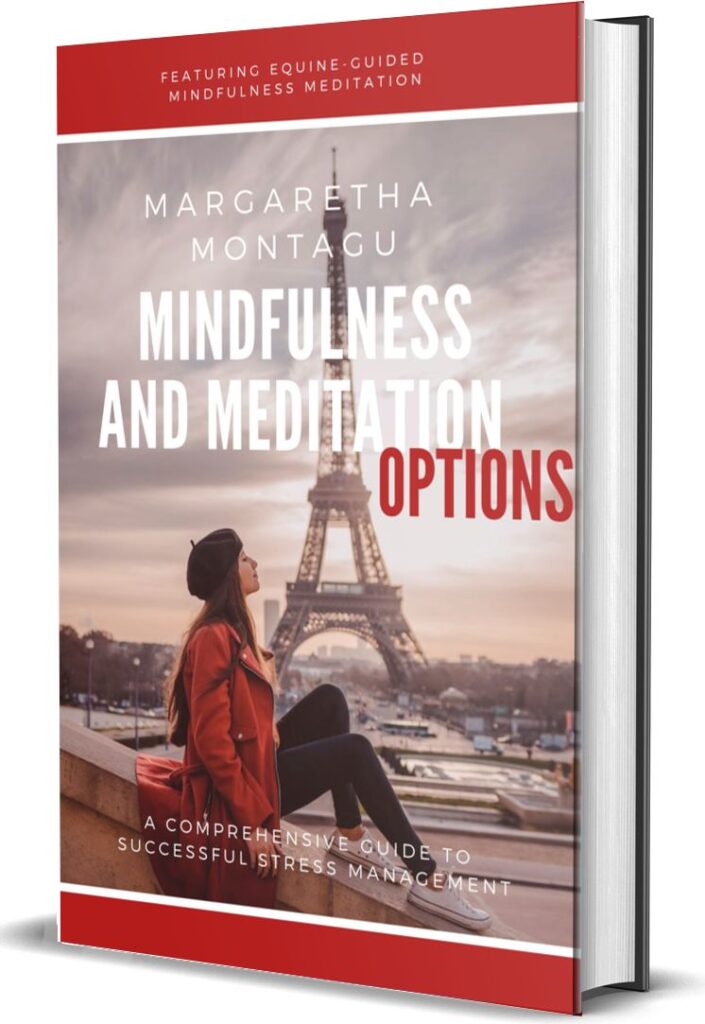
Mindfulness and Meditation Options: Featuring Equine-guided Mindfulness Meditation (Fabriqué en France Book 2)
Self-Confidence Made Simple: The 7 Secrets of Supreme Self-Esteem for Women who want to live fulfilling, purposeful and prosperous Lives (Fabriqué en France Book 1)
How To Make Your Next Retreat Your Best Retreat Ever (Fabriqué en France Book 4)
Everything I have created in the last decade was inspired and induced by a life transition, so theoretically, everything could be used to enrich my monster retreat.
But!
But, but, but…
What I want for my retreat guests, more than anything else, is time to relax, rest and recharge their batteries, in their own good time, at their own pace, while they benefit fully from connecting with my Friesians and Falabellas and reconnecting with Nature in one of the most beautiful parts of the world.
Also, I want this retreat to be structured in such a way that my guests will want to come back year after year for their reconnect-and-reset fix, to spend one blissful week in an as-familiar-as-a-favourite-winter-cardigan sanctuary, lightyears away from the overwhelming demands of their personal and professional lives.
If you would like to follow my journey and help me manifest my new retreat, just click on the button below and leave your e-mail address.
“I am an experienced medical doctor – MBChB, MRCGP, NLP master pract cert, Transformational Life Coach (dip.) Life Story Coach (cert.) Stress Counselling (cert.) Med Hypnotherapy (dip.) and EAGALA (cert.) I may have an impressive number of letters after my name, and more than three decades of professional experience, but what qualifies me to excel at what I do is my intuitive understanding of my clients’ difficulties and my extensive personal experience of managing major life changes using strategies I developed over many years.” Dr M Montagu
Having experimented with the Law of Attraction and having been thoroughly disillusioned more than a decade ago, I have had little time for the idea ever since.
Recently, a friend mentioned Human Design, and knowing nothing about it, I decided to look it up. According to this classification, I am a Reflector, not a Manifestor, which made me smile, and take the classification a bit more seriously, than I otherwise would have, as a scientist, because its effectiveness has not been confirmed by peer-reviewed research.
Ten years ago, I started a gratitude journal, and over the years, I became convinced of its powerful stress-reducing properties. Looking back, I realised that I also used it to set short, medium and long-term goals, and I wondered if that might have functioned as a manifestation activity. Could manifestation, in its simplest form, be nothing more than the brain’s Reticular Activation System (RAS) at work?
The RAS takes the information that we are constantly bombarded by from external sources, filters out the unnecessary and unimportant, and organises what is left into meaningful patterns. For example, saying an affirmation like “I am blessed” to yourself will trigger the Reticular Activating System, prompting it to notice any external validation for this affirmation.
In a similar way, keeping a manifestation journal can trigger the RAS to notice opportunities that will enable you to realise your dreams. Writing down your dreams helps clarify your intentions and focus your energy on working towards what you truly want. It allows you to track your progress over time, noting the steps you’ve taken and the milestones you’ve reached, which reinforces your commitment and motivation. Documenting your successes, no matter how small, also provides positive reinforcement.
I now more purposefully add my goals to my gratitude journal, to benefit from the support of my RAS.
How Not To Do It: Manifesting Madelaines
Beatrice’s journal smelled like burnt butter and broken dreams.
She cracked it open at 6:47 AM—the universe’s most auspicious time for manifestation, according to @SpiritualBaker333—and pressed her gel pen to the page with the fervor of a woman who’d watched one too many YouTube videos about the law of attraction.
I am a vessel for the perfect madeleine, she wrote in her best cursive. The scalloped edges call to me. The golden dome rises in my mind’s eye like a buttery sunset. I can already taste the delicate crumb, feel it dissolve on my tongue like edible nostalgia.
The pen’s ink bled slightly into the paper, creating a small blue halo around “nostalgia.” A sign from the universe? Beatrice chose to believe so.
Day three of manifestation journaling, and her kitchen counter looked like a crime scene. Flour dusted every surface in ghostly fingerprints. Egg yolks congealed in a measuring cup she’d forgotten about. The silicone madeleine pan—$47.99 on Amazon, worth every penny she’d convinced herself—sat in the sink, crusted with the remains of batch number eleven.
Eleven.
She’d been journaling for three weeks.
“The secret,” she’d told her storytelling circle last Tuesday, waving a lavender latte for emphasis, “is to write as if it’s already happened. Past tense. The universe doesn’t understand future tense.”
Marcus had raised an eyebrow. “Doesn’t the universe understand French pastry?”
Everyone had laughed. Beatrice had not.
Because this wasn’t just about pastry. This was about Proust. About involuntary memory. About creating something so transcendent that one bite could collapse time itself, could transport you to your grandmother’s kitchen or your first love’s apartment or some feeling you didn’t even know you’d lost.
Today I baked the perfect madeleine, she wrote on day nineteen. The kitchen smelled like browned butter and honey, like centuries of French grandmothers approving in chorus. When I lifted one from the pan, it released with a whisper, its belly golden as August light streaming through lace curtains.
She closed the journal. Picked up her whisk.
The batter looked promising—silky, the colour of pale morning sun. She’d brown-buttered. She’d rested. She’d chilled the pan. She’d even played Debussy while mixing because somewhere she’d read that sound vibrations affected molecular structure.
Twenty-three minutes later, she was staring at what could only be described as madeleine-shaped croutons. The edges had curled like arthritic fingers. The famous dome? Concave. When she bit into one, it crumbled into sawdust that sucked every molecule of moisture from her mouth.
She spat it into the sink and screamed into a dish towel.
Why isn’t this working?
The journal lay open on the counter, her elaborate cursive mocking her with its confidence. I am a vessel for the perfect madeleine.
“You’re a vessel for delusion,” she muttered, grabbing the pen.
Day 23: The madeleines taste like failure mixed with false hope and a $47.99 silicone pan that I’m starting to suspect is cursed.
She paused. Sniffed. Underneath the burnt-butter-disappointment smell, something else: the faint chemical tang of the pen, the vanilla extract she’d spilled on her wrist, the yeasty sourdough starter gurgling in the corner that she’d been successfully feeding for two years without journaling about it once.
At the storytelling circle that Thursday, she brought the journal.
“I’ve been manifestation journaling,” she announced, holding it up like evidence. “For the perfect madeleine. It’s not working.”
“Have you tried actually practising?” Marcus asked, too innocently.
The room went quiet.
Beatrice looked down at her journal, at weeks of elaborate prose about golden domes and transcendent crumbs and sensory time travel. At precisely zero notes about oven temperature or baking times or the actual chemistry of what makes a madeleine rise.
“I think,” she said slowly, “I’ve been writing fiction.”
The circle erupted in laughter—warm, knowing, not unkind.
“Welcome to storytelling,” Marcus grinned. “Now come over Sunday. My grandmother’s recipe. No manifestation required. Just butter, eggs, and showing up to learn.”
Beatrice closed her journal.
Sometimes the best stories are the ones where you stop writing and start living.
The journaling prompts below can significantly increase the effectiveness of your manifestation journal by triggering your RAS:
What is my ultimate goal and why is it important to me?
What steps can I take this week to move closer to my goal?
How will achieving my goal positively impact my life and the lives of others?
What resources and support do I need to manifest my goal, and how can I access them?
Who are the people that inspire me and how can I learn from their journeys?
How can I celebrate my progress, no matter how small, on the path to my goal?
What does my ideal day look like in vivid detail?
How will achieving my current goal change my life for the better?
What qualities do I most admire in others and wish to cultivate in myself?
What/who am I most grateful for in my life right now?
How do I envision my life five years from now?
What obstacles do I currently face, and how can I overcome them?
What positive affirmations can I use to empower my daily intentions?
What acts of kindness can I perform to improve my and others’ well-being?
What are my core values, and how do they guide my life’s choices?
If fear was not a factor, what would I pursue immediately?
What habits can I develop to bring me closer to my dreams?
In what ways can I positively impact my community?
What does success truly mean to me?
What are the most significant lessons I’ve learned this year?
How can I make my daily routine more aligned with my goals?
What limiting beliefs do I need to let go of to move forward?
How can I turn a recent challenge into an opportunity for growth?
5 FAQs About the Reticular Activating System
1. What exactly is the Reticular Activating System (RAS)?
The Reticular Activating System is a network of neurons located in the brainstem that acts as your brain’s gatekeeper and attention filter. Think of it as a neurological bouncer that decides which information gets VIP access to your conscious awareness and which gets left outside in the cold. This pencil-sized bundle of nerve cells processes millions of bits of sensory data every second—sights, sounds, smells, touches—and filters out about 99% of it so you’re not overwhelmed. Without your RAS, you’d be paralysed by the sheer volume of information bombarding your senses at every moment.
2. How does the RAS decide what’s important enough to notice?
Your RAS operates on a priority system based on three main criteria: survival relevance, emotional significance, and what you’ve repeatedly told it matters. Sudden loud noises always get through (survival). Your name spoken across a crowded room cuts through the chatter (personal relevance). And here’s where it gets interesting—whatever you focus on consistently, your RAS begins to recognise as important. This is why when you’re thinking about buying a red car, you suddenly see red cars everywhere. They were always there; your RAS just wasn’t letting them through until you signalled they mattered. It’s essentially programmable through attention and repetition.
3. Can I actually train or reprogram my RAS?
Yes, though “train” is more accurate than “reprogram.” Your RAS responds to consistent patterns of attention, emotion, and repetition. When you set clear intentions, visualise goals, or repeatedly expose yourself to certain information, you’re essentially teaching your RAS what to prioritise. This is the neurological basis behind practices like vision boards, affirmations, and goal-setting. However—and this is crucial—your RAS can’t distinguish between positive and negative focus. If you constantly worry about failure, your RAS will helpfully point out every possible failure scenario. The key is deliberate, consistent focus on what you want to notice, coupled with genuine emotional engagement with those goals.
4. What’s the connection between the RAS and sleep/wakefulness?
The RAS is literally your brain’s on/off switch for consciousness. It controls your sleep-wake cycle by regulating arousal and alertness levels throughout the day. When your RAS activity increases, you become more alert and wakeful; when it decreases, you drift toward sleep. This is why damage to the RAS can result in coma—the brain loses its ability to maintain wakefulness. The RAS also explains why certain sounds can wake you (a baby crying, your alarm) while others don’t (steady traffic noise). Even during sleep, your RAS continues monitoring for important stimuli, maintaining just enough vigilance to rouse you when necessary while filtering out irrelevant information that would otherwise fragment your rest.
5. Is the RAS the scientific explanation for manifestation and the law of attraction?
Partially, but it’s important to separate neuroscience from magical thinking. The RAS does explain why focusing on goals makes you more likely to notice opportunities related to those goals—it’s not that the universe is conspiring to help you, but that your brain is now alerting you to relevant information that was always present. This is a real, measurable phenomenon called selective attention. However, the RAS doesn’t make things materialise out of thin air or bend reality to your will. It simply makes you more aware and responsive to existing opportunities. The practical takeaway: set clear goals, focus on them regularly, and your RAS will help you spot the resources, people, and chances that can move you toward them. But you still have to take action—the RAS opens your eyes, but you have to walk through the door.
“I am an experienced medical doctor – MBChB, MRCGP, NLP master pract cert, Transformational Life Coach (dip.) Life Story Coach (cert.) Stress Counselling (cert.) Med Hypnotherapy (dip.) and EAGALA (cert.) I may have an impressive number of letters after my name, and more than three decades of professional experience, but what qualifies me to excel at what I do is my intuitive understanding of my clients’ difficulties and my extensive personal experience of managing major life changes using strategies I developed over many years.” Dr M Montagu
How Hyper-Successful People Use Micro-Manifestation The Myth of “Thinking Big” What if I told you that think big!—that beloved, motivational, plastered-on-vision-boards-everywhere mantra—is actually stopping you from achieving massive success? That your well-intentioned grand dreams might be the very thing keeping you stuck? I know, I know. That’s practically heresy in the world of self-improvement. We’ve …
Introverts vs Extroverts: Many introverts spend decades pretending to be extroverts to fit in but according to Laurie Helgoe, “Introverts are more effective leaders of proactive employees. When you have a creative, energetic workforce, an introvert is going to draw out that energy better.” Introduction: The Private Struggle of Successful Professional Introverts At some point …
There is no passion to be found playing small – in settling for a life that is less than the one you are capable of living. Nelson Mandela In Short Here’s the uncomfortable truth wrapped in a comfortable sweater: That “good enough” job, relationship, or living conditions you’re tolerating? It’s not prudent compromise—it’s you slowly …
I hear this constantly from executives: “I sleep, but I never feel restored. It’s like my brain is still running flat out even while I’m in bed.” Rachel, a Chief Marketing Officer, described it perfectly: “I go to sleep thinking about the team restructure. I wake up at 3am replaying that tense conversation with the …
Leaders tell me: “Balance is impossible. If I slow down, I fall behind. If I keep going, I burn out.” Jennifer, a Senior Vice President at a tech company, put it perfectly: “Everyone talks about work-life balance like I should just… work less. But I didn’t build my career by doing the minimum. I love …
Relax, Rejuvenate, and Rediscover Yourself at a Sanctuary in the foothills of the Pyrenées Mountains
A retreat should be a refuge: somewhere you can escape to, a place where you feel safe, seen and heard.
I mentioned that I run old-fashioned retreats that first and foremost offer my guests a safe haven where they can thoroughly relax, rest and fully recharge their batteries.
But what is a safe haven?
My definition of a safe haven is my grandmother’s kitchen. In the blink of an eye, I can imagine myself back there, sitting at the rough kitchen table, my feet dangling in the air as my legs are too short to reach the floor. The whole room is saturated with the smell of baking bread, and my mouth is watering in anticipation of the thick slice of steaming hot bread, drenched in homemade butter, that my grandmother will soon put in front of me. While I wait, my legs swinging back and forth impatiently, I stare in fascination at the huge variety of herbs drying on hooks on the 300-year-old oak beams, humming absentmindedly along with Maurice Chevalier on the radio, as he sings about bicycling down the deserted country roads. Finally, my grandmother gets up from the table where she has been shelling peas from her potager, to check the bread. I hold my breath, is it ready yet?
For my guests, I have tried to create a similar experience here on my little farm, in deepest rural France. The setting is an ancient half-timbered farmhouse, renovated as authentically as possible, rustic but comfortable, surrounded by woods, sunflower fields, vineyards and lush meadows, where my horses are grazing peacefully. The breeze here carries the perfume of a thousand wildflowers, and birds serenade my visitors from dawn to dusk, through the night even, if you count in the wooing owl couple. Talking about the night, here you can lie in a sunlounger, -or should that be a moonlounger? – and breathlessly take in the millions of stars that fill the night sky, as there is barely any light pollution here.
Here you can sleep for hours, and most of my guests do. They often sleep 10-12 hours on the first night, some sleep 10 hours every single night they are at Esprit Meraki, which means, loosely translated from the Greek, « made with love. »
A safe haven, a refuge, created with love.
Uninterrupted sleep, safeguarded from the sudden nerve-wracking blast of an alarm clock, just when you are sleeping at your deepest can do wonders for your general wellbeing. I usually suggest that my guests switch their phones to aeroplane mode and sleep until they wake up naturally, whether it’s 10, 11 or 12 o’clock. Many of my guests haven’t dared to do that for years.
Soon, feeling safe and supported, my guests break free from the suffocating stress that threatens their physical and mental health – it dissolves like the morning mist at sunrise. Breathing sparkling fresh air brings a healthy flush to everyone’s cheeks and simple rituals like strolling up to the potager to pick some sun-warmed tomatoes for the evening’s salad – and eating as many straight again straight off the plants – become a pilgrimage back to a simpler, slower, stress-free way of living, a lifestyle wholeheartedly indulged in here in the unspoilt and largely unexplored southwest of France.
I feel it is crucially important that retreat guests have enough time, at the beginning of a retreat, to leave their troubles behind and disconnect from their often demanding personal and professional lives, before the retreat program starts in earnest. If they want to spend the whole time they are here reading a book in the shade of the gnarled-with-age lime trees, sipping fruit juice or homemade herbal tea, and listening to the horses grazing peacefully close by, that is fine too.
Finding a safe place to rest and recharge your batteries can be transformative too.
Rest is not idleness, and to lie sometimes on the grass under trees on a summer’s day, listening to the murmur of the water, or watching the clouds float across the sky, is by no means a waste of time. – John Lubbock
Frequently Asked Questions about Retreats as Sanctuaries
1. What exactly do you mean by a “safe haven”?
A safe haven is a place where you can completely let your guard down—somewhere you feel safe, seen, and heard. For me, the definition of a safe haven is my grandmother’s kitchen: sitting at that rough kitchen table with my feet dangling, surrounded by the smell of baking bread, watching herbs dry on 300-year-old oak beams, and knowing that thick slices of steaming hot bread drenched in homemade butter were coming. It was a place saturated with love, comfort, and the simple rhythms of life. At Esprit Meraki, I’ve tried to recreate that same feeling—a refuge where stress dissolves like morning mist at sunrise, where you’re protected from the demands of the outside world, and where you can reconnect with the person you are beneath all the pressure and expectations.
2. Why is a safe haven so important for a retreat?
A retreat should be a refuge first and foremost—not just another place with a packed schedule and obligations. When you’re running on empty from demanding personal and professional lives, what you need most is sanctuary. A safe haven provides the essential foundation for genuine rest and transformation. It’s only when you feel truly safe and supported that the suffocating stress threatening your physical and mental health can begin to dissolve. Without this sense of safety, you remain in a state of vigilance, unable to access the deep rest your body and mind desperately need. I feel it is crucially important that guests have enough time at the beginning to leave their troubles behind and disconnect before any formal program starts. Some guests need the entire retreat just to rest, and that’s perfectly valid—finding a safe place to rest and recharge can be transformative too.
3. How does the physical environment create a sense of safety?
The setting itself is designed to wrap you in comfort and security. The ancient half-timbered farmhouse, renovated as authentically as possible, offers rustic warmth rather than sterile perfection. You’re surrounded by woods, sunflower fields, vineyards, and lush meadows where horses graze peacefully—nature’s own reassurance that life can move at a gentler pace. The breeze carries the perfume of a thousand wildflowers, birds serenade you from dawn to dusk, and at night, an owl couple woos under millions of stars visible in skies free from light pollution. These aren’t just pretty amenities—they’re deliberate elements that signal to your nervous system: you are safe here. You can breathe. You can let go. The whole environment invites you back to a simpler, slower, stress-free way of living that your body remembers and craves.
4. What does it mean to feel “seen and heard” at the retreat?
Being seen and heard means your needs, your pace, and your experience are honoured without judgment. If you need to sleep 10-12 hours on the first night (as most guests do), that’s celebrated, not questioned. If you want to sleep 10 hours every single night you’re here, that’s supported. If you need to spend the whole time reading under the gnarled-with-age lime trees, sipping fruit juice or homemade herbal tea while listening to horses graze, that’s fine too. There’s no pressure to be “productive” or to participate in activities if rest is what you need. After over a decade of leading retreats, I’ve learned that each person’s path to restoration is unique. A safe haven means having the freedom to follow your own rhythm and knowing that whatever you need is valid. Rest is not idleness, and sometimes lying on the grass under trees, listening to water murmur or watching clouds float across the sky, is exactly the medicine you need.
5. How does sleep factor into creating a safe haven?
Uninterrupted sleep, safeguarded from the sudden nerve-wracking blast of an alarm clock just when you’re sleeping at your deepest, can do wonders for your general well-being. In a safe haven, sleep is sacred and protected. I usually suggest that guests switch their phones to aeroplane mode and sleep until they wake up naturally, whether it’s 10, 11, or 12 o’clock. Many of my guests haven’t dared to do that for years—they’ve forgotten what it feels like to wake when their body is truly ready. This simple act of trusting your body’s need for rest, without guilt or anxiety about the time, is often the first step in breaking free from the chronic stress that has been suffocating you. When you’re in a truly safe space, your body finally feels permission to access the deep, restorative sleep it has been desperately craving.
6. What role do simple rituals play in creating safety?
Simple rituals ground you in the present moment and reconnect you with basic, nourishing aspects of life that stress often strips away. At Esprit Meraki, rituals like strolling up to the potager to pick sun-warmed tomatoes for the evening’s salad—and eating as many straight off the plants as you like—become a pilgrimage back to authenticity. These aren’t Instagram moments or wellness trends; they’re genuine reconnections with the rhythms of life that make us feel human and whole. When you sit at a table where someone has been shelling peas from the garden, when you smell bread baking and know it will soon be yours with homemade butter, when you hear Maurice Chevalier on the radio singing about bicycling down deserted country roads—these sensory experiences create safety through familiarity, comfort, and love. They remind you that life doesn’t have to be complicated to be rich and fulfilling.
7. Why do you emphasise “old-fashioned” retreats?
I run old-fashioned retreats because modern life has over-complicated what should be simple: rest, safety, and restoration. An old-fashioned retreat prioritises being a refuge above all else, rather than being another item on your to-do list or another performance to manage. It’s inspired by the timeless wisdom that rest is not idleness and that sometimes the most transformative thing you can do is simply be—lying on grass under trees, listening to nature, breathing clean air. Old-fashioned means valuing presence over productivity, depth over busyness, and genuine human connection over curated experiences. It means creating the atmosphere of my grandmother’s kitchen—that place where time moved differently, where you were unconditionally welcomed, where love was expressed through simple care. In our hyper-connected, always-on world, this kind of sanctuary has become revolutionary rather than traditional.
8. How soon do guests typically feel safe enough to truly relax?
Everyone’s timeline is different, which is why the beginning of the retreat is deliberately unstructured. Some guests begin to feel their shoulders drop and their breath deepen within the first few hours of arriving and breathing the sparkling fresh air. Others need several days before they can truly disconnect from the demanding lives they’ve left behind. I’ve learned that it’s crucially important to give guests enough time to leave their troubles behind before any formal program starts. Feeling safe and supported, guests gradually break free from the suffocating stress—it doesn’t happen on command or on schedule. The retreat is designed to hold space for however long it takes. The environment itself does much of the work: the peaceful grazing horses, the healthy flush that comes to cheeks from fresh country air, the birdsong, the stars, the absence of alarm clocks. These elements conspire to help your nervous system finally believe: you are safe here. You can let go.
9. What if I feel guilty about taking so much time out?
That guilt is precisely why you need a safe haven. Many of my guests haven’t dared to sleep until they wake naturally for years. They’ve internalised messages that rest is laziness, that productivity equals worth, and that they must constantly justify their existence through doing. A safe haven provides permission—and sometimes that external permission is what we need before we can grant it to ourselves. As John Lubbock wrote, “Rest is not idleness, and to lie sometimes on the grass under trees on a summer’s day, listening to the murmur of the water, or watching the clouds float across the sky, is by no means a waste of time.” At Esprit Meraki, this isn’t just a pretty quote—it’s a lived philosophy. When you see that resting is honoured here, when you’re surrounded by others who are also giving themselves permission, when you’re held in an environment that celebrates rather than judges your need for restoration, that guilt begins to loosen its grip. You start to remember that you are a human being, not a human doing.
10. How is this different from just taking a vacation?
A vacation often still operates within the framework of productivity—seeing sights, checking off experiences, justifying the expense through how much you packed in. Many people return from vacations feeling they need a vacation to recover from their vacation. A safe haven retreat is fundamentally different because it centres rest and safety rather than activity and achievement. It’s not about what you do; it’s about how deeply you can allow yourself to simply be. The whole environment—from the ancient farmhouse made with love to the invitation to pick tomatoes to the protection of your sleep—is designed to help you break free from the patterns that have been threatening your physical and mental health. Finding a safe place to rest and recharge your batteries can be transformative too, often more so than any amount of sightseeing or adventure. This is about returning to yourself, not escaping yourself. It’s about remembering who you are beneath all the stress and demands, in a place where you feel genuinely safe, seen, and heard.
In addition to the Camino de Santiago retreats that I host at my little French farm southwest of Bordeaux, I have also created 7 online courses, ex.The Purpose Protocols, The Roadmap to Resilience – from Burnout to Brilliance Protocol and The Change Careers without Starting from Scratch – each course is available with or without one-to-one support. To stay in contact, I invite you to subscribe to my newsletter, you’ll get immediate access to my free life crisis quiz.
An old-fashioned retreat is one with a rustic charm reminiscent of a bygone era, where guests can escape the modern world’s fast pace and engage in traditional activities like nature walks, storytelling, journaling, bread-making etc. Meals are homemade from scratch using traditional recipes and locally sourced ingredients. The retreat emphasises slow, simple living, while being present in the moment, combined with plenty of outdoor activities like hiking, wild swimming, forest bathing or stargazing to connect guests with the natural world.
Like Leonardo da Vinci, I believe that “Simplicity is the ultimate sophistication.”
These days, most retreats are bright, sparkling jewels in exclusive, exotic settings, often with a price tag to match. Nearly all retreats promise some or other sort of personal growth transformation, either emotional healing, spiritual awakening, increased physical fitness, stress reduction, relationship enhancement, leadership development, improved communication skills etc.
Groups are huge, ten to thirty people per retreat, and the retreat programs are busy. Accommodation is luxurious, meals are cooked by chefs hired for the purpose, catering for every possible diet, swag bags compete fervently for originality, excursions are plentiful, and additional options are varied.
My retreats are none of these things.
My retreats are like a soft, woollen, well-worn cardigan that you snuggle into every winter, that you wear year after year, just because it feels so wonderful against your skin, keeps you warm and carries so many happy memories. Just slipping it onto your shoulders makes you feel less stressed, it’s the first thing you reach for when you get home after a long day’s work.
Working as a medical doctor taught me that stress is either the cause or a contributory factor to a large number of dangerous physical and mental diseases, so during my retreats, I make sure my guests have ample time just to be…and breathe.
This has remained the primary focus of my retreats for more than a decade: to let my guests rest, relax, recharge their batteries, and…
Reconnect with Nature.
“I firmly believe that nature brings solace in all troubles.” – Anne Frank
Reconnecting with Nature is a powerful stress management strategy. Spending time in Nature can lower your cortisol levels and increase your serotonin levels, making you feel calmer and more content. It can also help you to sleep better, boost your immunity, your creativity (your problem-solving skills), and improve your cognitive function (including your memory.)
During a Camino de Santiago Crossroads retreat, here is the sun-blessed and largely unspoilt southwest of France, you will have the opportunity to reconnect to Nature, guided by a small herd of Friesians and Falabella horses. Horses thrive in a natural environment, and spending time with horses enables us to immerse ourselves in Nature, surrounded by the sights, sounds, and smells of the outdoors, helping us feel more grounded and present in the moment, allowing us to let go of distractions and fully engage with our surroundings.
Year after year, my retreat “regulars” return to get their “nature fix” with bags full of carrots, for the horses, who recognise and welcome them with soft whinnies as they rush to the paddock the moment they arrive at Esprit Meraki.
Maybe it’s time to escape the hustle and bustle of daily life, immerse yourself in the serenity of nature and to find solace in its breathtaking beauty? To nourish your mind, body, and soul at an Camino de Santiago Crossroads Retreat?
Because simplicity is not about deprivation. It’s about a greater appreciation for things that really matter.
Replies to this post:
I was so happy to receive your newsletter.As I read it, I thought, “Yes! A soft, woollen, well-worn cardigan!” It seems to me, too, that we need more of this in life.
Personally, I am turned off by the brighter, fancier, shinier “retreats” on offer. It is not what I’m looking for and somehow seems to muddle the idea of “retreat” with “five-star luxury break.” The two are not the same, and, generally, it shows. In fact, many seem to be in opposition to the “slow-down connection” that many of us crave, and the high price-tags are certainly restrictive.
Fortunately, there is room for everyone in this sphere: People who want the exotic, luxurious, gourmet, entertained experience can have that; those of us who want quiet, time, space, nature, breathing and fresh food can have that.
Honestly, though, everything about your retreats looks marvellous. I haven’t been in a position to attend one yet, but I look forward to doing so. From what I read in your blogs, they offer the kind of luxury I value. Robyn
I have thought about you often since staying with you last year. I will say, I personally did not expect to find such a serene and relaxing retreat, even though it was advertised as all of those things, I expected groups of people, organised ‘fun’, queuing for bathrooms and noise at nighttime.
I experienced the opposite and more. It was a quiet retreat with just myself and the lovely Carmella, and I still think about the camino walks, your AMAZING food, our chats not to mention just enjoying the surroundings. To feel at home in a stranger’s home is testament to what a fantastic host you are and the thought you put into everything. I did not think at any point that I had paid too much for the experience.
It may be that the social-media generation we have now are looking for all of those ‘sparkly’ things you have mentioned to experience and to advertise. But authenticity is priceless, and I believe that’s what you have and what you are. I know that I would love to visit again and also do the full Camino, maybe next year. Sarah
In addition to the Camino de Santiago retreats that I host at my little French farm southwest of Bordeaux, I have also created 7 online courses, ex.The Purpose Protocols, The Roadmap to Resilience – from Burnout to Brilliance Protocol and The Change Careers without Starting from Scratch – each course is available with or without one-to-one support. To stay in contact, I invite you to subscribe to my newsletter, you’ll get immediate access to my free life crisis quiz.
How Private Retreats Can Revolutionise Your Well-being
I have been hosting small group Camino de Santiago hiking retreats for more than a decade, here at my house in the southwest of France. Last week, I came across this post in a group: “Would you go on a private wellness retreat?”
The response was such an overwhelming “Yes!” that I started wondering why so many people are interested in attending a retreat on their own. Would I want to attend a solo (private) retreat?
I can see the attraction of a tailor-made private retreat: escaping from the ever more urgent demands and digital overwhelm of everyday life, spending a few days on my own, focusing on my own needs, taking activities at my own pace and in my own time, with one-on-one attention from the retreat leader…the idea has a certain appeal.
Are YOU thinking about running away from your life for a few days? Before you do something rash like moving to Bali or joining a circus, consider this then: a private retreat could be the answer you’re looking for. In this article, I explore why booking yourself into solitude, especially during major life transitions, isn’t selfish or indulgent, it’s possibly the most sensible thing you’ll do all year. We’ll look at what makes private retreats different from group experiences, why they’re particularly powerful during crossroads moments, and how stepping away might be the only way to truly step forward. Fair warning: contains one woman’s hilariously disastrous attempt at finding herself, practical wisdom, and zero judgment about where you are right now.
Five Key Takeaways
Private retreats offer bespoke transformation: Unlike group retreats where you’re part of the chorus, a private retreat lets you be the soloist, addressing your specific challenges without having to navigate other people’s emotional baggage alongside your own.
Solitude isn’t loneliness: Being alone in a supportive environment creates space for the kind of honest conversation with yourself that’s impossible when you’re performing your life for an audience, even a well-meaning one.
Major life transitions require dedicated processing time: Whether you’re recovering from burnout, grieving a loss, or standing at a crossroads, a private retreat provides the safe container you need to fall apart and reassemble yourself without witnesses.
Nature and stillness are underrated healing tools: When you strip away digital noise, social obligations, and the constant need to be “on,” your nervous system can finally exhale and your intuition can finally be heard.
Investing in yourself isn’t selfish: Taking time away to reconnect with who you are and what you truly want isn’t abandoning your responsibilities, it’s ensuring you’ll have something left to give when you return.
Introduction: The Permission Slip You’ve Been Waiting For
Here’s something nobody tells you about major life changes: they don’t come with an instruction manual, a helpline, or even a sympathetic customer service representative. One day you’re navigating your normal life, and the next you’re standing in the middle of emotional rubble wondering how you got here and where “here” even is.
Maybe your career imploded. Perhaps a relationship ended or transformed beyond recognition. You might be caring for aging parents whilst simultaneously launching teenagers into the world, feeling like a human wishbone pulled in opposite directions. Or maybe everything looks fine from the outside, but inside you’re running on fumes, held together by coffee and the sheer determination not to let anyone see you’re actually drowning in overwhelm.
The world has opinions about how you should handle these moments. “Stay busy!” they chirp. “Throw yourself into work!” “Get back out there!” “You’ve got this!” Well-meaning friends serve up platitudes like they’re handing out life preservers, but what you actually need is something entirely different: space. Time. Silence. A chance to hear yourself think without the Greek chorus of other people’s expectations drowning out your own voice.
That’s where a private retreat enters the story.
Not as an escape (though it can feel gloriously like one), but as a homecoming. A chance to remember who you are beneath all the roles you play and the masks you wear. Private retreats aren’t about running away from your life, they’re about running towards yourself, often for the first time in years.
In a world that glorifies constant connection and productivity, choosing solitude feels revolutionary. It is. Because the truth nobody wants to admit is this: sometimes the bravest thing you can do is stop. Stop performing, stop achieving, stop pretending you’re fine. Just… stop. And in that stopping, in that sacred pause, you might discover that the person you’ve been searching for, the answer you’ve been seeking, has been waiting patiently inside you all along.
The Story of Eleanor’s Magnificent Unravelling
Eleanor arrived at the farmhouse on a Tuesday afternoon in late September with three matching suitcases, a colour-coded itinerary, and an Excel spreadsheet titled “Operation Find Myself.” She was 47, recently made redundant from a job that had consumed her for two decades, and absolutely convinced that five days of structured self-discovery would solve everything.
The gravel crunched under her sensible walking shoes as she stepped out of the rental car, already mentally ticking off the first item on her to-do list: Arrive at retreat. Check. She’d read all the materials, researched mindfulness techniques, downloaded seven meditation apps, and packed three self-help books she fully intended to finish. Eleanor approached finding herself with the same methodical efficiency she’d brought to managing product launches and quarterly reports.
What she hadn’t planned for was Belle.
Belle, the enormous black Friesian mare, was standing by the fence as Eleanor hauled her perfectly organised luggage towards the house. The horse lifted her head, fixed Eleanor with eyes that seemed to see straight through the carefully constructed facade, and did something that stopped Eleanor mid-stride: she whinnied, soft and low, a sound that somehow contained both greeting and question.
Eleanor, who’d been holding her breath for approximately six months without realising it, exhaled.
The first 24 hours unfolded exactly as Eleanor had planned. She rose at 6:30, completed her morning pages, attended the guided meditation in the meadow (where she mentally drafted a memo about improving the session structure), went for her scheduled walk on the Camino path, and even managed to eat mindfully, though her brain kept trying to schedule her bites. By day two, her jaw ached from clenching, her shoulders had formed a permanent shrug, and she’d rewritten her reflection journal twice to make it neater.
Then came Wednesday afternoon.
The storytelling circle that evening was optional, but of course Eleanor attended, she wasn’t someone who skipped optional activities. Sitting on cushions around the fire pit, with two other solo retreatants and the retreat host, they were invited to share a story about a moment of transition. Eleanor, who could deliver presentations to boardrooms of fifty without breaking a sweat, found herself completely stuck.
“I don’t really have a story,” she said, picking at the fringe of her cushion. “I mean, I got made redundant. That’s not a story, that’s just… a thing that happened.”
The host, a woman with gentle eyes and an unsettling ability to wait through uncomfortable silences, simply nodded. “Sometimes the things that ‘just happen’ are where our biggest stories begin.”
That night, Eleanor couldn’t sleep. She lay in the brass bed in her room overlooking the sunflower fields, listening to the wind whisper through the trees, and felt something crack open in her chest. Not break, exactly. More like split, the way seeds split before they sprout.
Thursday morning, she abandoned her schedule entirely. Instead of her planned walk, she found herself back at the fence where Belle grazed. The mare approached, and Eleanor, who hadn’t cried in front of anyone since 1997, pressed her forehead against Belle’s warm neck and sobbed. Proper, ugly, hiccupping sobs that shook her entire body and scared two chickens in the adjacent field.
She cried for the job she’d lost, yes, but more for the life she’d never lived. For the novel she’d never written because reports and proposals took precedence. For the relationship that ended because she was always at the office. For the twenty years she’d spent becoming excellent at something that turned out to be entirely replaceable. For the daughter she was, who’d learned that love meant achieving and producing and never, ever being inconvenient.
Belle stood perfectly still, steady as a mountain, breathing her grassy breath while Eleanor fell apart. The horse’s warmth seeped through Eleanor’s cardigan, and the rhythmic rise and fall of Belle’s breathing gradually synced with her own. When Eleanor finally lifted her head, eyes swollen and nose running most inelegantly, Belle simply regarded her with what looked distinctly like approval.
“Well,” Eleanor said to the horse, her voice hoarse and wobbly, “that wasn’t on the schedule.”
Belle flicked an ear as if to say: Obviously. The best things never are.
That afternoon, Eleanor sat under the walnut tree with a notebook, not to make lists or plans, but simply to write. She wrote about the smell of the horse, warm and earthy and real. About the rough texture of Belle’s coat under her fingers and the surprising softness of her muzzle. About the sound of hooves on grass and how the afternoon light turned the meadow golden. About the taste of fresh bread at lunch and the sight of purple wildflowers she couldn’t name but desperately wanted to.
She wrote about how her body felt lighter, as if she’d been carrying invisible stones in her pockets for years and had only just discovered she could set them down. About the sudden, shocking realisation that she had absolutely no idea what she wanted to do next, and how terrifying and thrilling that was in equal measure.
By Friday, Eleanor had stopped checking her phone every ten minutes. She’d also stopped wearing her watch, which felt almost scandalously rebellious. She walked the Camino path without tracking her steps or pace. She sat in meditation without judging whether she was “doing it right.” She talked in the storytelling circle about failure and fear and the strange relief of having nothing left to prove.
On her last evening, sitting on the terrace with a glass of local wine, Eleanor watched the sunset paint the sky in shades of orange and pink she’d forgotten existed. Belle and the other horses grazed in the meadow below, their dark shapes silhouetted against the fading light. The air smelled of lavender and earth and possibility.
“I thought I’d come here to find answers,” Eleanor said to the host, who’d joined her to watch the light show. “I thought I’d leave with a plan, you know? A new direction.”
“And?” the host asked, her voice warm with understanding.
Eleanor smiled, surprising herself. “I think I found something better. I found the questions I was too afraid to ask. And maybe, just maybe, permission to not have everything figured out.”
The next morning, as Eleanor loaded her three matching suitcases back into the rental car (though she’d abandoned the colour-coded itinerary and let the Excel spreadsheet languish unopened), she paused at the fence one last time. Belle wandered over, and Eleanor offered her a piece of apple she’d saved from breakfast.
“Thank you,” she whispered to the horse, stroking her velvet nose. “For showing me it’s okay to fall apart. For teaching me that falling apart might actually be how you come back together.”
Belle crunched her apple thoughtfully, unbothered by philosophy or profundity, secure in the ancient equine wisdom that Eleanor was only beginning to grasp: sometimes you have to stand still in order to move forward. Sometimes strength looks like surrender. And sometimes, finding yourself requires getting thoroughly, magnificently lost first.
Eleanor drove away that morning without a five-year plan or a clear career trajectory. But she drove away different, softer around the edges, more honest in the middle. She drove away knowing that the most important thing she’d learned had nothing to do with mindfulness techniques or self-help strategies, and everything to do with the revolutionary act of simply being with herself, in all her imperfect, unscheduled, beautifully human messiness.
Three months later, she adopted two rescue horses.
Understanding Private Retreats: Solitude Is the Secret Ingredient
In our aggressively social world, where connection is currency and networking is considered a virtue, choosing solitude can feel almost transgressive. We’re told that healing happens in community, that sharing our stories creates connection, that we’re “better together.” And whilst there’s truth in that, there’s an equally important truth that gets whispered rather than shouted: sometimes you need to be alone.
Not lonely. Alone. There’s a universe of difference.
The Fundamental Difference Between Group and Private Retreats
Group retreats can be magnificent. They offer shared experience, collective energy, and the comfort of knowing you’re not the only one struggling. There’s something powerful about sitting in a circle with others who understand, who nod in recognition at your pain because they’ve felt it too.
But here’s what nobody mentions in the glossy retreat brochures: group experiences require performance. Even in the most supportive, non-judgemental circles, you’re still managing how you appear to others. You’re editing your tears, timing your breakdowns, wondering if you’re sharing too much or not enough. You’re comparing your journey to theirs, measuring your progress against their breakthroughs, feeling guilty when you’re having a bad day and everyone else seems to be glowing with transformation.
A private retreat strips all that away. There’s no audience for your unravelling, no witnesses to your worst moments, no need to put on a brave face during breakfast. You can cry at 3am without worrying about disturbing roommates. You can spend an entire day in silence without explaining yourself. You can eat chocolate biscuits in bed whilst reading your third novel of the week and call it “self-care” without irony or justification.
This isn’t about being antisocial or misanthropic. It’s about creating conditions where your authentic self, the one you might have been hiding even from yourself, can finally emerge without fear of judgment or the pressure to perform recovery in a way that makes others comfortable.
Why Major Life Transitions Demand This Kind of Space
Life transitions, the meaty ones that actually change who you are, don’t happen on schedule. They don’t follow a neat arc from problem to solution, from pain to healing, from confusion to clarity. They’re messy, nonlinear, full of false starts and backsliding and moments where you question everything, including your decision to question everything.
When you’re recovering from burnout, you might need three days of doing absolutely nothing before you can even begin to think about what comes next. When you’re processing grief, you might need to rage one day and feel perfectly fine the next, then wake up the third morning drowning in sadness again. When you’re standing at a crossroads, trying to choose between paths, you might need weeks of sitting with uncertainty before your intuition speaks up.
Private retreats honour this messy reality. They give you permission to take as long as you need, to change your mind, to have a breakthrough on Tuesday and a breakdown on Wednesday. There’s no group schedule to keep, no communal activities to attend unless you want to, no pressure to show up as anything other than exactly who you are in each moment.
The Science and Soul of Solitude
Research increasingly supports what contemplatives and introverts have known forever: time alone is essential for psychological wellbeing. Our brains need periods of low stimulation to process experiences, integrate learning, and make meaning from chaos. The default mode network, the brain’s “daydreaming” state, is where creativity emerges and problems solve themselves, but it only activates when we’re not engaged in directed attention or social interaction.
In practical terms, this means that the breakthrough you’re desperately seeking might require you to stop seeking it. The clarity you need might only emerge when you stop trying to force it. The answer you’re looking for might whisper itself during a solitary walk through wildflower meadows or whilst watching horses graze or in that spacious moment between waking and thinking where truth slips through before your defences rebuild.
But beyond the neuroscience, there’s something soulful about solitude. It’s where you remember who you were before the world told you who to be. It’s where the masks slip and the performance ends and you’re just… you. Raw, unedited, uncensored. And whilst that can be uncomfortable, profoundly so, it’s also where genuine transformation begins.
The Particular Power of Solitude in Nature
There’s a reason cultures across millennia have sent people into wilderness for vision quests, walkabouts, and spiritual retreats. Nature doesn’t require you to be anything other than what you are. A tree doesn’t judge your life choices. A mountain doesn’t care about your credentials. A sunrise doesn’t ask what you’ve achieved lately.
When you combine the solitude of a private retreat with immersion in nature, something alchemical happens. The constant low-level anxiety that characterises modern life, the vigilance required to navigate social situations and professional demands, begins to dissipate. Your nervous system, which has been in fight-or-flight mode for so long you’ve forgotten what calm feels like, gradually downshifts into rest.
Walking the Camino paths through ancient woods and sun-drenched vineyards, you’re not just exercising, you’re literally stepping away from your old story with each footfall. Sitting in a meadow with horses who model presence and authenticity without trying, you’re learning languages your body remembers even if your mind has forgotten. Sleeping in a 300-year-old farmhouse where hundreds of others have sought refuge and renewal before you, you’re plugging into a tradition of transformation that predates self-help books and therapy speak.
Nature, in her infinite patience, simply holds space for whatever needs to emerge. She doesn’t rush your healing or critique your process. She offers lessons without lectures: the storm that clears the air, the seed that waits in darkness before sprouting, the tree that grows around obstacles rather than breaking against them.
What Makes a Private Retreat Different from Just… Going Somewhere
Fair question. After all, couldn’t you just book an Airbnb in the countryside and call it a retreat? Technically, yes. But here’s the difference: a true private retreat offers more than just location, it offers intentional structure and supportive presence.
The structure isn’t rigid, it’s more like scaffolding, support for your transformation without constraints. It might include optional guided meditations, suggested walking routes, storytelling circles you can join or skip, mindfulness practices with horses who serve as four-legged meditation teachers. This gentle framework helps when you’re so overwhelmed you can’t even decide what to do with your day, offering possibilities without prescriptions.
The supportive presence, often an experienced guide who’s walked their own rough roads, matters more than most people realise. Not because you need someone to tell you what to do or think or feel, but because having a witness, someone who can hold space for your unravelling without trying to fix you, is profoundly validating. Someone who can say, “Yes, this is hard, and you’re not broken for finding it hard,” can be the permission slip you need to stop pretending you’re fine.
This is especially crucial if you’re recovering from trauma, processing grief, or dealing with mental health challenges. A retreat environment with someone trained to recognise when you might need additional support provides safety that a random Airbnb doesn’t. You have the solitude and privacy you crave, but you’re not truly alone if things get difficult.
The Practical Magic of Doing Nothing
One of the most radical aspects of a private retreat is permission to do absolutely nothing. Not “nothing” as in sitting still whilst your mind races with to-do lists and worries. Nothing as in genuinely resting, letting your nervous system reset, allowing your body to remember it’s safe to relax.
This is harder than it sounds. Most of us are achievement-oriented, we feel guilty if we’re not being productive. We fill silence with podcasts, stillness with scrolling, solitude with streaming. The idea of spending five days without producing anything tangible, without achieving anything measurable, without having something to show for our time, can feel almost terrifying.
But here’s the thing about doing nothing: it’s actually when everything happens. The insight that emerges during a afternoon nap. The clarity that crystallises whilst watching clouds drift past. The decision that makes itself whilst you’re reading on the terrace with a cat purring on your lap. The healing that occurs when you finally stop fighting and just let yourself be.
Private retreats honour this counterintuitive truth: sometimes the most productive thing you can do is nothing at all.
Frequently Asked Questions
Isn’t spending time alone during a crisis a bit… selfish? Shouldn’t I be with my family/at work/being useful?
Let’s reframe this, shall we? When you’re on an aeroplane and the oxygen masks drop, you’re instructed to secure your own before helping others. Not because you’re selfish, but because you can’t pour from an empty cup, you can’t support others from a place of depletion, and you’re genuinely no use to anyone when you’re running on fumes and resentment. Taking time for a private retreat isn’t abandoning your responsibilities, it’s ensuring you’ll have something left to give when you return. Consider this: what’s more selfish, taking a week to properly tend to your wellbeing, or continuing to show up half-present, exhausted, and increasingly bitter? Your family, your work, your community deserves the full version of you, not the depleted shadow you’ve become. Sometimes the most generous thing you can do for others is to properly care for yourself first.
What if I get there and realise I’ve made a terrible mistake and I’m actually worse at being alone than I thought?
First, that’s a completely valid fear, and second, it happens less often than you’d think. Most people discover that whilst the first day or two of solitude can feel uncomfortable (we’re not used to our own company), it quickly becomes something precious. However, if you genuinely struggle, a well-run private retreat will have contingencies. You’re not locked in a room, you have access to your host, you can adjust your schedule, add more structured activities, or simply cut your stay short if necessary. The beauty of a private retreat is its flexibility, it adapts to what you need rather than forcing you to adapt to it. Also, there’s a difference between productive discomfort (the kind that precedes breakthrough) and genuine distress. Any experienced retreat leader can help you distinguish between the two and support you accordingly.
How do I know if I need a private retreat versus regular therapy or coaching?
They’re not mutually exclusive, they serve different functions. Therapy and coaching are brilliant for ongoing support, processing trauma, developing new patterns, and accountability. A private retreat offers something different: intensive, immersive space for integration and transformation. Think of it this way: therapy is the weekly conversation that helps you understand your story, a retreat is the chapter where you actually live the changes you’ve been talking about. Many people find that combining both is most effective, regular therapeutic support plus occasional retreats for deeper work. If you’re in acute crisis, therapy first, retreats later. If you’re recovering from burnout, dealing with transition, or feeling stuck despite regular therapeutic support, a retreat might provide the breakthrough you need.
I’m an extrovert. Will I absolutely hate a private retreat?
Not necessarily, though you might need to approach it differently. Extroverts recharge through social interaction, so a week of complete solitude might indeed feel depleting rather than renewing. However, many extroverts find that a private retreat offers something they rarely experience: depth without distraction. Instead of choosing the longest retreat option, perhaps start with three to five days. Look for retreats that offer optional communal meals or activities, so you have some social contact without the full group-retreat experience. Consider a retreat that includes activities with other beings (horses, for instance) who provide companionship without the need for conversation. Many extroverts discover that whilst they love social connection, they’ve been using it to avoid being with themselves, and a private retreat offers the rare opportunity to develop that relationship.
What should I actually expect to happen during a private retreat? Will I have some massive epiphany?
Maybe? But probably not in the Hollywood movie way you’re imagining. Transformation rarely looks like a dramatic revelation accompanied by swelling orchestral music. More often, it’s quiet, cumulative, surprising. You might spend three days feeling absolutely nothing is happening, then on day four realise you’ve been sleeping through the night for the first time in months. You might have a good cry with a horse and feel oddly lighter afterwards. You might simply discover that you can spend an entire afternoon without checking your phone and the world didn’t end. Expect the unexpected, or more accurately, expect nothing specific and be open to whatever emerges. Some people leave with crystal-clear clarity about their next steps. Others leave with more questions but less fear about not having answers. Both are valuable. Trust that whatever happens is exactly what needs to happen, even if it doesn’t match your expectations.
Conclusion: The Plot Twist You Author Yourself
When you’re standing at a crossroads, afraid to move in any direction, frozen by the weight of choosing wrong, sometimes the bravest choice is to choose yourself.
Not in a selfish, abandoning-all-responsibility way. But in a “I matter, my wellbeing matters, and I deserve the time and space to figure out who I’m becoming” way.
A private retreat isn’t magic. It won’t solve all your problems, erase your past, or hand you a blueprint for your future tied up in ribbon. But it will give you something increasingly rare and infinitely precious: space to breathe, permission to rest, and the opportunity to hear yourself think without the static of everyone else’s opinions drowning out your inner wisdom.
In my years of hosting retreats and leading storytelling circles, I’ve witnessed countless transformations. Not the dramatic Before-and-After kind beloved by advertising, but the quieter, deeper kind that actually lasts. The woman who arrived brittle with burnout and left softer, slower, more herself. The man who came running from grief and left walking toward acceptance. The countless souls who showed up pretending to be fine and left courageously honest about not being fine at all, which turned out to be the beginning of actually becoming okay.
What they all had in common was this: they gave themselves permission to stop, to rest, to fall apart if necessary, to ask the questions they’d been avoiding, to be exactly as messy and uncertain and imperfect as they actually were. They chose solitude not as escape but as homecoming, not as isolation but as integration, not as giving up but as gathering themselves back together in more authentic arrangements.
Your life is your story, and right now you’re in one of those crucial chapters where everything changes. The chapter where the protagonist stops living everyone else’s script and starts writing her own. Where he finally admits the path he’s been following isn’t actually leading anywhere he wants to go. Where they gather the courage to say, “I don’t know who I’m becoming, but I’m willing to find out.”
This is sacred work, this unravelling and reweaving. It deserves dedicated time, protected space, and the kind of gentle, patient attention we so rarely give ourselves. It deserves the morning light through farmhouse windows, the ancient rhythm of walking pilgrim paths, the quiet wisdom of horses who know something about being fully present that humans have forgotten. It deserves your undivided attention, just for a few days, just long enough to remember who you are beneath all the roles and expectations and performances.
So perhaps the question isn’t whether you can afford to take a private retreat. Perhaps the question is whether you can afford not to. Whether you can afford to continue running on empty, performing fine, postponing the honest reckoning with yourself that you know, deep down, is overdue.
The story you’re living is still being written. There are blank pages ahead, waiting for your pen. The plot twist that changes everything might not be a dramatic external event, it might simply be you, choosing yourself, choosing rest, choosing the radical act of paying attention to your own life.
Your crossroads is waiting. So is your next chapter. And sometimes, the only way forward is to first stand still long enough to remember which direction actually feels like home.
Your Invitation: The Camino Calls, But Only When You’re Ready
There’s a particular magic that happens when you walk the Camino de Santiago through the sun-blessed southwest of France. Not the crowded, well-trodden routes everyone photographs for Instagram, but the quiet paths that wind through medieval villages, noble vineyards, and wildflower meadows where the only sound is your footfall and your breathing and the occasional greeting from a passing pilgrim.
My Camino de Santiago Crossroads Retreats are designed for people like Eleanor, like you, who stand at life’s turning points needing more than platitudes and prescriptions. They’re for those brave enough to admit they’re lost and wise enough to know that being lost might actually be the beginning of finding your true path.
During these seven-day private retreats at my 200-year-old farmhouse in Gascony, we combine the transformative power of walking ancient pilgrim routes with mindfulness practices, meditation exercises specifically designed for stress management, and the deep, honest work that happens in storytelling circles. Because I believe, with every fibre of my storyteller’s soul, that your story matters, that telling it truthfully heals, and that listening to others tell theirs builds bridges of compassion we desperately need.
The retreat includes optional guided walks on the Camino (you’re never forced to keep pace with anyone but yourself), equine-guided mindfulness sessions with my gentle Friesian horses who teach presence better than any human instructor, and plenty of unstructured time for whatever your soul requires, reading under the walnut tree, writing in the meadow, napping in the afternoon sunshine, or simply sitting with a cup of tea watching the light change over the vineyards.
We gather for home-cooked meals featuring local ingredients (because breaking bread together is its own form of storytelling), and optional evening storytelling circles around the fire pit where we share our journeys with gratitude and kindness, creating temporary communities of friendship built on authenticity rather than performance.
This isn’t a fitness retreat, though you’ll walk. It isn’t a silent retreat, though you’ll have abundant silence. It isn’t therapy, though healing happens. It’s something harder to categorise and more valuable than any single label could capture: it’s protected time and sacred space for you to unravel, examine, release, and reweave the story of your life into something that actually fits who you’re becoming.
The retreats are intentionally small, only three to four guests, ensuring genuine attention and the privacy necessary for deep work. Because whilst community has its place, some transformations require fewer witnesses and more spaciousness.
If this calls to you, if something in your body said “yes” before your mind could list all the reasons why you can’t possibly take a week for yourself right now, I invite you to explore more at margarethamontagu.com/camino-de-santiago-crossroads-retreat/. We can arrange a conversation to ensure this retreat fits your needs like your favourite worn-in hiking boots, comfortable enough to carry you through difficult terrain.
The Camino has been calling pilgrims for over a thousand years. It’s patient, it’ll wait. But perhaps your crossroads won’t. Perhaps the time to choose yourself, to honour your journey, to invest in your own transformation, is precisely now, when it feels most impossible and most necessary.
Come walk with me, not to find all the answers, but to ask better questions. Not to become someone new, but to remember who you’ve always been beneath the accumulated layers of should and must and supposed to. Not to escape your life, but to return to it renewed, clearer, more wholly yourself.
The path is waiting. Your story is waiting. You are waiting, somewhere beneath the exhaustion and overwhelm, waiting to be remembered and reclaimed.
All that’s required is one brave decision: to choose yourself, just for a week, just long enough to find your way home.
When you look back on this chapter of your life ten years from now, what do you hope you’ll have been brave enough to choose?
Research
My research revealed that a variety of solo (private) retreats are offered in various parts of the world. I discovered that people attend private retreats
To prevent/recover from burnout. A solo retreat offers you the privacy to gain deeper insight into yourself, your values, and your purpose in life. Spending time alone, away from the distractions and demands of daily life can empower you to identify your strengths and weaknesses clearly and adjust your lifestyle to avoid/bounce back from burnout.
To process overwhelm. If you feel overwhelmed by the multitude of decisions you face in your personal or professional life, a solo retreat can provide a secure environment where you can make important decisions with greater clarity and confidence.
To deal with past traumas, grief, or emotional injury, in a safe and supportive space. Being alone enables you to confront your emotions, process difficult experiences, and begin the journey towards healing, health and wholeness.
To reconnect with nature. Spending time alone in nature can be intensely rejuvenating and restorative, helping you to find inner peace, serenity, and rediscover your sense of awe and adventure.
To get unstuck. During a solo retreat, you’ll have the opportunity to reflect on your past experiences, evaluate your current circumstances, and set meaningful objectives for the future.
To escape your stifling, boring and monotonous daily routine. A private retreat allows you to explore a new location, a different culture, and alternative habits and gain a fresh perspective on your life, in your own time and at your own pace.
To unleash your creativity (and increase your ability to solve problems.) With time to yourself, you can often reignite the spark of inspiration that may have dimmed in the hustle and bustle of daily life.
To expand your spiritual practice. A solo retreat can enable you to commune with your innermost self and explore your relationship with the divine in a profound and meaningful way.
To disconnect from digital overload: If you struggle with technology addiction, a solo retreat provides a much-needed break from the constant bombardment of information allowing you to reduce your stress levels, reconnect with your senses and engage fully with the present moment.
A private wellness retreat offers a break from the demands and stresses of daily life, providing you with the chance to rest, relax, and replenish your energy reserves. It can be a catalyst for personal transformation, enabling you to confront challenges, overcome obstacles, and develop new skills, habits or perspectives.
A man can be himself only so long as he is alone, and if he does not love solitude, he will not love freedom, for it is only when he is alone that he is really free. – Arthur Schopenhauer
In addition to the Camino de Santiago retreats that I host at my little French farm southwest of Bordeaux, I have also created 7 online courses, ex.The Purpose Protocols, The Roadmap to Resilience – from Burnout to Brilliance Protocol and The Change Careers without Starting from Scratch – each course is available with or without one-to-one support. To stay in contact, I invite you to subscribe to my newsletter, you’ll get immediate access to my free life crisis quiz.
Don’t Fake It Until You Make It, Face It Until You Make It
The Case for Authenticity in Leadership and Life
What this is: A compassionate dismantling of the most overused advice in business, written by someone who learned the hard way (from horses, no less) that pretending to be confident when you’re terrified doesn’t just fail, it actively sabotages your success and your sanity.
What this isn’t: Permission to wallow in self-doubt or an excuse to avoid challenging situations. This is about the profound difference between performing competence and building it, between masking anxiety and transforming it.
Read this if: You’re exhausted from maintaining a facade of having it all together, you’ve noticed people can sense your uncertainty no matter how well you perform, or you’re wondering why “fake it till you make it” leaves you feeling hollower the higher you climb.
Five Key Takeaways
Authenticity creates trust, performance destroys it. People, like horses, sense incongruence between your internal state and external projection, and that mismatch erodes credibility faster than admitting uncertainty ever could.
“Faking it” teaches you to perform, not to grow. When you mask incompetence rather than confronting it, you never develop the actual skills you’re pretending to have, creating a precarious house of cards.
Vulnerability is the foundation of resilience. Facing challenges honestly, acknowledging what you don’t know, and actively learning builds genuine capability that performance can never replicate.
The cognitive load of maintaining a facade is crushing. Constantly monitoring what you say, how you appear, and whether your mask is slipping drains the mental resources you need for actual problem-solving and creativity.
Authentic leadership creates psychological safety that allows teams, families, and communities to thrive, whilst performative leadership breeds anxiety, distrust, and a culture of pretence.
Introduction: The Expensive Illusion of Certainty
Here’s what nobody tells you about “fake it till you make it”: it works brilliantly, right up until the moment it catastrophically doesn’t.
I’ve spent 20 years as a GP watching high-achievers collapse under the weight of their own performances. Executives who projected unwavering confidence whilst their bodies screamed warnings through insomnia, digestive issues, and mounting anxiety. Entrepreneurs who’d rather risk their businesses than admit they didn’t have all the answers. Professionals who built entire careers on the exhausting premise that vulnerability equals weakness.
And then I moved to the south of France and started working with horses.
If you want to understand why “faking it” is fundamentally flawed advice, try it with a 600-kilogram Friesian who can detect your heart rate from across a field. Horses are biofeedback machines wrapped in muscle and intuition. They respond not to what you’re projecting, but to what you’re actually feeling. The incongruence between your confident stance and your racing pulse? They feel it immediately. And they don’t trust it.
Over 15 years of hosting stress management retreats along the Camino de Santiago, I’ve watched this play out hundreds of times. The most successful people are often the most committed to their performances, and the most shocked when those performances stop working.
The alternative isn’t lowering your standards or abandoning ambition. It’s something far more radical and, paradoxically, far more effective: facing it until you make it.
Stress destroys Lives. To find out what you can do to safeguard your sanity by taking my insight-giving quiz, subscribe to my mailing list.
Sandra’s Story: When the Mask Cracks at the Worst Possible Moment
Sandra Pepper had perfected the art of looking like she had everything under control. At 42, she’d built a boutique consulting firm that advised multinational corporations on digital transformation. Her LinkedIn profile gleamed with recommendations. Her keynote presentations at industry conferences were polished to a mirror shine. Her team of twelve believed she knew exactly what she was doing at all times.
The truth was rather different.
Standing in the wings at the Tech Innovation Summit in Amsterdam, Sandra felt the familiar clench in her stomach. The auditorium held 800 people. Her presentation on AI integration strategies was loaded and waiting. She’d rehearsed it seventeen times. Every slide, every pause, every moment of calculated humour was choreographed.
She pressed her palm against the cool concrete wall backstage, steadying herself. The fabric of her charcoal suit felt suddenly too tight across her shoulders. Someone had turned up the heating, surely. Her mouth tasted metallic, that distinctive flavour of adrenaline she’d learned to associate with these moments.
“Sandra Pepper, everyone!” The applause rolled towards her like a wave.
She walked into the lights, her heels clicking against the stage floor with false confidence. Smiled. Clicked to the first slide. Opened her mouth.
Nothing came out.
Not stage fright, exactly. Something worse. A sudden, crystalline moment of clarity where she realised she didn’t actually believe a word of what she was about to say. She’d built this entire presentation on frameworks she’d borrowed from other thought leaders, theories she’d never properly tested, confident assertions about technologies she’d only read about in briefing documents.
She was a fraud. A very well-dressed, highly paid fraud. And 800 people were waiting.
The silence stretched. Someone coughed. Sandra felt sweat prickle along her hairline, could smell her own fear mixing with the expensive perfume she’d applied that morning. The stage lights were too bright, too hot. Her hands trembled slightly as she gripped the clicker.
“I’m sorry,” she heard herself say. Her voice sounded strange, unfamiliar. “I need to tell you something before we begin.”
What happened next surprised her more than anyone. Instead of the polished presentation she’d prepared, Sandra began speaking from a place of honesty she’d been suppressing for years. She talked about the gaps in her knowledge. The questions that kept her awake. The uncertainties inherent in emerging technologies. The consultants who pretended to have answers when the truth was we’re all figuring this out together.
The audience leaned forward. Someone started taking notes.
By the time Sandra finished, 45 minutes later, she felt hollowed out and somehow lighter. The applause was different this time, warmer, more genuine. Three CEOs approached her afterwards, not because she’d impressed them with certainty, but because she’d given them permission to be uncertain too.
In the taxi back to her hotel, Sandra’s hands still shook slightly. But the metallic taste was gone. She’d spent fifteen years building a fortress of competence, and in forty-five minutes she’d discovered that vulnerability was actually a door, not a weakness.
The real work, she realised, was just beginning.
The Neuroscience of Pretending: Your Brain Knows You’re Lying
Here’s what happens when you fake confidence you don’t feel: your brain registers the incongruence. The prefrontal cortex, responsible for executive function, becomes occupied with two tasks simultaneously: solving the actual problem and maintaining the performance of confidence. This cognitive splitting drains mental resources you desperately need for creative thinking, problem-solving, and genuine connection.
Research in neuroscience shows that authenticity activates the ventromedial prefrontal cortex, associated with self-referential processing and decision-making aligned with core values. When we perform rather than embody, we create what psychologists call “self-concept discrepancy”, the gap between who we are and who we’re pretending to be. This discrepancy doesn’t just feel uncomfortable. It manifests as chronic stress, decision fatigue, and what I’ve seen countless times in my medical practice, a cascade of stress-related health issues.
During my years hosting retreats along the Camino de Santiago, I’ve witnessed this transformation repeatedly. Participants arrive performing competence, maintaining careful control over how they’re perceived. Then something shifts. Maybe it’s the rhythm of walking. Perhaps it’s the raw honesty that emerges in our storytelling circles. Often, it’s the horses.
Twiss, my oldest Friesian, is particularly gifted at spotting incongruence. She’ll refuse to move for someone projecting false confidence, then follow like a shadow when that same person drops the performance and admits their fear. She’s not being difficult. She’s responding to authenticity, which in the animal world is synonymous with trustworthiness.
The “fake it till you make it” philosophy emerged from a genuine insight, that behaviour can influence emotion. But it’s been catastrophically misapplied. Amy Cuddy’s research on power posing, often cited to support this approach, actually showed that physical stances can temporarily affect hormone levels, not that pretending to have skills you lack is an effective development strategy.
What we actually need is the courage to “face it until we make it”, to confront our genuine capabilities, acknowledge our limitations, and build real competence rather than its performance. This isn’t about lowering standards. It’s about raising them. A performed expertise crumbles under pressure. Built expertise becomes unshakeable.
I’ve worked with dozens of high-achievers trapped in this performance cycle. The pattern is consistent: the higher they climb whilst maintaining the facade, the more terrified they become of being discovered. The energy required to maintain the illusion grows exponentially, leaving less capacity for actual growth, genuine connection, or sustainable success.
The alternative requires courage, but it’s the difference between a career built on sand and one built on bedrock. When you face your limitations honestly, you can actually address them. When you admit what you don’t know, you create space to learn. When you show up authentically, you give others permission to do the same, creating cultures of genuine innovation rather than performative certainty.
This shift, from performance to presence, from facade to facing, transforms not just individual lives but entire organisations and communities. Authentic leadership creates psychological safety. Teams stop wasting energy managing impressions and redirect it towards solving actual problems. Innovation flourishes because people feel safe admitting when approaches aren’t working. Trust deepens because congruence, that alignment between internal experience and external expression, is the foundation of all genuine connection.
Your body already knows this. That’s why maintaining the performance creates such physical toll: the elevated cortisol, the disrupted sleep, the digestive issues, the muscle tension. You’re asking your nervous system to sustain a state of vigilant monitoring, constantly scanning for threats to your carefully constructed image. It’s exhausting because it was never meant to be sustainable.
The Ripple Effect: How Authentic Leadership Transforms Communities
When one person chooses authenticity over performance, the effects radiate outward in ways that are difficult to overstate. I’ve documented this pattern across fifteen years of retreat work and through eight books exploring life’s most challenging transitions, divorce, loss, unexpected illness, and crisis.
Sandra’s moment of transparency on that Amsterdam stage didn’t just change her trajectory. Three of her team members later told her that her honesty gave them courage to admit their own knowledge gaps, leading to collaborative problem-solving that had been impossible when everyone was performing expertise. Her clients, relieved to work with a consultant who acknowledged uncertainty, brought her deeper into strategic conversations they’d previously handled internally. Her marriage improved because she stopped performing “having it all together” at home too.
This is the paradox of vulnerability in leadership: it’s simultaneously terrifying and magnetic. People are desperately hungry for permission to be human, to acknowledge complexity, to admit they don’t have all the answers. When you model that courage, you create space for others to drop their own exhausting performances.
In my medical practice, I saw this repeatedly. One executive’s decision to openly address their stress and anxiety gave their entire leadership team permission to prioritise wellbeing. One entrepreneur’s honesty about nearly burning out led to company-wide policy changes around working hours and mental health support. The ripple effects extended to families, as children watched parents model authentic vulnerability rather than brittle perfectionism.
This is why the work we do in our storytelling circles is so transformative. When people share their authentic experiences, witnessed without judgment, they discover that their “shameful secrets” are often universal struggles. The isolation that comes from performing competence dissolves. Connection deepens. Genuine resilience, the kind that doesn’t crack under pressure, begins to develop.
Excavating Your Authentic Self
Take 20 minutes with this powerful exploration. Find a quiet space where you won’t be interrupted.
Part One (10 minutes): Write freely about a situation where you’re currently “faking it.” What are you pretending to know, feel, or be capable of? What would happen if you admitted the truth? What are you actually feeling beneath the performance? Don’t edit, just write.
Part Two (10 minutes): Now write about what you’d need to feel safe dropping the facade. What support? What skills do you need to build? What conversations need to happen? What’s one small step toward facing rather than faking?
Keep this writing private. It’s not for sharing, it’s for seeing clearly. Sometimes the act of witnessing our own truth on paper is enough to begin shifting from performance to presence.
Further Reading: Five Unconventional Books on Authenticity and Growth
1. “The Gift of Failure” by Jessica Lahey Not your typical business book, but profoundly relevant. Lahey explores how protecting children from failure creates adults terrified of appearing incompetent. For high-achievers who learned early to perform perfection, this book excavates the roots of that pattern and offers a compassionate alternative.
2. “Immunity to Change” by Robert Kegan and Lisa Lahey This brilliant work reveals why we resist changes we genuinely want to make. The competing commitments framework explains why “fake it till you make it” feels safer than authentic vulnerability, and provides practical tools for genuine transformation.
3. “The Gifts of Imperfection” by Brené Brown Yes, Brown is well-known now, but this earlier work remains her most useful for high-achieving professionals. She dissects the difference between belonging (which requires authenticity) and fitting in (which requires performance) with surgical precision.
4. “Thinking in Bets” by Annie Duke Duke, a professional poker player, makes the compelling case for expressing uncertainty and probabilistic thinking rather than false confidence. In business and life, she argues, admitting what you don’t know is strategically superior to performing certainty. Revolutionary for decision-making.
5. “The Wisdom of Insecurity” by Alan Watts Written in 1951, still devastatingly relevant. Watts explores our addiction to the illusion of security and control, and what becomes possible when we face life’s inherent uncertainty with presence rather than performance. Dense but transformative.
P.S. If you’re ready for structured support in shifting from performance to presence, my two-day online course “Road Map to Resilience: From Burnout to Breakthrough” provides practical frameworks, guided exercises, and community support for building genuine resilience rather than its performance.
Camino Retreat Guest Testimonial:
“I arrived at Dr. Montagu’s retreat absolutely terrified but determined not to show it. I’d spent twenty years in corporate law perfecting the art of looking confident when I was drowning. On day two, working with Kashkin, one of the Friesian horses, everything shifted. He simply wouldn’t move when I was performing confidence. The moment I admitted out loud that I was scared and didn’t know what I was doing, he walked straight to me. That horse taught me what five executive coaches couldn’t: authenticity isn’t weakness, it’s the only foundation strong enough to build a real life on. Three months later, I’d left the partnership that was killing me and started a practice aligned with my actual values. Best decision of my life, and it started with a horse who refused to believe my lies.” — Rachel M., London
Virtual Storytelling Circle Testimonial:
“The storytelling circle gave me something I didn’t know I was missing: permission to be human. For eighteen months, I’d been the CEO everyone looked to for answers during the pandemic. I couldn’t show fear or uncertainty, or so I thought. In the circle, sharing my authentic story about nearly collapsing from the pressure, I discovered I wasn’t alone. Other participants shared their own struggles with maintaining facades. Dr. Montagu held space for all of it with such compassion. Now I lead differently. I still have high standards, but I’ve stopped pretending I have all the answers. My team is more innovative, more honest, and frankly, more loyal because they trust me now in a way they never did when I was performing infallibility.” — Simone K., Amsterdam
Five Razor-Sharp FAQs
Q: Isn’t “fake it till you make it” just another way of saying “act as if” or “grow into the role”?
A: No, and the distinction matters enormously. “Acting as if” or “growing into a role” assumes you’re building genuine capability whilst stretching into new responsibilities. “Faking it” implies maintaining a performance instead of developing skills. One is aspirational growth, the other is sustained pretence. Your nervous system knows the difference, and so does everyone around you.
Q: Won’t admitting uncertainty undermine my authority as a leader?
A: The opposite is true. Research on leadership consistently shows that leaders who acknowledge knowledge gaps whilst demonstrating commitment to learning them inspire more trust and loyalty than those who perform omniscience. Authority isn’t about knowing everything, it’s about being trustworthy, competent in your actual areas of expertise, and honest about your limitations. People respect authentic confidence far more than performed certainty.
Q: What’s the difference between healthy confidence and “faking it”?
A: Healthy confidence emerges from genuine capability and self-knowledge. You’re confident because you’ve actually developed skills, faced challenges, and learned from failures. “Faking it” is performing confidence you don’t feel about capabilities you don’t have. One feels grounded and sustainable. The other requires exhausting vigilance and creates mounting anxiety about being “found out.”
Q: How do I transition from performing to being authentic without losing professional credibility?
A: Start small. Instead of claiming expertise you don’t have, say “That’s outside my current knowledge, but I’ll research it and get back to you.” Instead of pretending problems don’t exist, acknowledge them whilst showing your commitment to solutions. You’ll discover that honesty about limitations, paired with competence in your actual areas of strength, builds credibility faster than performing perfection ever could.
Q: What if my entire career is built on “faking it”? Is it too late to change?
A: It’s never too late, though the transition requires courage. Many of my retreat participants arrive at exactly this realisation. The key is viewing it not as “I’ve been living a lie” but as “I’m ready to build something more sustainable and authentic.” Start by acknowledging one small area of uncertainty. Build genuine capability there. Let people see your learning process. You’ll be surprised how quickly authentic confidence replaces performed certainty, and how much lighter you feel.
Conclusion: The Courage to Be Real
The irony of “fake it till you make it” is that it keeps you perpetually performing instead of actually making it. You become so skilled at the facade that you never develop the substance behind it. You climb higher and higher on a ladder you’re increasingly certain is leaning against the wrong wall entirely.
Facing it until you make it requires different courage: the courage to be seen as you actually are, to admit what you don’t know, to build genuine capability rather than its performance. It’s harder at first. Vulnerability always is. But it’s the only path to sustainable success, authentic connection, and the kind of resilience that doesn’t shatter under pressure.
Your body is already trying to tell you this. The stress, the anxiety, the exhaustion, these aren’t weaknesses to be hidden. They’re messages that the performance has become unsustainable. The question isn’t whether to listen, but whether you’ll hear the whisper or wait for the scream.
The horses taught me something profound: authenticity isn’t a luxury, it’s a prerequisite for genuine connection, effective leadership, and sustainable success. They don’t respond to performance. Neither, ultimately, do people.
You don’t need to fake it. You never did. You just need the courage to face it, the compassion to be human, and the faith that genuine growth, however challenging, will always serve you better than performed perfection.
The real work isn’t learning to fake it better. It’s learning that you don’t have to.
An Invitation to Walk a Different Path
If this article has resonated with you, if you’re exhausted from maintaining facades and ready to build something more authentic and sustainable, I’d like to invite you to something genuinely different.
Our Camino de Santiago walking retreats in the south-west of France offer something you won’t find in conventional stress management programmes: space to drop the performance entirely. Over several days of guided walking along ancient pilgrimage routes, mindfulness and meditation practices, and profound encounters with my Friesian horses, you’ll discover what emerges when you stop performing and start being.
This isn’t another corporate retreat where you’re expected to network and impress. This is genuine sanctuary. The horses don’t care about your title, your achievements, or your carefully curated professional image. They respond only to who you actually are, beneath all that. In our storytelling circles, you’ll discover the liberating power of sharing your authentic experience with others doing the same.
The walking itself becomes meditation, the rhythm slowly dissolving the layers of performance you’ve accumulated. The landscape of rural France holds you whilst you shed what no longer serves. The horses mirror back your genuine state, teaching you the difference between presence and performance. And in the community of fellow travellers, you’ll discover you’re not alone in this exhaustion, or in the courage it takes to choose differently.
I keep the groups deliberately small. The pace is humane. The focus is on genuine transformation, not impressive takeaways for your LinkedIn profile. This is where burned-out executives become human again. Where entrepreneurs remember why they started. Where leaders discover that their vulnerability might be their greatest strength.
If you’re ready to stop faking it and start facing it, to build resilience that doesn’t require performance, to discover what becomes possible when you bring your whole, authentic self to your life and work, we’d be honoured to walk alongside you.
“Facing it” fosters a growth mindset—the belief that abilities and skills can be developed through dedication and hard work. Rather than fixating on external validation, a growth mindset enables us to view challenges as opportunities for learning.
A “Faking it until you make it” mentality can cause imposter syndrome, the fear that we will be exposed as frauds if we don’t maintain the facade of success. To truly thrive in today’s fast-paced and unpredictable world, we must embrace authenticity and increase our resilience. By facing challenges head-on, acknowledging our weaknesses, and committing to continuous growth, we can cultivate the inner strength needed to navigate life’s trials and tribulations. So, rather than faking it until you make it, have the courage to face it until you make it—the journey may be challenging, but the rewards are infinitely more fulfilling.
“Cultivating authenticity isn’t just about being genuine with others; it’s also about being genuine with ourselves. When we embrace vulnerability and face our fears with honesty, we forge deeper connections and achieve greater success in all aspects of life.” Brené Brown, a research professor at the University of Houston and the author of several bestselling books, including “The Gifts of Imperfection” and “Daring Greatly.”
Author Bio: Dr Margaretha Montagu – described as a “game changer”, “gifted healer”, “guiding light” and “life-enriching author” – is an experienced medical doctor, a certified NLP practitioner, a medical hypnotherapist, an equine-assisted psychotherapist (EAGALAcertified) and a transformational retreat leader who guides her clients through life transitions – virtually, or with the assistance of her Friesian and Falabella horses, at their home in the southwest of France.

. Six years ago, I suddenly had a strong desire to stop the bus and simply get off. But not in a dramatic “sell everything I own and move to an isolated cabin with an open fireplace in the Pyrenées mountains” sort of way. Although admittedly, after one particularly absurd day recently involving bureaucracy, passwords, …
A frank, funny, and surprisingly practical guide to using an ancient pilgrimage as a reset button for anxious, overwhelmed souls, helping them to reconnect with what actually matters What this is: A candid, warm, and occasionally cheeky article about what happens when stressed, switched-on people stop consuming the news and start walking ancient pilgrim roads. …
How a Long Walk Can Short-Circuit Your Existential Crisis I’ve been wondering about two things. Firstly, why nearly all of my Camino de Santiago walking retreats guests, often weary from the demands of modern life when they arrive, within just two or three days of treading this ancient path, experience what I call “life-changing incidents …
★★★★★ Reviewed by Margaretha Montagu, host of the Booklover’s Binge Reading and Camino de Santiago Walking Retreats There are books you read, and then there are books that read you. Paulo Coelho’s The Alchemist belongs firmly, defiantly, and rather magically in the second category. Published in 1988 and since translated into more than 80 languages, …
How walking an ancient trail in southwest France can quiet the noise of a world that won’t stop shouting What this is: A thoughtful, grounded exploration of the Camino de Santiago effect, specifically the French routes through southwest France, remains one of the most quietly radical acts of self-renewal available to anyone carrying the weight …