

The surprising science of quiet connection, a warm, witty, and genuinely useful guide for anyone craving real connection in a noisy world
What this is: A practical guide to understanding how introverts form friendships, what makes those friendships different, and how to build genuine connection with someone who’d rather discuss the meaning of life than the weather.
What this isn’t: A social skills course disguised as an article. Not a “10 easy steps to crack the quiet person” guide. Not the kind of advice that ends with you feeling like you need a spreadsheet to manage your relationships. And absolutely not a pep talk that ends with you downloading another app and wondering why human beings are so exhausting.
Read this if: You’re an introvert wondering why friendship feels harder than it looks on other people’s Instagram feeds. Or you’re an extrovert baffled by your quieter friends. Or you’re someone craving real, meaningful connection in a world that’s loud, anxious, and frankly exhausting right now.
5 Key Takeaways
- Introvert friendships are built on depth, not frequency. Quality time beats constant contact. A single three-hour conversation means more than a hundred casual check-ins.
- Introverts signal interest differently. They won’t always reach out first, but they remember everything you told them six months ago. That’s friendship, introvert-style.
- Shared experience in a low-pressure environment is the fastest path to introvert trust. Think: walks, books, meaningful activities, not crowded parties or relentless small talk.
- Friendship between introverts tends to be resilient, loyal, and remarkably low-drama. Long silences are not awkward. They are comfortable. That is the idea, anyway.
- If you’re currently stressed, overwhelmed, or going through a major life change, you may benefit from having an introvert friend. The kind of connection that will actually help you might look very different from what you’ve been chasing.
Introduction: Are You Tired of Friendships That Feel Supeficial?
You know that particular exhaustion, the one after a social event where you technically had fun but somehow feel emptier than when you arrived? Where you smiled, nodded, and said “we must do this again soon” to three different people you will never see again?
If so, I’ve written this article for you.
We are living through stressful times. World events scroll past in an endless, anxiety-inducing loop. Relationships are becoming frayed. People who once felt certain about who they were and what their life meant are standing in the ruins of old assumptions, quietly wondering what comes next.
And in the middle of all this, many of us are lonely in a way we can’t quite explain, surrounded by people but somehow invisible.
This article is about a different kind of connection. The kind that introverts have been quietly perfecting while the rest of us were networking.
By the end of this piece, you will understand what introvert friendships actually look like (spoiler: they’re extraordinary), how to build them, how to tell the difference between a friendship rooted in depth versus one rooted in habit, and, perhaps most importantly, what it means to finally be known by someone, rather than simply noticed.
Sophia’s Story: Or, How a Woman Who Thought She Was “Bad at Peopleing” Finally Found Her People
The Problem
Sophia Annesley had 3847 Facebook friends and felt, on most Sundays, profoundly alone.
That faint, persistent ache, like a room in her life she kept the door firmly closed on.
At 52, newly divorced, and armed with a CV that sparkled just enough to dazzle and deflect, Sophia had mastered the art of being impressive at a distance. At dinner parties, people leaned in. They admired. They nodded. They rarely asked anything that might require her to answer honestly.
Her laugh helped. It arrived promptly, did its job, and slipped away before it could overstay its welcome.
“Brilliant at the surface of things,” her ex-husband had once said, half admiring, half weary.
What he hadn’t added—and what Sophia was beginning, reluctantly, to suspect—was that she had spent her entire life skimming lightly, never quite landing.
The Struggle
She arrived at the Book Lovers’ Binge Reading and Camino de Santiago walking retreatin southwest France with a suitcase full of carefully chosen comforts: four well-loved novels she had no intention of being challenged by, a pristine journal she had been “meaning to start” for approximately six years, and a brightness that felt, even to her, a little over-polished.
The October air met her first—cool, clean, edged with woodsmoke. The Pyrenean foothills glowed in shades of amber and honey, as though the landscape itself had decided to slow down and savour things. The farmhouse smelled faintly of rosemary, old stone, and something baking that made her instantly, irrationally nostalgic.
Somewhere inside, someone laughed. Not loudly. Not performatively. Just… easily. The kind of laugh that didn’t need witnesses.
Sophia straightened slightly, as if preparing for an audition.
Her roommate, Nadia, listened to Sophia’s cheerful, slightly breathless account of the drive from the airport—the traffic, the turns, the heroic endurance of two uninterrupted hours behind the wheel—and then said, gently:
“That sounds like you needed a pit stop.”
Sophia paused, mid-performance.
“I’m sorry?”
“You didn’t stop once,” Nadia said. “I think you needed a break.”
It should have felt like a correction. It didn’t. It felt like someone had, quite unexpectedly, adjusted the focus on a lens Sophia didn’t know she was looking through.
The Turning Point
Nadia was quiet in a way that was not absence but presence. She didn’t fill the space—she seemed to deepen it. Being near her felt like sitting beside a fire: steady, unhurried, faintly hypnotic.
That first walk along the Camino path unfolded beneath chestnut trees dappling the ground with shifting light. The earth was soft underfoot, still holding the memory of recent rain. The air carried that unmistakable autumn sharpness—the kind that makes you breathe a little deeper without meaning to.
Sophia had arrived with conversational strategies. Backup topics. Emergency anecdotes. She used none of them.
Instead, they walked.
Boots against gravel. Leaves shifting overhead. A distant church bell marking time in a way that felt less like a schedule and more like a suggestion.
“I don’t usually like silence,” Sophia admitted eventually. “It makes me think.”
Nadia glanced at her, not unkindly. “You don’t do much of that?”
Sophia almost laughed—almost deflected—but something in the question stopped her. It had been a very long time since anyone had been curious about what was happening beneath the surface.
That evening, after a dinner that unfolded slowly—good food, soft conversation, no one rushing to fill gaps—Dr. Margaretha Montagu invited the group into reflection. Not in a heavy, clinical way. More like someone opening a window and suggesting, gently, that fresh air might be worth noticing.
“Set aside what you think you should need,” she said. “Just for a moment. And ask yourself what you actually do.”
Sophia sat with her untouched journal for a long time.
Then she began.
Six pages later, her hand aching slightly, she stopped and read the first line again:
I think I have been imitating friendship my entire adult life.
The words felt both shocking and… relieving. Like finally telling the truth in a room where no one was going to argue with you.
The Solution
Over the following days, something subtle and significant began to shift.
Nadia didn’t rush to respond. She let silences settle, like snow, undisturbed. She asked questions that didn’t corner Sophia, but somehow invited her forward—questions that assumed she had answers worth finding.
She remembered things. Small things. The name of Sophia’s daughter. A passing comment about a book she loved at twenty-three. The way Sophia took her coffee.
And she communicated with a kind of quiet precision. A poem slipped across the table. A photograph of a sky that looked almost painted. A single sentence that arrived at exactly the moment it was needed—no sooner, no louder.
Sophia began to notice how different this felt.
There was no performance required. No cheerful buffering. No need to prove she was interesting enough, easy enough, enough enough.
Mornings unfolded in companionable quiet—coffee warming her hands, the sound of pages turning, the gentle presence of others doing exactly the same.
Walks stretched into hours where very little was said and yet something unmistakable was exchanged.
For thirty years, Sophia had believed friendship was built on frequency, availability, a kind of relentless brightness.
Here, in the soft golden light of southwest France, among books, long walks, and women who seemed entirely comfortable being themselves, she discovered something altogether different.
Friendship, real friendship, wasn’t louder.
It was deeper.
It looked like someone asking, “What do you think?” and actually waiting for the answer.
It looked like silence that didn’t need fixing.
The Takeaway
Sophia flew home with all four of her carefully chosen novels still unread.
Instead, she carried two books from the shared library, both gently annotated in pencil, their margins filled with thoughts she hadn’t realised she’d been storing for years. She had long conversations she could still feel echoing. She had the beginnings of something that felt suspiciously like honesty and a started a letter, an actual handwritten letter, to Nadia that she finished on the plane. She also, for the first time in several years, did not dread going home.
How Do Introvert Friendships Actually Work? (And Why They’re Nothing Like What You’ve Been Told)
What’s the Real Difference Between Introvert and Extrovert Friendships?
To understand introvert friendships, it helps to start with what introversion actually is, which is not shyness, not antisocial behaviour, and emphatically not a personality flaw to be corrected. Introversion, at its core, is about where you get your energy. Extroverts recharge in the company of others. Introverts recharge alone, or in very small, very trusted groups.
This single difference shapes everything about how introverts approach connection.
Extrovert friendships tend to be wide networks, maintained through regular contact, group activities, and shared social experiences. They are warm, energetic, and enthusiastically social. They thrive on spontaneity and novelty.
Introvert friendships are, by contrast, deliberately narrow and extraordinarily deep. An introvert doesn’t want twenty friends. They want two or three people who know their entire interior world, who have earned the right to that knowledge through patience, consistency, and the willingness to have authentic conversations.
Why Does This Matter for People Going Through Major Life Changes?
When life shakes us, when divorce comes, or illness, or grief, or the quiet unravelling that happens when the world outside mirrors the uncertainty we feel inside, what we crave is not more company. We crave being understood
The research is illuminating. A 2021 study in the Journal of Personality found that introverts report higher relationship satisfaction when they prioritise depth over breadth, fewer, intenser connections predict wellbeing better than large social networks. When we are stressed, overstimulated, and frightened, what most of us actually need is less noise and more presence.
This is why so many people going through major life transitions find themselves, unexpectedly, craving quiet. Craving nature. Craving the company of people who will sit with them in the hard stuff without trying to fix it or cheer it away.
How Do You Actually Make Friends With an Introvert?
Here is the beautiful truth about introverts: they are not hard to befriend. They are just hard to impress. Which means the usual tools, charm, wit, charisma, breezy social momentum, don’t do much. What works instead is something more demanding, and infinitely more rewarding.
Show up consistently. Not loudly. Not dramatically. Just reliably. Introverts trust slowly, but once they trust you, it tends to be for life.
Ask real questions. Not “how are you?” but “what have you been thinking about lately?” Not “what do you do?” but “what are you reading?” The introvert who comes alive in a conversation about ideas is the same person who looked bored senseless at the party.
Respect solitude. If an introvert cancels, don’t catastrophise. It is rarely about you. It is almost always about energy. Send a gentle “no worries, let me know when you’re up for it,” and mean it.
Create low-stimulation environments. A walk, a shared meal, a reading afternoon, activities with a purpose and a natural rhythm. The Camino de Santiago, walked in companionable near-silence through ancient French landscapes, is, as it turns out, very nearly the perfect introvert-friendship incubator.
Reciprocate depth. The fastest way to lose an introvert’s trust is to ask them deep questions and then deflect when they ask you the same. Introverts don’t share easily, but when they do, they need to feel the risk was worth taking.
How Can One Person’s Introvert Friendship Ripple Outward?
This is where it becomes genuinely interesting. When someone learns to make, keep, and truly inhabit a friendship, something shifts not just in them but around them.
The person who discovers they can be fully understood by even one other person begins to show up differently in all their relationships: more present, less performative, less afraid. They stop wasting energy on surface connections and begin investing in the durable kind. They become, slowly, the sort of friend who asks the question nobody else asked, and means it.
And communities where that quality of presence becomes normal are remarkable places. They are less driven by comparison, less addicted to drama, more genuinely supportive. They produce the kind of belonging that makes people resilient in ways that no amount of social media connectivity can replicate.
5 Mistakes to Avoid When Befriending an Introvert
Are You Accidentally Pushing Your Introvert Friend Away?
1. Overwhelming them early. The most common mistake. You meet someone intriguing and quiet, you feel the spark of real connection, and you text them four times in a week, suggest plans for Tuesday and Thursday, and forward them six articles you think they’d enjoy. The introvert, quietly overwhelmed, begins to feel managed rather than met. Slow down. Let them set the pace.
2. Interpreting silence as rejection. An introvert who hasn’t responded to your message is probably thinking, recharging, or genuinely absorbed in something. An introvert who has gone quiet after a difficult conversation is processing, not retreating. Give them the gift of unhurried time.
3. Trying to bring them out of their shell. There is no shell. The quietness is not a protective layer to be dissolved with enough joviality. It is the actual person. Work with it, not against it.
4. Prioritising shared activities over shared meaning. Introverts will happily attend your book club, your walking group, your retreat. They will not happily attend your loud birthday dinner where they sit next to someone they’ve never met and discuss house prices for three hours. Shared meaning, shared interest, and shared quiet are the building blocks. Not just shared presence.
5. Expecting extrovert relationship maintenance norms. If you haven’t heard from your introvert friend in three weeks and then receive a long, thoughtful message at 11pm, that is not a lapse in friendship. That is an introvert friendship working exactly as designed. Adjust your expectations and you’ll find the relationship exponentially more nourishing.
A Short Intention-Setting Exercise: The One Thing
Before you move forward with any new friendship, introvert or otherwise, try this.
Ask yourself, gently: What do I most want another person to actually know about me, that I haven’t yet told anyone?
Write it down. You don’t have to share it with anyone. But hold it in mind. Because the friendship worth having, the one that will actually sustain you, is the one where that thing can eventually be said out loud, and met with curiosity rather than alarm.
Further Reading: 5 Books That Will Change How You Think About Friendship and Introversion
1. Quiet: The Power of Introverts in a World That Can’t Stop Talking by Susan Cain (2012) The essential starting point. Cain’s landmark work redefined how we understand introversion and made a generation of quiet people feel, finally, seen. Particularly valuable for understanding why introverts behave as they do in social settings, and what they’re actually offering when they offer their friendship.
2. Frientimacy: How to Deepen Friendships for Lifelong Health and Happiness by Shasta Nelson (2016) Nelson’s research-backed framework for understanding why adult friendships are hard and how to build them with intention. Her “friendship triangle” of positivity, consistency, and vulnerability maps beautifully onto what introvert friendships naturally prioritise.
3. The Introvert Advantage: How Quiet People Can Thrive in an Extrovert World by Marti Olsen Laney (2002) An accessible, deeply practical guide to understanding the introvert brain, including a genuinely illuminating section on introvert relationship styles. Essential reading if you are an extrovert trying to understand someone you love who recharges by being alone.
4. Big Friendship: How We Keep Each Other Close by Aminatou Sow & Ann Friedman (2020) An honest, funny, tender examination of what it takes to sustain a deep adult friendship, written by two women who discovered the hard way that even the best friendships require conscious maintenance. Especially relevant if you’re coming out of a major life transition and wondering what real friendship should look like now.
5. Lost Connections: Why You’re Depressed and How to Find Hope by Johann Hari (2018) Not strictly a friendship book, but perhaps the most urgent argument for why genuine human connection, the quiet, deep, introvert-approved kind, is not a luxury. It is a biological necessity. Essential reading for anyone who has been wondering why the world feels so hollow despite being so connected.
P.S. If you are navigating a major life change and looking for something short, practical, and surprisingly transformative, I’d gently recommend Embracing Change: In 10 Minutes a Day by Dr Margaretha Montagu. Built for real people with real lives and not enough hours in the day, it offers daily, manageable prompts for moving through change with intention rather than just endurance. Find it here.

If you are currently facing a major life transition or any other dramatic change in your circumstances, and you have no idea how you are going to cope, the good news is that the strategy presented in this book can help you, step by step, to improve your ability to handle the stress caused by change, even if you feel entirely powerless at the moment.
A Note About Nature and Why Your Nervous System Might Need Something Different
One of the most powerful tools for rebuilding genuine connection, both with others and with yourself, is reconnecting with the natural world. This sounds simple. It is actually profound.
As part of the Book Lovers’ Binge Reading retreats, guests receive complimentary access to my Reconnect with Nature: A Guided Journaling Course Inspired by Horses, an online course that uses the extraordinary emotional intelligence of horses as a lens for understanding your own responses, boundaries, and relational patterns.
You can explore the standalone course here.
Horses, as any introvert will tell you, are superb judges of authenticity. They don’t care about your credentials or your performance. They respond to your actual nervous system. Working with that reality, even through guided reflection, has a way of cutting through the noise and returning you to something true.
5 FAQs: What People Are Actually Asking Right Now
1. “Can an extrovert and introvert really be close friends?”
Absolutely, and often spectacularly well. The key is mutual curiosity rather than mutual expectation. The extrovert brings energy, spontaneity, and the willingness to initiate. The introvert brings depth, loyalty, and the extraordinary gift of full attention. When each stops trying to make the other more like themselves, something remarkable often happens.
2. “How do I know if an introvert actually likes me?”
They remember things. Specific things. The name of your childhood dog. What you said you were afraid of, three conversations ago. They send you something, an article, a quote, a photograph, that is clearly, specifically for you. Introvert affection is not loud. It is precise. Learn to read it.
3. “Why do I feel drained after social events even though I’m not an introvert?”
Stress and major life transitions have a way of temporarily shifting us toward introversion. When our nervous system is overwhelmed, it needs protection, not more stimulation. If you’re currently going through a hard time and suddenly craving quiet, cancelled plans, and long walks alone, you are not antisocial. You are self-regulating. Honour it.
4. “How do I make friends as an adult when everyone already has their people?”
Shared experience in a low-pressure environment. Not speed networking events. Not apps. Experiences that involve doing something real together, walking a path, reading in the same book, cooking a meal, where conversation can emerge naturally from activity rather than being the point of the exercise.
5. “Is it normal to feel lonelier now than I did ten years ago, even though my life looks fuller?”
Not only is it normal, it is arguably epidemic. Research by Dr Vivek Murthy, former US Surgeon General, identifies loneliness as a public health crisis. The solution, consistently, is not more connection in quantity, but a radical improvement in quality. One real friendship is worth a thousand polite acquaintanceships.
Conclusion: The Quiet Ones Are Usually the Ones Worth Cultivating
There is a reason the Camino de Santiago has been walked by pilgrims for over a thousand years. Not all of them were religious. Not all of them were in crisis. Many were simply people who understood, in some wordless way, that the answers they were looking for required a different kind of attention than their ordinary life permitted.
Walking through ancient landscape, in companionable silence, surrounded by people who have also chosen to slow down and show up, is one of the most introvert-friendly, soul-restoring, genuinely friendship-building experiences available to the stressed modern human.
The best friendships don’t announce themselves. They flourish in shared silences and honest conversations and the particular ease of being with someone who asks nothing from you except that you be real.
“The quieter you become, the more you are able to hear.” , Rumi
That, perhaps, is the ultimate secret of introvert friendship. It requires us to become, even briefly, quiet enough to actually hear each other.
And in a world currently doing everything it can to drown that out, that is nothing short of revolutionary.
Are You Ready to Start Connecting?
Imagine five unhurried days in the rolling landscapes of southwest France. Morning walks along the ancient Camino path, the air smelling of pine and possibilities. Afternoons curled up with a book you’ve been meaning to read for three years. Evenings with a small, carefully chosen group of interesting people who are also, like you, going through something real and looking for something genuine.
My Book Lovers’ Binge Reading and Camino de Santiago Walking Retreats are designed for exactly the kind of person who has read this far, the thoughtful, curious, slightly world-weary soul who suspects that what they need is not another strategy, but a genuine change of atmosphere.
If the relentless noise of current events is fraying your edges, if your friendships feel more exhausting than nourishing, if you’re craving the kind of deep conversation that only happens when everyone has slowed down enough to mean it, this retreat might be the most restorative thing you do this year.










Join us for the Book Lovers Binge Reading Camino de Santiago Walking Retreat in the sun-drenched southwest of France: a journey where the trail and the story unfold together. Walk ancient paths at your own pace, then settle in each evening with a good book. This isn’t a fitness challenge—it’s a gentle rhythm—one step, one chapter, one honest conversation at a time. Rolling hills, quiet villages, golden light. No expectations, no performance, no agenda but your own unfolding.
If you’d like more of this, the kind of warm, research-informed, gently no-nonsense thinking about life transitions, friendship, nature, and the art of going deeper, sign up for the newsletter. No noise. No spam. Just good thinking, when it matters.
Stress destroys Lives. To find out what you can do to safeguard your sanity by taking my insight-giving quiz, subscribe to my mailing list.
Here is a question worth sitting with:
If you stripped away all the friendships you maintain out of habit, geography, or obligation, and kept only the ones where you feel truly known, how many would you have?
And if that number is smaller than you’d like, what would it take to change it, not by adding more people, but by going deeper with one?

Author Bio: Dr Margaretha Montagu – described as a “game changer”, “gifted healer”, “guiding light” and “life-enriching author” – is an experienced medical doctor, a certified NLP practitioner, a medical hypnotherapist, an equine-assisted psychotherapist (EAGALAcertified) and a transformational retreat leader who guides her clients through life transitions – virtually, or with the assistance of her Friesian and Falabella horses, at their home in the southwest of France.
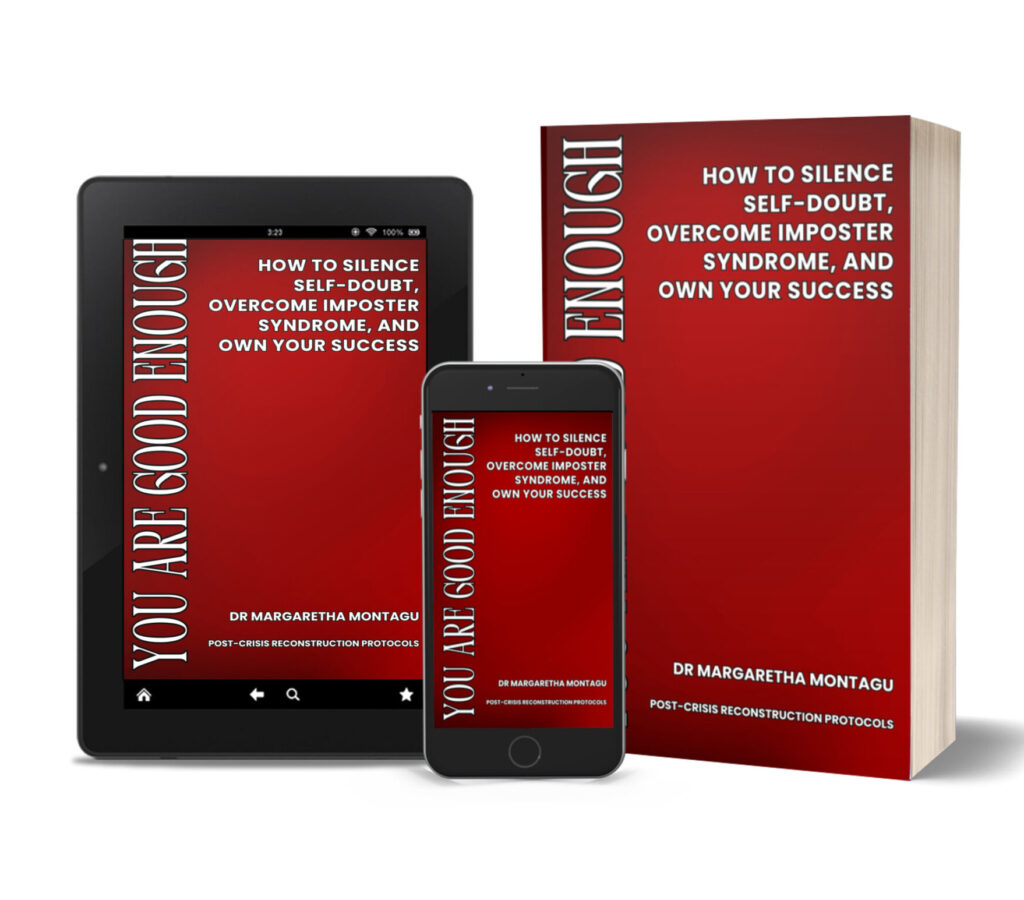
Stop second-guessing yourself. Start owning your success. This book gives you the step-by-step roadmap to break free from imposter syndrome, build unshakable confidence, and finally believe you deserve every bit of your success. You ARE Good Enough!
Stress destroys Lives. To find out what you can do to safeguard your sanity by taking my insight-giving quiz, subscribe to my mailing list.
References
- Mund, M., & Neyer, F. J. (2019). “Loneliness effects on personality.” European Journal of Personality, 33(4), 359–374. Examines how introversion and loneliness interact over time and what personality traits predict relationship satisfaction.
- Swickert, R. J., Hittner, J. B., Harris, J. L., & Herring, J. A. (2002). “Relationships among Internet use, personality, and social support.” Computers in Human Behavior, 18(4), 437–451. Explores how introverts use social platforms differently and the implications for genuine connection.
- Helgeson, V. S. (1994). “The effects of self-beliefs and relationship beliefs on adjustment to a relationship stressor.” Personal Relationships, 1(3), 241–258. Foundational work on how relationship depth, rather than breadth, predicts psychological resilience during life stress.
- Murthy, V. H. (2020). “Work and the loneliness epidemic.” Harvard Business Review.The former US Surgeon General’s analysis of loneliness as a public health crisis, with implications for how we build and maintain connection.
- Asendorpf, J. B., & Wilpers, S. (1998). “Personality effects on social relationships.” Journal of Personality and Social Psychology, 74(6), 1531–1544. Landmark longitudinal study on how introversion and extraversion shape the formation, quality, and maintenance of adult friendships.
Dr Margaretha Montagu, MBChB, MRCGP, NLP Master Practitioner, Medical Hypnotherapist, and Life Transition Coach, has spent over 20 years as a physician with a specialist interest in stress management, and more than 15 years hosting transformational retreats where guests walk the Camino de Santiago in southwest France. She is the author of 8 non-fiction books on divorce, loss, unexpected illness, and navigating crisis.