
If you wonder if there are alternatives to beach holidays for adults, rest assured, there are meaningful travel experiences for grown-ups who are bored of beach resorts but have been traumatised by tents — especially the 5-day Camino de Santiago option you didn’t know existed
What This Article Is About
There are two types of holiday that most adults of a certain age have been cycling through for the past decade, and neither of them is quite right anymore. There is the beach resort holiday, which involves a great deal of lying down, a drinks menu with too many options, and the nagging sensation on day three that you are bored in a way that is somehow more dispiriting than being bored at home, because at least at home you have the excuse of things to do. And then there is the adventure holiday, which involves sleeping in a tent, being cold in ways you didn’t know was possible, and spending a significant portion of each day doing something that feels less like leisure and more like a punishment you have paid a considerable amount of money for.
This article is about the third option. The one that sits precisely between ‘subjectively passive’ and ‘aggressively outdoorsy.’ The one that involves proper beds, good food, beautiful French countryside, genuine physical effort, and the particular kind of satisfaction that only arrives when you have done something that was worth doing. It is about the Camino de Santiago — specifically the French routes through some of the most quietly spectacular landscape in Europe — and why it has become, for a growing number of adults who have finally admitted that they want more from a holiday than a sun lounger and a wifi password, exactly the thing they had been looking for without knowing what to call it.
5 Key Takeaways about Meaningful Travel Experiences
- The meaningful holiday gap is real and growing. Research consistently shows that passive, consumption-based holidays produce significantly less lasting happiness than active, experience-based ones — and that the effort involved is directly correlated with the satisfaction remembered afterwards.
- The Camino de Santiago is not a hardcore adventure. It is a walking pilgrimage route through beautiful landscape with a thousand years of infrastructure behind it, which means that ‘adventure’ and ‘comfortable bed’ are not mutually exclusive propositions here.
- Five days is the Goldilocks duration for a genuinely transformative short break — long enough to actually arrive somewhere mentally, short enough to fit around the reality of modern working life without requiring a sabbatical.
- The French Camino routes offer something the more famous Spanish sections cannot: genuine wildness, dramatically fewer crowds, extraordinarily beautiful countryside, and the particular pleasure of being somewhere that feels discovered rather than overrun.
- The story you come home with matters more than you think. The memories that sustain people — the ones they are still telling five years later — are almost never from the beach holiday. They are from the time they did something.
The Man Who Had Run Out of Holiday Options
Patrick Brennan had been on a lot of holidays. He was fifty-six years old, a recently semi-retired management consultant from Dublin, a man who had spent thirty years travelling for work and who had, as a result, accumulated a fairly comprehensive knowledge of business hotels in fourteen countries and absolutely no knowledge of how to actually be anywhere. He had been to Rome three times and seen the Colosseum once, from a taxi, at speed, while on a phone call. He had stayed in a hotel in Kyoto that had a bathroom the size of his Dublin kitchen and had spent two of his four evenings there watching English-language television because he was too tired from the conference to do anything else.
The holidays were not better. His wife, Siobhan, was an infallible detector of his holiday restlessness, which typically set in around day two and manifested as a progressive inability to find a comfortable position on a sun lounger combined with a tendency to read the news on his phone with the intensity of a man who is monitoring a developing crisis rather than one who is, technically speaking, relaxing. They had done the Maldives. They had done Tuscany, twice. They had done a river cruise along the Danube that had been, by any objective measure, beautiful, and that Patrick had found, by a measure that was entirely his own, deeply boring in a way he felt guilty admitting because it seemed to reflect poorly on him as a human being.
He was not a difficult man. He was not impossible to please. He was simply, he had finally admitted to Siobhan over dinner one February evening, a man who needed to do something on holiday rather than merely be somewhere. He needed, he said, to feel like he’d earned the glass of wine at the end of the day. He needed, and this was harder to say, to come home with a story rather than a suntan.
Siobhan had looked at him across the table with the expression of a woman who had been waiting eleven years for him to say exactly this, and had refilled his glass, and had said: ‘I know exactly where we’re going.’
They arrived in France in July. The landscape was extraordinary — rolling hills and ancient forest and villages that appeared to have been designed by someone with an aggressive commitment to photogenic stonework, punctuated by the Camino’s shell waymarks pointing reliably north. Their accommodation was comfortable. There was hot water. There was, on the first evening, a bottle of local wine that was, Patrick later said, the best thing he had drunk in eleven years of trying to enjoy himself in expensive hotels.
He had walked eleven kilometres by the time he sat down to that wine. His legs ached pleasantly. He had spoken to a retired teacher from Glasgow on the path that morning about something he couldn’t quite remember now, but that had felt, at the time, entirely absorbing. He had stood on a ridge above a valley that had made him stop walking simply to look at it, which was not something he was in the habit of doing.
He had, he realised with a start, not checked his phone since ten o’clock that morning.
Siobhan was watching him from across the dinner table with that expression again — the one he recognised now as the look of a woman who had been right about something and was too fond of him to say so. He raised his glass. She raised hers. Through the window of the farmhouse dining room, the French countryside was doing what it did best in the early evening light, which was looking completely and unreasonably magnificent.
‘Right,’ said Patrick Brennan, semi-retired management consultant, lifelong over-thinker, and man who had run out of holiday options. ‘I understand now.’
What Patrick understood — and what the remaining four days confirmed with the unhurried certainty of good landscape and well-marked paths — is what this article is about.
Why Doing Something Sometimes Feels Better Than Being Somewhere
The science of holiday happiness is considerably more interesting than the holiday industry would like you to know, because if you knew it, you might stop booking the all-inclusive and start booking the walking retreat, and the profit margins are rather different.
The research — and there is a significant body of it, from positive psychologists and behavioural economists who have spent considerable time studying why expensive holidays so often produce such modest lasting happiness — consistently points to the same conclusions. Passive leisure produces what researchers call hedonic adaptation very quickly: the pleasure of lying by a pool diminishes rapidly as the novel becomes familiar, usually within two to three days, which is why the fourth day of a beach holiday so often has a quality of mild existential flatness that no cocktail menu fully resolves.
Active, effortful, experience-based leisure does something different. The effort involved — the physical challenge, the navigation of new situations, the moments of mild discomfort that resolve into satisfaction — creates memories that are stored differently. The brain, when encoding experiences, weights novelty, emotion, and effort. A day of walking through extraordinary French landscape, arriving tired and genuinely hungry at a farmhouse table as the light drops over the hills, produces a memory that is still vivid five years later. The day by the pool produces a general impression of warmth and a vague memory of reading something.
There is also what researchers call the ‘effort heuristic’ — the well-documented human tendency to value things more highly when they have cost us something. The wine at the end of a day’s walking tastes better than the wine at the pool bar not because it is better wine, but because it was earned. The conversation at dinner has a different quality because the day created the conditions for it. The sleep is deeper. The appetite is realer. The satisfaction is not manufactured by a hospitality industry working very hard to produce the impression of a good time — it is the genuine article, arrived at through the unglamorous but entirely reliable mechanism of having actually done something.
The best holidays are not the ones where everything was taken care of. They are the ones where you were required to show up — and discovered, in the showing up, that you were considerably more capable of enjoyment than the sun lounger had been giving you credit for.
The French Camino routes add a layer to this that is worth dwelling on. The sections of the Camino that pass through France — the Via Turonensis, the Via Lemovicensis, the Voie du Puy — are among the most historically rich and scenically extraordinary walking routes in Europe, and they carry a fraction of the foot traffic of the famous Camino Frances in Spain. This means something practical and something less tangible. Practically, it means you are walking through landscape that feels genuinely wild and genuinely yours, rather than through a procession of other walkers that occasionally resembles a mildly spiritual queue. Less tangibly, it means the sense of discovery that is so central to meaningful travel — the feeling of being somewhere real rather than somewhere prepared for your arrival — is present in a way that heavily touristed routes cannot fully provide.
You come home from the French Camino with stories that other people have not already heard. You come home with a landscape in your memory that is not available on anyone else’s Instagram feed. You come home having done something rather than been somewhere, which is a distinction that turns out, in the remembering, to matter enormously.
5 Mistakes to Avoid
1. Choosing the holiday that sounds impressive rather than the one that will actually suit you. All-inclusive resorts exist because a significant number of people genuinely enjoy them, and there is no shame in that. But if you are the kind of person who finds passive leisure quietly maddening — who comes home from beach holidays slightly more tired than when you left, who has never once used a hotel gym but somehow feels guilty about the fact — then booking another beach holiday in the hope that this time it will be different is an expensive way of ignoring information you already have about yourself.
2. Confusing ‘adventurous’ with ‘uncomfortable.’ This is the mistake that keeps a great many perfectly capable adults away from walking holidays, and it rests on a false binary. You do not have to choose between a five-star hotel and a sleeping bag on a hillside. The French Camino routes pass through villages with excellent accommodation, farmhouses with remarkable food, and gîtes that have been hosting pilgrims for centuries with a hospitality that puts most boutique hotels to considerable shame. Adventure does not require suffering. It requires only the willingness to walk somewhere beautiful and arrive hungry.
3. Under-estimating the social dimension. One of the least-advertised pleasures of a small-group walking retreat is the quality of the people you meet. The self-selecting nature of a Camino retreat — the fact that everyone there has chosen to spend their holiday doing something rather than nothing — produces, reliably, a more interesting dinner table than the average resort. People who walk pilgrimages tend to be people with things on their minds and the willingness to talk about them. The conversations that happen over dinner after a day on the path are frequently the ones guests remember longest. Budget for this. It is not a small part of the experience.
4. Arriving without any physical preparation and suffering for it unnecessarily. A five-day walking retreat on the French Camino is not an ultramarathon. It does not require special training or exceptional fitness. It does require that your feet have some prior acquaintance with your boots and that your body has been reminded, in the weeks beforehand, that it is capable of sustained walking. Build up gradually in the month before you arrive. Walk at weekends. The difference between arriving prepared and arriving unprepared is the difference between aching pleasantly and managing a crisis of blisters — and only one of those allows you to be present for the landscape.
5. Spending the whole time documenting it rather than experiencing it. The French Camino countryside is, without question, worth photographing. It is also worth putting the phone away for long enough to actually see it. The research on photo-taking and memory is nuanced — moderate photography can enhance memory, but the compulsive documentation of every moment is reliably associated with reduced presence and, paradoxically, less vivid memories of the experience itself. Take the photographs. Then put the phone in your pocket and walk. The landscape will still be beautiful when you look at it directly.
Further Reading
The Art of Travel by Alain de Botton
De Botton’s examination of why we travel, what we expect from travel, and why those expectations so frequently collide with reality is the most intelligent thing written on the subject since Montaigne. His central argument — that the quality of attention we bring to a place matters more than the place itself, and that we are capable of the same quality of attention in our own back garden as in the Maldives, if we could only slow down enough to deploy it — maps perfectly onto what the Camino does. The walking enforces the slowing. The landscape rewards the attention. Read this before you go and you will arrive already better equipped for what the path offers.
Wanderlust: A History of Walking by Rebecca Solnit
Solnit’s remarkable book traces the cultural, philosophical, and political history of walking — from the Romantics to the Situationists, from pilgrimage to protest — and makes the case, with scholarship and wit and considerable passion, that walking is not merely a form of transport but a mode of thinking, being, and relating to the world. It is the book that turns a walking holiday from a pleasant outdoor activity into something you understand yourself to be doing. Reading it is the difference between walking the Camino and knowing why you are walking the Camino, which turns out to be a significant difference in the quality of the experience.
Embracing Change — in 10 Minutes a Day by Margaretha Montagu
The meaningful holiday, at its best, is the one that changes something — in perspective, in habit, in the relationship between you and the life you have been living. The challenge, as every returning pilgrim knows, is holding onto that change when ordinary life reconvenes with its customary efficiency. Margaret Montagu’s Embracing Change — in 10 Minutes a Day is the practical companion for exactly that challenge: a gentle, honest, and genuinely useful guide to making the shifts that the Camino starts into the shifts that last. The ten-minutes-a-day format is designed for people with real lives and full schedules — which is to say, for most people reading this article. Read it on the journey home, while the walk is still in your legs and the wine is still in your memory.
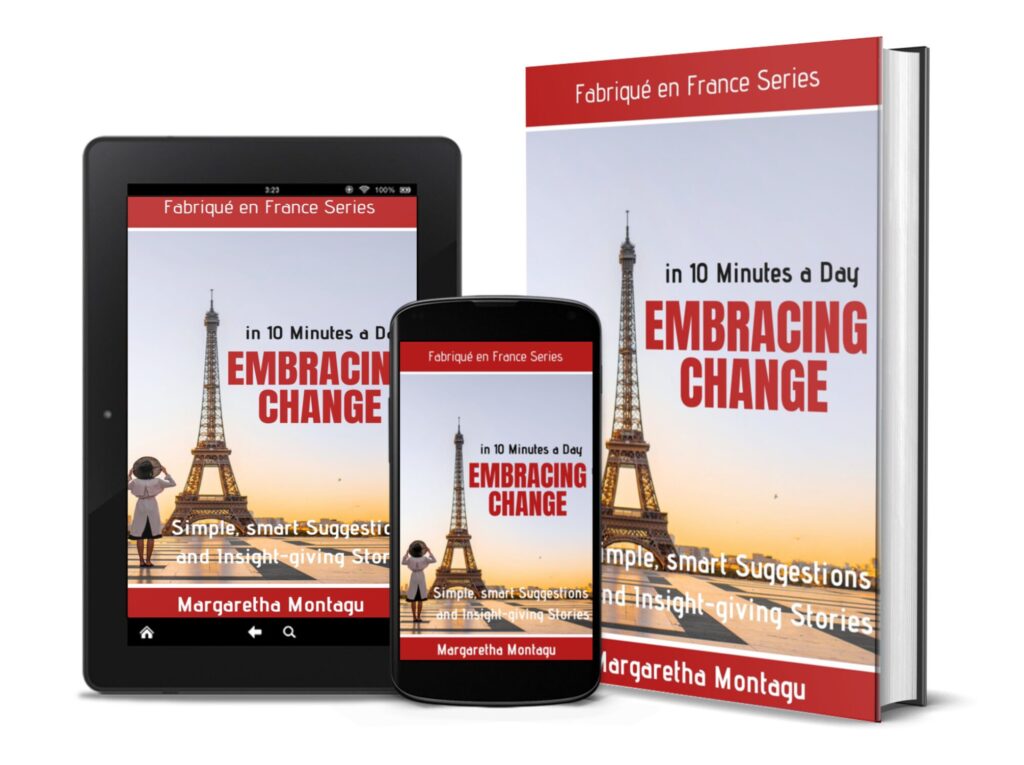
If you are currently facing a major life transition or any other dramatic change in your circumstances, and you have no idea how you are going to cope, the good news is that the strategy presented in this book can help you, step by step, to improve your ability to handle the stress caused by change, even if you feel entirely powerless at the moment.
5 FAQs about Meaningful Travel Experiences
How fit do I need to be for a five-day walking retreat on the French Camino?
Comfortably active rather than athletically exceptional. If you can walk for two to three hours without significant difficulty, you are in the right territory. The distances covered each of the 3 walking days chosen for manageability as well as beauty, and the pace is that of a group rather than a competition. The preparation that matters most is not gym work but consistent walking in the weeks beforehand, in the boots you plan to bring — your feet will thank you for this in ways that no amount of cardiovascular fitness can compensate for.
What makes the French Camino different from the Spanish one?
The Spanish Camino Frances is magnificent, historically important, and extraordinarily popular — in peak season, it carries tens of thousands of walkers, which creates a particular atmosphere that is communal and energetic and occasionally resembles a very purposeful outdoor festival. The French routes are different in character: wilder, quieter, more intimate, with a sense of discovery that the heavily walked Spanish sections can no longer fully provide. The landscape through southwest and central France — the Dordogne, the Lot valley, the volcanic plateau of the Massif Central — is among the most quietly extraordinary in Europe. For those coming for the experience of the path rather than the social spectacle of it, France offers something the Spanish sections cannot.
Is a retreat better than walking independently?
It depends entirely on what you are looking for. Independent walking offers freedom, flexibility, and the particular satisfaction of having navigated everything yourself. A small-group retreat offers something different: the route planned, the accommodation arranged, the logistics handled, and the landscape with the depth of long familiarity. For first-time Camino walkers, for people coming primarily for the experience rather than the logistics challenge, and for those who want to arrive simply to walk rather than to organise, the retreat is not the easier option so much as the more focused one. The effort goes into the walking. Everything else is taken care of.
What kind of people typically come on a Camino walking retreat?
The range is broader than you might expect — which is itself one of the pleasures of it. The consistent thread is not age or background or fitness level but a particular disposition: people who want more from a holiday than passive consumption, who have something on their minds that deserves more than a fortnight of distraction, and who are drawn to the idea of earning their rest rather than simply purchasing it. They tend to be good company at dinner. They tend to have interesting things to say. They tend, in my experience, to be people who are more interesting than the roles they occupy in their ordinary lives — and the Camino, reliably, gives those people room to show it.
Will I feel out of place if I’m not religious or spiritual?
Not in the slightest. The Camino de Santiago is a pilgrimage route with deep religious roots and a thoroughly secular present — the majority of modern walkers describe their motivation as personal, cultural, or simply adventurous rather than religious. What the pilgrimage structure provides is not a theological framework but a practical one: a route, a direction, a community of fellow travellers, and a daily rhythm of walking and arriving and resting that produces, regardless of what you believe, the particular quality of attention and clarity that the Camino is famous for. The path does not check your credentials. It simply marks the way with yellow arrows and shell symbols and lets you bring whatever you need to bring.
A Holiday Option You Haven’t Tried Yet?
Patrick Brennan came home from France on a Sunday evening. He was tired in the manner of a man who has used his body for something it was designed for rather than subjected it to another flight and another hotel room. His boots were muddy. His legs were, he reported to anyone who asked, absolutely fine, which was technically accurate and considerably underselling how fine they actually were.
He had walked approximately fifty kilometres over three days. He had eaten better than he had eaten in years, in the unpretentious way of food that has been earned rather than ordered. He had had a conversation on the third day with a woman from Montreal who was walking the Camino for reasons she explained over the course of six kilometres and that Patrick found, when he tried to summarise it to Siobhan that evening, surprisingly difficult to reduce to a sentence. He had taken forty-three photographs, which was forty-three fewer than he had taken in the Maldives and represented, in his view, a significant improvement in his relationship with the places he visited.
He had not once checked the news. He had not once looked for a sun lounger. He had not once reached for a cocktail menu and felt, inexplicably, that there was something missing from his life that could be addressed with a small paper umbrella.
‘Same time next year?’ said Siobhan.
‘Same time next year,’ said Patrick.
Five-day retreats on the French Camino are available for small groups of up to four guests. Three non-guided walks through some of the most beautiful countryside in France, proper beds, extraordinary food, and the particular satisfaction of having genuinely earned it. No cocktail umbrellas. No sun loungers – well, actually there are a couple. No sense, at any point, that you are spending your holiday in the wrong way.
Find out more and book your retreat at margarethamontagu.com
Do you dream of escaping your stressful life to raise a herd of goats or grow sunflowers in the south of France? Then you may be ready for an Esprit Meraki retreat. Get access to this “very serious” quiz to help you figure out how urgent your need for a change of scenery is, when you subscribe to my monthly newsletter.
If your soul is craving fresh air, meaningful movement, and a chance to reconnect with nature, join us on a Camino de Santiago Walking Retreat in the southwest of France. This isn’t just a scenic hike – it’s a powerful, natural reboot for your body, mind, and spirit. Imagine quiet paths, rolling hills, cozy evenings, and slow conversations. No fitness requirements. No forced bonding. No pressure to have a breakthrough. Just one foot in front of the other, and finding your way to a brighter future.
What Life Lessons Can You Learn While Walking the Camino de Santiago? – a free guide filled with 10 not just “quaint anecdotes” or Instagram-worthy moments (though there are plenty of those) but real transformations from real people who walked this insight-giving trail – Subscribe to my monthly newsletter to Download the Guide
Research
1. “A Wonderful Life: Experiential Consumption and the Pursuit of Happiness” — Professor Thomas Gilovich, Cornell University / Journal of Consumer Psychology (2014)
The foundational study behind this article’s entire argument, and one of the most cited pieces of research in positive psychology. Gilovich’s research demonstrates that experiential purchases provide greater satisfaction and happiness than material ones for three specific reasons: they enhance social relations more readily and effectively, they form a bigger part of a person’s identity, and they are evaluated more on their own terms rather than through invidious social comparisons. This is the science behind why a week on the French Camino leaves a deeper mark than a week at an all-inclusive resort. Cite it with confidence — it has been replicated across multiple studies over two decades.
2. “Why Travel Prolongs Happiness: Longitudinal Analysis Using a Latent Growth Model” — ScienceDirect / Tourism Management (2019)
This is the study that directly addresses hedonic adaptation — the mechanism this article identifies as the reason the beach holiday stops working by day three. The research provides evidence that travel experience actively reduces hedonic adaptation, and identifies expectation and serendipity as the two factors most important for prolonging happiness after a trip — meaning that active, discovery-based travel produces a more durable happiness effect than passive, predictable leisure. The French Camino, with its unpredictable encounters and ever-changing landscape, delivers precisely those two qualities in abundance.
3. “Examining the Change in Wellbeing Following a Holiday” — ScienceDirect / Tourism Management (2021)
The study that proves Patrick Brennan’s instinct was scientifically correct all along. This longitudinal research found that people who had greater optimal tourism experiences during their trip reported higher levels of both hedonic and eudaimonic wellbeing afterwards — and crucially, that the adaptation and decline of wellbeing was slower for those who had active, meaningful experiences compared to those who had passive ones, with eudaimonic wellbeing declining only marginally over the two months following the trip. In plain terms: the meaningful holiday keeps giving long after you’ve unpacked. Mundiplus

“I am an experienced medical doctor – MBChB, MRCGP, NLP master pract cert, Transformational Life Coach (dip.) Life Story Coach (cert.) Stress Counselling (cert.) Med Hypnotherapy (dip.) and EAGALA (cert.) I may have an impressive number of letters after my name, and more than three decades of professional experience, but what qualifies me to excel at what I do is my intuitive understanding of my clients’ difficulties and my extensive personal experience of managing major life changes using strategies I developed over many years.” Dr M Montagu