
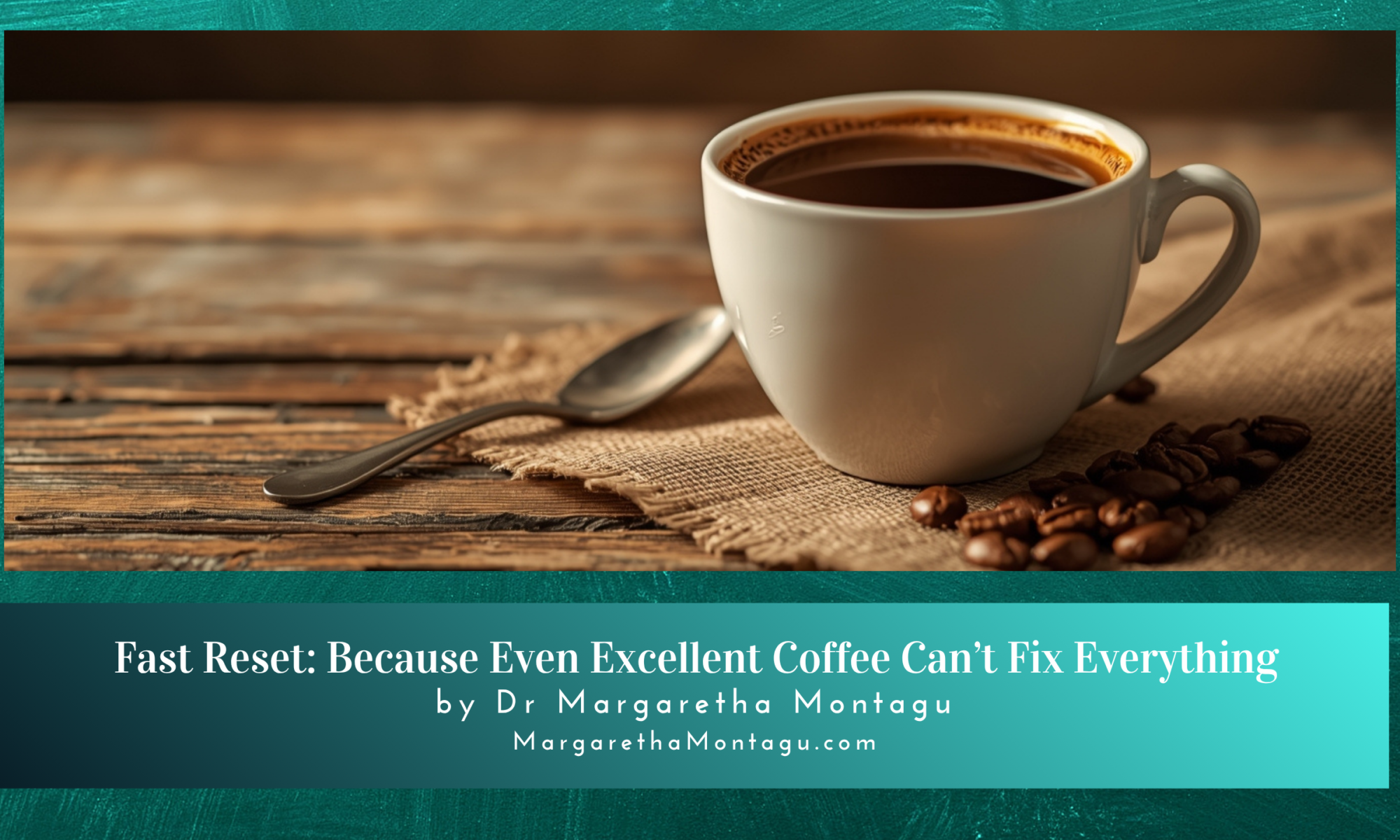
A perfectly good cup of coffee, one careless comment, and suddenly your brain is directing a full-length drama. Enter the fast reset—a small shift with a surprisingly big impact.
This article first appeared on my Substack “Margaretha Montagu’s Stories”
If you have met me, you will know that I’m serious about coffee. It’s not that I drink ten cups a day. I probably have no more than three, but it’s the best quality coffee I can afford to buy. It’s not that I’m addicted, not really, I just appreciate good coffee.
A Minor Betrayal, Served Hot
So imagine what it felt like when I’d just handed a friend a cup of coffee I made with genuine care — the best extra corsé beans, a double espresso, a little noisette with just a nuage of full-fat milk, the perfect sipping temperature and an aroma to get up for on a Sunday morning. And without missing a beat, without even a courtesy sip, they say: “Oh, thanks, but I’m more of a grand crème sort of person.” What? As in drowning that preciously, lovingly nurtured coffee flavour in gallons of cream?
Such a casual comment. Unthinking. Unbothered. As if she didn’t just audit my entire raison d’etre. I smile, and sip my perfect coffee. But internally? An in-depth review has begun. By lunch I’ve got it on endless replay. By mid-afternoon I’m Googling speciality coffee certifications, not entirely as a joke. By dinner I’ve decided I need a better (more expensive) coffee machine, different beans, less corsé, and possibly different friends.
The Olympic Sport of Overthinking
Most of us are experts at replaying such moments. And moments much worse than that. A perceived insult. A slight. A (possible) misunderstanding. We retell ourselves the story. For days. Weeks. Months. Years. We ask ourselves why did they say that and what did they mean by that until the original event, which maybe lasted five seconds, has been extended into a six-hour conversation with your inner critic.
Enter: The Fast Reset (Stage Left, Slightly Out of Breath)
Ironically, it was the coffee incident that led me to discover the fast-reset.
The “fast reset” is the art of recovering your composure before your imagination writes a wildly unhelpful sequel: you’ve been rattled, possibly been mildly dramatic about it, and then—through a deliberate shift like reframing—you return to yourself before the situation turns into a full-length, endlessly-repeated emotional soap opera.
Resetting is not pretending you’re fine when you aren’t. It’s not toxic positivity, or slapping a smile over something that obviously hurt. It’s not the infuriating advice to “just don’t let it bother you” — as if that were ever a useful instruction.
What It Actually Looks Like in the Wild
A real reset looks more like this:
You notice something’s off. Maybe your jaw is tight. Maybe you’ve reread the same paragraph four times. Maybe you’ve been a little snappier than usual, and you know it, and you don’t particularly like it. You stop. You acknowledge it — yeah, that thing she said this morning really got to me. You let yourself feel it briefly and honestly, without adding too much drama. And then, gently, deliberately, you put it down. You let it go.
You get back on track.
Not because it didn’t matter. But because you’ve decided the rest of your day matters more.
The Secret of Unshakeable People
This is what the people who seem unshakeable actually do. They FEEL it. They just don’t pitch a tent at that point in time.
Fast-resetters feel the frustration without becoming the frustrated person. They notice the bad mood the way you’d notice bad weather — real, inconvenient, temporary, and not a reflection of how the rest of the week will go.
They also tend to have what you might call an “exit ritual” — a small, almost mundane action that signals to the brain that a moment is over. A walk around the block. Splashing cold water on their face. Making a cup of coffee with slightly more ceremony than necessary. It sounds too simple to be real, but that’s precisely the point. The brain recognises and responds to patterns. When you consistently pair a small action with the intention to let go, that action eventually becomes the letting go.
Apparently. I’m still practising.
A New Philosophy: Feel It, Then Promptly Move On
Fast-resetting is a mindset shift, really — from “I’ll feel better once I’ve processed this properly” to “I’ve felt it. I’m done. Now moving on.”
There’s an almost stubborn power in this. In deciding that one bad moment doesn’t get to determine the rest of your day, week, month, etc.. In treating your own peace as something worth protecting, rather than something that gets eroded by whatever the day throws at you.
A Difficult Habit to Break
I can see exactly how valuable this skill could be. I understand the logic, I believe the science, and I am fully on board in principle. The problem is that I’m also someone who has been doing the precise opposite for four decades, which means my neural pathways are basically seasoned veterans at this point: highly trained, deeply committed, and completely unimpressed by my new intentions. You don’t rewire forty years of habit with a deep breath and a good attitude.
Like most skills, it no doubt gets easier the more you practise. I’ll have to do a LOT of practising to change this habit.
But I will, because my energy definitely isn’t endless, and I want what I spend it on, to matter.
Many of my Camino de Santiago walking retreat guests struggle with this. When you walk the Camino, for hours on end, sooner or later your brain might start rerunning past insults, arguments, disappointments, misunderstandings. You end up marinating yourself in a bad mood with real dedication, real craftsmanship even. And fast-resetting? Let’s just say it becomes a serious challenge, every step of the way.
Lots of time to practice, walking the Camino.
The Energy Audit You Don’t Need
Every time you replay an argument you can’t change, you spend energy. Every time you let a ten-second inconvenience simmer for three hours, you waste energy. Every time you carry a morning mood all the way into your evening, your energy gets depleted — and you spend it on something that’s already past history, that you cannot alter, that is frankly not worth making out the invoice.
Some things ARE worth sitting with, processing properly, talking through. But the unappreciated coffee? The terse reply? The plan that didn’t work out? Those have a natural expiry time, and it’s a lot shorter than we tend to give it.
Not Indifference—Discernment with Good Boundaries
Resetting fast isn’t indifference. It’s prioritisation. It’s the decision that your afternoon is more valuable than your grievance. That your presence — with yourself, with the people you love, with the work you care about — is worth more than the story of what went wrong at breakfast.
Reframe if you need to, as in “their behaviour says more about them than about me,” or whatever works in that specific situation. Then let the moment pass. Fretting about it uses up to much of your energy. Let it go.
Again and again and again.
I’d love to hear your thoughts on fast resetting – have you mastered the art? Or are you, like me, stil practising?










Join us for the Book Lovers Binge Reading Camino de Santiago Walking Retreat in the sun-drenched southwest of France: a journey where the trail and the story unfold together. Walk ancient paths at your own pace, then settle in each evening with a good book. This isn’t a fitness challenge—it’s a gentle rhythm—one step, one chapter, one honest conversation at a time. Rolling hills, quiet villages, golden light. No expectations, no performance, no agenda but your own unfolding.

Do you dream of escaping your stressful life to raise a herd of goats or grow sunflowers in the south of France? Then you may be ready for an Esprit Meraki retreat. Get access to this “very serious” quiz to help you figure out how urgent your need for a change of scenery is, when you subscribe to my monthly newsletter.

Author Bio: Dr Margaretha Montagu – described as a “game changer”, “gifted healer”, “guiding light” and “life-enriching author” – is an experienced medical doctor, a certified NLP practitioner, a medical hypnotherapist, an equine-assisted psychotherapist (EAGALAcertified) and a transformational retreat leader who guides her clients through life transitions – virtually, or with the assistance of her Friesian and Falabella horses, at their home in the southwest of France.