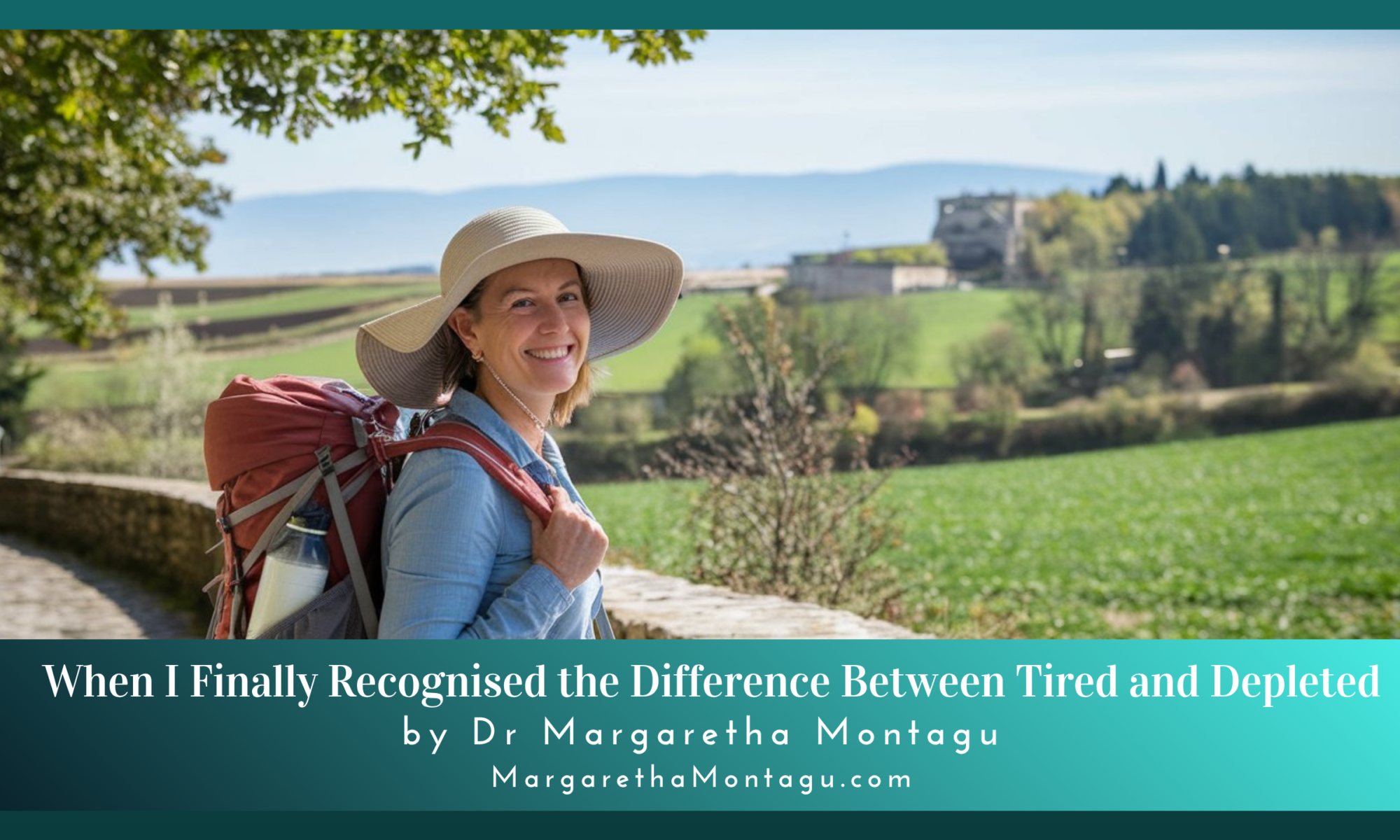
For years I thought tired was just tired. You slept badly, you had a heavy week, you caught up on Saturday and by Sunday night you were more or less yourself again. That was my entire model of fatigue management for the first decade of my career, and it worked fine, right up until that week.
I’d had a full weekend off. No shifts, no emergencies, nothing more strenuous than a walk in the park and a slow lunch with a friend. I remember thinking, on the Sunday evening, that I should have felt restored. I didn’t. I felt exactly the same as I had on Friday, which is to say hollowed out in a way that a lie-in hadn’t touched. That was the first time I understood, properly, that tired and depleted are not the same thing, and that I’d been treating one as if it were the other for years.
Tired responds to rest. That’s really the whole test. You sleep, you switch off for a weekend, and your body pays back what it borrowed. Depletion doesn’t work like that, because depletion isn’t a sleep debt, it’s a nervous system that has been running on alert for so long it’s forgotten how to stand down. You can sleep nine hours and wake up just as flat as when you went to bed, because the problem was never the hours, it was the setting you’d been running on.
I saw this constantly in patients, long before I recognised it in myself. The teacher who took every school holiday off and came back as tired as when the holiday started. The new mother who slept when the baby slept and still cried in my consulting room from sheer exhaustion. I used to write “rest and review” on their notes, and it never worked, and I never quite asked myself why.
What I eventually understood, mostly from my own collapse, is that depletion has a physical signature that tiredness doesn’t. Tired people crave sleep. Depleted people often can’t sleep properly at all, or sleep and wake up unrefreshed, because the system that’s meant to switch off for the night has forgotten how. Tired people feel better after a good meal. Depleted people go off food, or eat for comfort without much pleasure in it. Tired people miss their normal life and want to get back to it. Depleted people look at their normal life and feel nothing much at all, which frightened me more than any of the other symptoms combined, because it’s the one that gets mistaken for contentment.
I want to be careful here, because I’m not describing depression, though the two can certainly overlap, and if what you’re reading sounds like more than exhaustion, that’s a conversation for your GP you need, not a blog post. What I’m describing is something more specific: a body that has been in a low-grade state of alert for so long, work, money, caregiving, always being needed, always half-braced for the next demand, that it no longer has a functioning “off” switch. Rest doesn’t fix that, because rest assumes the switch works. You need to reactivate the switch when you’re depleted, which is a slower and less obvious process than taking a weekend off.
This is, if I’m honest, the whole reason why my one-on-one Rested, Rooted and Realigned retreat is three days and not one. A single day off barely registers with a depleted nervous system, in the same way a single good meal doesn’t fix six months of not eating properly. It takes a day just to notice you’ve arrived. It takes a second day for your body to start believing you’re not about to be called back to something. It’s usually only on the third day that people tell me they’ve slept properly for the first time in months, and it’s never the horses or the Camino de Santiago walking alone that does it, it’s the accumulated permission of having nowhere else to be.
3-day/2-night Private “Press Pause” Nervous System Regulation Retreat –this bespoke, one-on-one retreat on the Camino de Santiago in the sun-blessed southwest of France enables you to press pause, connect with a small herd of Friesian and Falabella horses, recalibrate your inner compass, and return to your life rested, rooted and realigned with who you are now.
If you’ve been resting for months and still don’t feel restored, you’re probably not tired in the way rest can fix. You’re depleted, and that takes longer to undo. Rested, Rooted and ReAligned was created to close that gap, the one between “I slept” and “I feel like myself again.”
Curious whether it’s for you?Click here to find out more.
Do you dream of escaping your stressful life to raise a herd of goats or grow sunflowers in the south of France? Then you may be ready for an Esprit Meraki retreat. Get access to this “very serious” quiz to help you figure out how urgent your need for a change of scenery is, when you subscribe to my monthly newsletter.
In addition to the Camino de Santiago retreats that I host at my little French farm southwest of Bordeaux, I have also created 7 online courses, ex.The Purpose Challenges, The Roadmap to Resilience – from Burnout to Brilliance Challengeand The Change Careers without Starting from Scratch Challenge– each course is available with or without one-to-one support. To stay in contact, I invite you to subscribe to my newsletter, you’ll get immediate access to my free retreat readiness quiz.
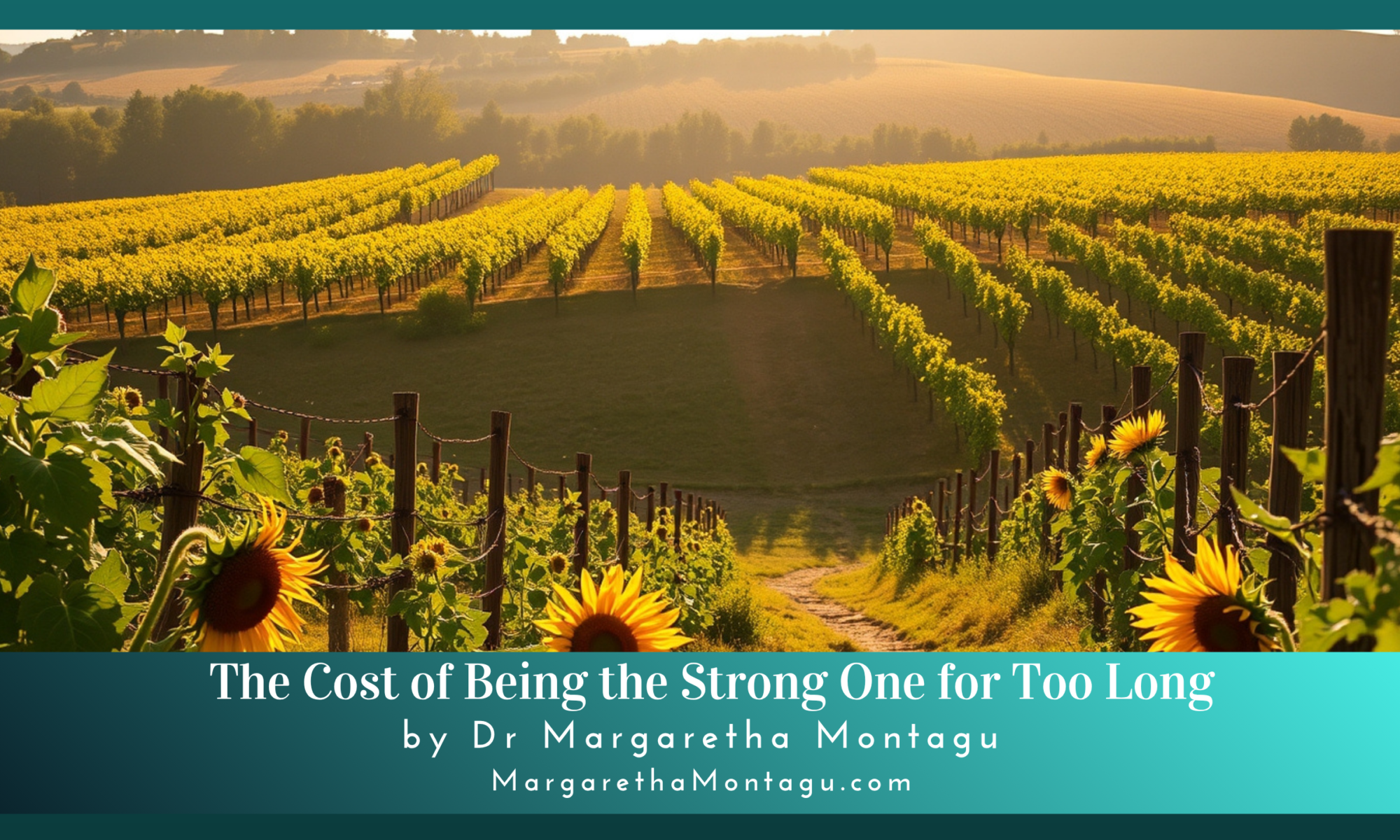
There’s a particular kind of tired that doesn’t show up on any test. I know because I’ve had patients describe it to me for two decades, and because I lived it myself for rather longer than I’d like to admit. It’s the tiredness that comes from being the one everyone else leans on, for so long that you’ve forgotten there was ever a version of you who got to lean on someone else.
I had a patient once, I’ll call her Anne, who came to see me for headaches that wouldn’t resolve. She was fifty-two, ran a household of six, including an elderly father-in-law and a daughter going through a divorce, and had not, by her own account, had a single day off in three years where someone else was responsible for holding things together. Her headaches weren’t a mystery once you knew that. What was a mystery, at least to her, was that she’d never once considered herself under strain. “I’m the practical one,” she told me. “Someone has to be.”
That sentence has stayed with me longer than almost anything else a patient has said to me. Someone has to be. It’s such a reasonable thing to think, and it’s exactly the thought that keeps capable people running on empty for years without ever naming what’s happening to them.
Being the strong one has a strange kind of invisibility built into it. Nobody checks in on the person who’s always fine, because you’ve spent years demonstrating, quite convincingly, that you don’t need checking in on. You become the person others call when something’s wrong, which means you’re perpetually discussing everyone else’s crisis and rarely, if ever, discussing yours with anyone. Over time this stops feeling like a role you play and starts feeling like a fact about who you are. Not “I’m coping right now” but “I’m a coper.” The first is a temporary state. The second is an identity, and identities are much harder to put down, even when they’re crushing you.
I need to be specific about the cost, because “burnout” as a word has become so broad it’s almost stopped meaning anything. The cost of being the strong one for too long is rarely dramatic. It’s more often a gradual narrowing. You stop mentioning that you’re struggling, because you’ve noticed people seem faintly relieved when you say you’re fine, and some unconscious part of you doesn’t want to destroy that relief. You stop asking for help with small things, because it’s quicker to just do them yourself, and soon you’re doing everything yourself, and calling it efficiency instead of what it actually is. You develop headaches, or a bad back, or insomnia, or the kind of low mood that doesn’t look like sadness so much as a faint, permanent greyness over everything, and you treat each symptom as an isolated inconvenience rather than what it usually is: your body’s attempt to get your attention after your mind stopped listening.
The particular irony of this pattern is that the people most likely to fall into it are precisely the people least likely to ask for help, because asking for help feels like abdicating the role that gives them their sense of worth. I’ve watched capable women in particular function like this for decades, often praised the entire way for their resilience, which is a strange thing to be congratulated for when what it’s actually costing you is your health.
If any of this sounds familiar, and I suspect it does, the first step usually isn’t a retreat or a course or even a conversation with a friend. It’s simply naming the pattern out loud, ideally to someone who’s spent years watching what unmanaged strain does to a body and a mind, and who can help you build something more sustainable than white-knuckled coping.
That’s the work I do, the before, during and after my retreats. As a stress management expert with two decades of clinical experience and a fair amount of hard-won personal history on the subject, I help people who’ve been the strong one for too long recognise the pattern before it costs them their health, and build something more sustainable in its place.
If Anne’s story, or any part of your own, sounds alarmingly familiar, I’d genuinely like to help.
Do you dream of escaping your stressful life to raise a herd of goats or grow sunflowers in the south of France? Then you may be ready for an Esprit Meraki retreat. Get access to this “very serious” quiz to help you figure out how urgent your need for a change of scenery is, when you subscribe to my monthly newsletter.
It’s time to kick exhaustion to the curb and finally ditch that terminally overwhelmed feeling, evict your inner critic, declutter your mind and take control of your life like a boss. You’re about to turn your life from a comedy of errors into a blockbuster success story (with a much better soundtrack). This two-day online course is designed for anyone facing a major life transition, needing to dramatically reduce stress, end exhaustion and overwhelm, and prevent or recover from burnout.
3-day/2-night Private “Press Pause” Nervous System Regulation Retreat –this bespoke, one-on-one retreat on the Camino de Santiago in the sun-blessed southwest of France enables you to press pause, connect with a small herd of Friesian and Falabella horses, recalibrate your inner compass, and return to your life rested, rooted and realigned with who you are now.
“I am an experienced medical doctor – MBChB, MRCGP, NLP master pract cert, Transformational Life Coach (dip.) Life Story Coach (cert.) Stress Counselling (cert.) Med Hypnotherapy (dip.) and EAGALA (cert.) I may have an impressive number of letters after my name, and more than three decades of professional experience, but what qualifies me to excel at what I do is my intuitive understanding of my clients’ difficulties and my extensive personal experience of managing major life changes using strategies I developed over many years.” Dr M Montagu
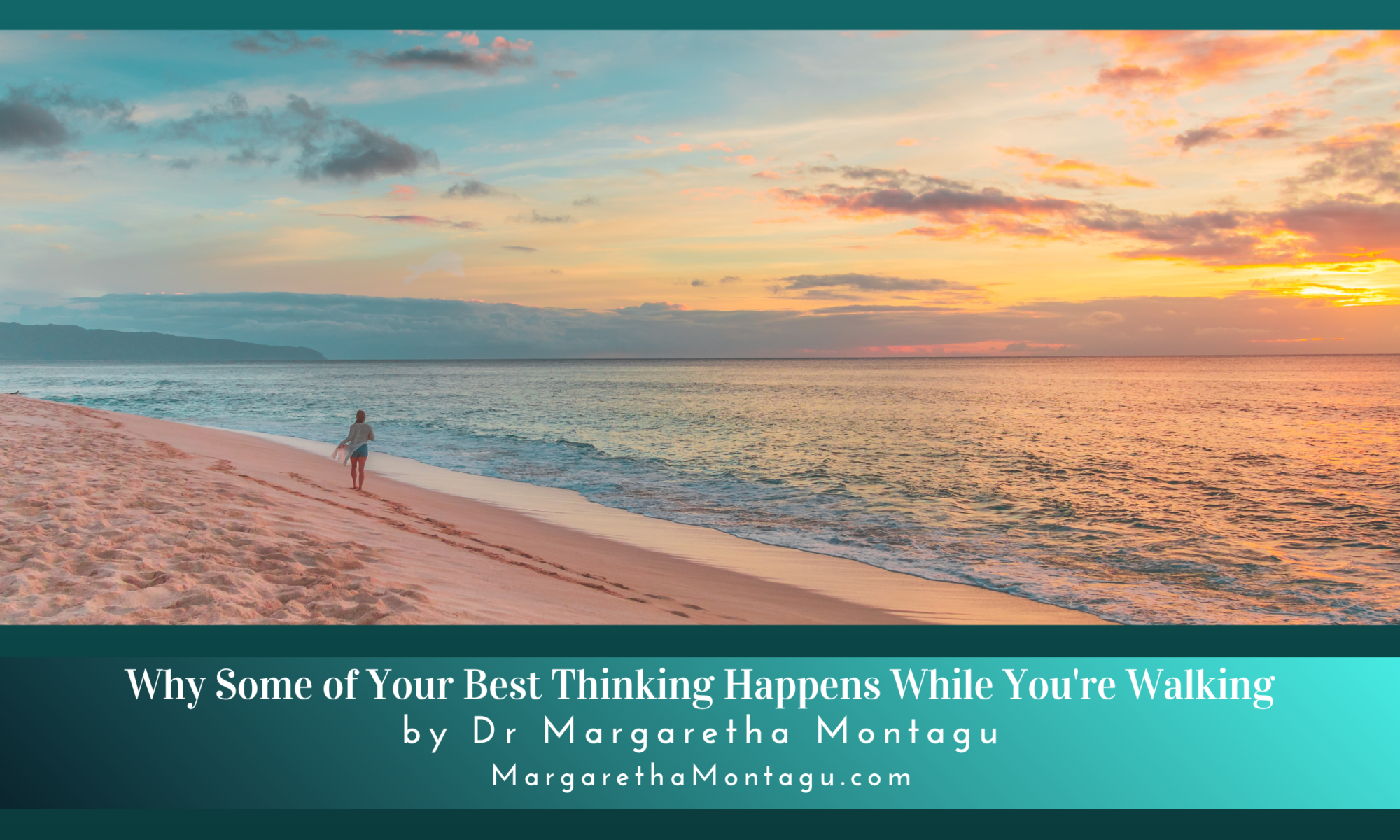
Have you ever noticed that some problems shrink once you start walking?
The problem itself hasn’t changed. The difficult conversation still needs to happen. The diagnosis hasn’t disappeared. Your bank account hasn’t magically recovered. Yet somewhere between the first few hundred metres and the next bend in the path, your mind begins to loosen its grip.
You breathe a little more easily.
You stop rehearsing imaginary arguments.
You notice the birdsong, the breeze, the scent of wildflowers or freshly cut hay.
Without quite knowing how, you begin to think clearly.
I’ve always found that fascinating.
With my medical background, I do appreciate the science. Walking increases blood flow to the brain, reduces stress hormones and encourages the release of chemicals that improve mood and cognitive function. It’s hardly surprising that we often think more clearly after a walk than after another hour spent worrying in the same chair.
But I suspect there’s something else going on too.
Walking changes our perspective in more ways than one.
When we’re anxious, our world closes in on us. Our attention narrows until all we can see is the problem directly in front of us. We go round and round the same thoughts like a hamster on a wheel, hoping that one more lap will somehow produce a different answer.
It rarely does.
Walking interrupts that pattern.
The rhythm of placing one foot in front of the other has a calming effect that sitting still often doesn’t. The body is moving forwards, and somehow the mind begins to believe that moving forwards is possible too.
Perhaps that’s why walking has been part of the human story for so long.
Countless ordinary people have gone for “a walk to clear my head” without ever reading a scientific paper explaining why it works.
Sometimes instinct gets there before research does.
One of the things I’ve observed over the years is that answers rarely arrive when we chase them. They tend to appear when we create enough space for them to catch up with us.
That’s why I encourage people not to fill every walk with podcasts, phone calls or endless scrolling. There is nothing wrong with those things in moderation, but they don’t leave much room for your own thoughts to emerge.
Silence can feel surprisingly uncomfortable at first.
Then something changes.
The mental noise begins to settle, rather like muddy water left undisturbed. The questions that seemed impossibly tangled became a little clearer. Not always because you’ve found the answer, but because you’ve finally found the right question.
Someone arrives convinced they need to make a huge decision immediately. They spend a couple of days walking quietly through fields, forests and sleepy villages, and by the end of the week, they’re asking completely different questions.
Their circumstances haven’t necessarily changed.
They have.
I think that’s because walking reminds us of something we often forget during difficult times.
Life is lived one step at a time.
Not twenty miles at a time.
Not five years at a time.
One step.
When we’re facing a life quake, a change, challenge or crisis, it’s tempting to believe we must have the whole plan ready before we can begin. We want certainty before we take action. Unfortunately, life is rather stingy with certainty.
What it usually offers instead is the next step.
And then the one after that.
Looking back, most of the important changes in my own life didn’t begin with a grand master plan. They began with a conversation, an unexpected opportunity, a quiet realisation or quite literally a long, slow walk.
Only in hindsight did the path make sense.
Perhaps that’s the greatest lesson walking has to teach us.
You don’t need to see the entire journey before you take the first step.
You simply need the courage to trust that the path will reveal itself as you keep moving.
After all, every destination, no matter how extraordinary, begins in exactly the same way.
With one foot in front of the other.
5-day/4-night “Press Pause” Nervous System Regulation Retreat– If your soul is craving fresh air, meaningful movement, and a chance to reconnect with nature and connect with horses, join me on a powerful, natural reboot for your body, mind, and spirit. Same content as the 3-day retreat, spread over 5 days. And an extra day of walking. No extreme fitness requirements. No forced bonding. No pressure to have a breakthrough. For one or two guests travelling together.
“I am an experienced medical doctor – MBChB, MRCGP, NLP master pract cert, Transformational Life Coach (dip.) Life Story Coach (cert.) Stress Counselling (cert.) Med Hypnotherapy (dip.) and EAGALA (cert.) I may have an impressive number of letters after my name, and more than three decades of professional experience, but what qualifies me to excel at what I do is my intuitive understanding of my clients’ difficulties and my extensive personal experience of managing major life changes using strategies I developed over many years.” Dr M Montagu
Do you dream of escaping your stressful life to raise a herd of goats or grow sunflowers in the south of France? Then you may be ready for an Esprit Meraki retreat. Get access to this “very serious” quiz to help you figure out how urgent your need for a change of scenery is, when you subscribe to my monthly newsletter.
A perfectly good cup of coffee, one careless comment, and suddenly your brain is directing a full-length drama. Enter the fast reset—a small shift with a surprisingly big impact.
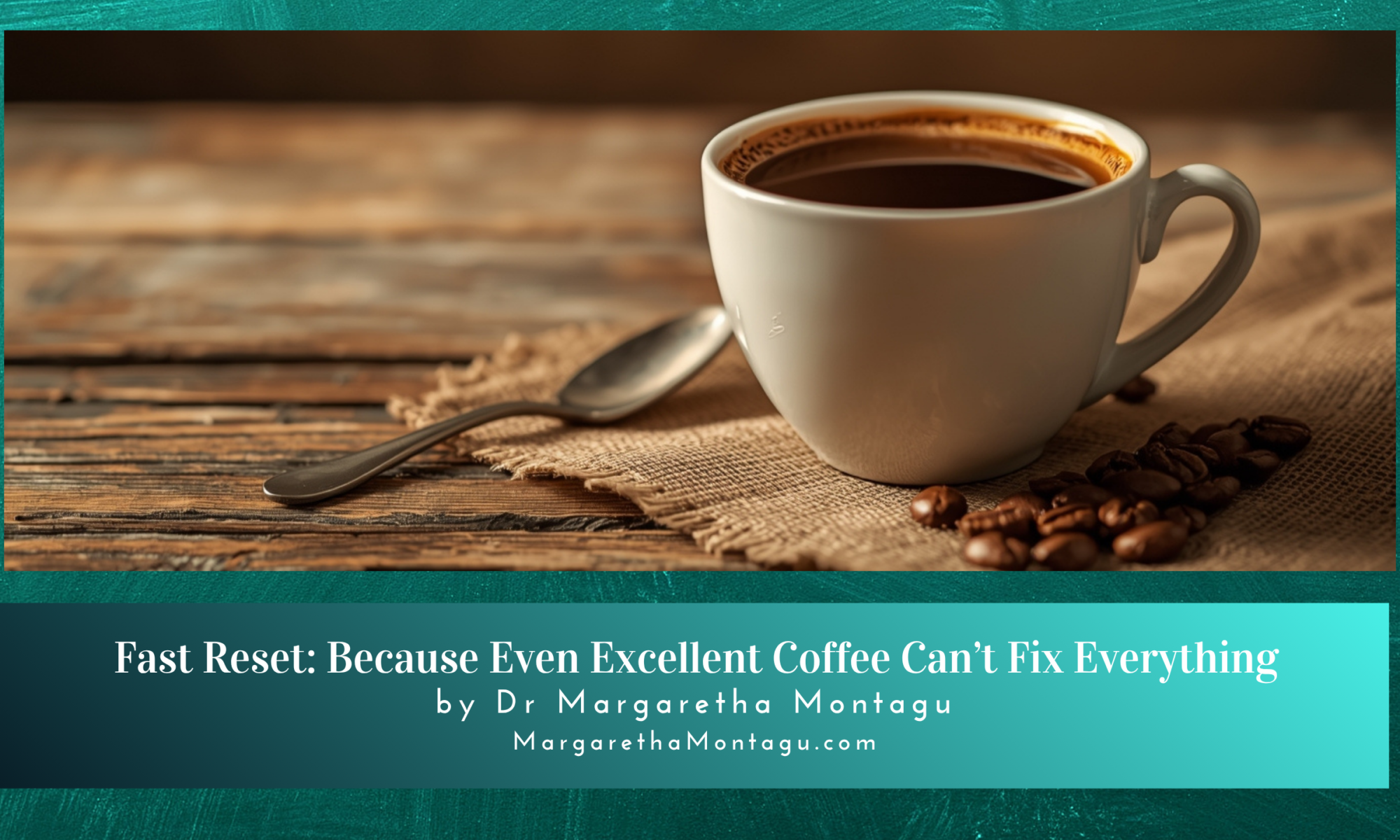
If you have met me, you will know that I’m serious about coffee. It’s not that I drink ten cups a day. I probably have no more than three, but it’s the best quality coffee I can afford to buy. It’s not that I’m addicted, not really, I just appreciate good coffee.
A Minor Betrayal, Served Hot
So imagine what it felt like when I’d just handed a friend a cup of coffee I made with genuine care — the best extra corsé beans, a double espresso, a little noisette with just a nuage of full-fat milk, the perfect sipping temperature and an aroma to get up for on a Sunday morning. And without missing a beat, without even a courtesy sip, they say: “Oh, thanks, but I’m more of a grand crème sort of person.” What? As in drowning that preciously, lovingly nurtured coffee flavour in gallons of cream?
Such a casual comment. Unthinking. Unbothered. As if she didn’t just audit my entire raison d’etre. I smile, and sip my perfect coffee. But internally? An in-depth review has begun. By lunch I’ve got it on endless replay. By mid-afternoon I’m Googling speciality coffee certifications, not entirely as a joke. By dinner I’ve decided I need a better (more expensive) coffee machine, different beans, less corsé, and possibly different friends.
The Olympic Sport of Overthinking
Most of us are experts at replaying such moments. And moments much worse than that. A perceived insult. A slight. A (possible) misunderstanding. We retell ourselves the story. For days. Weeks. Months. Years. We ask ourselves why did they say that and what did they mean by that until the original event, which maybe lasted five seconds, has been extended into a six-hour conversation with your inner critic.
Enter: The Fast Reset (Stage Left, Slightly Out of Breath)
Ironically, it was the coffee incident that led me to discover the fast-reset.
The “fast reset” is the art of recovering your composure before your imagination writes a wildly unhelpful sequel: you’ve been rattled, possibly been mildly dramatic about it, and then—through a deliberate shift like reframing—you return to yourself before the situation turns into a full-length, endlessly-repeated emotional soap opera.
Resetting is not pretending you’re fine when you aren’t. It’s not toxic positivity, or slapping a smile over something that obviously hurt. It’s not the infuriating advice to “just don’t let it bother you” — as if that were ever a useful instruction.
What It Actually Looks Like in the Wild
A real reset looks more like this:
You notice something’s off. Maybe your jaw is tight. Maybe you’ve reread the same paragraph four times. Maybe you’ve been a little snappier than usual, and you know it, and you don’t particularly like it. You stop. You acknowledge it — yeah, that thing she said this morning really got to me. You let yourself feel it briefly and honestly, without adding too much drama. And then, gently, deliberately, you put it down. You let it go.
You get back on track.
Not because it didn’t matter. But because you’ve decided the rest of your day matters more.
The Secret of Unshakeable People
This is what the people who seem unshakeable actually do. They FEEL it. They just don’t pitch a tent at that point in time.
Fast-resetters feel the frustration without becoming the frustrated person. They notice the bad mood the way you’d notice bad weather — real, inconvenient, temporary, and not a reflection of how the rest of the week will go.
They also tend to have what you might call an “exit ritual” — a small, almost mundane action that signals to the brain that a moment is over. A walk around the block. Splashing cold water on their face. Making a cup of coffee with slightly more ceremony than necessary. It sounds too simple to be real, but that’s precisely the point. The brain recognises and responds to patterns. When you consistently pair a small action with the intention to let go, that action eventually becomes the letting go.
Apparently. I’m still practising.
A New Philosophy: Feel It, Then Promptly Move On
Fast-resetting is a mindset shift, really — from “I’ll feel better once I’ve processed this properly” to “I’ve felt it. I’m done. Now moving on.”
There’s an almost stubborn power in this. In deciding that one bad moment doesn’t get to determine the rest of your day, week, month, etc.. In treating your own peace as something worth protecting, rather than something that gets eroded by whatever the day throws at you.
A Difficult Habit to Break
I can see exactly how valuable this skill could be. I understand the logic, I believe the science, and I am fully on board in principle. The problem is that I’m also someone who has been doing the precise opposite for four decades, which means my neural pathways are basically seasoned veterans at this point: highly trained, deeply committed, and completely unimpressed by my new intentions. You don’t rewire forty years of habit with a deep breath and a good attitude.
Like most skills, it no doubt gets easier the more you practise. I’ll have to do a LOT of practising to change this habit.
But I will, because my energy definitely isn’t endless, and I want what I spend it on, to matter.
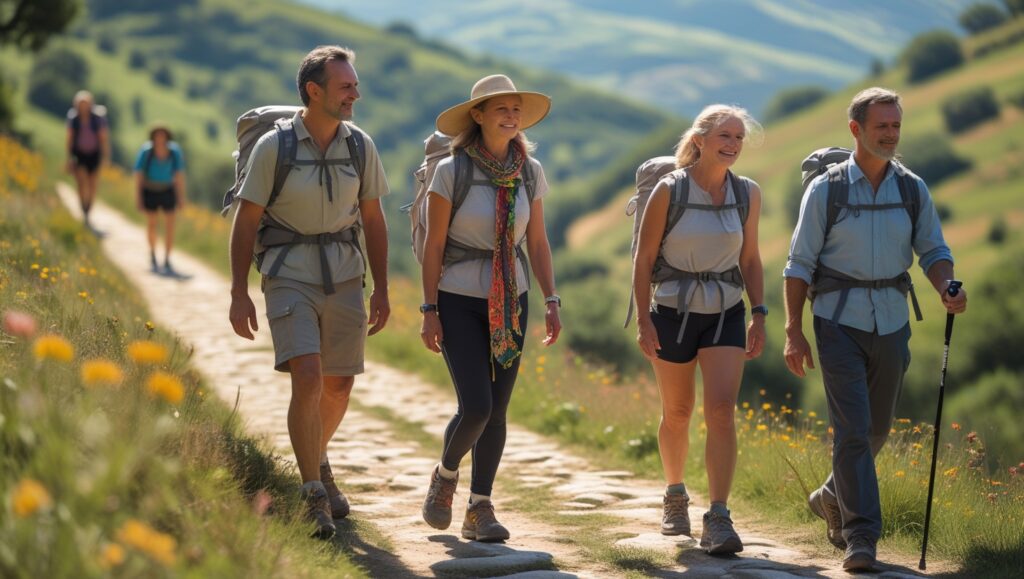
Many of my Camino de Santiago walking retreat guests struggle with this. When you walk the Camino, for hours on end, sooner or later your brain might start rerunning past insults, arguments, disappointments, misunderstandings. You end up marinating yourself in a bad mood with real dedication, real craftsmanship even. And fast-resetting? Let’s just say it becomes a serious challenge, every step of the way.
Lots of time to practice, walking the Camino.
The Energy Audit You Don’t Need
Every time you replay an argument you can’t change, you spend energy. Every time you let a ten-second inconvenience simmer for three hours, you waste energy. Every time you carry a morning mood all the way into your evening, your energy gets depleted — and you spend it on something that’s already past history, that you cannot alter, that is frankly not worth making out the invoice.
Some things ARE worth sitting with, processing properly, talking through. But the unappreciated coffee? The terse reply? The plan that didn’t work out? Those have a natural expiry time, and it’s a lot shorter than we tend to give it.
Resetting fast isn’t indifference. It’s prioritisation. It’s the decision that your afternoon is more valuable than your grievance. That your presence — with yourself, with the people you love, with the work you care about — is worth more than the story of what went wrong at breakfast.
Reframe if you need to, as in “their behaviour says more about them than about me,” or whatever works in that specific situation. Then let the moment pass. Fretting about it uses up to much of your energy. Let it go.
Again and again and again.
I’d love to hear your thoughts on fast resetting – have you mastered the art? Or are you, like me, stil practising?
Join us for the Book Lovers Binge Reading Camino de Santiago Walking Retreat in the sun-drenched southwest of France: a journey where the trail and the story unfold together. Walk ancient paths at your own pace, then settle in each evening with a good book. This isn’t a fitness challenge—it’s a gentle rhythm—one step, one chapter, one honest conversation at a time. Rolling hills, quiet villages, golden light. No expectations, no performance, no agenda but your own unfolding.
Do you dream of escaping your stressful life to raise a herd of goats or grow sunflowers in the south of France? Then you may be ready for an Esprit Meraki retreat. Get access to this “very serious” quiz to help you figure out how urgent your need for a change of scenery is, when you subscribe to my monthly newsletter.
Author Bio: Dr Margaretha Montagu – described as a “game changer”, “gifted healer”, “guiding light” and “life-enriching author” – is an experienced medical doctor, a certified NLP practitioner, a medical hypnotherapist, an equine-assisted psychotherapist (EAGALAcertified) and a transformational retreat leader who guides her clients through life transitions – virtually, or with the assistance of her Friesian and Falabella horses, at their home in the southwest of France.
For the exhausted, the overwhelmed, the overstimulated, and the quietly desperate for a different kind of life
I know we are nearly halfway through April, but it’s not too late. Should you want to, you can still make this year a slow year.
A slow year is a conscious, deliberate choice to organise a year around intensity and authenticity rather than velocity — protecting pockets of undisturbed rest, unhurried experience, and real focus, and treating these not as rewards to be earned once everything else is done, but as non-negotiables woven into the fabric of daily life.
It draws from the broader Slow Movement philosophy and stands as a quiet rebellion against the cult of productivity and the relentless urgency of our fast-paced modern life — not by doing less, necessarily, but by doing what actually matters, at a pace that allows you to be fully present.
The intentional living trend that’s less about doing less — and more about doing what actually matters
What this is: A practical guide to embracing the “slow year” — not as a romantic notion you flirt with in January and abandon by mid-February, but as an actual, lived experiment in doing life at a more reasonable pace. The kind where you still get things done (you are not, contrary to popular existential dread, turning into a moss-covered bench), but you stop behaving as though every email is a small emergency and every goal must be achieved before lunch.
It’s about learning how to move through 2026 with a steadier nervous system, clearer priorities, and the quiet, radical decision not to sprint just because everyone else has laced up their metaphorical running shoes and is charging toward burnout with impressive enthusiasm. There will be no rigid rules, no sanctimonious finger-wagging, and absolutely no requirement to churn your own butter unless you feel a deep and personal calling to do so.
What this isn’t: Not a lecture about digital detoxing delivered by someone who secretly checks their phone under the table. Not a minimalism manifesto that suggests you can solve existential angst by owning exactly seven objects (three of which are beige). And certainly not another breathless productivity system that promises you “more time” and then quietly fills that time with… more productivity.
You will not be asked to wake up at 4:30am, journal for an hour, meditate for another hour, drink something green and morally superior, and then optimize your circadian rhythm while listening to a podcast about optimizing your circadian rhythm. This is not about doing less so you can do more. It’s about doing what matters, at a pace that doesn’t make you question your life choices every Tuesday afternoon.
Read this if: You’re weary of the noise — not just the literal kind, but the constant, low-grade urgency humming in the background of modern life. You’ve opened the news recently and felt that peculiar mix of concern, disbelief, and a sudden desire to lie down in a dark room with a cup of tea and no Wi-Fi. Read this if you’ve started to suspect that “keeping up” is a game with no finish line, no prize, and slightly questionable rules.
Read this if there’s a quieter, wiser part of you (often drowned out by notifications and other people’s expectations) gently suggesting that there might be a different way to live a year. One with more pauses. More presence. Fewer self-imposed deadlines that were, if we’re honest, never agreed upon by anyone except your inner overachiever. Read this if you’d like to end 2026 not feeling like you survived it by clinging to the side, but like you actually inhabited it — fully, deliberately, and without needing a recovery period.
5 Key Takeaways
A slow year is not about doing less. It’s about doing things that genuinely matter — with more presence, less panic.
Intentional slowness is a radical act in a culture addicted to urgency, and choosing it requires nerve.
Nature, story, and stillness are not luxuries. They are, according to a growing body of research, genuinely restorative to a stressed nervous system.
Community and shared experience amplify the benefits of slow living far beyond anything you can achieve alone on a yoga mat.
Small, consistent rituals — a morning walk, a real book, a conversation without a screen — compound quietly into something that changes you.
Introduction
The world is, at present, exhausting, in the “I opened Twitter before my first coffee and now I need to lie down” sense. Climate headlines. Political upheaval. Cost-of-living squeezes. A relentless news cycle that seems to operate on the assumption that you actually want to feel terrible, all the time.
And here you are. Smart, resourceful, not new to hard seasons, and yet — something in you is fraying at the edges. The old strategies are not quite cutting it anymore. The weekend reset doesn’t hold till the end of Tuesday. The to-do list lengthens overnight. The things that used to light you up now barely register.
You are not broken. You are overstimulated, over-scheduled, and chronically under-nourished by the things that actually matter.
This article is about a different kind of year. A slow one. And no, that doesn’t mean quitting your job and moving to a yurt (although, honestly, some days). It means something more nuanced and more intentional than that.
Part One: The Story of Andrew Garnier, or How a Man Who Fed Everyone Finally Fed Himself
A Retreat in the French Pyrenees, Late October
Andrew Garnier had not eaten a meal sitting down in eleven years.
Not a proper one. Not the kind where you taste what’s in front of you, where you notice the weight of the fork or the particular way a good wine opens up after ten minutes in the glass. He was the chef. He plated. He tasted in fractions, a brush of sauce on a fingertip, a fragment of crust stolen mid-service, a half-spoonful of something that needed more acid. He fed three hundred people a week in his restaurant, Sel Gris, and had held his Michelin star for six consecutive years. He did not, as a rule, eat.
He slept four to six hours. He communicated mostly in imperatives. His sous-chef had started leaving printed notes on his office door rather than speaking to him directly, which Andrew had noticed and chosen not to examine too closely.
It was his older sister, Céleste, who staged the intervention. Not dramatically — she was not a dramatic woman — but firmly, in the way that only a sibling who has watched you slowly disappear can manage. She booked the retreat. She told him the dates. She said, with a precision that remined him of their mother: “You are not well, Andrew. You are just very busy, which is not the same thing.”
He drove to southwest France on a Tuesday in October, telling himself he would check the restaurant group chat every two hours.
He checked it twice the first day. Once the second. After that, he forgot.
The farmhouse surprised him. Not because it was beautiful, though it was, but because of the silence. Andrew Garnier had not stood in silence since he could remember. His world was constructed of sound: the clatter of a professional kitchen, the low roar of a full dining room, the perpetual percussion of a phone that never stopped vibrating on a countertop. Here, in the courtyard, with his bag still in his hand, he could hear a woodpecker somewhere in the trees. He stood there longer than was strictly necessary, listening.
There were three other guests. A retired cardiologist from Lyon who had recently survived a health scare that had, as he put it with elegant understatement, “clarified his priorities considerably.” A secondary school teacher from Cork who had not read a novel in three years and was embarrassed about it. A middle-aged architect from Stockholm who walked like someone recently released from a long captivity — which, in a sense, he had been.
Andrew, who spent his professional life emitting confidence and authority, found that in this company, he had very little to emit. They did not know him. They did not care about his star. They passed the bread and asked him how he’d slept.
It was strangely magical.
On the first morning, they walked a stretch of the ancient Camino de Santiago — a pilgrimage route worn smooth by a thousand years of seeking feet — through woodland already turning amber and copper, the air sharp with the smell of cold earth and pine resin. Andrew, whose daily exercise consisted of moving very fast between a pass and a stove, found the pace disorienting at first. There was no urgency. There was no destination beyond the next ridge.
Andrew crouched and rubbed a sprig of thyme between his fingers. He held his hand to his face and breathed in. A smell he had used ten thousand times, reduced to a technique, abstracted into a menu. And here it was, growing out of a rock in the Pyrenees, wild and indifferent and extraordinarily alive.
Something in his chest made a sound it had not made in a long time. Not a crack. Something gentler. Something splitting open.
In the afternoons, they read. Real books. Andrew, who had not finished a book in two years, had packed three, optimistically. He chose a novel at random — The Old Ways by Robert Macfarlane — and by page thirty he was unreachable. Not gone. More precisely located than he’d been in months. He read for three hours and noticed it had happened only because his tea had gone cold.
Dinner that evening was a long, cheerful affair. A paella, a local favourite, roasted root vegetables, cheeses from a nearby farm, a wine from just over the Spanish border. Andrew ate it. All of it. At a table. Sitting down. The cardiologist poured him a second glass without asking and he did not check his phone.
Afterwards, they sat by the fire and talked. Not networking. Not pitching or impressing or managing. The teacher from Cork said she’d been so tired she’d stopped being able to tell the difference between sadness and exhaustion. The architect said he’d built beautiful spaces for other people to inhabit and had somehow neglected to inhabit any himself. Andrew said almost nothing, but listened with the full, still attention he usually reserved for a dish that wasn’t working.
On the fourth morning, before breakfast, he sat alone with his journal in the paddock, watching the horses move in the early mist. There is something about a horse at rest — the weight and warmth of it, the absolute unhurried presence — that refuses to be rushed by. You cannot multitask near a horse at rest. It will have none of it.
Andrew wrote for an hour. Not a menu. Not a staffing rota. He wrote about his father, who had cooked Sunday lunch every week of his childhood without fanfare or ambition, and how the smell of a roasting chicken could still, if he let it, make him feel genuinely safe. He wrote about what he had wanted, at twenty-two, before the wanting had been overtaken by the doing. He wrote, slowly, the first few lines of a different kind of year.
He flew home on a Friday with aching legs, a finished novel, four pages of journal, and an idea for a tasting menu built entirely around the wild herbs of the Camino path. His sous-chef said he looked strange. “Strange how?” Andrew asked. She thought about it and said: “Like yourself, actually.”
He took that as the highest possible compliment.
Part Two: So, What Actually Is a “Slow Year”?
The phrase “slow year” sits within a broader cultural movement, a quiet rebellion against the cult of productivity that has colonised most of modern life.
It draws from the Slow Movement, which began with food (the Slow Food movement, founded in Italy in 1989 as a response to a McDonald’s opening near the Spanish Steps, of all the inciting incidents) and has since spread into living, travel, fashion, and the general philosophy of doing things at the pace at which they can actually be done well.
A slow year is, at its simplest, a conscious choice to organise twelve months around intensity rather than velocity. It is a year in which you decide, in advance, that you will protect pockets of genuine rest, real attention, and unhurried experience, and that you will treat these not as rewards to be earned but as non-negotiables.
This is not the same as a sabbatical, although it can include one. It is not retirement. It is not a vow of poverty or a rejection of ambition. It is closer to what the philosopher Blaise Pascal was gesturing at in the seventeenth century when he observed (and this has aged extraordinarily well) that all of humanity’s problems stem from the inability to sit quietly in a room alone.
What a Slow Year Actually Looks Like in Practice
Protected mornings. Not all of them, not always. But enough of them. A slow morning is one in which you do not immediately hand your nervous system over to other people’s agendas.
Reading actual books. Not articles. Not threads. Not summaries of books. The sustained attention required by long-form narrative is, it turns out, a genuine cognitive and emotional tonic.
Choosing presence over documentation. Less photographing the moment, more inhabiting it.
Spending significant time in natural environments. Not as exercise, necessarily — though that helps too — but as a form of recalibration. Trees are astonishingly good at this. Research agrees.
Joining a pilgrimage. Not necessarily religious, though it can be. The act of walking somewhere, with intention, over time, changes something in the brain and the body that cannot easily be replicated by a weekend spa.
Seeking genuine community. Not networking. The kind of conversation that happens when people are fed and rested and not performing.
The Ripple Effect
When one person in a household, a family, a team, a community chooses to slow down deliberately, something shifts in the ecosystem around them. We are, as a species, deeply porous. We regulate each other’s nervous systems. A calmer person makes it easier for others to be calm. A person who has stopped performing urgency gives others silent permission to stop too.
The slow year is not a selfish act. It is, in many ways, one of the most generous things you can offer the people around you. A version of yourself that is not running on fumes, not half-present, not held together by caffeine and obligation.
Communities, too, shift when their members return to a human pace. Local shops. Conversations with neighbours. The re-emergence of people who have time to show up, to help, to notice.
Part Three: 5 Mistakes to Avoid When You’re Trying to Live More Slowly
1. Treating “slow” as a binary switch
You cannot go from 0 to 60 mph to a full stop without consequences. The people who announce loudly that they are “doing a digital detox” and then relapse by Tuesday have confused an aspiration with a strategy. A slow year is built in increments. One protected morning. One real walk. One book finished without guilt. Small and consistent beats dramatic and short-lived.
2. Waiting for permission
No one is going to give you a slow year. Your employer will not schedule it. Your family’s needs will not spontaneously reduce. The news will not become less alarming. If you are waiting for circumstances to align before you begin living more intentionally, you are going to wait a very long time. You choose it, in spite of the evidence.
3. Going it alone
Slow living done in isolation tends to feel self-indulgent and collapses quickly under social pressure. Community is load-bearing. Shared meals, shared walks, shared stories, shared laughter — these are not optional extras. They are the structure.
4. Confusing slowness with passivity
A slow year is not about achieving less. Some of the most creative, productive, and influential people in history were radical slowpokes by modern standards. Darwin took long daily walks. Wordsworth composed while walking. Keats wrote letters. Depth and output are not arch enemies. Slowing down often unlocks capacities that busyness has been suppressing.
5. Ignoring your body
The mind wants to intellectualise this. To read the books, think the thoughts, perhaps make a vision board. But the body is the instrument. Chronic stress lives in the tissues. Walking in nature, physical tiredness from real exertion, the weight and warmth of a real meal eaten slowly — these reach parts that no amount of journaling reaches alone. Don’t outsource the physical. Include it.
A Short Intention-Setting Exercise: Your Slow Year Manifesto
Answer these three questions, longhand if you can:
1. What am I most hungry for, that I haven’t been getting? (Not achievements. Qualities of experience. Think: stillness, beauty, laughter, depth, freedom, belonging.)
2. What one thing, if I protected it consistently this year, would change how I feel most days? (A morning walk? An hour of reading before bed? A weekend monthly without commitments?)
3. Who would benefit if I became calmer and more present? (Write the names. Let that be your motivation on the days when you feel like you don’t have “time.”)
Recommended Reading: 5 Books for Your Slow Year
1. In Praise of Slowness by Carl Honoré (2004) The book that essentially launched the modern slow movement. Honoré, a self-confessed speed addict, travels the world examining cultures and communities that have pushed back against the cult of fast. Rigorous, funny, and quietly life-altering. An essential primer.
2. The Nature Fix by Florence Williams (2017) Williams travels to Finland, Japan, and South Korea to investigate why time in nature makes humans measurably healthier and happier. The science is robust, the writing is beautiful, and you will want to be in a forest within twenty minutes of opening it.
3. How to Do Nothing: Resisting the Attention Economy by Jenny Odell (2019) Part manifesto, part art criticism, part ecological love letter — this book is for the thoughtful person who suspects that reclaiming attention is actually a political act. Demanding and rewarding in equal measure.
4. The Ruthless Elimination of Hurry by John Mark Comer (2019) Do not be put off by the subtitle. This is a sharp, honest, and beautifully observed book about what chronic hurry costs us at the deepest level, and what a different pace might restore. Written with faith as its frame, but with insights that reach well beyond any one tradition.
5. Wintering: The Power of Rest and Retreat in Difficult Times by Katherine May (2020) Written in the aftermath of a family crisis, Wintering is about the seasons of withdrawal that every life contains — and how to move through them with more grace than dread. Tender, wise, and full of lovely, slow sentences.
PS: If you’re looking for a practical, day-by-day companion for the kind of inner shifts a slow year invites, my book Embracing Change — in 10 Minutes a Day is exactly the kind of quiet, grounded guide you need. It won’t shout at you. It won’t give you a seven-step system. It will, gently and consistently, help you move.
If you are currently facing a major life transition or any other dramatic change in your circumstances, and you have no idea how you are going to cope, the good news is that the strategy presented in this book can help you, step by step, to improve your ability to handle the stress caused by change, even if you feel entirely powerless at the moment.
Q1: Is a “slow year” realistic for someone with a demanding job and family responsibilities? Yes — with one significant caveat: it will not happen by accident. You will need to decide, in advance, that certain things are protected. You don’t need a sabbatical or a six-figure savings pot. You need three or four genuine anchors in your year — experiences or rituals that are slow, nourishing, and non-negotiable. The rest can be ordinary. The anchors change everything.
Q2: I’m not sure I can “do nothing.” I get anxious when I’m not productive. Is slow living for me? Possibly more for you than for anyone else. The anxiety you feel about stillness is the symptom, not the verdict. Most people who describe themselves as “unable to relax” are not constitutionally incapable of it — they are deeply habituated to urgency. That habituation can change. It usually changes first in the body, on a walk or in a chair by a fire with a good book, before the mind catches up.
Q3: How is a reading retreat on the Camino different from just going on holiday? A holiday is typically about escape — different scenery, same self. A retreat offers something more structural: a container in which something can actually shift. The combination of purposeful walking (the Camino is one of the oldest pilgrimage routes in the world), extended reading, good food, and genuine community creates conditions for a kind of recalibration that a week in Tenerife, lovely as it is, tends not to.
Q4: Do I have to be religious to walk the Camino? Absolutely not. The vast majority of Camino walkers today describe themselves as non-religious. The path is ancient, yes — and that antiquity gives it a weight and a quality of silence that is palpable regardless of belief. What it asks of you is simply your feet and your attention. That’s enough.
Q5: I’ve been stressed for so long I’m not sure I know what “restored” feels like. Is that normal? Entirely. Chronic stress normalises itself. You stop remembering what baseline feels like and start mistaking exhaustion for personality. Many people who attend retreats report being surprised by the return of things they’d forgotten: curiosity, appetite (for food, ideas, company), a capacity for genuine joy. These things didn’t go anywhere. They were just buried under the noise.
Conclusion: The Year Ahead
There is a version of 2026 that looks very much like 2025. Fast, loud, anxious, and over before you could catch your breath.
And there is another version.
One with mornings that belong to you. Long walks on ancient paths through oak and bracken. A book so absorbing you miss your stop. A meal that took two hours because the conversation was too good to rush. A sky full of stars above a stone farmhouse in southwest France, the smell of woodsmoke in the air, and the quiet, settled knowledge that you are, finally, somewhere real.
You get to choose which version you’re in.
The world will not slow down for you. But you — smart, capable, weathered, ready — can choose a different pace. Not as an escape from your life. As a deeper entrance into it.
Join us for the Book Lovers Binge Reading Camino de Santiago Walking Retreat in the sun-drenched southwest of France: a journey where the trail and the story unfold together. Walk ancient paths at your own pace, then settle in each evening with a good book. This isn’t a fitness challenge—it’s a gentle rhythm—one step, one chapter, one honest conversation at a time. Rolling hills, quiet villages, golden light. No expectations, no performance, no agenda but your own unfolding.
But Are You Ready for a Retreat?
Do you dream of escaping your stressful life to raise a herd of goats or grow sunflowers in the south of France? Then you may be ready for an Esprit Meraki retreat. Get access to this “very serious” quiz to help you figure out how urgent your need for a change of scenery is, when you subscribe to my monthly newsletter.
Not sure if now is the right time, or which retreat is the right fit? Take the Ready for a Retreat? Quiz when you sign up for my newsletter, and find out exactly what kind of slow experience your particular form of tired is calling for.
References
Bratman, G. N., Hamilton, J. P., Hahn, K. S., Daily, G. C., & Gross, J. J. (2015). Nature experience reduces rumination and subgenual prefrontal cortex activation. Proceedings of the National Academy of Sciences, 112(28), 8567–8572.
Kabat-Zinn, J., Massion, A. O., Kristeller, J., Peterson, L. G., Fletcher, K. E., Pbert, L., … Santorelli, S. F. (1992). Effectiveness of a meditation-based stress reduction program in the treatment of anxiety disorders. American Journal of Psychiatry, 149(7), 936–943.
Mar, R. A., Oatley, K., & Peterson, J. B. (2009). Exploring the link between reading fiction and empathy: Ruling out individual differences and examining outcomes. Communications, 34(4), 407–428.
Selhub, E. M., & Logan, A. C. (2012). Your brain on nature: The science of nature’s influence on your health, happiness and vitality. Journal of Affective Disorders, evidence reviewed in book-form but founded on peer-reviewed studies; see also: Ulrich, R. S. et al. (1991). Stress recovery during exposure to natural and urban environments. Journal of Environmental Psychology, 11(3), 201–230.
Aspinall, P., Mavros, P., Coyne, R., & Roe, J. (2015). The urban brain: Analysing outdoor physical activity with mobile EEG. British Journal of Sports Medicine, 49(4), 272–276.
Céline had officially decided that life could take its unwanted diagnosis and kindly shove it into a snowdrift.
Preferably one a million miles from her little flat. Lourdes had turned itself into a Christmas snow globe: the Basilica glowing bright blue in the cold dusk, pilgrims queuing for crêpes near the Gave de Pau, the deep, dark river glittering with reflections of twinkling lights, and cafés steaming up their windows with the scent of café crème and sugar-dusted beignets.
Céline, however, was taking no part in any of it. She had been hibernating beneath an absurdly thick goose-down duvet for three days straight, cocooned in its protective warmth and, until a determined knock finally rattled her door.
“Open up,” Jean called.
“I’m not here,” Céline croaked from under her duvet.
“I can hear you not being here,” he replied. “Open the door.”
She cracked the door open an inch. Jean stood there wrapped in layers of wool, and the unshakeable smugness of someone who knew he was doing the right thing. Snowflakes melted on his beard, forming tiny rivers that made him look like a Saint Bernard who’d had a spiritual revelation.
Céline, horrified, stared at the shopping bag Jean had dropped on her kitchen table.
“No,” she said.
“Yes,” Jean replied, already unpacking: thermal base layers, waterproof shells, crampon-compatible boots and a sleeping bag rated to minus-twenty.
“I’m not going hiking.”
“Of course you are. It’s exactly what you need.”
“Jean, I have a medical—”
“I know. The doctor told you six weeks ago. You’ve spent those six weeks in this apartment Googling symptoms and stalking sad people on the internet who have the same diagnosis. Wasting precious time. Now we’re going to the mountains because I’m your friend and I’ve decided to kidnap you for your own good. Legally ambiguous, maybe, but morally sound.”
Céline looked at Jean—fifty-three, weathered by thirty years of guiding tourists up and down Pyrenean peaks. He wasn’t leaving. He’d stand there until she packed or until she called the police, and probably the police wouldn’t help, because he gave most of them their mountain rescue training.
“I’m not doing Christmas this year,” she said.
“Fine,” he said. “Then we’re going hiking.”
He shoved a thermos into her hands. It was warm. It smelled like hot chocolate. Dark, thick, sinful piping hot chocolate. She glared at it. He smirked.
“You monster,” she whispered.
Before she had time to rally her defences, they were on their way. The trail to the cabin was blanketed in fresh snow, the kind that squeaked underfoot. The Pyrenees loomed on all sides, their peaks slicing the pale sky with the sort of majestic indifference only mountains can pull off. Pines sighed under the latest snowfall, and the cold stung Céline’s cheeks, sharp and honest. Her breath puffed out in angry clouds. The air smelled of pine resin and something clean and new—like the world had been scrubbed with mint.
She wanted to be home. She wanted her duvet. She wanted the version of her life that existed before her doctor dropped this diagnosis into her lap like an anvil from a great height.
Instead, she came to the belated conclusion that her friend Jean, whom she had known for thirty years, was a lunatic.
Every few minutes, she caught him glancing at her—not with pity, but with a sort of practical attention, like he was checking the weather. She found that infuriatingly comforting.
They climbed for four hours. Jean didn’t talk about her diagnosis. Didn’t ask how she was feeling. Didn’t offer platitudes about staying positive or fighting through it. He just climbed, occasionally calling back practical things: “Watch that patch of ice,” “Use your poles here,” “See that ridge? That’s where we’re going. Yes, the one that looks a hundred miles away.”
“Why aren’t you asking me about it?” Céline said, finally.
“About what?”
“The diagnosis. What it means. How I’m feeling. All the things everyone else asks.”
Jean bit into his chocolate, considering. “Because I figured you’ll tell me when you want to. Also, because right now, it really doesn’t matter.”
“Doesn’t matter? Jean, my entire life just—”
“Your entire life is right here. This mountain. This moment. That ridge we’re climbing. The fact that your left crampon is slightly loose and you need to tighten it before we continue or you’ll twist your ankle.” He gestured at the vast landscape. “Everything else is just stories we tell ourselves.”
Céline wanted to argue. Wanted to explain that it wasn’t that simple, that fear and uncertainty weren’t things you could just out-hike. But her crampon was loose. And the next section of the trail required focus or she’d fall. And arguing with Jean was like arguing with a mountain goat—technically possible, but ultimately pointless.
She tightened her crampon. They kept climbing.
When they reached the top, the wind nearly blew them over. Below stretched a valley blanketed in white, a river frozen in thick, glassy swirls reflected the sky like a broken mirror.
Céline stopped. Her heartbeat—fast from the climb, fast from fear of her own future—slowed into something steadier.
“It’s beautiful,” she said quietly.
“Yes,” Jean said. “Stunningly so.”
She almost told him everything right there—about how terrified she was, how betrayed she felt by her own body, how every choice now tasted like uncertainty.
They reached the cabin by late afternoon on Christmas Eve. It was small, wooden, and crooked in the most charming way imaginable, like a house that had attempted to bow and gotten stuck halfway. Icicles hung like crystal daggers from the eaves.
Inside, the air was warmer than she expected, scented with woodsmoke and pine needles.
Jean hung a tiny string of battery-powered fairy lights above the window.
Céline raised an eyebrow. “Really? Outdoor gear, yes. Emergency supplies, yes. But fairy lights?”
“There’s more to me than meets the eye, you know, ” he chuckled.
They ate thick winter soup, sept légumes, that warmed her from the inside out, spreading heat into places that had felt cold long before the snow came. They tucked into wild boar sausages roasted over the open fire, warm bread, and homemade butter. Afterwards, he poured her a small cup of mulled wine. The scent of citrus peel and cinnamon filled the cabin. Each sip was a tiny Christmas hug.
The wind howled relentlessly outside, but the cabin held firm.
Céline lay in her sleeping bag, every muscle aching, and thought about the trail tomorrow. About placing one foot in front of the other. About how the present moment was the only moment that actually existed.
She slept better than she had in six weeks.
The next day, they left in darkness, headlamps cutting through the predawn cold. The trail was technical—crampons biting ice, hands on rock, exposure that made Céline’s stomach drop.
Jean climbed with the steady rhythm of someone who’d done this a thousand times. Céline followed, focused on nothing but the next handhold, the next step, the way her breath became ragged in the thin air.
The summit at sunrise: Céline stood atop Taillon, all 3,144 meters of it, part of the Monte Perdido range, watching the world below ignite. Wave after wave of peaks, their jagged crowns drenched in gold, pink, and the faint lavender of early dawn. Below, the Cirque de Gavarnie yawned wide beneath them—an immense, ice-armoured amphitheatre shimmering in the cold. Spain lay hazy and honey-coloured on the southern horizon; to the north, France dozed in shadowy blues, about to wake from the night. The world felt impossibly vast, utterly indifferent, and so heartbreakingly beautiful that her breath caught in her throat.
“Fifteen years ago,” Jean said, “I fell. Bad fall, shattered leg, three surgeries. Doctors said I’d never guide again. Maybe never climb properly again.”
Céline looked at him. He’d never mentioned this.
“I spent six months convinced my life was over. Everything I was—mountain guide, climber, the person people trusted to keep them safe—gone.” He gestured at the peaks around them. “Then a friend dragged me out here. Made me climb on crutches.”
“You got over it?”
“Eventually. Took two years. Different than before, harder in some ways, but I’m still here.” He turned to face her fully. “Your diagnosis—it’s changed things. I know. It’s scary. The future’s uncertain. But Céline, the future was always uncertain. We just pretended otherwise.”
“That’s supposed to be comforting?”
“Non. It’s supposed to be true.” He smiled. “You just climbed a mountain with a medical condition that terrifies you. You’ll climb other mountains—actual and metaphorical. Some days will be harder. Some days you’ll want to quit. But you know what? Just take it one step at a time. That’s all any of us can ever do.”
Jean produced wine he’d somehow packed, cheese, cold sausage, and a small chocolate bûche de Noël that had survived the journey slightly crushed but otherwise intact.
“Joyeux Noël,” he said, raising his tin cup.
“Merry Christmas. Thank you. For this. For not letting me disappear into the darkness.”
“De rien. Friends don’t let friends Google their symptoms ad infinitum, alone in empty flats.” He cut the bûche, handed her a piece. “Next year, we do the GR10. The whole thing. You, me, sixty days across the Pyrenees.”
“Jean, I don’t know if I can—”
“I know you don’t know. We plan it anyway. Make reservations. Buy maps. Give yourself something to train for.” He ate his chocolate.
They descended slowly, carefully, Céline’s legs trembling with exhaustion. She realised that this—this was how you lived with uncertainty. Not by conquering fear, but by continuing to climb, one step at a time, all the way to whatever summits remained.
The Making Friends and Maintaining Friendships Masterplan
The holiday season is the perfect time to reconnect with old friends. Life transitions often pull us in different directions, but that doesn’t mean the bond is lost. Sometimes, reaching out after years apart can feel like picking up right where you left off.
Think about someone you’ve lost touch with—a friend who once meant a lot to you. What would it feel like to reconnect? You might just reignite a friendship that brings new joy and comfort.
When a crisis makes you want to hide, call the friend who won’t let you—the one who’ll drag you out of your apartment and make you do something physical, challenging, and completely unrelated to your problem. Accept the metaphorical shopping bag on your kitchen table. Go on the hike, take the class, do the thing that forces you into your body and out of your head.
Worst case scenario: You’re exhausted, slightly hypothermic, and still have the same problems you started with.
Best case scenario: You discover that fear is just another mountain—terrifying but climbable if you focus on one step at a time, instead of the summit. Your friend who’s survived their own crisis shows you that strength isn’t fearlessness, it’s movement despite fear. You learn that the present moment—crampon on ice, breath in cold air, one foot then the other—is the only moment you can actually control, and that’s enough. You plan impossible future hikes because planning means believing in a future, and believing means you’ve already started climbing out of the place where fear wanted you to stay forever, small and safe and frozen, and you realize that summits—actual and metaphorical—are still possible, and the friend who wouldn’t let you hide becomes the person who taught you that living with uncertainty means living anyway, one foot in front of the other, all the way up.
Newsletter Subscription
I’m still collecting subscriptions to my news letter with these post, so if you haven’t subscribed already and would you like to find out what type of friend you are, how well you know your friends or if you and a new friend really are compatible, subscribe my filling in your email address in the box below and I’ll send you a set of light-hearted quizzes, quotes and questions to help you do just that. Just fill in the form below and you’ll get immediate access to them all. You can unsubscribe from this list effortlessly and at any time. Included:
–How well do you know your Friends? Quiz – What is Your Friendship Style? and Are your Friendship Styles compatible? Quiz – 20 of the Most Inspiring Friends and Friendship Quotes and – 20 lighthearted Questions you can ask to get to know a new Friend
Discover how to build meaningful, lasting friendships and create a support system that truly has your back—delivered straight to your inbox!
Friends and Friendships
Discover how to build meaningful, lasting friendships and create a support system that truly has your back—delivered straight to your inbox! (newsletter subscription included)
Thank you so much!
More information about making friends and maintaining friendships (including the quizzes I mentioned) is on its way to you. You have also successfully subscribed to my newsletter.
Your life just changed forever. This isn’t just another setback—it’s a fundamental shift in everything you thought you knew about what truly matters. In this groundbreaking guide, you’ll discover how to navigate the uncharted territory that follows a life-altering diagnosis. Unlike traditional self-help books that might offer vague platitudes, After the Diagnosis provides a practical framework for rebuilding your life when the foundations have been shaken.
Author Bio: Dr Margaretha Montagu – described as a “game changer”, “gifted healer”, “guiding light” and “life-enriching author” – is an experienced medical doctor, a certified NLP practitioner, a medical hypnotherapist, an equine-assisted psychotherapist (EAGALAcertified) and a transformational retreat leader who guides her clients through life transitions – virtually, or with the assistance of her Friesian and Falabella horses, at their home in the southwest of France.
Pierre stared at the email on his phone screen with the particular despair of someone who’d just watched their dreams get bureaucratically slaugthered. Again.
“Re: Mobile Food Service Permit Application #2847-B. Unfortunately, we require additional documentation regarding…”
He stopped reading. There were seventeen more paragraphs. There were always at least seventeen more paragraphs.
Behind him, his food truck La Route Épicée, painted an optimistic orange-and-yellow, equipped with a state-of-the-art kitchen he’d gone into serious debt for, sat immobile in a parking lot on the outskirts of Bayonne. It had been sitting there for three months. Three months of paperwork. Three months of “just one more form.” Three months of watching the Christmas market season—the lucrative, business-saving Christmas market season approach.
His phone rang. Maïa.
“You got the email,” she said. Not a question.
“How did you—”
“Because I know that sound you just made. The sound of a man being slowly strangled by French bureaucracy. Come to the shop. I have chocolate. Also, I have a plan.”
“I don’t need chocolate, I need a permit—”
“Everyone needs chocolate. Especially people lying to themselves about not needing chocolate.”
Maïa’s chocolaterie sat in the heart of old Bayonne, all exposed stone and wooden beams, the air thick with the smell of cocoa and caramelised sugar.
Maïa stood behind the counter wearing an apron that said “La Vie est Courte, Mangez du Chocolat“—life is short, eat chocolate. She was thirty-two, Pierre’s age, and had somehow managed to build a successful business while he was fighting self-righteous bureaucrats who seemed to have a vendetta against him, personally.
She slid a plate across the counter. Three pieces of dark chocolate, each topped with something unexpected: espelette pepper, fleur de sel, smoked paprika.
“Eat,” she commanded. “Then we talk about your terrible decision-making.”
Somewhat miffed, Pierre nevertheless ate. The chocolate was perfect—bitter, complex, the pepper building slowly at the back of his throat.
“You’re wasting your time,” Maïa said.
“Excuse me?”
“The permit. You’re fighting a system designed to make you quit. It’s nearly November. Even if you got approved tomorrow—which you won’t—you’d miss the entire Christmas season. Face it: your food truck is dead until January.”
Pierre felt something crack in his chest. Hearing it said out loud made it heart-wrenchingly real.
“So what am I supposed to do? Give up? Go back to working in someone else’s kitchen?”
“Non.” Maïa leaned forward. “You take a stand at the Chocolate Fair.”
The Salon du Chocolat de Bayonne—Bayonne’s famous chocolate fair. Chocolatiers from across the Basque Country and beyond set up elaborate stalls. Thousands of people attended. It was, essentially, chocolate Disneyland.
“I don’t make chocolate, Maïa. I make—”
“Fusion cuisine that nobody can try because your truck is a very expensive parking ornament. I know.” She pulled out her phone, showed him photos. “I have a double stall this year. Very prestigious, corner position. I’m offering you half. You make a small menu—four dishes, maybe five—incorporating Basque chocolate. Savoury, sweet, whatever your brain comes up with. We split the space, split the costs, you get access to my permits and my suppliers.”
“That’s not my concept—”
“Your concept is currently sitting in a parking lot, making no money AT ALL and crushing your soul. This is called adaptation. Also called not being a complete idiot.” The joy of having friends who don’t beat around the bush.
Pierre looked at the chocolate on the counter. At Maïa’s face—determined, certain, the expression of someone who’d already decided this was happening and was just waiting for him to catch up.
“I don’t know anything about cooking with chocolate.”
“Good thing your best friend is a chocolatier then, isn’t it?”
There were only five days left until the fair opened.
Maïa’s kitchen became a laboratory of taste bud destroying disasters. Pierre’s first attempt—duck confit with chocolate mole—was so rich it felt like eating velvet-covered concrete. His second—chocolate-espelette glazed pork belly—set off the smoke alarm and made Maïa’s assistant cry (probably from the pepper, though it was hard to tell). The third attempt—chocolate-infused squid ink risotto—looked like something dredged from the bottom of a gothic lake and tasted, according to Maïa, “like the ocean had a nervous breakdown and decided to punish humanity.” They tried to feed it to Maïa’s neighbour’s cat, who sniffed it once and walked away with visible disdain.
The chocolate and anchovy croquettes that were theoretically sound—salty, bitter, fried—but in practice tasted like Pierre had weaponised the concept of umami. Maïa took one bite, held up her hand for silence, chewed thoughtfully, then said, “I think you’ve created something that violates the Geneva Convention.”
“You’re thinking too complicated,” she said, rescuing the pork belly before it became charcoal. “This is Basque Country. People want familiar made interesting, not interesting made incomprehensible.”
“I don’t do familiar. I do fusion—”
“Fusion is just familiar ingredients having an identity crisis. Stop fighting your location. Use it.”
She handed him a bar of her signature dark chocolate—70% cacao from Cameroonian beans, made in Bayonne for three generations. “Start here. What does this taste like?”
Pierre closed his eyes, let the chocolate melt on his tongue. “Earth. Smoke. Something almost savoury.”
“Exactement. So use it that way. Think: what grows here? What do people eat here? How does chocolate fit?”
By day three, they had it:
Txistorra sausage with a chocolate-red wine reduction. The sausage—spicy, fatty, distinctly Basque—cut by the bittersweet depth of Maïa’s chocolate and local Irouléguy wine.
Pan-seared foie gras with a chocolate-and-pear compote. Controversial, decadent, impossible to stop eating.
Marmitako—traditional Basque tuna stew—finished with a square of dark chocolate that melted into the broth, adding complexity without sweetness.
And for dessert: gâteau Basque reimagined, filled with chocolate-cherry cream, topped with candied espelette.
“This,” Maïa said, tasting the tuna stew on day four, “this is what you should have been making all along. This is you, but also Basque. Fusion that makes sense.”
Pierre stared at her. “You just revolutionised my entire business concept in a kitchen the size of a closet.”
“Eh oui, so I did. You’re welcome. Also, dinner is on you tonight.”
That year, the Chocolate Fair exploded with people—locals, tourists, families with children hopped up on sugar samples, serious foodies with notebooks, everyone drawn by the smell of chocolate handmade-with-love and Pierre’s sausages sizzling on Maïa’s portable burner.
Their stall looked like controlled chaos. Maïa’s chocolates on one side—elegant, precisely arranged—Pierre’s pop-up kitchen on the other, steam rising, plates moving, the scent of his cooking cutting through the sweetness like a jazz note in a symphony.
By noon, they’d sold out of the foie gras.
By three, the tuna stew was gone.
By five, people were queuing thirty deep, phones out, taking photos of Pierre’s dishes, of Maïa’s chocolates, of the sign Pierre had hastily made: “Basque Fusion—La Route Épicée@Maïa Chocolaterie.”
A food critic from Sud Ouest approached tentatively, tasted everything, took notes with an expression that revealed nothing and everything. A chef from San Sebastián tried the txistorra, closed his eyes, and said something in rapid Euskara that made Maïa laugh.
“What did he say?”
“That you’ve finally stopped being a Parisian chef pretending to understand the Basque Country and started being a Basque chef with a few promising ideas.”
Pierre wasn’t sure if that was a compliment or an insult. Didn’t matter—the man bought six portions to take back to his restaurant.
By closing time, they were exhausted, depleted, covered in chocolate and olive oil and the particular satisfaction of having fed several hundred people something they’d remember. For a long time.
Maïa produced a bottle from under the counter. Patxaran—traditional Basque sloe berry liqueur, dark red, smelling of anise and success.
“To adaptation,” she said, pouring two glasses.
“To friends with brilliant ideas,” Pierre countered.
They clinked glasses, drank, and watched the fair wind down around them—the lights, the people, the success that had materialised from desperation and friendship and Maïa’s refusal to let Pierre’s concept die in a parking lot.
Pierre’s phone buzzed. An email. He almost ignored it.
The food critic. Five stars. Photos of every dish. Final line: “La Route Épicée has found its route—and it runs directly through the Basque Country’s heart, with a stop at Maïa’s chocolaterie. Book ahead for January.”
“We’re doing this again,” Pierre said. “Not just Chocolate fairs in November. Christmas. New Year. Regular pop-ups. Your kitchen, my food, our collaboration.”
“Obviously. You think I’d let you go back to fighting permit applications alone? You’d starve.”
Pierre laughed, surveyed the disaster zone of their successful day, and thought about how sometimes the best business plan is just having someone who believes in you enough to hand you half their stall and say, “Now stop being stupid and cook.”
The Making Friends and Maintaining Friendships Masterplan
The holiday season is the perfect time to reconnect with old friends. Life transitions often pull us in different directions, but that doesn’t mean the bond is lost. Sometimes, reaching out after years apart can feel like picking up right where you left off.
Think about someone you’ve lost touch with—a friend who once meant a lot to you. What would it feel like to reconnect? You might just reignite a friendship that brings new joy and comfort.
Next time you’re stuck in a professional or creative crisis, reach out to a friend who understands your field—and be willing to accept help that looks different from what you imagined. Ask for advice. Accept the corner of someone’s stall, their kitchen, their contacts, their hard-won local knowledge. Be willing to adapt your vision to reality without abandoning what makes it yours.
Worst case scenario: Your collaboration doesn’t work, you spend a week trying something different, and you go back to your original plan with new insights.
Best case scenario: Your best friend revolutionises your entire business concept in five days, gives you access to their infrastructure and their community connections, challenges you to stop fighting your location and start using it, and accidentally creates a partnership that transforms both your businesses. You discover that adaptation isn’t failure—it’s evolution, and sometimes the thing you thought was a compromise (chocolate in your savoury dishes, a pop-up instead of a food truck, fusion that respects its foundation) becomes the signature that makes everything work. You learn that friendship in business isn’t just emotional support—it’s someone handing you half their stall and saying “stop being stubborn, cook something,” and refusing to let your dream die in a parking lot because bureaucracy is terrible, but giving up is worse.
If you’re currently stuck in bureaucratic hell or professional limbo with a dream that’s going nowhere, what would your Maïa tell you to do differently?
Newsletter Subscription
I’m still collecting subscriptions to my news letter with these post, so if you haven’t subscribed already and would you like to find out what type of friend you are, how well you know your friends or if you and a new friend really are compatible, subscribe my filling in your email address in the box below and I’ll send you a set of light-hearted quizzes, quotes and questions to help you do just that. Just fill in the form below and you’ll get immediate access to them all. You can unsubscribe from this list effortlessly and at any time. Included:
–How well do you know your Friends? Quiz – What is Your Friendship Style? and Are your Friendship Styles compatible? Quiz – 20 of the Most Inspiring Friends and Friendship Quotes and – 20 lighthearted Questions you can ask to get to know a new Friend
Discover how to build meaningful, lasting friendships and create a support system that truly has your back—delivered straight to your inbox!
Friends and Friendships
Discover how to build meaningful, lasting friendships and create a support system that truly has your back—delivered straight to your inbox! (newsletter subscription included)
Thank you so much!
More information about making friends and maintaining friendships (including the quizzes I mentioned) is on its way to you. You have also successfully subscribed to my newsletter.
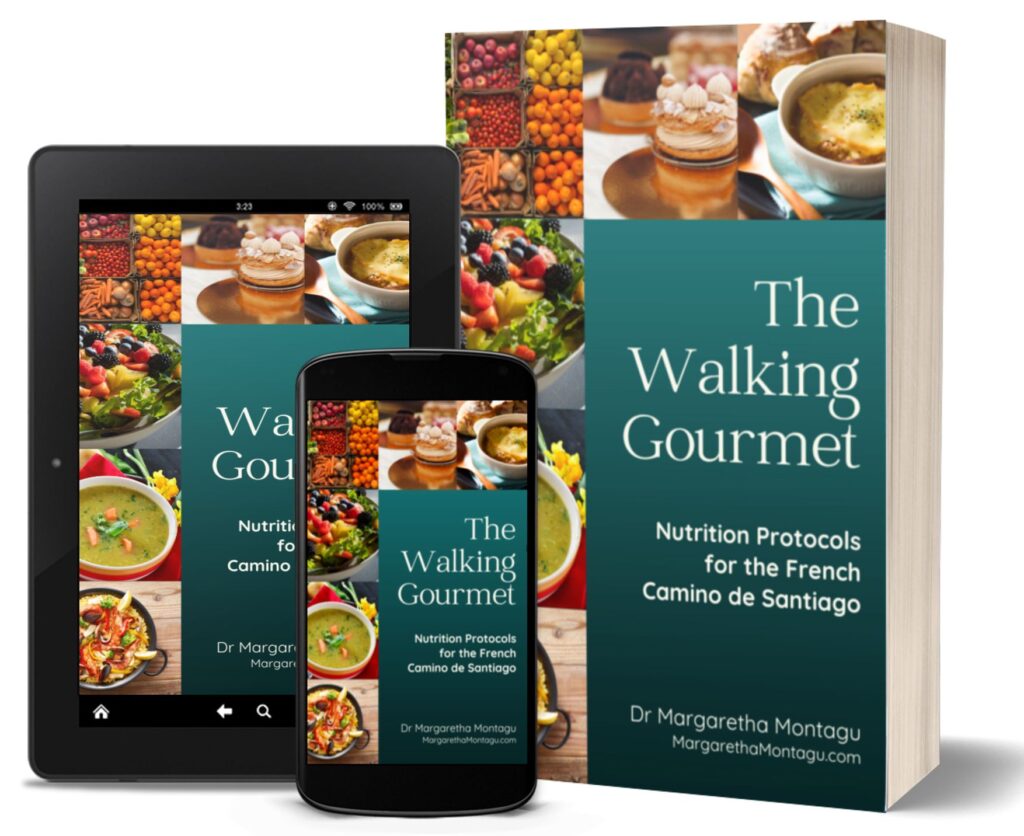
I’ve lost count of the number of guests who have asked for the recipes of the dishes I serve during my retreats. I’ve finally gotten around to publishing my retreat recipe collection as an e-book. If you’re interested in nutrition, especially while you’re walking the Camino de Santiago, or you just love authentic French cuisine, here is a link to my ebook The Walking Gourmet: Essential Food Strategies for the French Camino de Santiago
Author Bio: Dr Margaretha Montagu – described as a “game changer”, “gifted healer”, “guiding light” and “life-enriching author” – is an experienced medical doctor, a certified NLP practitioner, a medical hypnotherapist, an equine-assisted psychotherapist (EAGALAcertified) and a transformational retreat leader who guides her clients through life transitions – virtually, or with the assistance of her Friesian and Falabella horses, at their home in the southwest of France.
Theme: The Importance of Making Friends and Maintaining Friendships during Difficult Times
Today’s Story: Au Café des Platanes
Friends as Chosen Family
The air outside the Café des Platanes smelled like caramelised sugar, finest dark roast coffee, and old radiators working overtime against the sudden cold. A hand-lettered sign propped up in the window read “Atelier d’Écriture Créative—Tout Les Mardis à 19h” with a small fountain pen sketched beneath it.
Outside, Natalie was trying to keep her footing on the treacherous cobblestones. Through the steamed-up glass, she could see four women already seated at a corner table. Behind her, a group of laughing people was setting up the Christmas market on the town’s central square—wooden chalets strung with garlands, the smell of roasting chestnuts drifting on the cold air, someone testing speakers with a crackly recording of French carols.
She clutched her A4-sized notebook, containing a random collection of half-finished stories, against her chest like a shield.
You don’t have to go in, her brain offered helpfully. You could walk to the boulangerie, buy a croissant aux amandes, go home to your rented apartment, and curl up on the sofa with your cat and a chocolat chaud.
But her sister in London had been annoyingly insistent during their last video call: “You need to get out more. Mingle. Meet people. Join some groups. You moved to France to start a new chapter, not to become a hermit in a French flat, however cosy and comfortable.”
Natalie pushed open the door.
The brass bell above it jangled. Heads turned. The café was pleasantly warm, despite the struggling heaters, all three-legged wooden tables and mismatched wooden chairs, strings of white lights woven around exposed beams. The room was dominated by a huge Christmas tree decorated with vintage postcards. A dog was fast asleep in a basket next to the roaring fireplace. French jazz played softly from speakers that had probably been installed in 1977.
“Bonsoir, Madame et bienvenue!” A woman with silver-streaked hair in a violet scarf waved enthusiastically. “Vous êtes là pour l’atelier de l’écriture? Sorry, you’re here for the writing? I’m Patricia. British, been here twelve years, still can’t properly conjugate a single irregular verb. Sit, sit—Marc will bring you something to drink.”
Marc, presumably the owner, appeared with a knowing smile and a café crème.
The other women introduced themselves: Amara, French-Senegalese, with box braids and paint-stained fingers, who’d recently moved down from Paris; Jin, Korean-American, speaking careful French with a perfect accent that suggested expensive language lessons; Sophie, French, roughly Natalie’s age, wearing a sweatshirt that said “J’ai des sentiments mitigés” and holding a large glass of dark red wine; and Lisa, Austrian, who still missed her children who had moved to Vienna and Stuttgart ten years ago.
“I’m Natalie. American. Moved here three months ago.” She settled into a chair that was actually comfortable, unlike the avarage plastic torture device in every community centre she’d ever entered in the States.
“Right,” Patricia said, adding sugar to her espresso with the dedication of someone who’d given up pretending to like it bitter, “who brought something to share?”
Silence. Outside, someone was hanging lights in the plane trees. The Christmas market music drowned out the café’s jazz—an accordion version of “Petit Papa Noël.”
“Right,” Patricia said. “First meeting nerves. perfectly understandable. Maybe we should start with why we’re here? I’ll go first. I’m recently widowed, my children in Manchester think I should sell this house and move into one of those ghastly retirement communities, and I’d rather eat my own boots. I’ve always wanted to write, but spent forty years convinced I had nothing interesting to say. Then Roger died last Christmas Eve—horrible timing—and suddenly I found I had rather a lot to say.”
The silence shifted—still dense, but less defensive. Someone’s phone buzzed. The dog in the basket snored.
“I’m going through a divorce,” Natalie heard herself say. “I used to write. Before I got married and somehow forgot I was a person with interests beyond making dinner reservations and pretending my husband’s jokes were funny.”
Sophie raised her glass of wine in a sardonic toast. “Similar situation, different catastrophe. Broke up with my boyfriend of seven years. He kept the Paris apartment, and I got the ancestral house in the countryside that needs new plumbing and possibly an exorcist. I know exactly four people here: my notaire, my pharmacist, the woman at the tabac, and the man who delivers my Amazon packages and definitely judges my life choices.”
Jin laughed softly. “Corporate burnout. Silicon Valley tech startup, eighty-hour weeks, stock options I never cashed because I was too busy building someone else’s dream. Had a panic attack during a funding presentation, decided France sounded ‘interesting,’ applied for a skills visa. My mother in Seoul is thrilled I’m finally ‘finding myself.’ She hopes it’s a phase.”
“Cancer,” Amara said simply, and the word landed like a stone in still water. Marc, delivering more coffee, squeezed her shoulder gently. “Courage, ma belle.” She smiled up at him. “Finished treatment in September. Everyone keeps congratulating me like I won a competition, but mostly I feel like someone took me apart and put me back together without looking at the instruction manual. Missing pieces, extra pieces in weird places. I’m trying to figure out who this version is.”
Lisa was last. She folded her hands around her steaming tea—something herbal that smelled like Christmas spices. “Empty nest. Both children long grown and gone, living in cities I can barely afford to visit. Husband and I looked at each other across the breakfast table six months ago and realised we’d forgotten how to talk about anything except the children. So I came here—this was my grandmother’s house, left to me. He stayed in Austria. We’re… figuring it out.”
Patricia looked around the table at this mismatched collection of women. “Well,” she said, a smile crinkling the corners of her eyes. “at least we have lots of life experience. Writers need material. Nothing says ‘compelling narrative’ like an existential crisis during the most wonderful time of the year.”
Someone giggled nervously. Soon they were all laughing, with relief mostly, at not having to pretend everything was magical just because there were Christmas lights everywhere.
“Right,” Patricia said, pulling out a battered Moleskine. “I brought a short story. It’s probably dreadful. It’s about a woman who ‘accidentally’ destroys her husband’s antique cricket bat collection.”
“I need to hear this immediately,” Sophie said, refilling her wine glass.
Soon, they developed habits.
Patricia always arrived first, claiming the corner table near the radiator. Marc would have their usual drinks ready—café crème for Natalie, espresso for Patricia, dark Madiran wine for Sophie (“An acquired taste,” she insisted), ginger tea for Lisa, and hot, melted chocolate for Amara, who said after chemo everything else tasted like metal. Jin brought pastries—sometimes kouign-amann from the Breton bakery, sometimes pain aux raisins, once an entire galette des rois, even though it was barely December. Amara sketched in the margins while people read, creating tiny illustrations of their stories. Lisa had started bringing stollen from the German bakery one town over. Sophie appointed herself sommelier, bringing different wines each week and explaining their terroir with the seriousness of someone who’d grown up in wine country. Natalie, who’d barely spoken that first week, now brought printed copies of her work, her confidence growing like a seed tentatively reaching toward the light.
They wrote about everything. Amara wrote speculative fiction where women with bodies that had betrayed them transformed into creatures with wings. Jin wrote sharp, funny essays about the tech world that had chewed her up. Lisa wrote aching pieces about the rooms filled with ghosts her children left behind. Sophie wrote experimental poetry that made no sense grammatically in either French or English but somehow captured exactly what heartbreak felt like at 3 AM in an empty house that creaked with loneliness. Patricia was working on a novel about a woman who started by destroying her husband’s cricket bat collection and then moved on to ever more ambitious targets.
“It’s very therapeutic,” Patricia explained.
“It’s slightly concerning,” Jin said.
“Et alors?” Patricia teased.
Natalie wrote about divorce, but sideways—stories about women who woke up in different countries, living different lives, in different dimensions where they’d made different choices. Stories about becoming unrecognisable to yourself in foreign languages.
“These are good,” Amara said after Natalie finished reading one evening. Outside, the Christmas market was still in full swing—carousel music drifting across the square, the smell of vin chaud and croustade, children shrieking with joy near the ice rink they’d set up. “Like, actually good. Vraiment. You should submit this somewhere.”
“Oh, I don’t know—”
“Submit it,” Sophie said firmly. “We’re not doing that thing where we diminish our own work because we’re women who were socialised to apologise for existing, in three languages.”
The meetings stretched longer. Till eight, then nine, then Marc would finally start stacking chairs around them, and they’d realise it was past eleven and he wanted to go home. They exchanged phone numbers. Started a WhatsApp group that soon featured the best writing memes, recipe exchanges and 2 AM messages like “cannot sleep, obsessing about mortality, someone send cat videos.”
When Natalie’s ex-husband got engaged, she texted the group at 11 PM: Is it normal to want to set things on fire? Asking for a friend.
Five responses came within minutes: Very normal (Patricia) What things? Be specific (Jin) I’m bringing wine (Sophie) Coming over with cookies straight-from-the-oven (Lisa) Already in my car, be there in 10 (Amara)
They all showed up at her flat. Brought wine, melt-in-the-mouth cookies, and Patricia’s latest chapter, which involved increasingly creative uses of sporting equipment as murder weapons.
“I’m fine,” Natalie said, which was a lie, and they all knew it.
“Bien sûr,” Lisa said, opening the wine. “That’s why we’re here. To be fine together.”
They stayed until 2 AM, reading terrible reviews of her ex-husband’s favourite restaurant aloud in dramatic voices, workshop-editing Patricia’s murder scene (“More visceral! More conviction!”), and letting Natalie cry when she finally stopped pretending she wasn’t going to. Outside, everything was silent except for the wind whipping around the bare branches of sleeping trees and the distant sound of church bells marking the hour.
On Christmas Eve, they met at Patricia’s house, which smelled of pine needles, woodsmoke, and pain d’épices. Candles flickered on every surface. And over the fireplace, stockings hung—six of them, each in a different fabric, clearly handmade.
“I may have gotten carried away,” Patricia said, catching Natalie’s look.
Each stocking had a name stitched on it: Patricia. Amara. Jin (in Hangul). Sophie. Lisa. Natalie.
Something in Natalie’s chest cracked open.
They settled into Patricia’s living room with champagne and sablés and the particular comfort of a space warmed by both fire and friendship.
They talked about the year, about survival, about the strange gift of falling apart in good company in a foreign country where even buying stamps was an adventure.
“I joined this group,” Natalie said quietly, “because I was desperately lonely and my sister threatened to fly here and physically drag me to social events. I thought I was coming to practice writing in my second language.”
“Plot twist,” Sophie said. “Tu as trouvé une famille.”
“Very Hallmark Channel of us,” Jin added.
“I’m serious. A year ago, I didn’t know any of you. I was married and miserable in a different country. I thought moving to France would fix me, or at least give me a better choice of cheese while I figured my life out. And instead I found—” She gestured helplessly at the room, the stockings, the faces watching her with understanding from four different continents. “This.”
“Through the universal language of the written word,” Patricia said. Somewhere in the house, a clock chimed midnight.
Outside, church bells rang Christmas Eve into being. Marc texted the group chat a photo of the café’s Christmas tree with the message “Joyeux Noël, mes écrivaines préférées,” and somewhere in the warmth of that room was every good reason to keep showing up, keep trying, keep believing that the best things in life often come disguised as Tuesday night writing groups in cafés that smell like coffee and caramel and hope.
“Mardi prochain?” Lisa asked.
“Mardi prochain,” they agreed.
Today, join one group—online or in person—centred around something you genuinely care about, even if (especially if) you’re going through a difficult time and even if it’s in a language you’re still learning. Book club. Writing group. Hiking club. Cooking class. Language exchange. Art workshop. Choir. Whatever sparks even mild interest. Worst case scenario: You spend a few Tuesday evenings with people who share one interest, stumble through conversations in mixed languages, and decide it’s not for you. Best case scenario: You walk into a café and walk out six months later with five people from four continents who have stockings with your name on them, who show up at midnight when you’re falling apart, who become the family you didn’t know you were building while you thought you were just learning to write better dialogue in your second language. Tuesday after Tuesday, story after story, crisis after crisis, until one day you realise you’re not alone anymore in this foreign country and you haven’t been for a while, and the word “home” suddenly means something different than it did when you arrived.
Making Friends and Maintaining Friendships Masterplan
The holidays can highlight the importance of family, especially if you’re going struggling through a major life crisis, but for some, traditional family relationships may feel strained or distant. This is where friends can become your chosen family—a group of people who truly see, accept, and support you.
Maybe take a moment to appreciate the friends who’ve stepped into that role in your life? These relationships are a testament to the idea that family isn’t always about blood—it’s about love, loyalty, and shared experiences.
How well do you know your new friends? If you and a new friend are really compatible? For my Radical Renaissance students, I have created a set of light-hearted quizzes, quotes and questions about frienship, as I firmly believe a strong support group is invaluable in a crisis. Just fill in the form below and you’ll get immediate access to them all. I’ll also add you to my newsletter list, though you can unsubscribe from this list effortlessly and at any time. Included:
– How well do you know your Friends? Quiz
– What is Your Friendship Style? and Are your Friendship Styles compatible? Quiz
– 20 of the Most Inspiring Friends and Friendship Quotes and
– 20 lighthearted Questions you can ask to get to know a new Friend
Discover how to build meaningful, lasting friendships and create a support system that truly has your back—delivered straight to your inbox!
Friends and Friendships
Discover how to build meaningful, lasting friendships and create a support system that truly has your back—delivered straight to your inbox! (newsletter subscription included)
Thank you so much!
More information about making friends and maintaining friendships (including the quizzes I mentioned) is on its way to you. You have also successfully subscribed to my newsletter.
I put the essence of who I am, and everything I have experienced that makes me who I am, with great enthusiasm, into my retreats, courses and books. – Dr Margaretha Montagu (MBChB, MRCGP, NLP master pract (cert,) Transformational Life Coach (dip,) Life Story Coach (cert) Counselling (cert,) Med Hypnotherapy (dip) and EAGALA (cert)
The counterintuitive mindfulness practice that’s revolutionising how we handle stress, make decisions, and reclaim our sanity
Micro-meditations are bite-sized mindfulness practices lasting anywhere from 30 seconds to five minutes that can be seamlessly woven into your workday. For time-strapped executives and entrepreneurs drowning in back-to-back meetings, ping-ponging between crises, and perpetually three steps behind their to-do lists, these miniature mental resets offer surprising stress relief. Think of them as espresso shots for your nervous system, minus the jitters. This article explores what micro-meditations actually are, whether the science backs them up, and how they might just save your sanity whilst boosting your bottom line. Plus, there’s a cautionary tale about a chap named Marcus who learned this lesson the hard way.
Micro-meditations has been a life-saver for me, I don’t think my business would have survived without it.
Five Key Takeaways
Micro-meditations are brief mindfulness practices (1-5 minutes) that fit seamlessly into the busiest schedules and require no special equipment or training.
The research is compelling: Studies show consistent micro-meditation practice can reduce workplace stress by 28%, improve sustained attention by 43%, and boost productivity by an average of 62 minutes per week.
They’re particularly powerful for entrepreneurs and executives, who face 50% higher rates of mental health challenges than the general population and make 80% of decisions based on emotions.
Even 1-2 minute practices create measurable brain changes, reducing amygdala reactivity (your brain’s alarm system) and activating the parasympathetic nervous system for immediate stress relief.
Consistency is more important than duration: Multiple brief sessions throughout the day can be more effective than one longer meditation for workplace wellbeing and sustained focus.
Introduction: The Pause That Pays Dividends
Here’s a radical thought for your overscheduled, perpetually-behind, caffeine-fuelled brain: what if the most productive thing you could do right now is absolutely nothing for precisely 90 seconds?
I know, I know. You haven’t got 90 seconds. You’ve got investor pitches to perfect, teams to manage, fires to extinguish, and that looming deadline that’s keeping you awake at 3 AM. The very notion of stopping feels dangerous, perhaps even reckless. After all, sharks die if they stop swimming, right? (Actually, that’s a myth, but that’ll have to be in another article.)
Yet here’s what two decades of running wellness retreats and my years as a medical doctor have taught me: the entrepreneurs and executives who resist pausing are often the ones hurtling fastest toward burnout. Research now confirms what I’ve witnessed time and again, those who practise micro-meditations demonstrate a 29% improvement in decision-making, experience significantly lower stress levels, and gain an average of 62 additional productive minutes each week.
Micro-meditations aren’t about transcendence or achieving some zen-like state of eternal calm (though wouldn’t that be lovely?). They’re about creating tiny pockets of intentional awareness throughout your day, brief moments where you stop reacting and start responding. They’re the difference between drowning in the overwhelm and surfing the waves of entrepreneurial chaos with something resembling grace.
Let me tell you about Marcus.
The Tale of Marcus and the Meeting That Never Ended
Marcus Thornbury hadn’t slept properly in four months, though he’d never admit it, not even to himself.
At 42, he’d built his fintech startup from a scribbled napkin idea into a Series B company with 47 employees, venture capital breathing down his neck, and competitors snapping at his heels. Success tasted metallic, like blood from biting your cheek, sharp and salty. His days blurred into a relentless sequence: morning standup at 7:30, product reviews at 9:00, investor calls at 11:00, strategy sessions at 2:00, crisis management (always, always crisis management) at 4:00, followed by after-hours emails that stretched until midnight.
This particular Tuesday started badly and accelerated downhill from there.
Marcus had spilled his double espresso on his laptop keyboard at 6:47 AM, the brown liquid seeping between the keys with cruel determination. The acrid smell of burnt coffee mingled with the sharp tang of his own sweat as he frantically dabbed at the keys with yesterday’s shirt. His hands trembled, not from the caffeine he hadn’t yet consumed, but from the accumulated exhaustion of a hundred sleepless nights.
By 10:00 AM, he was trapped in Conference Room B with his CFO, CTO, and head of product, arguing about whether to pivot their core offering or double down on their current strategy. Sarah, his CFO, kept citing burn rate statistics that made his chest tighten. Dev, his brilliant but maddeningly literal CTO, countered every suggestion with technical objections. Marcus could hear his own pulse throbbing in his ears, a dull whoosh-whoosh that drowned out coherent thought.
“Marcus? Marcus, are you even listening?” Sarah’s voice cut through the fog.
He wasn’t. He’d been staring at the motivational poster on the wall, “Innovate or Die,” watching the letters blur and refocus whilst his mind careened through worst-case scenarios. The conference room suddenly felt impossibly small, the recycled air thick and stale, tasting of old coffee and accumulated stress. The fluorescent lights hummed their maddening frequency above him. His shirt collar felt like a noose.
“I need five minutes,” Marcus said, standing abruptly. His chair scraped against the floor with a screech that made everyone wince. “Just… five minutes.”
He found himself in the tiny kitchenette, gripping the edge of the sink, knuckles white. The cold stainless steel was the only solid thing in his spinning world. Through the window, he watched September clouds drift past, indifferent to his crisis. A lorry rumbled by on the street below, its diesel exhaust wafting up, harsh and real.
That’s when Priya from marketing walked in.
“You look like I feel,” she said, reaching for the kettle. “Which is to say, terrible.”
Marcus attempted a laugh that came out more like a bark. “That obvious?”
“You’ve been wearing that same expression for three months.” She poured hot water over a tea bag, and the scent of chamomile bloomed between them, soft and incongruous against his panic. “Can I tell you something weird that’s been helping me?”
Marcus nodded, desperate.
“Ninety-second meditations. I learned it in this online storytelling circle I joined, of all places.” She glanced at her watch. “We’ve got time right now. Just humour me.”
What happened next would strike Marcus, later, as absurdly simple. Priya had him stand with his feet flat on the floor, “like you’re a tree, rooted,” she said. She guided him to place one hand on his chest, feeling the rise and fall of his breath. The warmth of his own palm against his sternum felt startling, intimate, like he was meeting himself for the first time in months.
“Breathe in for four. Hold for four. Out for four. Hold for four,” Priya murmured, her voice steady as a metronome.
At first, Marcus’s mind raced, cataloguing all the reasons this was nonsense, all the urgent matters waiting in Conference Room B. But somewhere around breath seven, something shifted. The tightness in his chest loosened by perhaps two degrees. By breath twelve, he noticed the smooth coolness of the sink still beneath his other hand, the distant sound of traffic, the ordinary miracle of his lungs doing what they’d done automatically for 42 years.
Ninety seconds. That’s all it took.
When Marcus returned to the meeting, something had changed. Not everything, certainly. The problems were still there, looming and complex. But he could suddenly see the space between the problems and his reaction to them. He could hear Sarah’s concerns without his nervous system treating them as existential threats. He could consider Dev’s technical constraints as information rather than obstacles.
They made their decision in 20 minutes flat.
Over the following weeks, Marcus built those 90-second pauses into his day. Before investor calls. Between meetings. When his inbox made his chest tight. It felt ridiculously small, almost embarrassingly simple. Yet the cumulative effect astonished him. His team noticed it first, “You seem… present?” his head of product ventured one afternoon, making it a question.
Six months later, Marcus would sign on for one of my Camino de Santiago Crossroads retreats, seeking to deepen what those miniature moments had awakened. But that’s his next chapter. This one belongs to the revelation that you don’t need to climb a mountain or spend a month in silence to find your centre. Sometimes you just need 90 seconds and the courage to pause.
What Exactly Are Micro-Meditations?
Let’s demystify this term that’s been floating around wellness circles and corporate boardrooms with equal enthusiasm.
Micro-meditations are precisely what they sound like: abbreviated mindfulness practices lasting anywhere from 30 seconds to five minutes that you can perform virtually anywhere, without special equipment, apps, or assuming the lotus position at your desk. They’re meditation’s pragmatic cousin, designed for the reality of modern work life rather than some idealised retreat scenario.
Think of traditional meditation as a full Sunday roast with all the trimmings, whilst micro-meditations are those perfectly-formed canapés at a cocktail party: small, satisfying, and you can have several throughout the evening. Both nourish, just in different ways and contexts.
The beauty lies in their accessibility. Whilst conventional wisdom once insisted that meaningful meditation required 20-30 minutes of uninterrupted silence, emerging research reveals that brief, consistent practices can actually be more effective for workplace wellbeing than occasional longer sessions. The reason? Sustainability and compound effects.
The Science Behind the Brevity
Here’s where it gets fascinating, and where my medical background makes me particularly evangelical about this practice.
Research from the University of Wisconsin-Madison demonstrates that even 1-2 minute mindfulness practices can measurably reduce amygdala reactivity, essentially calming your brain’s alarm system that triggers stress responses. When your amygdala is constantly firing, you’re operating in a state of perpetual threat detection, which is exhausting and clouds decision-making.
Studies published in 2024 revealed that employees maintaining consistent micro-meditation practices for just 12 weeks showed remarkable improvements: a 43% enhancement in sustained attention tasks, 32% reduction in workplace conflicts, 27% increase in creative problem-solving scores, and 38% decrease in sick days taken. These aren’t marginal gains; they’re transformative shifts that ripple through every aspect of professional life.
Even more compelling for time-pressed entrepreneurs, Aetna’s corporate mindfulness programme found that participants gained an average of 62 minutes of productivity per week, translating to over 3,000 minutes annually from a minimal daily investment. That’s essentially buying back an entire work week through practices that collectively take less time than your morning commute.
Why Entrepreneurs Need This More Than Most
If you’re running a startup or leading a company, pay particular attention here.
Research shows entrepreneurs face mental health challenges at rates 50% higher than the general population, grappling with unique pressures that come with leadership. The emotional volatility of startup life, where setbacks arrive with brutal regularity, means founders need tools for emotional regulation that are both powerful and portable.
Here’s a sobering statistic: emotions drive 80% of our decisions and actions. For leaders making high-stakes choices daily, the ability to create space between emotional reactions and strategic responses isn’t just nice to have; it’s essential for survival. Micro-meditations provide precisely this skill, helping founders separate temporary hurdles from core mission and identity.
Studies focusing specifically on mindful leaders show they demonstrate 29% improvement in decision-making and strategic thinking, stemming from enhanced ability to focus and empathise with their teams. This translates directly to increased employee engagement and lower turnover rates, two metrics that profoundly impact your bottom line.
Practical Techniques You Can Start Today
The genius of micro-meditations lies in their simplicity. Here are several evidence-based techniques you can implement immediately:
The Four-Four-Four Breath: Inhale for four counts, hold for four, exhale for four, hold for four, then repeat for 90 seconds. This box breathing pattern activates your parasympathetic nervous system, triggering the relaxation response.
The Desk Body Scan: Sitting with feet flat and hands resting comfortably, spend two minutes mentally scanning from toes to head, noticing areas of tension without trying to change them. This builds awareness and often spontaneously releases held stress.
The Meeting Transition Pause: Take three intentional breaths between commitments, setting a brief intention for the next engagement. This prevents you from carrying emotional residue from one interaction into the next.
Mindful Technology Use: Before opening your email or checking Slack, take 30 seconds to notice your breath and set an intention for how you want to engage. This tiny pause prevents reactive doom-scrolling and maintains agency.
The key is consistency over duration. Multiple brief sessions scattered throughout your day create cumulative benefits that surpass what most busy professionals can sustain with longer, infrequent practices.
The Compound Effect: Small Practices, Substantial Results
What I’ve observed in two decades of retreat work, and what the research now confirms, is that micro-meditations operate on a compound interest model.
Each brief practice creates what researchers call a “state change,” interrupting autopilot mode and returning you to present awareness. Individually, these moments might seem insignificant. Collectively, they fundamentally alter how you navigate your day, your decisions, and ultimately, your life trajectory.
Companies embracing micro-meditation initiatives report not just individual benefits but organisational transformation. Aetna’s programme, for instance, saw 28% decrease in stress levels and 20% improvement in sleep quality amongst participants. The ripple effects touched team dynamics, customer relationships, and innovation capacity.
This isn’t about achieving some permanent state of unshakeable calm (which, frankly, sounds rather boring). It’s about building resilience, the capacity to bend without breaking under pressure. It’s about reclaiming agency in a world designed to keep you reactive, scattered, and perpetually behind.
Further Reading: Three Essential Books
“Wherever You Go, There You Are” by Jon Kabat-Zinn: I’ve recommended this classic to countless retreat participants and storytelling circle members because Kabat-Zinn, founder of the secular mindfulness movement in the West, makes meditation accessible without stripping it of depth. His writing feels profoundly grounding, balancing intellectual rigour with deep humanity. For executives resistant to anything that feels “too Buddhist or mystical,” this book presents mindfulness as common sense rather than spiritual practice, whilst offering brief chapters perfect for busy schedules.
“The Miracle of Mindfulness” by Thich Nhat Hanh: Vietnamese monk Thich Nhat Hanh writes with such gentle wisdom that even the most sceptical entrepreneur finds themselves softening. This slender volume focuses on integrating mindfulness into everyday activities, washing dishes, drinking tea, walking from your car to your office, making it ideal for understanding how micro-meditations weave into ordinary life. His approach emphasises that practice doesn’t require retreating from the world but rather engaging more fully with it.
“Buddha’s Brain: The Practical Neuroscience of Happiness, Love & Wisdom” by Rick Hanson: For the data-driven leaders who need to understand the mechanism behind the method, neuropsychologist Dr. Hanson brilliantly bridges neuroscience and contemplative practice. He explains precisely how mindfulness rewires neural pathways, offering bite-sized exercises and “brain breaks” specifically designed for common challenges like anxiety and decision fatigue. This book transforms micro-meditations from woo-woo to actionable neurobiology, which can be tremendously reassuring for analytical minds.
A Word from the Storytelling Circle
“I joined Margaretha’s online Storytelling Circle expecting to work on my presentation skills, and somehow ended up with something far more valuable. She introduced us to these tiny meditation practices, literally 60-90 seconds, before we’d begin sharing our stories. I was sceptical, thought it was a bit precious, honestly. But I started using them before difficult client calls and board meetings. The difference has been remarkable, I’m calmer, more articulate, and I’ve noticed my team responding differently to my leadership. These micro-moments have become non-negotiable parts of my workday. Who knew that learning to tell better stories would teach me to live a better one?” — James K., Tech Entrepreneur, London
Five Sharp FAQs
Can micro-meditations really make a difference if they’re so brief? Yes, and the research is unequivocal on this point. Studies show that consistent brief practices (1-5 minutes) can reduce amygdala reactivity, decrease cortisol levels, and improve focus just as effectively as longer sessions for workplace applications. The key is consistency; multiple short practices throughout the day often outperform single longer sessions because they’re more sustainable and create repeated “state changes” that interrupt stress accumulation.
How often should I practise micro-meditations at work? Aim for 3-5 brief sessions strategically placed throughout your day: upon arriving at work, before important meetings or calls, during natural transition points (lunch, between tasks), and before leaving for home. The beauty is flexibility; even twice daily provides measurable benefits, whilst more frequent practice compounds results. Research suggests that consistency matters more than frequency.
What if I can’t quiet my mind or I’m too distracted? Here’s the liberating truth: you’re not trying to empty your mind or achieve some blissed-out state. Micro-meditations aren’t about eliminating thoughts but rather noticing them without getting swept away. Distraction is normal; the practice is simply returning attention to your breath or body when you notice you’ve wandered. That returning is the practice, not a failure of it.
Do I need apps or guided recordings? Absolutely not, though they can be helpful if you prefer structure. The techniques described, breath counting, body scanning, intentional pausing, require nothing beyond your own awareness. This is partly why micro-meditations work so well for busy professionals; there’s zero barrier to entry. You can practise in a taxi, before presentations, or whilst your computer boots up.
How quickly will I notice benefits? Many people report feeling calmer and more focused after even a single practice session, experiencing immediate physiological changes as the nervous system shifts. However, the compound benefits, improved decision-making, enhanced emotional regulation, increased resilience, typically become noticeable within 2-4 weeks of consistent practice. Research showing substantial workplace improvements used 12-week timeframes, suggesting patience pays dividends.
Conclusion: The Power of the Pause
In a culture that glorifies busy-ness and treats rest as weakness, micro-meditations represent quiet rebellion. They’re your declaration that you’re more than your output, that sustainable success requires tending your inner landscape, and that 90 seconds of intentional awareness holds more value than 90 minutes of scattered reactivity.
After 20 years of guiding people through transformational retreats and witnessing countless executives arrive burnt out and leave renewed, I can tell you this with certainty: the entrepreneurs who thrive long-term aren’t necessarily the most driven or talented. They’re the ones who’ve learned to pause, to create space between stimulus and response, to access wisdom rather than just information.
Micro-meditations won’t solve all your problems (if only it were that simple). Your competitors will still compete. Your inbox will still overflow. Challenges will still arrive with dismaying regularity. But you’ll meet them differently, with more clarity, resilience, and perhaps even a bit of grace.
The invitation is simple: try it. Right now, before you click away from this article, take 90 seconds. Feel your feet on the floor. Notice three breaths. That’s it. You’ve just practised.
The transformation begins not in grand gestures but in these miniature moments of coming home to yourself, repeatedly, throughout your day.
A Bold Invitation: Walk Your Way to Renewal
If Marcus’s story resonated, if you’ve been running on empty whilst telling yourself you’ll rest “when things calm down” (spoiler: they never do), perhaps it’s time for something more substantial than stolen moments at your desk.
From March through November, I host seven-day Camino de Santiago Crossroads retreats in the breathtaking south-west of France, specifically designed for people standing at life’s transitions, launching new chapters, leaving behind what no longer serves, stepping toward what might. These aren’t your typical walking holidays; they’re transformational experiences that weave together gentle daily hikes through ancient pilgrimage routes, guided mindfulness and meditation practices (including, yes, micro-meditations you can take back to your boardrooms), and the profound healing that happens in storytelling circles.
We gather both online and in-person, sharing our stories around fires and over meals, discovering that we’re never as alone in our struggles as we imagined. I bring two decades of retreat leadership and my background as a medical doctor to create spaces where high-achievers can finally stop achieving and simply be. Where the only metric that matters is how you feel, not what you produce. Where the walking itself becomes meditation, each step a tiny practice of presence.
The Camino teaches what micro-meditations hint at: transformation happens not in giant leaps but in the accumulation of intentional steps. One foot in front of the other. One breath at a time. One story shared, then another, then another, until you remember who you are beneath all the doing.
What tiny pause might you build into tomorrow that could change everything? I’d love to hear what resonates, or what you’re already doing to create space in your overscheduled days. Drop a comment below.
If you’re feeling overwhelmed, exhausted, or on the edge of burnout, you need immediate support. The Road Map to Resilience: Burnout to Brilliance online course (with the option of adding coaching sessions) is designed for exactly that: a practical, step-by-step course to help you regain control, rebuild your energy, and find clarity in the chaos. This isn’t a quick fix—it’s about proven strategies to calm your nervous system, shift your mindset, and create sustainable resilience. No need to cope with this on your own—let’s get you back on track.
“I am an experienced medical doctor – MBChB, MRCGP, NLP master pract cert, Transformational Life Coach (dip.) Life Story Coach (cert.) Stress Counselling (cert.) Med Hypnotherapy (dip.) and EAGALA (cert.) I may have an impressive number of letters after my name, and more than three decades of professional experience, but what qualifies me to excel at what I do is my intuitive understanding of my clients’ difficulties and my extensive personal experience of managing major life changes using strategies I developed over many years.” Dr M Montagu
At a Glance: You know that peculiar knot in your stomach that appears around 4pm on Sunday? The one that whispers, “Monday’s coming,” with all the menace of a Dementor in a business suit? You’re not imagining it, you’re not weak, and you’re certainly not alone. This article explores why even successful people—yes, the ones with the corner offices and impressive LinkedIn profiles—experience the Sunday scaries and Blue Mondays with remarkable regularity. We’ll unpack the science, share an unforgettable story, and offer practical wisdom for breaking free from the weekly cycle of dread. Whether you’re a CEO or an entrepreneur building your dream, understanding this phenomenon is your first step towards reclaiming your weekends and transforming your Mondays.
Five Key Takeaways
The Sunday scaries affect 80% of professionals, with the anxiety typically peaking at 3:58pm on Sunday afternoons, making it a widespread biological and psychological response rather than a personal failing.
Monday stress is measurably different in your body, with research showing heightened cortisol levels and a 19% increase in cardiovascular events on Mondays compared to other days of the week.
Success doesn’t immunise you against anticipatory anxiety, which explains why even accomplished executives and entrepreneurs experience weekly dread despite loving their work and achieving remarkable results.
The transition shock between weekend freedom and weekday structure activates your fight-or-flight response, creating genuine physical symptoms including racing heartbeats, shallow breathing, and exhaustion.
Breaking the cycle requires addressing root causes, not just surface symptoms, including examining work-life boundaries, cognitive patterns, and the deeper question of alignment between your work and your purpose.
Introduction: The 4pm Sunday Apocalypse
Picture this: It’s Sunday afternoon, golden light slanting through the windows, the remains of a lovely lunch still on the table. You should be content. You’ve earned this rest. Yet there it is again—that familiar tightening in your chest, the mental fog rolling up like an unwelcome guest. Your mind begins its weekly inventory of everything waiting for you on Monday: the emails, the meetings, the decisions, the expectations.
Research shows this feeling typically kicks in around 3:58pm on Sundays, with such precision you’d think our bodies had been programmed by some cruel cosmic scheduler. The phenomenon has earned itself a name—the Sunday scaries—and if you’re experiencing it, you’re in remarkably good (or should I say, anxious) company.
Studies indicate that 80% of Americans experience the Sunday scaries, with higher rates amongst younger generations. But here’s what fascinates me: this isn’t just affecting people who hate their jobs. High achievers, successful entrepreneurs, beloved leaders—people who’ve worked incredibly hard to build careers they’re genuinely proud of—still find themselves dreading Monday morning with surprising intensity.
Why? And more importantly, what can we do about it?
Annie Willets’ Scary Story
Annie Willets sat in her tastefully appointed living room on a Sunday in late October. The room smelled of the cinnamon candles she’d lit earlier—her attempt at creating “hygge,” that Danish contentment she’d read about in one of those lifestyle magazines. Her hands cradled a cup of Earl Grey that had gone lukewarm twenty minutes ago, forgotten as her mind spiralled through Monday’s agenda like a tornado through a filing cabinet.
She could hear her children laughing in the garden, their voices bright as bells, and she wanted to go out there, to be present, to soak up these fleeting moments of their childhood. Instead, she sat frozen, her stomach performing acrobatics that would have impressed a Cirque du Soleil performer.
Annie was, by any reasonable measure, successful. At 42, she’d built a thriving consultancy firm that helped businesses navigate complex transformations. Her clients adored her. Her team respected her. She’d been featured in industry publications with titles like “The Woman Who Makes Change Happen.” Yet here she was, every Sunday without fail, feeling like a condemned prisoner counting down to execution.
The physical symptoms had become so predictable she could set her watch by them. First came the vague unease around lunchtime, subtle as a whisper. By 3pm, her shoulders had migrated up towards her ears, muscles taut as piano wire. Then came the nausea, the racing thoughts, the peculiar sensation of her skin feeling too tight for her body. Her husband, Tom, had stopped asking “What’s wrong?” because they both knew the answer: nothing specific, everything general, Sunday itself.
She’d tried all the recommended remedies. The Sunday evening yoga class (spent obsessing about Monday whilst pretending to find child’s pose relaxing). The elaborate meal planning (which only added “prep lunches for the week” to her mental load). The inspirational podcasts (which made her feel guilty for not being more grateful). Nothing touched the core of it.
What bewildered Annie most was the contradiction of it all. She genuinely loved her work. When she was in the thick of a challenging project, guiding a client through a breakthrough, she felt alive, purposeful, exactly where she was meant to be. So why did the mere anticipation of Monday feel like swallowing stones?
That particular Sunday, as the light continued its inevitable fade, Annie noticed something she’d never paid attention to before. Her youngest daughter, Grace, had come running in from the garden, cheeks flushed, leaves tangled in her hair, eyes shining with some magnificent discovery. “Mummy, come see! The spider built a web between the fence posts and the light’s making rainbows in it!”
Annie’s first thought—the one that arrived before she could intercept it—was: “I don’t have time. I need to review the presentation deck for tomorrow’s client meeting.”
But she caught herself. Sunday evening, nowhere she needed to be for another twelve hours, and her instinct was to refuse her daughter’s invitation to witness beauty. The realisation landed like a slap.
She followed Grace outside, the grass cool and slightly damp beneath her bare feet, the air carrying that peculiar October scent of decay and renewal intermingled. The spider’s web was indeed spectacular, stretched between two fence posts like nature’s own cathedral window, each strand catching the low sun and fracturing it into impossible colours.
“It’s extraordinary,” Annie whispered, crouching down to Grace’s height.
“Do you think she’s scared of Mondays?” Grace asked, with the kind of profound randomness that only seven-year-olds possess.
Annie laughed, surprising herself with the genuine sound of it. “I don’t think spiders have Mondays, darling.”
“Lucky,” Grace said solemnly, then ran off to find her brother.
Annie stayed there, studying that web, watching how it moved with the breeze, how remarkably resilient it was, how the spider had simply built what she needed and then settled in to wait with no apparent anxiety about what Monday morning might bring.
Later, when I heard Annie share this story in one of my storytelling circles—her voice catching as she described that moment of recognition—I saw heads nodding around the room. Successful people, creative people, people who’d built remarkable things, all of them trapped by the same invisible web of anticipatory dread, all of them forgetting to look at actual spider webs on Sunday evenings because they were too busy catastrophising about meetings that hadn’t happened yet.
Annie’s turning point came when she began to understand that her Sunday scaries weren’t really about Monday at all.
Understanding the Sunday Scaries: The Science of Anticipatory Dread
The Sunday scaries represent a form of anticipatory anxiety, which involves nervousness and dread about something that hasn’t happened yet. When you experience them, your adrenal glands release cortisol and adrenaline, flooding your system with stress hormones that create genuine physical symptoms—increased heart rate, difficulty breathing, headaches, and trouble sleeping.
What makes this phenomenon particularly insidious for successful executives and entrepreneurs is that it’s often unrelated to job satisfaction. Studies show that even employees who genuinely like their jobs experience Sunday night anxiety, which explains why Annie Willets could simultaneously love her work and dread the week ahead.
The transition from weekend relaxation to work mode represents a challenging 180-degree turn. During weekends, your cognitive load decreases significantly. No alarm clocks, no commutes, no boss checking in, no constant demands on your attention. Your nervous system settles into a different rhythm. Then Sunday evening arrives, and your body begins preparing for the dramatic shift back to high-performance mode.
Research indicates that 74% of those experiencing Sunday scaries report their feelings increased due to economic uncertainty, whilst 37% cite being more overwhelmed at work than ever before. For entrepreneurs and executives, these pressures compound. You’re not just responsible for your own performance; you’re often carrying the weight of entire teams, clients, stakeholders, and business outcomes.
The really sobering data? Research shows that far more heart attacks occur on Mondays and Sundays than on any other day of the week, suggesting that Sunday anxiety and Monday stress create genuine physiological risks. Studies across entire countries have found a 19% increase in the odds of sudden cardiac death from confirmed heart attacks and other cardiovascular events on Mondays.
Why Blue Mondays Hit High Achievers Particularly Hard
Here’s the paradox: the very qualities that make you successful—high standards, deep responsibility, commitment to excellence—also make you more vulnerable to Blue Mondays. Research suggests that the Monday blues affect how a person responds to stress, with people approaching and reacting to stressors differently at the beginning of the week than at the end.
Recent research has discovered that people who report feeling anxious on Mondays show evidence of heightened activity in the body’s stress-response system over months. Even more concerning, scientists have found that for some people, Monday anxiety becomes so routine that it becomes an automatic bodily response, one that persists even when the original trigger is gone.
This means years of Sunday scaries and Blue Mondays can literally reshape your stress response system, creating a conditioned reaction that continues even after circumstances change. It’s like Pavlov’s dog, except instead of salivating at a bell, you’re experiencing cortisol spikes at the mere sight of Sunday evening.
For entrepreneurs, there’s an additional layer. You chose this path. You built this business or career from nothing. You’re supposed to be living your dream, so admitting that Sunday evenings fill you with dread feels like betraying everything you’ve worked for. The shame compounds the anxiety.
Breaking Free: Addressing the Root Causes
Through my work with storytelling circles, I’ve watched countless successful people wrestle with this question: If I’m doing work I believe in, work that matters, work I chose—why does it still feel like Sunday evenings are trying to suffocate me?
The answer, I’ve discovered, usually isn’t about adding more self-care rituals or productivity hacks. It’s about examining some deeper questions:
Are you truly aligned with your purpose, or are you performing someone else’s definition of success? Sometimes we build impressive careers on foundations we never consciously chose. We inherit expectations—from family, from culture, from our younger selves who didn’t know what we know now. The Sunday scaries can be your inner wisdom whispering that something fundamental needs examination.
Have you created healthy boundaries, or have you let work colonise every corner of your life? The ability to truly switch off has become harder than ever, with many employees tempted to peek at emails or chat apps on Sunday to find out what the week will look like—which can worsen feelings of anxiety or dread. Technology has obliterated the walls between work and life, and for business owners, those walls were fragile to begin with.
Are you working from a place of approach motivation or avoidance motivation? Research shows that focusing on the beautiful, wonderful, desirable things you can accomplish at work can quiet the avoidance system and actually create excitement about Monday morning rather than dread. Ask yourself honestly: Am I moving towards something inspiring, or running from something frightening?
What stories are you telling yourself about Monday? Our minds excel at catastrophising. We imagine worst-case scenarios, difficult conversations, overwhelming workloads—most of which either don’t materialise or aren’t as terrible as we anticipated. Cognitive distortions like catastrophising and overgeneralising can significantly contribute to Monday anxiety.
The storytelling circles I facilitate have become powerful spaces for executives and entrepreneurs to explore these questions without the usual professional masks. When Annie Willets shared her spider web story, another participant—a tech CEO managing 200 employees—confessed he’d been secretly planning to sell his company simply to escape the Sunday scaries, without ever examining why he felt that way.
Through stories, we discover patterns. We recognise ourselves in each other’s experiences. We realise that success doesn’t mean the absence of struggle; it means having the courage to face what’s actually happening rather than what we’re performing.
Further Reading: Unconventional Wisdom for the Sunday-Scared Soul
“The Places That Scare You” by Pema Chödrön This isn’t a business book, and that’s precisely why it belongs on this list. Chödrön, a Buddhist nun, writes about working with fear and uncertainty rather than against them. For executives experiencing Sunday scaries, her teachings on staying present with discomfort—rather than trying to escape it through distraction or toxic positivity—offer profound relief. She reminds us that anxiety is part of being alive and engaged with life, not evidence that something’s wrong with us. This book taught me that the Sunday scaries might not be a problem to solve but an invitation to examine what matters.
“Burnout: The Secret to Unlocking the Stress Cycle” by Emily Nagoski and Amelia Nagoski The Nagoski sisters explain something crucial that most productivity advice misses entirely: completing the physiological stress cycle. They distinguish between stressors (the things causing stress) and stress (the physical state in your body). You can remove every Monday stressor and still feel the Sunday scaries if you never complete the stress cycle. Their practical, science-based strategies for moving stress through your body—from exercise to creative expression to deep breathing—directly address why Sunday evening anxiety persists even when Monday morning isn’t objectively threatening. This book changed how I understand the physical manifestation of anticipatory anxiety.
“Four Thousand Weeks: Time Management for Mortals” by Oliver Burkeman Burkeman’s central thesis—that you have approximately 4,000 weeks on earth if you’re lucky—provides the most compelling reframe of Sunday scaries I’ve encountered. When you truly absorb the brevity of life, spending 52 evenings a year in anxiety-induced misery becomes intolerable. Not because you should optimise every moment for productivity, but because Sunday evening is life too. It’s not just the preamble to Monday; it’s one of your 4,000 weeks. Burkeman’s acceptance of limitation and inevitable incompletion offers surprising peace to achievement-oriented people who believe they should be able to do it all without stress.
A fromStory from a Circle
“Before joining the storytelling circles, I thought my Sunday anxiety meant I’d chosen the wrong career. I’d built a successful architecture firm from nothing, and yet every Sunday at 4pm like clockwork, I’d feel physically ill. The shame was almost worse than the anxiety itself. How could I admit that I dreaded Monday when so many people would kill for the opportunities I had?
Hearing others’ stories, particularly Annie’s spider web moment, helped me realise I wasn’t broken. The Sunday scaries weren’t a verdict on my career choices; they were a signal that I’d stopped distinguishing between urgent and important, between presence and performance. I’d let Sunday become nothing more than Monday’s waiting room.
Now, I protect Sunday evenings like a sacred ritual. No emails, no ‘quick prep work,’ no catastrophising about the week ahead. I cook elaborate meals, I read fiction, I literally go outside and look at actual nature—not as some wellness checkbox, but because I deserve to inhabit my life, not just endure it. The Mondays haven’t magically become perfect, but I’m no longer spending 15% of my week in anticipatory dread about them.”
— Sarah J., Architect and Founder, Bristol
Frequently Asked Questions
Q: Is it normal to experience Sunday scaries even when I love my job?
Absolutely. The Sunday scaries affect people even when they genuinely like their jobs. The anxiety isn’t necessarily a referendum on your career choice; it’s often about the abrupt transition from weekend freedom to weekday structure, the weight of responsibility, or cognitive patterns that have become habitual over time. Loving your work and feeling anxious about Monday aren’t mutually exclusive experiences.
Q: At what point do Sunday scaries become a mental health concern rather than just normal work stress?
Whilst the Sunday scaries are common, if they’re causing significant distress or interfering with your ability to enjoy your weekend, it may be worth exploring strategies with a mental health professional. Warning signs include: physical symptoms that persist or worsen, complete inability to relax on weekends, intrusive thoughts about work that you can’t control, or Sunday anxiety that doesn’t diminish once Monday actually arrives. If your anticipatory anxiety never resolves when you face the thing you were worried about, that suggests something beyond typical Sunday scaries.
Q: Why do my Sunday scaries seem worse than other people’s, even though I’m more successful?
Success often intensifies rather than alleviates Sunday scaries because you’re carrying more responsibility, making higher-stakes decisions, and often have fewer people who understand your unique pressures. Additionally, achievement-oriented people tend to have perfectionist tendencies and heightened sensitivity to potential failure. You may also be more skilled at appearing confident externally whilst managing significant internal anxiety—remember, surveys show up to 90% of millennials and Gen Z report experiencing Sunday scaries, so you’re likely surrounded by people hiding the same feelings.
Q: Will changing jobs or careers solve my Sunday scaries?
Sometimes, but not always. If your Sunday anxiety stems from genuine misalignment—you’re in the wrong role, toxic environment, or work that violates your values—then change might be necessary. However, research shows that some people’s Monday anxiety becomes so routine that it persists even when the original trigger is gone. Before making dramatic career changes, explore whether the issue is the work itself or your relationship with work, your boundaries, your cognitive patterns, or unprocessed stress in your nervous system.
Q: What’s the single most effective strategy you’ve seen for reducing Sunday scaries?
There isn’t one universal solution because the root causes vary so significantly. However, the pattern I’ve observed in people who successfully transform their Sundays involves shifting from avoidance to approach. Research shows that focusing on positive outcomes and excitement about what you can accomplish, rather than dreading potential problems, can significantly reduce anticipatory anxiety. This doesn’t mean toxic positivity; it means examining whether you’re running towards something you value or away from something you fear. Combined with genuine boundary-setting and completing your stress cycles physically, this approach-orientation creates sustainable change.
Conclusion: Reclaiming Sunday Evening
The Sunday scaries and Blue Mondays aren’t character flaws. They’re not evidence that you’re weak, ungrateful, or insufficiently resilient. They’re signals—sometimes quiet whispers, sometimes screaming sirens—that something in your relationship with work, time, or purpose needs attention.
For successful executives and entrepreneurs, acknowledging these feelings can feel like admitting failure. You’ve worked so hard to build something meaningful. You’re supposed to be beyond this sort of thing. But perhaps that’s precisely backwards. Perhaps the willingness to sit with your Sunday evening anxiety, to examine it with curiosity rather than judgment, to tell the truth about your experience—that’s what genuine success looks like.
Annie Willets, standing in her garden that October evening, watching rainbows fracture through spider silk, discovered something that years of productivity advice had never taught her: presence is not a reward you earn after completing all your tasks. It’s a choice available in any moment, including 4pm on Sunday afternoon.
Your Sunday scaries might not disappear entirely. They might be companions on your journey rather than problems to solve. But they don’t have to steal 15% of your week. They don’t have to poison your rest with anticipation of battles that rarely materialise as feared.
The spider in Grace’s web didn’t dread Monday. She simply built what she needed and settled in to wait, responding to each moment as it arrived rather than catastrophising about moments yet to come. There’s wisdom in that patience, that presence, that refusal to mortgage today’s peace for tomorrow’s imagined problems.
What if you approached Sunday evening not as Monday’s waiting room, but as its own complete experience, worthy of your full attention? What if you protected it fiercely, not as another wellness task to optimise, but as sacred time that belongs to you and no one else?
The work will be there Monday morning. It always is. But Sunday evening—this Sunday evening, one of your precious 4,000 weeks—is happening right now. What would it feel like to actually be in it?
Discover the Purpose Protocols: Transform Your Relationship with Monday
The Sunday scaries often signal something deeper than poor time management or insufficient self-care. They whisper that you’re living out of alignment with your authentic purpose, trapped in patterns that no longer serve you, performing a version of success that someone else wrote for your life.
The Purpose Protocols aren’t another productivity system promising to squeeze more efficiency from your already overstretched schedule. It’s a transformative online courses, with optional one-to-one support, designed specifically for successful executives and entrepreneurs who’ve achieved everything they thought they wanted, yet still find themselves dreading Monday morning.
Through a carefully designed series of modules combining storytelling, reflective practices, and practical frameworks, you’ll explore:
Uncovering Your Authentic Purpose: Move beyond inherited expectations and societal definitions of success to discover what genuinely lights you up and gives your life meaning. We use narrative techniques from my storytelling circles to help you identify the patterns and values that have shaped your journey, often hidden beneath years of professional performance.
Redesigning Your Relationship with Work: Learn to distinguish between healthy achievement and toxic productivity, between presence and performance. You’ll develop practical strategies for setting boundaries that honour both your ambitions and your humanity, creating space for rest without guilt.
Completing Your Stress Cycles: Understand the neuroscience behind why Sunday scaries persist even when Monday isn’t objectively threatening, and learn evidence-based techniques for moving stress through your body rather than carrying it into each new week.
Creating Approach-Oriented Goals: Shift from running away from fear towards moving toward what excites and inspires you. This fundamental reframe transforms not just your Sundays, but your entire relationship with your work and life.
This isn’t about abandoning your ambitions or lowering your standards. It’s about ensuring those ambitions are truly yours, and that the path toward them nourishes rather than depletes you. Because you didn’t build something extraordinary just to spend every Sunday evening dreading it.
Your Mondays deserve better. More importantly, you deserve better.
The Purpose Pursuit Challenge – if you want to discover your life purpose, this course will provide you with the clarity, motivation and direction you need to manifest your next chapter – in both your personal and professional life. Get immediate access
The Purpose Pivot Challenge – drawing inspiration from the Camino de Santiago, this transformative course guides you through a proven framework to recalibrate your authentic purpose and create a meaningful and fulfilling next act. Get immediate access
The Purpose Pivot Protocol honours your journey whilst challenging you to question whether the destination is truly where you want to go. Because sometimes the bravest thing a successful person can do is admit that Sunday evening shouldn’t feel like this.
Author Bio: Dr Margaretha Montagu – described as a “game changer”, “gifted healer”, “guiding light” and “life-enriching author” – is an experienced medical doctor, a certified NLP practitioner, a medical hypnotherapist, an equine-assisted psychotherapist (EAGALAcertified) and a transformational retreat leader who guides her clients through life transitions – virtually, or with the assistance of her Friesian and Falabella horses, at their home in the southwest of France.
References
How to ward off the ‘Sunday scaries’ before the new week begins by prof Jolanta Burke, Centre for Positive Psychology and Health, RCSI University of Medicine and Health Science
Grupe DW, Nitschke JB. Uncertainty and anticipation in anxiety: an integrated neurobiological and psychological perspective. Nat Rev Neurosci. 2013 Jul;14(7):488-501.
Abend, R., Gold, A. L., Britton, J. C., Michalska, K. J., Shechner, T., Sachs, J. F., Winkler, A. M., Leibenluft, E., Averbeck, B. B., & Pine, D. S. (2019). Anticipatory Threat Responding: Associations with Anxiety, Development, and Brain Structure. Biological Psychiatry, 87(10), 916.
Yoshimura, S., Okamoto, Y., Yoshino, A., Kobayakawa, M., Machino, A., & Yamawaki, S. Neural Basis of Anticipatory Anxiety Reappraisals. PLOS ONE, 9(7), e102836.
All content of this website is copyrighted. You cannot copy the content of this page