
Your Camino de Santiago Crossroads Retreat Begins the Moment You Close Your Front Door Behind You – How to transform travel delays, mishaps, and detours into powerful lessons in mindful travel
My own experience: Stranded At The Airport: What 50 Hours of Delays Taught Me About Stress and Self-Care
What this is: A field guide to transforming those endless hours of travel delays into actual, usable wisdom. This is about why your experience doesn’t politely wait until you’ve unpacked your bag at the Esprit Meraki, and why the journey home is where most people unconsciously delete everything they just learned. Spoiler: the uncomfortable bits are part of the curriculum, not justan inconvenience.
What this isn’t: Another saccharine “the journey is the destination” sermon from someone who’s never missed a connection or slept on an airport floor. This isn’t about pretending that lost luggage is the universe sending you gifts. This is unflinching, practical mindfulness for people who’ve weathered genuine storms and are done with spiritual platitudes that evaporate the moment real life steps up.
Read this if: You’ve booked a Crossroads retreat and secretly worry you’ll arrive home two weeks later exactly as scattered as when you left, just with better stories and a lighter bank account. Read this if you’re exhausted from waiting for your life to begin “once everything settles down.” Read this if you suspect that the magic isn’t in the meditations, it’s in how you handle the taxi driver who takes the scenic route and charges you double.
5 Key Takeaways for the Mindful Traveller
- Mindfulness doesn’t have an on/off switch – treating your journey as “dead time” trains your brain to defer awareness, making it harder to access when you arrive.
- Travel disruptions are practice runs for life’s curveballs – how you respond to a cancelled flight reveals exactly how you’ll respond to unexpected life challenges.
- The liminal space of travel mirrors life transitions – you’re literally between worlds, making it the perfect laboratory for testing new ways of being.
- Your body can’t tell the difference between “I’m stressed because my flight’s delayed” and “I’m stressed because my life is falling apart” – the cortisol surge is identical, which means the opportunity to practice mindfulness is identical too.
- The story you tell yourself about inconvenience shapes your entire experience – reframe the narrative from “obstacle” to “opportunity” and watch what changes.
Introduction: When the Detour Becomes the Destination
The text arrives at 6:47 a.m., in the departure hall, two hours before your flight to that retreat you’ve been planning for months. Flight cancelled. Rescheduled for tomorrow. We apologise for the inconvenience.
And just like that, your carefully constructed plan to “finally get your life together” feels like it’s crumbling before it begins
Most people panic, rage, and feel victimised by the universe. They treat the journey to their transformational experience as an annoying preamble, something to be endured rather than experienced.
But your retreat, your transformation, your next chapter doesn’t begin when you walk through the doors of your retreat. It began the moment you decided to go, and everything that happens between here and there, including the cancellations, the delays, the lost luggage, and the stranger who talks too loudly on the train, is not an obstacle to your growth but the very substance of it.
In this article, you’ll discover why making the journey part of the retreat experience isn’t just an interesting philosophical exercise; it’s a practical strategy that can determine whether your transformation lasts a weekend or a lifetime. You’ll learn how to remain mindful during the chaos of travel, how to reframe disruptions as opportunities, and most importantly, how to stop postponing your life until “you get there.”
The Story of Elena Vargas and why treating travel as an inconvenience can rob you of a powerful growth opportunity
The Mindful Journey: How to Stop Waiting for Your Life to Begin
Elena Vargas had planned her Camino retreat with military precision.
Six months after her divorce was finalised, four months after her mother’s funeral, three weeks after her position at the law firm was “restructured” (which is corporate-speak for “you’re out”), Elena had finally done what everyone told her to do: she’d booked something for herself. A seven-day walking retreat in south-west France, complete with storytelling circles, time in nature, and the promise of clarity she desperately craved.
She’d colour-coded her packing list. Downloaded meditation apps. Read three books on mindfulness. She was going to arrive ready, open, transformed, or at the very least, calm.
The universe, apparently, had other plans.
Her train from London to Paris was delayed by two hours due to “technical difficulties,” which meant she missed her connection to Toulouse. The customer service representative, who seemed to take personal pleasure in her predicament, informed her that the next available train wasn’t until the following morning. Elena could feel the familiar tightness in her chest, the one that had become her constant companion since everything fell apart. Her carefully constructed timeline was unravelling.
She found herself in a budget hotel near Gare Montparnasse, the kind with thin walls and a persistent smell of disinfectant masking something less pleasant. The room was beige, relentlessly beige, with a single window overlooking a car park. This was not the transformation she’d paid for.
Elena sat on the edge of the bed, still in her coat, and felt the tears begin. Not the gentle, cathartic kind, but the hot, angry tears of someone who’s had quite enough, thank you very much. She’d done everything right. She’d asked for help. She’d invested in herself. And here she was, alone in a beige room in Paris, no closer to peace than she’d been yesterday.
Then, because she was hungry, she ventured out.
The November air hit her face, sharp and clean. The street was narrow, lined with small shops already closing for the evening. She could smell roasting chestnuts from somewhere nearby, mingling with the scent of rain on old stone. A woman walked past with a small dog wearing a ridiculous tartan coat. Someone was practising piano, the notes drifting from an upper window, hesitant but earnest.
Elena stopped walking.
When had she last noticed the smell of rain? When had she last heard piano music and actually listened? For six months, she’d been moving through her life in a fog of logistics and grief, waiting for some future moment when she would finally feel present. And here she was, unexpectedly stranded in Paris, and for the first time in months, she was actually aware of her surroundings.
She bought chestnuts from a street vendor, burning her fingers slightly as she peeled them. She sat on a bench in a small square and watched people hurry past, each absorbed in their own private dramas. A couple argued quietly in rapid French. A teenager slouched past, earphones in, lost to the world. An elderly man fed pigeons with the solemnity of someone performing a sacred ritual.
Elena realised something that felt simultaneously obvious and revolutionary: she’d been treating her life as a waiting room. Waiting for the divorce to be final. Waiting for the grief to pass. Waiting to arrive at the retreat where the real healing would begin. But life wasn’t happening at the retreat. Life was happening right now, on this bench, with burnt fingers and the taste of chestnuts and the sound of an argument she couldn’t understand.
The next morning, her train to Toulouse was delayed again. Then cancelled entirely. Elena was rerouted through Bordeaux, adding five hours to her journey. The old Elena would have spiralled. The Elena sitting in the train station, however, bought a coffee, found a quiet corner, and pulled out her journal.
“What if this is part of my retreat?” she wrote.
By the time she finally arrived at the retreat centre, thirty-six hours late, tired, rumpled, and carrying a bag that had somehow acquired a mysterious stain, Elena had already begun her transformation. Not because the delays had been delightful, they hadn’t, but because she’d stopped waiting for her life to begin somewhere in the future.
The retreat facilitator met her at the door with a knowing smile. “Interesting journey?” she asked.
“The most present I’ve been in months,” Elena admitted.
“That’s often how it works. The journey shows you what you need to learn. The retreat helps you process it.”
Why the Journey IS the Retreat: Understanding the Psychology of Presence
How Does Travel Reveal Our Default Patterns?
Think of your journey to a retreat as a diagnostic tool, one that reveals with uncomfortable clarity exactly how you relate to uncertainty, discomfort, and lack of control.
When your flight is delayed, when your luggage is lost, when you’re lost in a train station where nobody speaks your language, your nervous system responds exactly the way it responds to any perceived threat. Your body doesn’t distinguish between “this is just inconvenient travel” and “this is a genuine crisis.” The cortisol surge is the same. The intensity of the fight-or-flight activation is the same. The stories you tell yourself about what it all means are the same patterns you run in every stressful situation.
In my nearly twenty years of hosting transformational retreats, I’ve observed a consistent pattern: the guests who arrive most frazzled by their journey are often the ones who resist the retreat process most strongly. Not because they’re difficult people, but because they’ve already trained their nervous system to treat disruption as disaster. They’ve spent their entire journey reinforcing the neural pathways that say: things should be different from what they are, and it’s a problem that they’re not.
Conversely, the guests who treat their journey as part of their practice, who notice their reactions without being consumed by them, who find small moments of presence amidst the chaos, these are the people who tend to have the most profound breakthroughs. They’ve already begun the work of rewiring their relationship with uncertainty before they ever set foot in a workshop circle.
This isn’t metaphysical speculation. Neuroscience supports this: your brain is constantly making predictions about the world and comparing them to reality. When reality doesn’t match your predictions (missed connection, lost luggage, unexpected delay), you experience what researchers call “prediction error.” How you respond to prediction error, whether with rigid resistance or flexible adaptation, determines your capacity for growth.
Why Does Mindfulness During Transit Matter More Than You Think?
The liminal space of travel, that in-between state where you’re neither here nor there, is psychologically powerful. You’ve left your old context but haven’t arrived at your new one. Your usual roles, routines, and identities are temporarily suspended. This makes travel a uniquely fertile ground for transformation, if you’re willing to engage with it.
“The journey to the retreat mirrors the very transition you’re trying to navigate in your life. You’re literally in transit, moving from one state to another. How you handle that external journey directly influences how you’ll handle your internal one.” Dr. Margaretha Montagu
Consider this: if you spend your entire journey to a mindfulness retreat being utterly unmindful, anxious, resistant, and future-focused (“I just need to get there, then I’ll relax”), you’re reinforcing exactly the patterns you came to change. You’re telling your brain and body: presence is conditional. Peace is somewhere else. Your life will start when you arrive.
But life is not happening later. It’s happening in the airport lounge, in the taxi queue, in the moment your train passes through unexpected countryside. Every moment you defer presence is a moment lost, and more importantly, it’s practice in deferral. You’re literally training yourself to postpone your life.
What Happens When We Reframe Disruption?
When you begin to see delays, detours, and disruptions not as obstacles to your retreat but as the curriculum itself, something fundamental shifts.
That cancelled flight becomes an opportunity to practice non-attachment to outcomes. That lost luggage becomes a lesson in impermanence and letting go. That stranger who won’t stop talking becomes a chance to practice compassionate boundaries or radical listening, depending on what you need to learn.
This isn’t about positive thinking or pretending that inconveniences are wonderful. It’s about recognising that your response to small disruptions is practice for your response to large ones. The divorce you’re navigating, the career change you’re contemplating, the loss you’re processing, these major life transitions will continue to present unexpected challenges. Your journey to the retreat is simply a microcosm of that larger journey, compressed into a few hours or days.
Research in post-traumatic growth suggests that it’s not the event itself that determines whether we grow from adversity, it’s the meaning we make of it. When you consciously choose to see your travel disruptions as opportunities for learning rather than evidence of your bad luck or the universe’s indifference, you’re literally rewiring your interpretive framework. You’re building new neural pathways that serve you not just at the retreat, but in every challenging moment that follows.
This is particularly crucial for people navigating major life transitions. You’ve already survived divorce, bereavement, illness, career upheaval, or other significant challenges. You don’t need someone to tell you that life is uncertain; you already know. What you need are practical strategies for meeting uncertainty with presence rather than panic. Your journey to the retreat is the perfect, low-stakes environment to practice those strategies before deploying them in higher-stakes situations.
Five Mistakes to Avoid When Travelling to Your Retreat
1. Treating the Journey as “Dead Time”
The Mistake: Viewing travel as something to endure, disconnect from, or “get through” as quickly as possible. Filling every moment with distractions, screens, music, anything to avoid being present with the in-between space.
Why It Matters: You’re training your brain to treat large portions of your life as something to escape from. If you can’t be present during a few hours of travel, how will you be present during the months-long transition you’re navigating at home?
The Alternative: Designate portions of your journey as “practice time.” Even fifteen minutes of deliberate presence, noticing your surroundings, your breath, your thoughts without judgment, begins the work of re-engagement with your life as it is, not as you wish it were.
2. Over-Planning Every Detail
The Mistake: Creating such a rigid itinerary that any deviation feels like a crisis. Booking impossibly tight connections. Leaving no buffer for the inevitable delays and disruptions.
Why It Matters: Over-planning is a control strategy rooted in anxiety. It gives you the illusion that you can prevent uncertainty. Life transitions have already shown you that you can’t control outcomes; trying to control your travel down to the minute reinforces an illusion that will continue to create suffering.
The Alternative: Build flexibility into your plans. Arrive the night before if possible. Choose the less convenient but more spacious option. Practise saying, “I don’t know exactly when I’ll arrive, and that’s okay.”
3. Arriving Exhausted and Calling It Endurance
The Mistake: Pushing through exhaustion, taking red-eye flights, minimising sleep and self-care because “the retreat is the priority.”
Why It Matters: You can’t find presence when you’re depleted. Arriving exhausted means you’ll spend the first days of your retreat simply recovering rather than engaging. It’s also a pattern worth examining: are you habitually prioritising some future outcome over your present wellbeing?
The Alternative: Treat your journey as the beginning of your retreat. Rest when you need to rest. Eat proper food. Arrive nourished, not martyred.
4. Resisting What Is
The Mistake: Spending your entire journey in an argument with reality. “This shouldn’t be happening. The train should be on time. That person shouldn’t be talking so loudly. I should have left earlier.”
Why It Matters: “Should” is the language of resistance. Every moment you spend arguing with what is happening is a moment of suffering you’re creating for yourself. This pattern doesn’t magically disappear when you walk into the retreat centre.
The Alternative: Practice Byron Katie’s question: “Is it true?” Is it true that the train should be on time? Trains are sometimes late. That’s reality. Can you be with what is without needing it to be different?
5. Waiting for Permission to Begin
The Mistake: Believing that the transformation, the healing, the growth begins when someone official (the retreat leader, the workshop facilitator, the guru) tells you it has begun.
Why It Matters: You’re outsourcing your authority. You’re reinforcing the belief that you need external validation or the “right” conditions to access your own wisdom and presence.
The Alternative: Decide that your retreat begins the moment you leave your house. You don’t need anyone’s permission to be present with your life. The retreat facilitators are there to guide and support, but the transformation is yours, and it begins when you say it does.
Intention Setting Exercise: The Threshold Practice
Before you leave for your next retreat, try this brief but powerful exercise:
Step One: Find Your Threshold Stand in your doorway, literally on the threshold between your home and the outside world. Place one hand on your heart and one hand on your belly.
Step Two: Acknowledge What You’re Leaving Take three slow breaths and silently acknowledge what you’re leaving behind, temporarily or permanently. “I’m leaving behind my daily routine, my comfort zone, my need to know what happens next.”
Step Three: Set Your Journey Intention Speak this intention aloud or silently: “Everything that happens from this moment until I return is part of my practice. The delays, the discomforts, the unexpected moments, all of it is curriculum. I choose to remain present with what is.”
Step Four: Cross the Threshold Physically step across your threshold with awareness. This is not symbolic; this is the actual beginning of your retreat. Notice how it feels to claim this moment as significant.
Step Five: Check In During Transit Set a reminder on your phone for every two hours of travel. When it goes off, pause. Place your hand on your heart. Ask yourself: “Am I present right now, or am I waiting for my life to begin somewhere else?”
This simple practice creates a container for your journey that transforms it from dead time into sacred time.
Further Reading: Five Books on Mindful Journeying and Presence
1. The Art of Pilgrimage: The Seeker’s Guide to Making Travel Sacred by Phil Cousineau
I’ve recommended this book to countless retreat guests over the years because Cousineau understands that pilgrimage isn’t about the destination; it’s about the transformation that happens when you approach travel with reverence and attention. He offers practical wisdom on how to turn any journey into a sacred practice, which is exactly what making your travel part of your retreat requires.
2. Wherever You Go, There You Are by Jon Kabat-Zinn
The title says it all. Kabat-Zinn’s classic on mindfulness meditation includes a crucial chapter on “falling awake,” the practice of bringing awareness to moments we typically sleepwalk through. If you’ve ever arrived somewhere with no memory of the journey, this book will show you why that matters and how to change it.
3. The Places That Scare You: A Guide to Fearlessness in Difficult Times by Pema Chödrön
Travel disruptions scare us because they represent loss of control, and life transitions scare us for the same reason. Chödrön, a Buddhist nun, offers compassionate, practical guidance on staying present with uncertainty and discomfort. Her concept of “staying with the rawness” is particularly relevant when you’re stuck in an airport at 2 a.m. questioning all your life choices.
4. A Philosophy of Walking by Frédéric Gros
Gros examines what happens to our minds when we walk, particularly when we walk long distances. Relevant for anyone travelling to a walking retreat or contemplating the Camino, this book explores how the rhythm of walking creates a meditative state that makes transformation possible. The journey on foot becomes a metaphor for the inner journey.
5. The Surrender Experiment by Michael A. Singer
Singer’s memoir chronicles what happened when he decided to stop resisting life and simply say yes to what showed up. It’s a radical approach that won’t suit everyone, but the core principle, that our resistance to what is creates our suffering, is universally applicable. Particularly powerful for understanding why fighting against travel delays causes more distress than the delays themselves.
P.S. I’d be remiss not to mention my own book, Embracing Change, in 10 Minutes a Day, which offers daily practices for staying present during major life transitions. The exercises are designed specifically for people who don’t have hours to meditate but desperately need tools to navigate uncertainty with more grace.

If you are currently facing a major life transition or any other dramatic change in your circumstances, and you have no idea how you are going to cope, the good news is that the strategy presented in this book can help you, step by step, to improve your ability to handle the stress caused by change, even if you feel entirely powerless at the moment.
The Purpose Pivot Protocol: A Framework for Transformation
Many of the guests in my storytelling circles are working through my Purpose Pivot Protocol online course, a structured programme designed specifically for people navigating major life transitions. This Post-Crisis Reconstruction Protocol combines practical exercises with deep reflection to help you move from “what just happened to me?” to “what do I want to create next?”
One of the core modules addresses exactly this issue: how to stop waiting for your life to begin and start engaging with it exactly as it is right now. The participants who get the most from this protocol are those who understand that transformation isn’t a destination you arrive at; it’s a practice you engage with daily, in small moments, including the moments when your train is late and you’re tired and you just want to be there already.

The Purpose Pivot Protocol – drawing inspiration from the Camino de Santiago, this transformative course guides you through a proven framework to recalibrate your authentic purpose and create a meaningful and fulfilling next act. Get immediate access
Five FAQs About Mindful Travel and Retreat Preparation
1. What if I genuinely don’t have time to “make the journey part of the retreat”? I’ve only got a week off work.
The beauty of this approach is that it doesn’t require more time; it requires more attention. You’re making the journey anyway. The question is whether you’ll spend those hours in resistance and distraction or in present-moment awareness. Even choosing to be mindful for ten-minute intervals during your travel creates neurological changes that serve you. Start small: can you be fully present while waiting to board? During takeoff? While drinking your coffee in the station?
2. Isn’t this just another way of telling people to be grateful for inconvenience? Some delays are genuinely awful.
Absolutely not. This isn’t about gratitude-washing genuine hardship or pretending that sleeping on an airport floor is delightful. It’s about recognising the difference between the event (delay, cancellation, lost luggage) and your response to it. The event is often beyond your control. Your response is within your control. Practising presence during travel disruptions doesn’t mean you enjoy them; it means you suffer less because you’re not adding layers of resistance, catastrophising, and victim stories on top of the actual inconvenience.
3. What if something goes so wrong during my journey that I miss most of my retreat? Isn’t that just bad luck?
I’ve hosted retreats for twenty years, and I’ve seen people arrive days late who had more profound experiences than people who arrived punctually. The question isn’t “how much retreat time did you get?” but rather “how present were you with the time you had?” Also, it’s worth examining the story “I missed the retreat.” Did you? Or did your retreat simply look different than you expected? Sometimes the universe’s curriculum is different from the one you signed up for, and often it’s exactly what you needed.
4. How do I stay mindful during travel without seeming weird or making others uncomfortable?
Mindfulness doesn’t require any external changes to your behaviour. You can be fully present while appearing entirely normal. The practice happens internally: noticing your breath, your body sensations, your thoughts, your environment, without needing to do anything about them. If you’re travelling with others who might not understand, simply tell them you’re doing some reflecting or processing, and might be quieter than usual.
5. What’s the point of being mindful during travel if I’m just going to go back to my stressful life afterwards anyway?
This question reveals the exact belief that creates suffering: that your “real life” is something separate from moments like travel, and that peace is only available in special circumstances. Your stressful life is your life. Practising presence during travel trains you to access presence in your stressful life. The retreat doesn’t remove you from reality; it teaches you new ways of being with reality. The journey is where you test whether those ways actually work.
Conclusion: The Life You’re Waiting For Is Happening Right Now
Here’s what nearly twenty years of guiding people through major life transitions has taught me: we spend an extraordinary amount of our lives waiting for our lives to begin.
We wait for the divorce to be final. We wait for the new job to start. We wait for the grief to pass. We wait to arrive at the retreat, the workshop, the place where transformation will finally happen.
Meanwhile, life is occurring in the waiting room. In the departure lounge. In the delay. In the detour.
Making your journey part of your retreat isn’t a philosophical nicety; it’s a practical strategy for reclaiming all those moments you’ve been discounting as irrelevant. It’s a recognition that if you can’t find presence in the imperfect, inconvenient, uncomfortable moments, you won’t find it anywhere, because that’s what most of life consists of.
Your retreat doesn’t begin when you walk through those doors. It began when you decided you were ready for something different. Everything that happens between here and there is not an obstacle to your transformation; it IS your transformation.
The delays teach you patience. The disruptions teach you flexibility. The discomfort teaches you that you can be uncomfortable and still be okay. The unexpected moments teach you that your best life might not look anything like the one you planned.
As the poet David Whyte writes: “The journey is rarely the straight path between two points. The detour is the path.”
Take the Next Step: Join Us on the Camino de Santiago
If this article has resonated with you, if you’re ready to experience what happens when you stop waiting for your life to begin and start engaging with it exactly as it is, I’d love to welcome you to one of my seven-day Crossroads Camino de Santiago hiking retreats in the beautiful south-west of France.
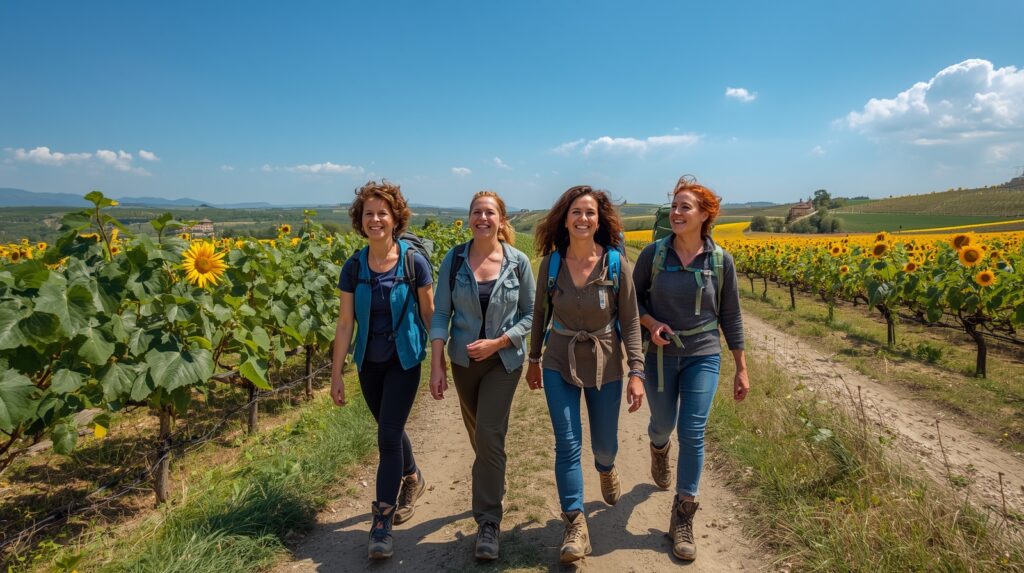








These aren’t ordinary walking holidays. They’re carefully designed immersive experiences that begin the moment you leave home and continue through every step you take on the ancient pilgrimage route. You walk through stunning French countryside, you share stories in circles with my Friesian horses (who are remarkably good listeners and have an uncanny ability to reflect back exactly what you need to see), and we practice staying present with whatever arises, blisters and breakthroughs, rain and revelation.
The focus is on your specific transition, whether you’re navigating divorce, loss, career change, illness, or simply the sense that your next chapter is calling and you’re ready to answer. This is for people who’ve already survived enough to know they’re stronger than they thought, and now want to be more intentional about what comes next.

If your soul is craving fresh air, meaningful movement, and a chance to reconnect with nature, join us on a Camino de Santiago Crossroads Retreat in the southwest of France. This isn’t just a scenic hike – it’s a powerful, natural reboot for your body, mind, and spirit. Imagine quiet paths, rolling hills, cozy evenings, and slow conversations. No fitness requirements. No forced bonding. No pressure to have a breakthrough. Just one foot in front of the other, and a journey that meets you exactly where you are.
You don’t need to have all the answers before you come. You just need to be willing to stop postponing your life until conditions are perfect.
A Closing Reflection
Think about the last time you travelled somewhere significant. Can you remember the journey, or just the arrival?
What would it mean to live your life in such a way that you remembered not just the destinations, but every step that brought you there?

10 Powerful Life Lessons Learned While Walking the Camino de Santiago – a free guide filled with 10 not just “quaint anecdotes” or Instagram-worthy moments (though there are plenty of those) but real transformations from real people who walked the same insight-giving trail you might want to walk one day – Subscribe to my monthly newsletter to Download the Guide

“I am an experienced medical doctor – MBChB, MRCGP, NLP master pract cert, Transformational Life Coach (dip.) Life Story Coach (cert.) Stress Counselling (cert.) Med Hypnotherapy (dip.) and EAGALA (cert.) I may have an impressive number of letters after my name, and more than three decades of professional experience, but what qualifies me to excel at what I do is my intuitive understanding of my clients’ difficulties and my extensive personal experience of managing major life changes using strategies I developed over many years.” Dr M Montagu
Research
Waterhouse J, Reilly T, Edwards B. The stress of travel. J Sports Sci. 2004 Oct;22(10):946-65; discussion 965-6.
Ramsey, J. R., Zhang, Y., Lorenz, M. P., & Hosany, S. (2025). Travel Stress, Leisure Exploration, and Trip Satisfaction: The Mediating Role of Travel Adjustment. Journal of Travel Research.
Abdul Shukor S, Kattiyapornpong U (2024), “Solo female travelers: a systematic literature review and future research agenda”. Consumer Behavior in Tourism and Hospitality, Vol. 19 No. 3 pp. 366–382