
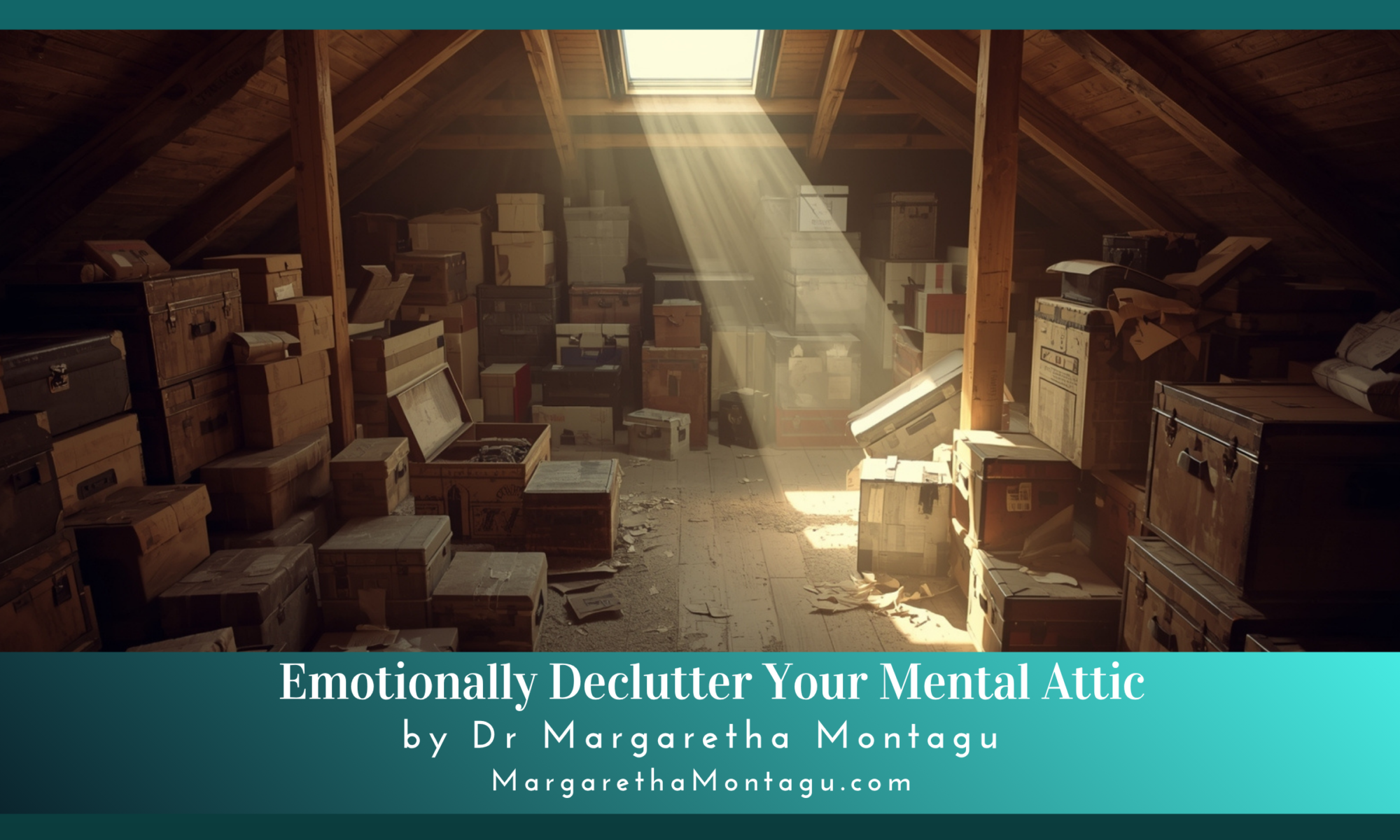
Or: Taking a good look at everything you’ve been meaning to deal with that is rusting or rotting in the rafters of your mind.
This article first appeared on my Substack, Margaretha Montagu’s Stories.
There is a particular kind of horror that only reveals itself in an attic.
Not the horror of spiders, though they are certainly present and clearly thriving. Not even the horror of how much you can accumulate in a lifetime of enthusiastic collecting. No, I’m talking about the deeper, stranger horror of lifting a cardboard lid and discovering that time is not, in fact, linear — that 2009 is apparently right here, in this box, wedged between a broken fondue set and a dress you bought in a moment of optimism that the receipt, typically, firmly states is non-refundable.
I’ve been decluttering my attic here at my little farmhouse in the southwest of France. This is the kind of project you undertake with a brisk, practical energy that lasts approximately forty minutes, at which point you find a letter, or a photograph, or — in my case this week — a handmade birthday card from someone who is no longer alive, and you sit down on a dusty floor to confront your emotions.
This is what the minimalism gurus don’t put on their Instagram grids: that physical clutter and emotional clutter are not two separate problems. They are the same problem, wearing different outfits. Every box is a filing cabinet of unprocessed feelings. Every “I’ll deal with this later”, whether it applies to the broken fondu set or the unresolved grief, you store in your attic, inexplicably heavier every time you try to lift it.
I am an enthusiastic hoarder of emotional experience. I collect feelings the way other people collect commemorative plates: with initial enthusiasm, then habit, then a vague sense that it’s too late to stop now and at least it fills the empty shelves. I keep the resentments that should have been composted years ago. I keep the grief I never quite processed. I keep the guilt about the things I said, and the guilt about the things I didn’t say, and the guilt about not feeling guiltier about either.
Do you do that too?
It’s not surprising that we’re all exhausted.
The technical term for all of this is emotional clutter: the accumulated weight of unprocessed feelings, unresolved conflicts, suppressed emotions, and psychological furniture we’ve been rearranging rather than removing. Unlike the fondue set, it doesn’t sit still and wait patiently. It surfaces at 3 am with remarkable reliability, demanding its moment on stage just when you were desperate for a full night’s sleep.
The good news is that emotional clutter can be cleared. It just requires something slightly more inconvenient than a bin bag and a strong cup of tea. It requires, infuriatingly, that you actually pay attention to it.
Which brings me to Sophie.
Sophie had the slightly bewildered air of someone who had booked one of my Camino de Santiago walking retreats six months ago, in a moment of decisive clarity, and was only now as she arrived in Gascony, beginning to wonder what exactly she’d been thinking.
“I’m not really a walking person,” she told me. “My therapist suggested it. She said I needed to process. I don’t actually know what she meant.”
When I collected her atthe end of her first day’s walk, she was sitting on a low stone wall outside a tiny Romanesque chapel, boots off, looking at her feet with the particular expression of someone who has been crying and has decided to be very casual about it.
“Good walk?” I said.
“Illuminating,” she said, which is a word that means a lot happened and I’m not ready to talk about it yet.
This is normal, I should say. The sheer relentless beauty of the landscape that insists that you pay attention to it, eventually brings you to the door of your mental attic.
Over the next four days, Sophie’s story came out in bits and pieces, the way the best stories always do. Not as a tidy narrative with a beginning and a middle and a lesson, but sideways, in fragments, the way you’d unpack a long forgotten box: holding each thing up to the light, deciding what to do with it.
What was in Sophie’s attic?
There were memories of her mother, for a start.
Her mother had died three years ago, after a long illness that had required Sophie to be extremely competent and extremely present and not, at any point, fall apart, because someone had to manage things, and Sophie was the one who always managed things. She had arranged the funeral with impressive efficiency. She had been a rock. Everyone said so. She had not, in any meaningful sense, grieved, because there had not been a moment designated for it, and afterwards life had simply kept going in its relentless way, and she had kept going with it, and the grief found its way the attic. Into the box labelled later.
“I cried for forty minutes walking between two villages today,” she told me, on day two, matter-of-factly. “I think it was the poppies. They were so very, very red.” She paused. “I think I’ve been meaning to do that for three years.”
There was also her ex-business partner. The friendship and working relationship that had ended badly, in a way that still, four years later, required Sophie to take a specific route through her professional network to avoid ever encountering him at events. She described this detour with the fluency of someone who had rehearsed the neutral version so many times it had become the only version — and then stopped, mid-sentence, on day three, and said: “Do you know what? I am still absolutely furious about that. I thought I’d dealt with it. I haven’t dealt with it at all. I’ve just been carrying it around dressed up as ‘moving on pomptly.'”
She put down her coffee.
“He was genuinely dreadful,” she said, with some satisfaction, and for the first time all week, she looked like a woman who had finally cleared a very dark corner of her mental attic.
There was the matter of her children — adult now, scattered, living lives she was proud of and also occasionally baffled by. She had a particular way of talking about her son’s career change: the careful, supportive language of a mother who had done her very best and was still, in the small hours, wondering if she’d said the wrong thing, at the wrong moment, during a conversation she could recite from memory but still couldn’t quite interpret. Was I too critical? Not critical enough? Did I project? Am I projecting now about whether I projected? Arrrgh!
This is what guilt does. It doesn’t sit still. It metabolises into anxiety, which metabolises into a desperate need to control, which metabolises into exhaustion, which brings you, eventually, to a walking retreat in Gascony asking a near-stranger why you can’t seem to stop feeling guilty.
And then — this one arrived quietly, on the last evening, after dinner, the kind of conversation that happens when good food, good conversations and millions of stars conspire — there was the version of Sophie’s life she had meant to live. The painting she loved, once. The months painting in Italy that never materialised, because something more urgent always had to come first.
“I’m not sure I’ve allowed myself to have dreams of my own,” she said, “in quite a long time.”
“Well,” I said. “It seems like you’ve got some mental decluttering to do.” Always pointing out the obvious, that’s me.
Sophie is not a case study. She is a composite of dozens of guests, and also, frankly, a composite of most people I’ve met, because this is not unusual. This is the standard-issue internal condition of a person who has been living a full, demanding life and doing the entirely normal thing of dealing with urgent before important, and outer before inner, and later before now.
The Japanese concept of Yutori (ゆとり), which means “creating room to breathe,” inspired me to start decluttering my attic. Yutori is the gentle art of creating space in your life, physically, but as I soon discovered, also emotionally.
It seems to me that emotional decluttering can create yutori: room to think, feel, and respond rather than react. When your mind is crowded with unfinished thoughts, worries, and emotional residue, there is simply no room left for yutori.
What you can do to clear some space in your mental attic:
Name the emotion. Vague discomfort has enormous power. Specific discomfort is manageable. “I’m stressed” is not manageable. “I’m still carrying resentment about a friendship that ended badly and I’ve been pretending it’s resolved when actually I’m just avoiding it” — that you can work with.
Feel it. The reason emotional clutter accumulates is that we are collectively very talented at reframing, repressing, and keeping busy. The feeling doesn’t go away; it just moves deeper into storage. Grief needs to be grieved. Anger needs to be addressed. Cry, if you need to cry. Rage if you need to rage.
Forgive. Forgiveness is the most misunderstood item in the emotional decluttering toolkit, because people think it means acceptance. It does not. It means evicting a memory from the penthouse apartment it has been occupying in your head, rent-free, for years. Because carrying resentment is genuinely exhausting and you have better things to do with your energy.
Close the open loops. There is a peculiar tax levied on all unfinished business. The conversation you’ve been putting off. The apology you keep meaning to make. The decision you’ve been holding in ‘pending’ for so long the folder has started to smell – like a blocked drain, not a camembert. Every open loop costs you — inability to concentrate, sleepless nights, a low-level hum of dread that you’ve stopped noticing because it’s always there.
Revisit your dreams. This one is underrated. Emotional clutter isn’t only the heavy negative material — it’s also the dreams that got shelved, the desires that were deemed impractical, the creative self that got set aside when the mortgage materialised. Acknowledging what you actually want, even if you can’t act on it immediately, is not self-indulgence. It’s maintenance.
Stop refilling your mental attic. The relationship that consistently costs more than it gives. Scrolling that leaves you feeling worse. That obligation you so bitterly resent. What comes in matters as much as what you clear out.
At the end of Sophie’s retreat, she wasn’t fixed — that’s not how this works, and anyone who tells you otherwise is selling something. But she was lighter. She’d opened some boxes. She’d looked at the contents properly, in decent light, and made some decisions about what needed to stay and what definitely needed to go.
Walking the Camino de Santiago helps declutter your inner world by stripping life down to its essentials—as you walk, your mind naturally settles and what once felt heavy becomes lighter. Far from the daily demands and distractions of everyday life, you gain perspective on what truly matters, while the physical act of walking helps release emotions stored in the body. Without forcing anything, thoughts surface, feelings are processed, and unnecessary burdens fall away.
If you’re carrying the ever-increasing exhaustion of someone who has been saying “I’m fine” for a bit too long—and if the idea of walking an ancient pilgrimage route sounds like less of a pipedream and more of a return to sanity—I’ve created my Camino de Santiago hiking retreats with you in mind. Even a single day can Even a one-day retreat can clear more mental space than a week of overthinking ever could.
You can find out more here, or simply reply to this post to check availability.

















What Life Lessons Can You Learn While Walking the Camino de Santiago? – a free guide filled with 10 not just “quaint anecdotes” or Instagram-worthy moments (though there are plenty of those) but real transformations from real people who walked this insight-giving trail – Subscribe to my monthly newsletter to Download the Guide

If your soul is craving fresh air, meaningful movement, and a chance to reconnect with nature, join us on a Camino de Santiago Walking Retreat in the southwest of France. This isn’t just a scenic hike – it’s a powerful, natural reboot for your body, mind, and spirit. Imagine quiet paths, rolling hills, cozy evenings, and slow conversations. No fitness requirements. No forced bonding. No pressure to have a breakthrough. Just one foot in front of the other, and finding your way to a brighter future.

“I am an experienced medical doctor – MBChB, MRCGP, NLP master pract cert, Transformational Life Coach (dip.) Life Story Coach (cert.) Stress Counselling (cert.) Med Hypnotherapy (dip.) and EAGALA (cert.) I may have an impressive number of letters after my name, and more than three decades of professional experience, but what qualifies me to excel at what I do is my intuitive understanding of my clients’ difficulties and my extensive personal experience of managing major life changes using strategies I developed over many years.” Dr M Montagu