
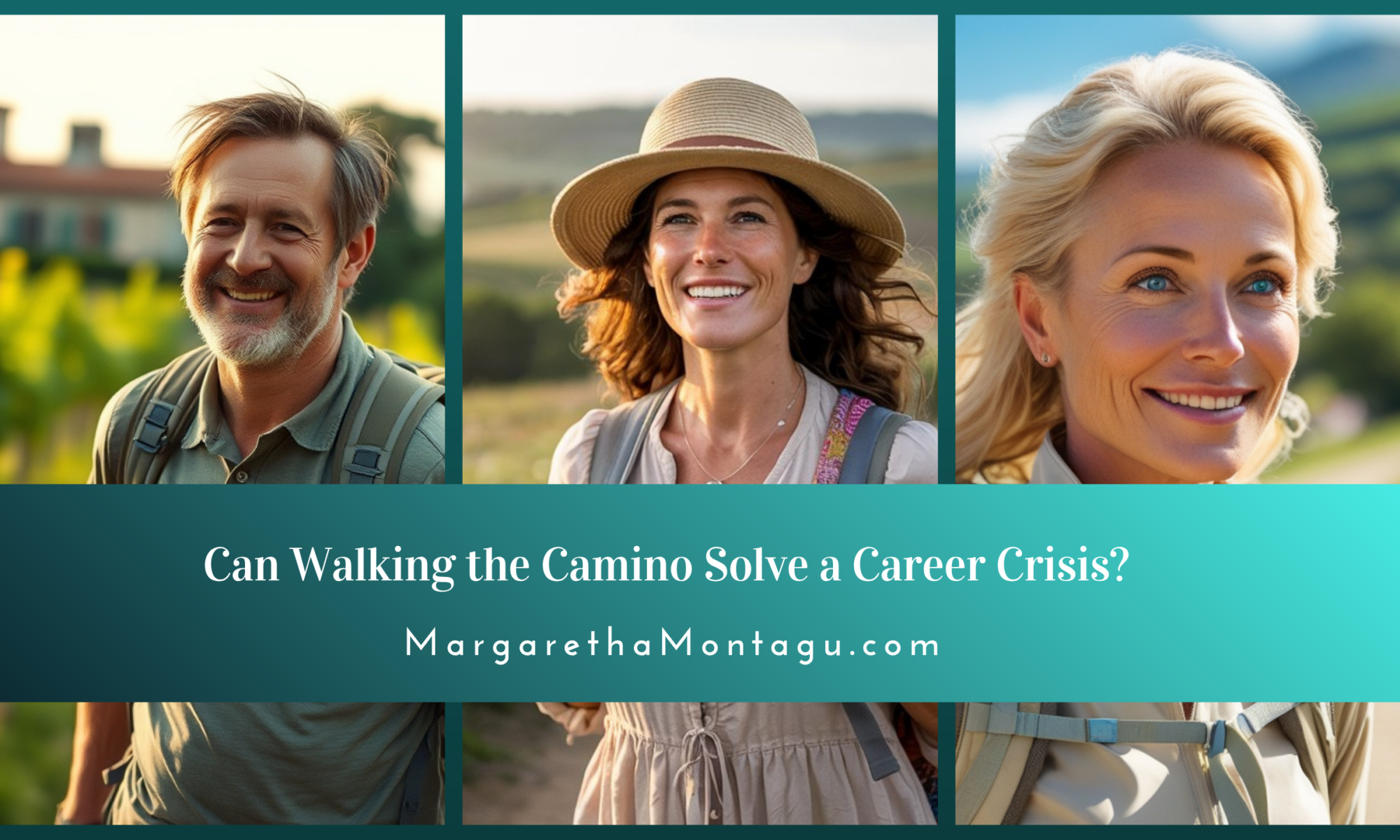
When you’ve outgrown the job, the industry, or possibly the identity you built in your thirties and forties, the Camino has a suggestion: start walking.
Does walking the Camino actually help with a career crisis?
Yes — but not by producing answers directly. A 5-day break with 3 days of sustained walking on the Camino in southwest France reduces rumination and restores the brain’s executive control, measurably, according to Stanford and University of Utah research. That cognitive shift is what makes the underlying career question audible. The clarity people report afterward is a byproduct of the walking, not a guarantee built into the itinerary.
This article explains why that works, what a typical five-day walking retreat involves, how it compares to therapy and career coaching, and what to do with the clarity once you have it. It includes a named case study, three peer-reviewed studies, and a comparison table to help you work out whether what you’re feeling is ordinary work frustration or something that needs more than a holiday to resolve.
5 Key Takeaways
- A career crisis in midlife is not necessarily about failure. It is the signal that an identity built in your thirties has done its job and is ready to be renegotiated — and most workplaces give you no space to hear that signal clearly.
- Walking in nature measurably reduces rumination. A 2015 Stanford study (Bratman et al., PNAS) found a 90-minute nature walk reduced both self-reported rumination and activity in the subgenual prefrontal cortex, the brain region tied to repetitive negative self-focus.
- A five-day break is enough. The shift doesn’t require a sabbatical — it requires enough consecutive days of walking, nature, and removal from professional context for the brain’s default mode network to do the background processing your commute and your inbox don’t allow.
- The Via Podensis through France offer this without overcrowded paths — walkable by anyone reasonably active, not requiring athletic preparation.
- Clarity is not a five-year plan. Most people return from the Camino with a clearer question, if not a finished answer — and that distinction matters more than it sounds, because the wrong plan built on the right question is still the wrong plan.
The Woman Who Had Everything and Couldn’t Explain Why That Was the Problem
Sophia Renard was, by the metrics her industry used to measure such things, doing extremely well. She was forty-six years old, a senior partner at a marketing consultancy in Paris, a woman who had spent twenty-two years building a career with the focused determination of someone who had known exactly what she wanted since her mid-twenties. She had the partnership, the clients, the reputation, the LinkedIn profile that was, if she were being objective, genuinely impressive.
She had also, for approximately two years, been waking at four in the morning. Not with anxiety exactly — just awake, her mind running at full capacity with nothing in particular to process, which was somehow more disconcerting than if it had been processing something specific. Her doctor said the things doctors say. Her husband Luc suggested she was working too hard, which was accurate and not useful. A therapist asked good questions she answered articulately and left no clearer than when she arrived.
The Camino was Luc’s idea, framed carefully as a holiday rather than a prescription. She arrived in the French countryside on a Saturday in October, had dinner with the small group of other walkers, said little, and went to bed at nine.
She woke at four. Out of habit she reached for her phone, then put it face-down and lay listening to a silence that was older and less pressured than the Paris one. She began walking the next morning through French farmland that looked as though it had been managing perfectly well for centuries.
On the second day, on a long straight section between two villages whose names she’d already forgotten, a thought arrived so simple it stopped her walking.
She had spent twenty-two years doing what she’d decided she wanted at twenty-four. She had done it extremely well. And somewhere in the last two years, without ceremony, she had finished wanting it. Not the work — the wanting. The drive. It had quietly redirected itself somewhere she hadn’t yet looked.
She stood on the path for a long moment. A bird she couldn’t identify called from a field to her left. She began walking again. She did not have the answer yet. For the first time in two years, she had the question — and the question turned out to be most of the work.
Is what you’re feeling a career crisis, or just a bad few months?
The two are easy to confuse and respond to different things. Ordinary work frustration eases with a holiday and is usually tied to a specific project, person, or deadline. A deeper identity-level shift persists across good weeks and bad ones, shows up as unexplained early waking, and doesn’t lift when something at work goes well.
Here is a quick way to tell the difference before you book anything — a holiday for the first, a different kind of break for the second:
| Signal | This is restlessness | This is something else |
| Frequency | Comes and goes with workload, eases on holiday | Persists even when the work itself is going well |
| Focus | Frustration with a specific project, boss, or team | A diffuse sense that the role itself no longer fits |
| Sleep | Occasional bad nights before a deadline or review | Recurring early waking with no specific trigger |
| Response to success | A win resolves the feeling, at least for a while | A win registers but doesn’t touch the underlying flatness |
| Timeframe | Weeks | Many months to several years |
Why does walking bring career clarity?
Walking in nature shifts the brain into its default mode network — a state of undirected, self-referential thinking associated with insight and autobiographical processing. Professional environments do the opposite: meetings, inboxes, and targets keep the brain in directed-attention mode, which actively suppresses the kind of background processing a career question needs to surface.
This matters because the modern response to career uncertainty — career assessments, coaching frameworks, five-year plans — assumes clarity comes from more analysis. That assumption solves the wrong problem. A career crisis in midlife is rarely a lack of information. It’s a perception problem: you already have the data, you just can’t see your own situation clearly enough from inside it, because the environment that produced the question is also the environment preventing you from answering it.
The career clarity the Camino produces isn’t the result of thinking harder about the problem. It’s the result of finally, for three consecutive days, thinking about something else — and letting the brain do the work it’s been trying to do at four in the morning for two years.
Removing the professional context matters too. Identity at work is environment-dependent: take the office, the title, and the inbox away, and the role becomes visible as a construction rather than a fact. On the Via Podensis, you are not the senior partner. You are a person walking through a Gascon forest. For most people carrying significant professional identity, that’s unexpectedly clarifying.
How does a Camino walking retreat compare to therapy or career coaching?
Each tool does something different, and the comparison helps clarify which one you actually need right now.
| Approach | Best for | Limitation |
| Therapy | Processing specific emotional content, patterns, or past experience with professional support over time | Talk-based; doesn’t directly engage the nature-walking mechanism that reduces rumination |
| Career coaching | Structuring a known goal into an action plan, CV, or transition strategy | Assumes you already know what you want; doesn’t help if the question itself is unclear |
| Camino retreat | Creating the cognitive conditions for the question to surface clearly in the first place | Produces clarity, not a finished plan — you still need to act on what it reveals |
Many people use these in sequence rather than as alternatives: the Camino to find the real question, then coaching or therapy to work out what to do about it.
What does a five-day French Camino walking retreat actually involve?
For anyone picturing a religious pilgrimage with hostel dormitories and strangers with blisters, the small-group version looks different in practice:
- Three guided walks across the retreat, typically 10–15km per day on the Via Podensis — slightly shorterthan the daily stage range walked on the full French Camino routes, but paced for a three-day walk rather than a month-long pilgrimage.
- Same, comfortable accommodation each night — proper beds, in a 200-year-old farmhouse — with a maximum of four guests per retreat, so the group stays small enough for real conversation.
- Meals built around the regional Gascon table: the kind of food that makes the evenings as memorable as the walking.
- Unstructured time built in deliberately — afternoons and evenings with nothing scheduled, because the clarity this article describes tends to arrive unscheduled. If you can walk for two to three hours without significant difficulty, and you’ve done some walking in the weeks beforehand, you’re ready.
5 Mistakes to Avoid
1. Bringing the laptop. A significant number of people bring their work as a security object, not intending to use it but unable to commit to five days without it nearby. Leave it. The insight you need cannot be found in a browser tab.
2. Using the walk as a strategy session. The temptation is to think hard and systematically about the career question while walking. This produces the same circular thinking the four o’clock mornings already produce. The clarity arrives in the gaps between thoughts, not in the thoughts themselves.
3. Expecting a five-point plan to fall out of the French sky. The Camino produces clarity — a sense of what matters — not a strategy document. Arrive expecting a direction, not a finished route.
4. Treating restlessness as failure. A career crisis at midlife is frequently a sign you’ve accomplished enough of what you set out to do that you’re now free to ask what’s next. That reframe is uncomfortable and accurate.
5. Not acting on what the walk reveals. The clarity is real but fragile once ordinary life reconvenes. Write down what you understood before you land, and identify one small, concrete next step before the week is out.
Further Reading
Designing Your Life by Bill Burnett and Dave Evans
Two Stanford professors apply design thinking to building a career that actually fits, using prototyping and curiosity rather than five-year planning. Most useful after the Camino, when the clarity is fresh and the question becomes what to do with it.
The Second Mountain by David Brooks
Brooks argues that the first mountain — career, achievement, accumulated professional identity — gives way in midlife to a second mountain: vocation over career, depth over breadth. It names, with precision, the exact transition this article describes.
Embracing Change — in 10 Minutes a Day
Career renegotiation is a change problem — not dramatic enough to force itself, not comfortable enough to ignore. Margaret Montagu’s Embracing Change — in 10 Minutes a Day offers a practical framework for the daily choices that move you toward the life you want. Read it on the flight home, when the question shifts from what do I want to how do I begin.

If you are currently facing a major life transition or any other dramatic change in your circumstances, and you have no idea how you are going to cope, the good news is that the strategy presented in this book can help you, step by step, to improve your ability to handle the stress caused by change, even if you feel entirely powerless at the moment.
If a career crisis has you questioning whether you’ve simply outgrown structure altogether, Walking to Reduce Anxiety: The Ancient Art of Walking Your Worries Away on the Camino de Santiago looks at the broader case for walking as a reset for an overloaded nervous system.
If the uncertainty you’re feeling is less about career and more about a creeping sense of stuckness in general, How to Retire From Stress (Even If You Can’t Retire From Work) covers the high-performer’s version of this problem in more detail.
And if you’re approaching this as a sceptic who doesn’t buy the idea that a walk can fix anything, The Camino for Sceptics was written for exactly your objection.
5 FAQs
Can walking actually produce career clarity, or is that wishful thinking?
The neuroscience supports it. Walking in nature activates the brain’s default mode network, the state associated with insight and self-referential processing, while reducing the cortisol and mental fatigue that cloud judgement. It’s not magic — it’s measurable neuroscience plus five days of uninterrupted silence.
What if I spend the whole retreat worrying about work instead of thinking clearly?
This is the most common day-one experience and it resolves quickly. By day two, most people report the work worry has receded to background noise; by day three it’s frequently inaudible. The walking itself does this work — you don’t have to force it.
I’m not ready to decide anything — is the retreat still worth it?
Yes. The Camino is a clarity tool, not a decision-making tool, and clarity is the prerequisite for any useful decision rather than the decision itself. Most people leave with a clearer question, not a finished plan — which is the more valuable outcome at this stage.
How do I justify five days away to my employer or to myself?
Five days of annual leave needs no justification to your employer. Internally: the person who returns with real clarity about the next decade of their working life is a more valuable professional than the one still waking at four every morning running a job that no longer fits.
What if the clarity I find is something I don’t want to act on?
Then you have clarity and a choice, which is more than you had before. Some people return knowing, for the first time with certainty, that they want to stay exactly where they are — and find that certainty arrived at through walking feels entirely different from certainty assumed by default.
Sophia Renard came home from France on a Thursday and was back in the Paris office by Monday — faster, she admitted, than strictly necessary. But she came back differently, carrying something two years of four o’clock mornings hadn’t managed to produce on their own.
She had not resigned or restructured anything visible. What she had done, somewhere on a straight section of the Via Podensis, was locate the thing that had shifted — and understand it as a direction to follow slowly, not a problem to solve immediately. She stopped waking at four most nights within a few weeks. Luc noticed. He said nothing, which was one of the things she had always liked best about him.
If you’ve been waking at four in the morning with a mind that has something to say and nowhere to say it, spring and autumn retreats on the Camino de Santiago in southwest France are available for small groups of up to four guests. Three non-guided walks through the Gascon countryside, proper rest, regional food, and the particular quality of silence that tends to make the important things audible.
Find out more and book your retreat
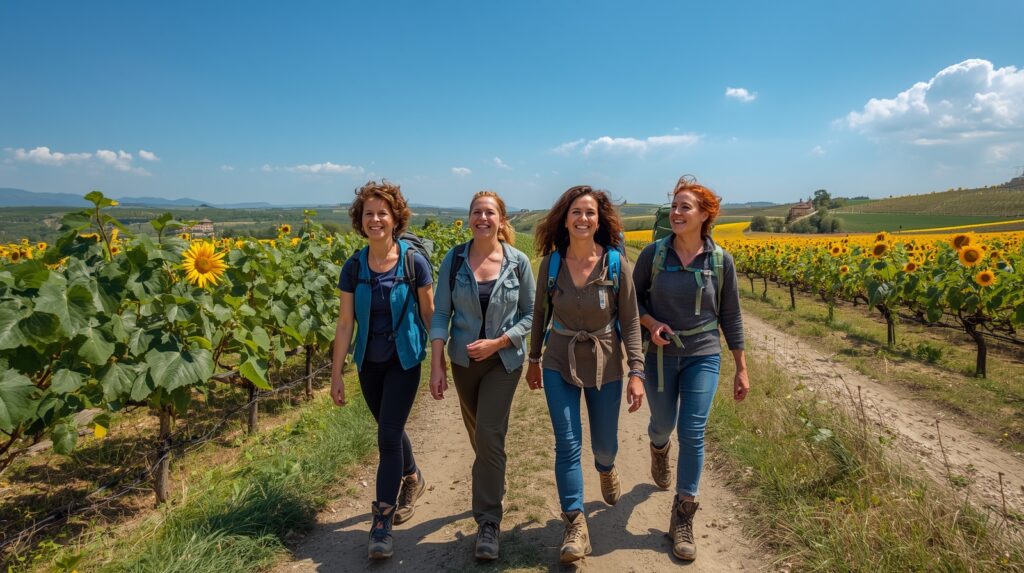


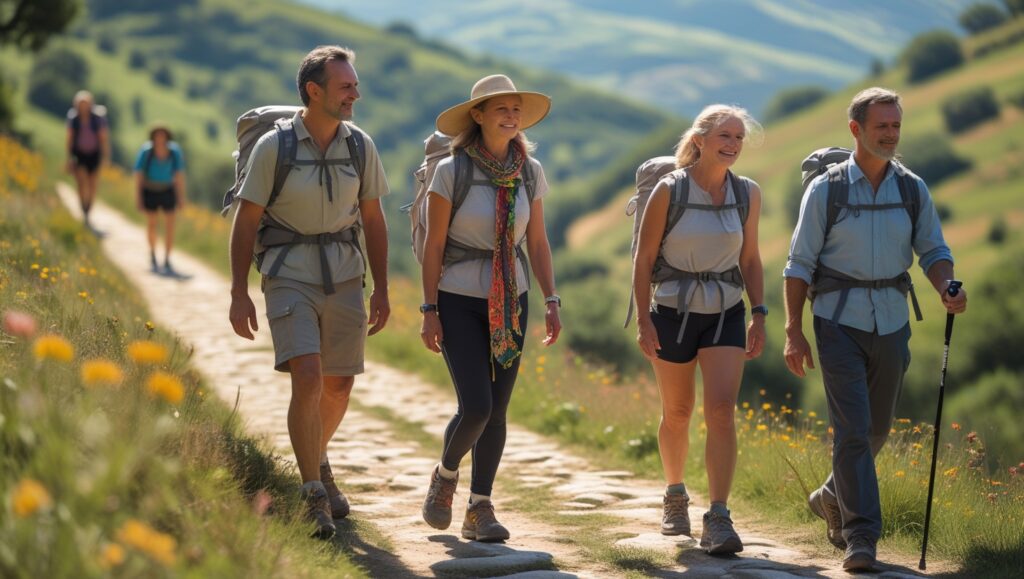










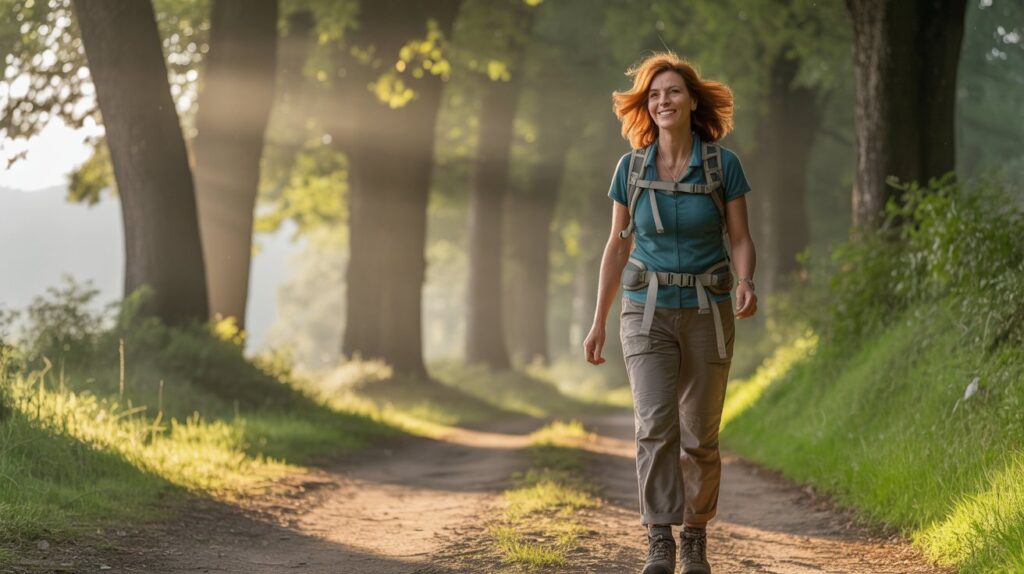
| Think of asking your employer to pay for this stress-reducing break; you can motivate your application by mentioning that, according to Forbes, approximately 70% of people experienced burnout in the last year. Work-related consequences include job dissatisfaction, decreased productivity, poor performance, professional mistakes, absenteeism, quiet quitting and resignations, resulting in a high turnover rate. Although conditions at work may also need improvement, a retreat focused on stress management, led by a medical doctor, can contribute significantly to preventing burnout in employees. |
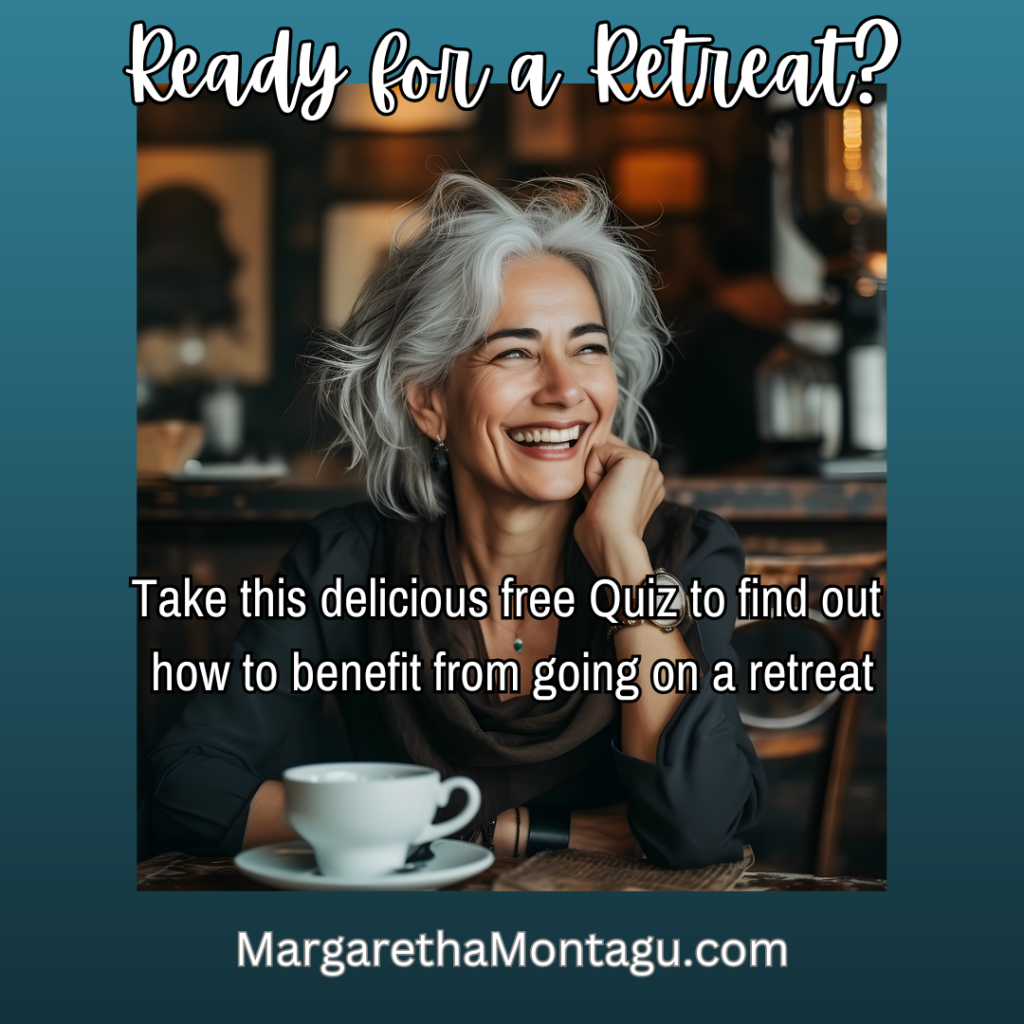
Do you dream of escaping your stressful life to raise a herd of goats or grow sunflowers in the south of France? Then you may be ready for an Esprit Meraki retreat. Get access to this “very serious” quiz to help you figure out how urgent your need for a change of scenery is, when you subscribe to my monthly newsletter.
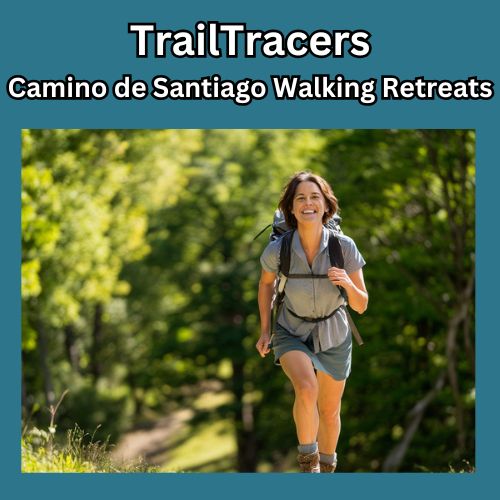
If your soul is craving fresh air, meaningful movement, and a chance to reconnect with nature, join us on a Camino de Santiago Walking Retreat in the southwest of France. This isn’t just a scenic hike – it’s a powerful, natural reboot for your body, mind, and spirit. Imagine quiet paths, rolling hills, cozy evenings, and slow conversations. No fitness requirements. No forced bonding. No pressure to have a breakthrough. Just one foot in front of the other, and finding your way to a brighter future.

“I am an experienced medical doctor – MBChB, MRCGP, NLP master pract cert, Transformational Life Coach (dip.) Life Story Coach (cert.) Stress Counselling (cert.) Med Hypnotherapy (dip.) and EAGALA (cert.) I may have an impressive number of letters after my name, and more than three decades of professional experience, but what qualifies me to excel at what I do is my intuitive understanding of my clients’ difficulties and my extensive personal experience of managing major life changes using strategies I developed over many years.” Dr M Montagu
3 Peer-Reviewed Research Articles That Support This Article
The claims above are grounded in published research, not impression. Each study below addresses a specific mechanism this article relies on.
1. Nature Experience Reduces Rumination and Subgenual Prefrontal Cortex Activation
Bratman, G.N., Hamilton, J.P., Hahn, K.S., Daily, G.C., & Gross, J.J. (2015). Proceedings of the National Academy of Sciences, 112(28), 8567–8572.
Stanford researchers compared a 90-minute walk in nature against an equivalent urban walk. The nature-walk group showed significantly reduced self-reported rumination and measurably lower activity in the subgenual prefrontal cortex — the region tied to repetitive negative self-focused thought. This is the direct evidence for why the four-in-the-morning loop quietens on a walking retreat.
2. How a Walk in Nature Restores Attention and Improves Executive Control
McDonnell, A. & Strayer, D. University of Utah, Department of Psychology.
Using EEG monitoring on 92 participants, this study found that a 40-minute walk through nature — but not through an equivalent urban route — produced measurable improvements in executive control, the prefrontal-cortex function governing decision-making and working memory. This is the mechanism behind clearer, calmer thinking after walking, not just calmer feeling.
3. Attention Restoration Theory
Kaplan, R. & Kaplan, S. (1989). The Experience of Nature: A Psychological Perspective. Cambridge University Press.
The foundational framework explaining why natural environments allow directed-attention fatigue to recover. The Kaplans’ theory of ‘soft fascination’ — the effortless attention nature requires compared with the demands of a screen or a meeting — explains why five consecutive days produces a depth of mental recovery that a single evening off cannot.