How Helping Just One Person Can Change Hundreds of Lives (The Ripple Effect of Purpose)

What is the purpose of LIfe?

“No act of kindness, no matter how small, is ever wasted.” – Aesop

What if I told you that helping just one person could transform hundreds of lives? It sounds like wishful thinking, but science backs it up. This article explores the profound ripple effect that occurs when we focus our energy on genuinely helping one individual. Through the story of Maggie Smith, a struggling teacher who discovered her purpose, we’ll uncover how small acts of intentional kindness create exponential change. You’ll learn five key principles for maximising your impact, discover practical exercises to identify your ripple-starting moments, and understand why purpose-driven action always trumps scattered good intentions.

What Is The Purpose Of Life?

We live in a world obsessed with scale. Bigger is better. More followers, more likes, more impact. But here’s what the metrics-obsessed culture doesn’t want you to know: the most profound changes in human history started with one person helping one other person.

Not a thousand. Not a million. One.

The mathematics of kindness work differently than the mathematics of capitalism. When you genuinely help one person transform their life, you’re not just changing their story—you’re rewriting the stories of everyone they’ll touch for the rest of their existence.

Let me tell you about Maggie Smith, and how her decision to truly see one struggling student didn’t just save a life—it created a legacy that’s still growing decades later.

The Teacher Who Almost Quit (Maggie’s Story)

The fluorescent lights hummed their familiar tune of institutional despair as Maggie Smith sat at her desk, surrounded by towers of ungraded papers that seemed to mock her dwindling enthusiasm. The coffee in her chipped mug had gone cold hours ago, leaving behind a bitter residue that matched the taste in her mouth about her teaching career.

It was November 2003, and after fifteen years in the classroom, Maggie was ready to surrender. The smell of industrial disinfectant mixed with teenage body spray created that uniquely public-school cocktail that used to energise her but now made her stomach turn. She could hear the distant sound of lockers slamming and sneakers squeaking against linoleum—sounds that once meant possibility but now felt like prison bars closing.

Her resignation letter sat in her top drawer, three paragraphs of polite defeat that she’d rewritten seventeen times. The principal was expecting it Monday morning.

That’s when she noticed him.

Marcus Williams sat in the back corner of her third-period English class, his shoulders hunched like he was trying to disappear into his oversized hoodie. While other students chattered about weekend plans, Marcus stared at his desk with the intensity of someone studying hieroglyphics. His notebook remained closed, his pen untouched.

For weeks, Maggie had mentally filed Marcus under “Disengaged” and moved on. There were twenty-eight other students who raised their hands, turned in assignments, and gave her something to work with. Marcus was just… there. A warm body filling a seat until graduation set him free.

But something about his stillness caught her attention that grey November afternoon. Maybe it was the way his fingers trembled slightly as he gripped the edge of his desk. Maybe it was how he jumped when the bell rang, as if he’d forgotten where he was. Or maybe it was the fresh bruise barely visible beneath the sleeve of his sweatshirt.

After class, Maggie watched Marcus gather his things with the careful precision of someone who’d learned that drawing attention meant trouble. He moved like he was underwater, every action deliberate and quiet.

“Marcus,” she called softly. “Could you stay for just a minute?”

His whole body tensed. The few remaining students filtered out, their voices fading down the hallway until only the hum of fluorescent lights remained.

“Am I in trouble?” His voice was barely a whisper, and Maggie’s heart clenched at the raw fear in it.

“No, honey. Not at all.” She pulled a chair close to her desk, the metal legs scraping against the floor. “I just wanted to check in. How are you doing?”

Marcus’s laugh was sharp and humourless. “I’m fine.”

But his hands told a different story, fidgeting with the frayed edge of his notebook. The faint smell of cigarettes and something else—fear, maybe—clung to his clothes.

Maggie had asked this question a thousand times to a thousand students. Usually, “fine” was enough. Keep the conversation light, acknowledge their existence, move on. But looking at Marcus—really looking—she saw something that made her pause.

In his eyes, behind the careful walls he’d built, was a flicker of the same desperation she felt. The bone-deep weariness of someone who’d stopped believing things could get better.

Instead of accepting his “fine,” Maggie leaned forward slightly. “Marcus, what I’m about to tell you might sound crazy, but I need you to hear it. I think you have something important to say. I think you have stories in you that the world needs to hear.”

Marcus blinked, confusion replacing the guarded expression on his face.

“I don’t know what’s going on at home,” Maggie continued, her voice steady despite the way her heart was racing. “I don’t know what voices are telling you that you don’t matter. But I’m telling you that you do. And I’d like to help you find those stories, if you’ll let me.”

The silence stretched between them like a held breath. Through the windows, Maggie could see other teachers heading to their cars, eager to escape for the weekend. She should be packing up too, getting home to her own family. But something about this moment felt bigger than schedules and routines.

Finally, Marcus spoke. “What if there’s nothing there? What if I’m just… empty?”

The question hung in the air, raw and honest. Maggie recognised it as the same question she’d been asking herself for months. What if she’d used up all her good ideas? What if she had nothing left to give?

“Then we’ll start with that,” she said. “We’ll start with empty, and we’ll see what grows.”

That conversation lasted twenty-three minutes. Twenty-three minutes that changed everything.

Over the following weeks, Maggie began staying after school twice a week with Marcus. Not for tutoring or makeup work, but for conversations. Real ones. She brought hot chocolate in a thermos—the good kind with actual marshmallows—and they talked about books, about dreams, about the weight of carrying secrets.

Slowly, Marcus began to write. First, fragments. Observations about the way rain sounded different depending on whether you felt safe inside or were trying to find shelter. Descriptions of his younger sister’s laugh, bright and untouched by the darkness that filled their apartment. Memories of his grandmother’s hands, how they could make anything feel better just by smoothing his hair.

The writing was raw, powerful, and heartbreakingly honest. Maggie felt her own purpose rekindling as she watched Marcus discover his voice. The resignation letter in her drawer became a relic of a different person—someone who’d forgotten that teaching wasn’t about curriculum standards or test scores. It was about seeing the spark in someone and refusing to let it die.

By spring, Marcus had written enough pieces for a small collection. But more than that, he’d started talking to other students. Kids like Alicia, who cut herself in the bathroom stalls. David, whose stutter made him retreat into silence. Sarah, whose eating disorder was slowly killing her.

Marcus began sharing his writing with them, and something magical happened. They started writing too. Not because they had to, but because they’d seen someone like them—someone who understood darkness—create light with words.

That small group became the foundation for a peer support program that’s still running at the school today. Marcus went on to become a social worker, dedicating his life to helping at-risk youth. But his influence didn’t stop there.

The students he reached in high school carried his lessons forward. Alicia became a counsellor specialising in self-harm recovery. David overcame his stutter and now teaches public speaking to kids with speech difficulties. Sarah founded a nonprofit focused on body positivity and mental health.

Each of them helped dozens of others. Those dozens helped hundreds more. The ripple effect from Maggie’s twenty-three-minute conversation with one struggling student has now touched thousands of lives across multiple generations.

Marcus still sends Maggie Christmas cards. He’s thirty-eight now, married with twin daughters, and his organisation has helped over 2,000 young people find their voices. In his cards, he always includes the same message: “Thank you for seeing me when I couldn’t see myself.”

But here’s what Marcus doesn’t know: that conversation saved Maggie too. It reminded her why she became a teacher in the first place and gave her thirty more years of purposeful impact in the classroom. She never did turn in that resignation letter.

Instead, she framed it as a reminder that our biggest breakthroughs often come disguised as our darkest moments, and that sometimes the person you save by helping someone else is yourself.

Five Key Takeaways: The Science of Ripple Effects

1. Quality Over Quantity Creates Exponential Impact

The research is clear: deep, meaningful help to one person creates more lasting change than surface-level assistance to many. When you invest genuinely in someone’s transformation, you’re not just changing their trajectory—you’re potentially altering every relationship they’ll have for the rest of their life.

2. Purpose Is Contagious

Research also shows that when we witness someone living with clear purpose, it activates our own sense of meaning. Maggie’s renewed sense of purpose after helping Marcus didn’t just benefit her—it radiated to every student she taught afterwards.

3. Trauma-Informed Kindness Multiplies

When you help someone heal from their wounds, you don’t just stop their pain—you prevent them from passing that trauma to others. Every person Marcus helped was someone who didn’t have to carry forward the cycle of hurt he experienced.

4. Small Actions + Consistent Presence = Massive Change

Maggie didn’t need a grand gesture or unlimited resources. She needed twenty-three minutes of genuine attention and a willingness to show up consistently. The compound effect of small, purposeful actions always outweighs sporadic grand gestures.

5. Your Ripples Outlive You

The most profound impact often occurs decades after the initial help. Maggie’s influence lives on through Marcus, through the students he helps, through their future families and communities. Purpose-driven action creates legacy by default.

Exercises to Identify Your Ripple Moments

Narrative Journaling Prompt

Write about a time when someone’s belief in you changed your trajectory. Use all five senses to bring the memory to life:

  • What did you see in their face when they looked at you?
  • What sounds surrounded that moment?
  • What physical sensations did you experience?
  • What did hope smell/taste like?
  • How did their faith in you change your own inner voice?

Now flip the perspective: When have you been that person for someone else? What ripples might you have started without realising it?

The One-Person Impact Audit

  1. Identify three people currently in your life who seem to be struggling or searching
  2. For each person, write down:
    • One specific way you could offer meaningful help
    • What unique perspective or skill you bring to their situation
    • How helping them aligns with your own sense of purpose
  3. Choose one person and commit to one specific action this week

The Legacy Letter Exercise

Write a letter to yourself from the perspective of someone whose life you helped transform, twenty years from now. Let them tell you about the ripple effects of your kindness—how it changed not just them, but their children, their community, their purpose. This exercise helps you see the long-term potential of present-moment compassion.

The impact I have on people is my entire purpose. Both my and my company’s purpose is to help people find their flow and attain the freedom they need to thrive. Without a focus on other people, I feel my purpose would be empty and unfulfilling.

—Arman Assadi, co-founder and CEO, Project EVO

My philosophy is that we’re all put on this earth to be part of the same team. I try to help anyone I can any way I can, and I’m very grateful to be surrounded by friends and colleagues who share the same view and passion for paying it forward.

—Brittany Hodak, Co-Founder, The Superfan Company

My kids are my life’s purpose. I want to be sure I’m setting a good foundation for them and am able to provide the best opportunities for them. I know they are always watching me both in and outside of the octagon and I want to be a good example for them.

Tyron Woodley, UFC welterweight champion


Ready to Find Your Life Purpose?

Feeling inspired but not sure where to start? You’re not alone. Many people want to create a meaningful impact but feel overwhelmed by the endless needs around them.

That’s exactly why I created my free quiz: “Ready to Find Your Life Purpose?” Take this quiz today, because the world doesn’t need another person trying to save everyone—it needs you helping the one person only you can reach.

Further Reading

  • “The Tipping Point” by Malcolm Gladwell – Explores how small changes can make a big difference
  • “Half the Sky” by Nicholas Kristof and Sheryl WuDunn – Powerful examples of individuals creating massive social change
  • “The Power of Moments” by Chip Heath and Dan Heath – The science of creating transformative experiences
  • “Option B” by Sheryl Sandberg and Adam Grant – Building resilience and helping others through difficult times
  • “Man’s Search for Meaning” by Viktor Frankl – The foundational text on finding purpose through service

Frequently Asked Questions

Q: What if I don’t feel qualified to help anyone else when I’m struggling myself?

A: Some of our most powerful help comes from our wounds. Maggie was ready to quit teaching when she helped Marcus—her vulnerability made her more, not less, effective. Your struggles give you credibility and compassion that someone who’s “figured it all out” simply can’t offer.

Q: How do I know if I’m actually helping or just interfering?

A: The key is invitation, not invasion. Notice genuine need, offer specific help, and let the other person choose whether to accept. Maggie didn’t try to solve all of Marcus’s problems—she simply offered to help him find his voice.

Q: What if the person I help doesn’t seem to create ripples of their own?

A: Remember that ripples often happen invisibly and across long timeframes. Your help might prevent someone from making a destructive choice, which affects every person they would have hurt. Sometimes the ripple is what doesn’t happen.

Q: I’m an introvert—can I still create a meaningful impact?

A: Absolutely. Some of the most powerful help happens in quiet, one-on-one conversations. Introverts often excel at deep, meaningful connections that create lasting change. Your preference for quality over quantity is actually an advantage in ripple creation.

Q: How do I avoid burnout while trying to help others?

A: Focus on your “one person” rather than trying to help everyone. Set clear boundaries around your time and emotional energy. Remember that sustainable help comes from a full cup, not an empty one. This is exactly what my “Overwhelm to Opportunity” guide addresses—download it for specific strategies.

Conclusion

The world doesn’t need you to save everyone. It needs you to truly see someone. To offer the kind of deep, purposeful help that transforms not just their story, but the stories of everyone they’ll touch for the rest of their life.

Maggie Smith thought she was just having a conversation with a struggling student. She had no idea she was starting a revolution of kindness that would span generations. That’s the beautiful secret of ripple effects—they always start bigger than you think and grow beyond what you can imagine.

Your one person is waiting. They might be sitting in the back corner of your metaphorical classroom, shoulders hunched, convinced they’re invisible. Or they might be the person in your family, your neighbourhood, your workplace who’s been carrying a burden too heavy for one person to bear.

The question isn’t whether you have something to offer—you do. The question is whether you’ll trust that twenty-three minutes of genuine attention might just change hundreds of lives.

The ripples are ready to begin. All they need is you to make the first splash.

Ready to start your ripple effect? Register for the Purpose Pursuit Protocol or the Purpose Pivot Protocol and discover how to identify your unique gifts, find your ideal person to help, and create sustainable impact that energises rather than drains you. Because the world is waiting for the change only you can create.

The Purpose Pursuit Protocol – if you want to discover your life purpose, this course will provide you with the clarity, motivation and direction you need to manifest your next chapter – in both your personal and professional life. Get immediate access

The Purpose Pivot Protocol – drawing inspiration from the Camino de Santiago, this transformative course guides you through a proven framework to recalibrate your authentic purpose and create a meaningful and fulfilling next act. Get immediate access

“I am an experienced medical doctor – MBChB, MRCGP, NLP master pract cert, Transformational Life Coach (dip.) Life Story Coach (cert.) Stress Counselling (cert.) Med Hypnotherapy (dip.) and EAGALA (cert.) I may have an impressive number of letters after my name, and more than three decades of professional experience, but what qualifies me to excel at what I do is my intuitive understanding of my clients’ difficulties and my extensive personal experience of managing major life changes using strategies I developed over many years.” Dr M Montagu

References

  • Kim ES, Chen Y, Nakamura JS, Ryff CD, VanderWeele TJ. Sense of Purpose in Life and Subsequent Physical, Behavioural, and Psychosocial Health: An Outcome-Wide Approach. Am J Health Promot. 2022 Jan;36(1):137-147. 
  • Ryff, C. D., & Singer, B. H. (2004). Psychological well-being: Meaning, measurement, and implications for psychotherapy research. Psychotherapy and Psychosomatics, 73(4), 183-192.
  • Steger, M. F., Oishi, S., & Kashdan, T. B. (2009). Meaning in life across the life span: Levels and correlates of meaning in life from emerging adulthood to older adulthood. The Journal of Positive Psychology, 4(1), 43-52.
  • Schippers MC, Ziegler N. Life Crafting as a Way to Find Purpose and Meaning in Life. Front Psychol. 2019 Dec 13;10:2778. 
  • Zika, S., & Chamberlain, K. (1992). On the relation between meaning in life and psychological well-being. British Journal of Psychology, 83(1), 133-145.
  • Sutin AR, Luchetti M, Aschwanden D, Lee JH, Sesker AA, Stephan Y, Terracciano A. Sense of purpose in life and concurrent loneliness and risk of incident loneliness: An individual-participant meta-analysis of 135,227 individuals from 36 cohorts. J Affect Disord. 2022 Jul 15

What to Expect at a Retreat: What Turns Ordinary Retreats Into Life-Changing Experiences?

what to expect at a retreat

The counterintuitive secret to getting everything you need from your retreat experience

What to expect at a retreat? Your retreat contribution isn’t about being the loudest voice or the perfect participant—it’s about showing up authentically, creating space for others while honouring your own needs, and remembering that your unique perspective is exactly what the group needs to hear.

Introduction: The Uncomfortable Truth About Retreats

Here’s something retreat leaders won’t tell you in their glossy brochures: the magic doesn’t happen because of the facilitator, the stunning location, or even the carefully curated program. The real transformation occurs in the spaces between—in the shared vulnerability of strangers becoming witnesses to each other’s stories, in the collective exhale when someone finally speaks their truth, and yes, in what YOU bring to the circle.

Most people approach retreats like spiritual consumers, wondering what they’ll get out of the experience. But what if I told you that the participants who transform the most are the ones who flip this question entirely? What if the secret to profound personal breakthrough lies not in what you receive, but in what you’re willing to give?

Lisa’s Story: The Reluctant Retreat Revolutionary

Lisa Tredoux had never been the sharing type. At 42, she was more comfortable analysing quarterly reports than analysing her feelings, more at ease commanding boardroom presentations than sitting in meditation circles. So when her sister gifted her a spot at a women’s retreat in the mountains of New Mexico—”because you desperately need this, Lis”—she almost didn’t go.

The morning of departure, Lisa stood in her pristine kitchen, the smell of her usual black coffee mixing with the unfamiliar scent of the patchouli soap her sister had insisted she pack. The retreat centre had sent a list of “suggested items to bring,” and Lisa had methodically checked each box: journal (unused, purchased specifically for this), comfortable clothes (her definition being yoga pants that still had tags), and an “open heart” (whatever that meant).

The drive to the retreat centre wound through high desert landscape, the autumn air crisp against her rental car windows. As red rock formations grew larger in her windshield, Lisa’s stomach churned with something she hadn’t felt since her first job interview—the uncomfortable mixture of excitement and terror that comes with stepping into unknown territory.

The retreat centre itself was nothing like the corporate hotels where Lisa usually stayed for conferences. Adobe walls the colour of sunset, wooden beams that creaked with stories, and the overwhelming scent of sage and something else—something that smelled like possibility, though Lisa wouldn’t have named it that then.

During the opening circle, twenty-three women sat on cushions arranged around a small altar decorated with crystals, feathers, and photographs. Lisa perched uncomfortably on her cushion, her corporate blazer feeling absurdly out of place as women shared their intentions. She listened to stories of divorce, career changes, spiritual seeking, and general life upheaval, planning to keep her own sharing brief and surface-level.

But when the talking stick—a piece of driftwood wrapped in leather and beads—made its way to her hands, something unexpected happened. The weight of it felt substantial, grounding. Lisa looked around the circle at faces she’d known for only two hours, faces that somehow already felt familiar, and heard herself say, “I don’t know why I’m here. My sister says I’ve forgotten how to be human.”

The words hung in the air like smoke from the altar’s smouldering sage. Lisa’s throat tightened with the vulnerability of it, but instead of judgment, she saw nods of recognition around the circle. Sarah, the yoga teacher from Portland, gave her a small smile. Maria, the recently divorced mother of three, reached over and briefly touched her knee.

By the second day, something shifted. During a partnered exercise, Lisa found herself paired with Janet, a soft-spoken librarian from Minnesota who was grieving her mother’s recent death. As Janet spoke about feeling invisible in her grief, Lisa recognised something in her voice—the same isolation she felt in her corner office, surrounded by success but starving for connection.

“I see you,” Lisa said simply, surprising herself with the words. “I see how much you loved her.”

Janet’s tears came then, not the polite tears of someone trying to hold it together, but the raw, shoulder-shaking sobs of someone finally feeling safe enough to break. Lisa held space for her, offering tissues from the travel pack she’d tucked in her pocket (old habits die hard), and discovered something remarkable: being present for someone else’s pain somehow eased her own chronic loneliness.

That evening, as the group gathered for dinner—simple vegetarian fare served on mismatched plates—Lisa found herself listening differently. Instead of waiting for her turn to speak or checking her phone under the table, she absorbed stories. She asked follow-up questions. She laughed at Maria’s jokes about dating after divorce, and she offered encouragement when Sarah shared her dreams of opening her own studio.

On the third morning, during a solo reflection walk, Lisa wandered down a dusty trail bordered by juniper trees. The desert silence was profound—no city traffic, no email notifications, just the sound of her footsteps and the occasional call of a hawk overhead. She sat on a large boulder still warm from yesterday’s sun and pulled out her journal.

For the first time in years, words flowed onto the page without agenda or editing. She wrote about the weight of always being the strong one, about the exhaustion of perfectionism, about the fear that if she stopped performing, she’d disappear entirely. She wrote about watching her retreat-mates share their struggles and realising that vulnerability wasn’t weakness—it was the most courageous thing she’d ever witnessed.

When she returned to the group for the afternoon session, Lisa made a decision that would have seemed impossible four days earlier. During the check-in circle, she shared what she’d written—not the polished, boardroom version, but the raw, honest truth about feeling lost despite appearing successful.

The response was immediate. Women around the circle nodded with recognition. Several shared their own stories of professional success coupled with personal emptiness. The conversation that followed was rich, deep, and transformative—not because of anything the facilitator did, but because Lisa had been willing to go first into vulnerability.

That evening, as Lisa packed her bags in the small adobe room that had become unexpectedly sacred, she realised something profound: she hadn’t just attended a retreat—she had helped create one. Her willingness to be authentic had given others permission to do the same. Her questions had deepened conversations. Her presence—not her performance, but her simple, honest presence—had mattered.

The drive home was different. The desert landscape looked the same, but Lisa felt fundamentally changed. She’d discovered that contribution wasn’t about having all the answers or being the most spiritual person in the room. It was about showing up as herself and trusting that she was enough.

Months later, when friends asked about her retreat experience, Lisa would struggle to explain the transformation. How do you describe the feeling of being truly seen? How do you quantify the value of authentic connection? How do you measure the impact of finally understanding that your presence—imperfect, uncertain, beautifully human—is a gift worth giving?

Five Key Takeaways: What to expect at a Retreat

1. Vulnerability is a Superpower, Not a Weakness When you share authentically, you create permission for others to do the same. Your struggles aren’t burdens to hide—they’re bridges to genuine connection. The retreat experience transforms when participants realize they’re not there to impress each other, but to witness each other.

2. Questions Are More Powerful Than Answers Instead of feeling pressure to have insights to share, focus on asking thoughtful questions. “How did you feel?” or “What would you tell someone else in your situation?” can unlock profound conversations and help others process their own experiences more deeply.

3. Presence Trumps Performance Every Time Your value in a retreat setting isn’t determined by how articulate, spiritual, or “healed” you appear. Simply being fully present—listening without judgment, witnessing without fixing—creates the sacred container where transformation happens.

4. Energy is Contagious—Choose Yours Wisely Whether you bring curiosity or cynicism, openness or resistance, your energy ripples through the group. This doesn’t mean forcing positivity, but rather bringing conscious awareness to how your attitude affects the collective experience.

5. Your Story Matters More Than You Think That thing you think makes you different or weird? That struggle you’re embarrassed about? That joy you’re afraid to own? These are exactly the stories that need to be heard. Your unique perspective is precisely what’s missing from the circle until you share it.

Transformative Exercises

The Contribution Compass

Before your next group experience (retreat, workshop, or even dinner party), ask yourself:

  • What am I hoping to receive from this experience?
  • What am I afraid to share or show?
  • What unique perspective or experience do I bring?
  • How can I create space for others while honouring my own needs?

The Sacred Pause Practice

During group conversations, practice pausing for three breaths before responding. This simple act often shifts you from reactive listening (planning what you’ll say next) to receptive listening (truly hearing what’s being shared). This shift alone can transform group dynamics.

“The most precious gift we can offer others is our presence.” – Thich Nhat Hanh

Your Camino de Santiago Retreat

Speaking of transformative journeys, if Lisa’s story resonates with you, you’ll love my free guide: “10 Life Lessons Learned on the Camino de Santiago.” This downloadable resource shares profound insights from my own pilgrimage experience—lessons about courage, authentic presence, and the transformative power of showing up as yourself. Each lesson includes reflection questions and practical applications for bringing Camino wisdom into your daily life. [Download your free copy here] and begin your own journey of authentic contribution, wherever you are.

Further Reading

  • “Daring Greatly” by Brené Brown – The definitive guide to vulnerability and authentic living
  • “The Art of Gathering” by Priya Parker – Revolutionary insights on how to create meaningful group experiences
  • “The Gifts of Imperfection” by Brené Brown – Practical guidance on wholehearted living
  • “Big Magic” by Elizabeth Gilbert – Inspiration for showing up creatively and authentically

Frequently Asked Questions about What to expect at a Retreat

Q: What if I’m naturally introverted? How can I contribute without forcing myself to be someone I’m not?

Introverts often make the most powerful retreat contributions precisely because they listen deeply and speak thoughtfully. Your gift might be creating space for others, asking insightful questions, or offering quiet support. Remember, contribution isn’t about airtime—it’s about authentic presence.

Q: I’m going through a really difficult time. Won’t sharing my struggles bring down the group energy?

Your struggles, shared authentically, don’t diminish group energy—they often enhance it by creating deeper connection and meaning. However, there’s a difference between sharing for healing and dumping for attention. Share from a place of seeking understanding or connection, not from a place of needing others to fix you.

Q: What if I disagree with something someone shares? Should I speak up?

Retreats aren’t debate forums, but they can hold respectful difference of opinion. If you disagree, consider whether your perspective adds value to the conversation or whether it’s coming from ego. Often, you can honor both your truth and theirs: “That’s interesting—my experience has been different” opens dialogue without creating conflict.

Q: How do I balance being helpful with not taking over or trying to fix everyone?

The urge to fix others often comes from discomfort with their pain or a need to feel useful. Practice witnessing without advising. Ask “Would you like me to just listen, or are you looking for feedback?” Most people need to be heard more than they need to be helped.

Q: What if I leave the retreat feeling like I didn’t get what I came for?

Sometimes the most profound retreats are the ones that don’t meet our expectations but exceed our needs. Consider that what you received might be different from what you wanted—and potentially more valuable. Often, the real integration happens weeks or months later when you realise how the experience shifted something fundamental in your way of being.

Conclusion: The Ripple Effect of Authentic Contribution

Lisa Tredoux returned home from her retreat with more than new insights and a few journal entries. She carried with her the profound understanding that her authentic presence was not just welcome—it was necessary. Six months later, she was facilitating her own women’s circles, creating spaces where vulnerability could flourish and authentic connection could take root.

This is the ripple effect of truly contributing to your retreat experience. When you show up authentically, you don’t just transform yourself—you create the conditions for others to transform as well. You model what it looks like to be courageously human. You demonstrate that perfection isn’t the price of admission to meaningful connection.

Your next retreat is waiting for you—not the polished, spiritual version of you, but the beautifully imperfect, gloriously human, authentically present you. The one who knows that the greatest gift you can give isn’t your wisdom or your healing or your perfect participation. It’s simply your willingness to show up, to be seen, and to see others in return.

Because here’s the truth retreat brochures will never tell you: the magic you’re seeking isn’t hidden in the program or the location or the facilitator’s expertise. It’s woven into the fabric of human connection that gets created when people are brave enough to be real with each other.

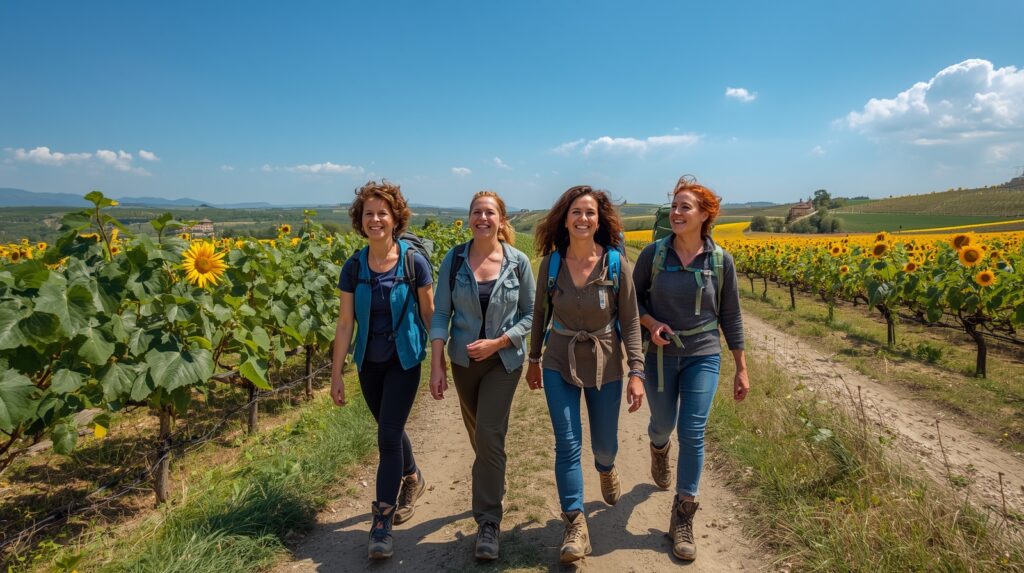
If your soul is craving fresh air, meaningful movement, and a chance to reconnect with nature, join us on a Camino de Santiago Crossroads Retreat in the southwest of France. This isn’t just a scenic hike – it’s a powerful, natural reboot for your body, mind, and spirit. Imagine quiet paths, rolling hills, cozy evenings, and slow conversations. No fitness requirements. No forced bonding. No pressure to have a breakthrough. Just one foot in front of the other, and a journey that meets you exactly where you are.

“I am an experienced medical doctor – MBChB, MRCGP, NLP master pract cert, Transformational Life Coach (dip.) Life Story Coach (cert.) Stress Counselling (cert.) Med Hypnotherapy (dip.) and EAGALA (cert.) I may have an impressive number of letters after my name, and more than three decades of professional experience, but what qualifies me to excel at what I do is my intuitive understanding of my clients’ difficulties and my extensive personal experience of managing major life changes using strategies I developed over many years.” Dr M Montagu

How to Keep Your Ducks in a Row When You’re Getting Divorced

getting divorced

Sometimes the best thing you can do is let your ducks waddle wherever they please while you focus on not drowning in the pond.

A Tsunami in a Duck Pond

Picture this: You wake up one morning thinking you’re the CEO of Duck Management Inc., only to discover that your ducks have unionised, your pond has sprung a leak, and someone’s changed all the rules overnight. Welcome to divorce, where your carefully orchestrated life suddenly resembles a nature documentary gone very, very wrong.

Maxine’s Story: The Entrepreneur Who Lost Her Compass (And Found Her True North)

Maxine Ashton had always been the woman with the plan. At 42, she’d built a successful marketing consultancy from her kitchen table, raised two teenagers who actually still spoke to her, and maintained a marriage that looked picture-perfect from the outside. Her life was a masterclass in organisation – colour-coded calendars, automated systems, and yes, metaphorically speaking, ducks that marched in perfect military formation.

Then came the morning that changed everything.

The coffee maker’s familiar gurgle filled the silence of their suburban kitchen, its rich aroma mingling with the lingering scent of yesterday’s dinner – rosemary chicken that now seemed like a relic from another lifetime. Max’s fingers trembled as she held the letter she’d found tucked under her laptop, the crisp white paper feeling like sandpaper against her skin.

“I can’t do this anymore,” it began. Twenty-two years of marriage, reduced to three pages of careful, lawyer-approved language.

The words blurred as her eyes filled with tears that tasted of salt and disbelief. Outside, she could hear their neighbour’s dog barking – the same golden retriever that had witnessed their children’s first steps in this very backyard. Everything looked the same, yet nothing would ever be the same again.

Max’s first instinct? Grab her planner and start making lists. “Lawyer consultation. Bank statements. Tell the kids. Update insurance.” Her pen scratched frantically against paper, the familiar ritual of organisation her lifeline in the storm. But as she wrote, something strange happened – the lists kept growing longer, more chaotic, like a hydra sprouting new heads with each task listed.

Three weeks later, she sat in her car outside her attorney’s office, engine idling, heat blasting against the November chill that seemed to have settled permanently in her bones. Her hands gripped the steering wheel so tightly her knuckles had gone white, and she could taste the metallic tang of anxiety in her mouth.

“Just breathe,” she whispered to herself, watching other people walk purposefully down the sidewalk – people whose lives weren’t imploding, who knew where they were going. The leather seat creaked as she shifted, trying to gather courage.

That’s when she saw them – a small family of ducks waddling across the busy street, completely oblivious to the honking cars swerving around them. No perfect plan. Just instinctual and intentional movement toward the pond on the other side of the road.

“Well, that’s either the most inspiring thing I’ve ever seen, or I’m officially losing my mind,” Max laughed, surprising herself with the sound. It was the first genuine laugh she’d had in weeks, and it felt like coming up for air.

Inside the law office, fluorescent lights hummed overhead as Max spread documents across the mahogany conference table. The papers rustled with each movement, creating a papery cacophony of her dissolving life. Her lawyer, Janet, smelled like expensive perfume and competence – a combination Max found oddly comforting.

“The hardest part,” Janet said gently, “isn’t the legal stuff. It’s learning to trust yourself again when everything you thought you knew has shifted.”

As Max drove home that evening, past strip malls and suburban lawns dotted with fallen leaves that crunched under her tires, she realised something profound: she’d spent so much energy trying to keep her ducks in a row that she’d forgotten to make sure that her row was heading in the right direction.

That night, she did something she hadn’t done in years. She turned off her phone, ran a bath hot enough to fog the bathroom mirror, and sat in the lavender-scented water until her fingertips pruned. The silence felt foreign after months of anxious planning, but gradually, she began to hear something underneath the quiet – her own voice, asking questions she’d been too busy to consider.

Who was she beyond wife and mother and successful entrepreneur? What did she want her next chapter to look like? The answers didn’t come in neat bullet points, but in fragments of dreams she’d shelved long ago, possibilities that made her pulse quicken with something that felt suspiciously like hope.

Over the following months, Max learned to embrace what she started calling “productive chaos.” Instead of rigid schedules, she created flexible frameworks. Instead of controlling outcomes, she focused on showing up authentically for each moment. Her business evolved, her relationship with her children became more spontaneous, and slowly – like morning mist lifting from a pond – a new version of herself emerged.

The ducks were still waddling every which way. But Max had learned something revolutionary: sometimes the most beautiful formations happen when you stop trying to force them and simply trust the natural flow of life.

Five Key Takeaways

1. Perfectionism Is the Enemy of Progress When your life is in transition, “good enough” isn’t just acceptable – it’s strategic. The energy you spend trying to make everything perfect is energy you could use for healing, growing, and building your new reality.

2. Your Support System Matters More Than Your Organisational Skills All the organisational tools in the world won’t replace the power of genuine connection. Invest in relationships with people who see your worth beyond your productivity levels.

3. Flexibility Is Your Superpower Rigid plans crack under pressure. Flexible approaches bend and adapt. Learn to pivot gracefully, and you’ll navigate uncertainty with confidence rather than anxiety.

4. Small Consistent Actions Trump Grand Gestures You don’t need to overhaul your entire life overnight. Daily acts of self-care, regular check-ins with your values, and incremental progress toward your goals will carry you further than dramatic life changes.

5. Trust Your Inner Compass External validation feels good, but internal wisdom keeps you on track long-term. Learn to distinguish between your authentic voice and the noise of others’ expectations.

The Power of Putting Pen to Paper

Writing it out

Write about a time when something you thought was falling apart actually opened space for something better to emerge. Use all five senses to describe both the moment of chaos and the first glimpse of possibility. What did you learn about your own resilience?

The “Duck Check” Exercise:

Each evening, ask yourself three questions:

  1. What “ducks” did I try to force into line today that weren’t actually mine to move?
  2. Where did I show myself compassion when things didn’t go according to plan?
  3. What one small step can I take tomorrow that aligns with who I’m becoming rather than who I used to be?

As Maya Angelou once said, “Try to be a rainbow in someone’s cloud.” Sometimes, the most radical thing you can do during a life transition is to be that rainbow for yourself.

Feeling Overwhelmed by Uncertainty About Your Future?

If Sam’s story resonates with you, you’re not alone. Change – even positive change – can feel overwhelming when you’re in the thick of it. Take my “Are You Feeling Overwhelmed by Uncertainty About Your Future?” quiz to discover your unique navigation style and get personalised strategies for moving forward with confidence rather than chaos.

Frequently Asked Questions

Q: How do I know if I’m managing the divorce process well or just barely surviving? A: The difference isn’t in having everything under control – it’s in how you respond to the lack of control. Are you making decisions from fear or from values? Are you isolating or reaching out? Surviving becomes easier when you start making choices that honour your authentic self rather than just managing the crisis.

Q: What if my ex-partner is making it impossible to stay organised and focused? A: You can only control your own actions and responses. Set boundaries where possible, document what you need to document, and focus your energy on what serves your healing rather than what perpetuates drama. Sometimes the most organised thing you can do is disengage from chaos that isn’t yours to clear up.

Q: How do I explain to my children that our family structure is changing without scaring them? A: Age-appropriate honesty paired with consistent reassurance works better than false cheerfulness. Focus on what remains stable (your love for them, their security, their routines) while acknowledging that some things are changing. Children are remarkably adaptable when they feel safe and informed.

Q: I feel guilty for not being more upset about my marriage ending. Is this normal? A: Absolutely. Grief isn’t linear, and relief is a valid part of the process. You might feel sad about the end of something while simultaneously feeling hopeful about new possibilities. Both emotions can coexist, and both are completely normal responses to major life changes.

Q: When will I feel “normal” again, and what does that even look like? A: “Normal” after a major life transition isn’t about returning to how things were – it’s about creating a new baseline that honours who you’re becoming. Most people report feeling significantly more stable and confident 12-18 months after major changes, but healing isn’t a race. Your timeline is uniquely yours.

The Beautiful Mess of Becoming

Here’s what nobody tells you about keeping your ducks in a row during a divorce: the goal isn’t perfect alignment. It’s learning to find grace in the midst of chaos, strength in the face of uncertainty, and hope in the space between who you were and who you’re becoming.

Your ducks don’t need to march in formation. They just need to know you’re committed to showing up – for them, for your healing, and for the magnificent, messy, beautiful adventure of creating a life that truly fits who you are.

Sometimes the bravest thing you can do is stop trying to control the ducks and start trusting your ability to navigate whatever waters lie ahead. After all, the best stories aren’t about perfect journeys – they’re about imperfect people finding their way home to themselves.


The Bottom Line: When life turns your carefully organised world upside down, the secret isn’t better organisation – it’s better self-compassion, stronger support systems, and the courage to trust that you can handle whatever comes next, even if you can’t see the whole path from where you’re standing. Your ducks will find their way. Your job is to keep swimming.

If you need some support, have a look at these options:

The Divorce/BreakUp Recovery Protocol

Author Bio: Dr Margaretha Montagu – described as a “game changer”, “gifted healer”, “guiding light” and “life-enriching author” – is an experienced medical doctor, a certified NLP practitioner, a medical hypnotherapist, an equine-assisted psychotherapist (EAGALAcertified) and a transformational retreat leader who guides her clients through life transitions – virtually, or with the assistance of her Friesian and Falabella horses, at their home in the southwest of France.

Stress destroys Lives. To find out what you can do to safeguard your sanity by taking my insight-giving quiz, subscribe to my mailing list.

Writing Memoir Together

memoir

Most of the women who attend my Writing and Walking the Camino de Santiago retreats are writing a memoir. I’ve been wondering why? No mind-numbing crime stories? No tales of passionate love? No bone-chilling horror stories?

Nope. 90% are in the 55-75 age group and are writing their memoirs.

Maybe it’s because by this age, we’ve lived through entire novels—epic love stories, cliffhanger career chapters, plot twists no one saw coming. We’ve weathered heartbreaks, raised families, buried dreams (and revived a few), and learned the hard way that what doesn’t kill you usually makes a great chapter title.

During the retreat, my guests often make significant progress but they are only here for 5 or at most 7 days, and then they leave again.

It is difficult to continue on your own, no matter how motivated you are.

Especially as there’s more to memoir writing than might immediately meet the eye. It

  • Helps us process major life shifts: The 50s, 60s and 70s often bring significant transitions like becoming empty nesters, caring for ageing parents, retirement or confronting mortality. Writing can be a way to process these changes and find meaning in them.
  • Offers freedom from earlier constraints: In this age range, we find ourselves with more freedom to speak our truth. Our children may be grown, careers established or winding down, and we’re less concerned about potential professional or social repercussions from sharing candid stories.
  • Helps us to reclaim our narrative: After decades of often putting others first – families, careers, communities – we finally feel free to tell our story our way, unfiltered and unabridged. This can be particularly powerful for those of us whose voices were historically marginalised or overlooked.
  • Facilitates personal growth and transformation: Writing about difficult experiences – trauma, abuse, addiction, mental illness, or loss – can be deeply therapeutic. The act of putting painful memories into words, examining them, and contextualising them within a larger life story often helps us process unresolved emotions and find closure or acceptance.
  • Empower us to help other women: A memoir isn’t just about looking back; it’s about leaving behind a compass for others. A quiet “Here’s what I’ve learned—take what you need.” We write with the explicit hope that our struggles, mistakes, and hard-won wisdom might help other women navigate similar challenges or feel less alone in their experiences.
  • Makes us more creative: Some discover or rediscover writing as a form of creative expression later in life, when we finally have the time and mental space to pursue it seriously
  • Contributes to the historical record: Many of us recognise that our experiences – whether ordinary or extraordinary – deserve to be documented, especially given how women’s stories have often been excluded from official histories.

Writing a memoir is a challenge at any age, but in your 50s, 60s, it’s an act of enormous courage. It says, I’ve been through the fire, and here’s how I turned the ashes into art.

Maybe that’s why so many women pick up the pen at this age. We finally realise that our voice—this wise, witty, scared and scarred voice—deserves to be heard.

So I had an idea.

What if we could all write according to a predetermined structure and get together once a month to support each other and hold each other accountable, chapter by chapter?

With 8 books under my belt, I would love to share what I know, and I am sure that there are many of you who could make substantial contributions given the chance.

For more than three years, I have been playing with the idea of starting a walking, reading and writing community, without ever really finding a suitable structure. I’ve looked at memberships, masterclasses, masterminds, mentorships and digital subscription boxes, but so far nothing fit.

I also firmly believe in the power of storytelling as a vehicle for self-discovery, self-expression, and self-care, in addition to the points above, and what I’d like to do by helping women who have lived rich lives and are ready to make sense of their experiences, step into their authentic voices, as they write their memoirs:

  • helping women excavate their stories – not just the “highlight reel” but the turning points, challenges overcome, lessons learned, and moments that shaped them – helping them see patterns and meaning they might have missed.
  • helping women find their unique storytelling voice through different mediums – written memoir pieces, oral storytelling, visual narratives, or even digital formats. Many women this age were taught to minimise their experiences or put others first, so claiming their voice is both healing and empowering.
  • helping women create tangible story legacies – family histories, recorded stories for grandchildren, or even community oral history projects. This gives their storytelling work a concrete purpose and impact.
  • helping women process unresolved experiences, claim their resilience, forgive themselves and others, and integrate all parts of their journey into a coherent, empowering narrative.
  • helping women identify stories (imposed narratives) others have told about them – “you’re too sensitive,” “you’re not creative,” “your dreams aren’t practical”, and rewrite their stories from their own perspective.

My aim is that by year’s end, you will have 12 powerful stories – creating a meaningful collection you can share with family, publish or keep as personal treasure.

And, why not, if we have enough members, publish an anthology with your contributions each month? This means you could be a published author within a month of joining our writing community.

What do you think?

Living Intentionally

living intentionally

How can You Live Your Life More Intentionally?

The Short Answer: Living intentionally means making conscious choices aligned with your values, regularly pausing to assess what truly matters, and having the courage to say no to what doesn’t serve your authentic self, even when it’s uncomfortable.

The Art of Living Intentionally

Picture this: You’re 85 years old, sitting in your favourite chair with a cup of tea growing cold in your hands. As you look back on your life, what do you see? A series of incidents that happened to you, or a collection of moments you deliberately chose?

Living intentionally isn’t about having every minute planned or becoming some zen master who never loses their keys (though that would be nice). It’s about becoming the author of your own story rather than a passive character watching life unfold. It’s the difference between drifting down a river and choosing your direction—sometimes going with the current, sometimes paddling upstream, but always making conscious choices about where you want to go.

Most of us stumble through life on autopilot, reacting to whatever comes our way. We say yes to commitments that drain us, spend time on activities that don’t fulfil us, and wonder why we feel so disconnected from our own lives. But what if there was another way?

Amanda’s Awakening

Amanda Lewis had always been the woman who had it all figured out. At 60, she was the epitome of success—a wardrobe full of designer suits, a wine collection that seriously impressed dinner guests, and a calendar so packed it required colour-coding. Her morning routine was a masterpiece of efficiency: espresso machine humming at 5:47 AM sharp, the bitter richness coating her tongue as she scrolled through emails that had accumulated overnight like digital snow.

But on this particular Tuesday morning in October, something was different.

The familiar ping of her phone felt like nails on a chalkboard. The fluorescent office lights seemed to buzz louder than usual, casting everything in a harsh, unforgiving glare. Even her favourite silk blouse felt scratchy against her skin, as if her body was rejecting the very uniform of her success.

“I can’t do this anymore,” she whispered to her reflection in the bathroom mirror during her lunch break. The words surprised her—they seemed to come from somewhere deep inside, a place she’d been ignoring for years.

That evening, Amanda found herself in her kitchen, not preparing her usual efficient dinner-for-one, but standing perfectly still, listening. The hum of the refrigerator. The distant sound of her neighbour’s TV through the walls. The rhythm of her own breathing. When was the last time she’d actually listened to anything?

She opened her laptop and began typing—not a work email or quarterly report, but a letter to herself:

“Dear Amanda, when did you stop dreaming? When did you trade your soul for a salary? When did you become so busy living someone else’s idea of success that you forgot to ask what success meant to you?”

The questions poured out, each one hitting like a small earthquake. She wrote about the art classes she’d abandoned for MBA courses, the travel dreams shelved for career advancement, the relationships sacrificed on the altar of ambition. The taste of tears mixed with the lingering coffee on her lips as she realised she’d been living someone else’s life for decades.

That night, Amanda couldn’t sleep. She lay in her perfectly appointed bedroom, staring at the ceiling, feeling the weight of her Egyptian cotton sheets like a shroud. At 3 AM, she got up and did something she hadn’t done in twenty years—she went outside and looked at the stars. The cool October air raised goosebumps on her arms, and for the first time in months, she felt fully alive.

The next morning brought an unusual sight: Amanda’s resignation letter. Not a dramatic storming out or a bridge-burning manifesto, but a thoughtful, intentional choice. She’d spent the pre-dawn hours researching art therapy programs, travel opportunities for mature students, and volunteer positions that aligned with her forgotten values.

“You’re having a midlife crisis,” her sister proclaimed over lunch the following week. The restaurant was their usual spot—white tablecloths, overpriced salads, conversations that skimmed the surface like stones on water.

“No,” Amanda replied, surprising herself with the firmness in her voice. “I’m having a midlife awakening. There’s a difference.”

She pulled out a small notebook—not her usual leather-bound planner, but a simple journal with a soft, worn cover. “I’ve been asking myself different questions. Not ‘What should I do?’ but ‘What do I want to create?’ Not ‘What will people think?’ but ‘What would make me come alive?'”

The transformation wasn’t instant or Instagram-ready. There were moments of doubt, nights when the financial anxiety kept her awake, days when the old patterns tried to reassert themselves like muscle memory. But Amanda had tasted something she’d forgotten existed: the sweet satisfaction of alignment between her choices and her values.

Six months later, she was teaching art to children in a community centre that smelled of tempera paint and possibility. Her hands, once manicured for boardroom presentations, were now stained with colours that wouldn’t wash out completely—and she loved it. The sound of children’s laughter had replaced the aggressive buzz of conference calls. Instead of the metallic taste of stress, she savoured the simple pleasure of shared creativity.

“I thought I was successful before,” Amanda told me during one of our coaching sessions, her eyes bright with the kind of energy that comes from living authentically. “But I was just busy. I was productive, but not purposeful. I was achieving, but not thriving.”

She paused, looking out the window where late afternoon sunlight painted everything golden. “The funny thing is, I make less money now, but I feel richer than I ever have. I sleep better, laugh more, and for the first time in decades, I’m excited about tomorrow.”

Amanda’s story isn’t unique—it’s happening all around us, in quiet moments of courage when people choose intentionality over inevitability. It’s the sound of someone saying no to a good opportunity because it’s not the right opportunity. It’s the sight of a packed schedule with white space deliberately preserved for what matters most. It’s the taste of a meal eaten slowly, without distractions, in the company of people who truly see and hear you.

Five Key Takeaways for Living Intentionally

1. Clarity Comes Before Change

You can’t live intentionally if you don’t know what you’re aiming for. Amanda’s transformation began with honest self-reflection, not action. Before making any major changes, invest time in understanding your core values, natural strengths, and what genuinely brings you joy, not what you think should bring you joy.

2. Small Choices Create Big Shifts

Intentional living isn’t about dramatic life overhauls (though sometimes those happen). It’s about making conscious choices in small moments: choosing to put your phone away during dinner, deciding to say no to commitments that don’t align with your values, or pausing before reacting to ask, “What response would my best self choose?”

3. Discomfort Is the Price of Authenticity

Living intentionally often means disappointing people, facing uncertainty, and choosing harder paths because they’re more meaningful. Amanda had to sit with financial anxiety and social judgment. The discomfort is temporary, but the regret of not living authentically lasts forever.

4. Your Energy Is Your Most Precious Resource

Pay attention to what gives you energy and what drains it. Intentional living means becoming a fierce guardian of your energy, investing it in people, activities, and pursuits that align with your values and contribute to your growth.

5. Progress, Not Perfection

There’s no such thing as perfectly intentional living. You’ll make choices you regret, get pulled back into old patterns, and have days when you feel completely off track. The key is to notice, course-correct, and keep choosing consciousness over autopilot.

Narrative Journaling Prompt: The Raw Life Review Exercise

Imagine you’re 90 years old, sitting in your favourite spot, looking back on your life. Write a letter from your future self to your current self, addressing these questions:

  • What choices are you most proud of?
  • What risks are you grateful you took?
  • What would you change if you could?
  • What advice would you give about living more intentionally?

Write for at least 15 minutes without stopping. Don’t worry about grammar or making sense—let your future wisdom flow onto the page. This exercise often reveals insights that your logical mind might miss.

Additional Exercises for Intentional Living

The Energy Audit: For one week, track your energy levels after different activities, interactions, and commitments. Rate each on a scale of 1-10 (1 = draining, 10 = energising). Use this data to make more intentional choices about how you spend your time.

The Values Clarification: List your top five values (examples: creativity, family, adventure, service, learning). For each major decision over the next month, ask: “Which of my values does this choice support or compromise?” Choose accordingly.

The Monday Morning Test: Before committing to anything new, ask yourself: “If I had to do this every Monday morning for the next year, would I be excited or dreadful?” Your immediate gut reaction is usually the right answer.

“The privilege of a lifetime is being who you are.” – Joseph Campbell

Ready to Start Living Intentionally?

If Amanda’s story resonates with you, if you’re feeling that familiar tug of “there has to be more than this,” you might be ready for a radical reset. Sometimes we need a structured approach to uncover what intentional living looks like for our unique situation.

That’s why I’ve created the “Ready for a Radical Reset?” quiz—a thoughtful assessment that helps you identify where you are on your intentional living journey and what specific areas need your attention. It’s not about judgment or comparison; it’s about clarity and direction.

The quiz explores your relationship with time, energy, values, and choices, offering personalised insights and practical next steps. Because here’s the truth: we all know we want to live more intentionally, but knowing where to start can feel overwhelming.

Take the quiz when you’re ready to move from wanting change to creating it.

Frequently Asked Questions

Q: Is intentional living just another way of saying “self-care”? A: While self-care is important, intentional living goes much deeper. Self-care is about maintaining your well-being; intentional living is about aligning your entire life with your authentic values and purpose. It’s the difference between taking a bubble bath and restructuring your life around what truly matters to you.

Q: What if I don’t know what my values are or what I want? A: That’s completely normal and actually a great starting point. Begin by noticing what you don’t want—what drains your energy, what feels misaligned, what makes you feel resentful. Often, understanding what we’re moving away from helps clarify what we’re moving toward. The exercises in this article are designed to help with this discovery process.

Q: How do I live intentionally when I have responsibilities like kids, a mortgage, and a demanding job? A: Intentional living isn’t about abandoning responsibilities; it’s about approaching them consciously. You might not be able to quit your job tomorrow, but you can choose how you show up to it. You can’t eliminate all obligations, but you can examine which ones truly serve your family’s well-being and which are just habit or social pressure.

Q: Isn’t this just privileged advice for people who have choices? A: While it’s true that some people have more external constraints than others, everyone has some degree of choice in how they respond to their circumstances. Intentional living isn’t about having unlimited options; it’s about making conscious choices within whatever constraints exist. Sometimes the most intentional thing is choosing your attitude, your focus, or how you spend your free 15 minutes.

Q: How long does it take to start living intentionally? A: The beauty is that you can start right now with your very next choice. However, rewiring ingrained patterns and creating sustainable change typically takes months or years. Be patient with yourself—this is a lifelong practice, not a destination you arrive at and then you’re done.

Further Reading

If Amanda’s story has sparked something in you and you’re hungry for more wisdom on living intentionally, here are some transformative books that can guide you deeper into this practice:

“Essentialism: The Disciplined Pursuit of Less” by Greg McKeown This isn’t just about decluttering your closet—it’s about decluttering your entire life. McKeown shows you how to identify what’s truly essential and eliminate everything else. Perfect for recovering people-pleasers who struggle with saying no.

“The Power of Now” by Eckhart Tolle While some find Tolle’s spiritual approach challenging, his core message about presence is fundamental to intentional living. You can’t make conscious choices if you’re always mentally living in the past or future.

“Atomic Habits” by James Clear Intentional living happens in the small moments, and Clear’s book is masterful at showing how tiny changes compound into life transformation. Essential reading for anyone who wants to bridge the gap between intention and action.

“The Gifts of Imperfection” by Brené Brown Brown’s research on vulnerability and authenticity provides the emotional foundation for intentional living. You can’t align with your values if you don’t have the courage to be seen as you truly are.

“Digital Minimalism” by Cal Newport In our hyperconnected world, intentional living requires being deliberate about technology use. Newport offers practical strategies for reclaiming your attention and time from digital distractions.

“Mindset” by Carol Dweck Intentional living requires believing that change is possible. Dweck’s research on growth mindset provides the psychological foundation for transforming your life at any age.

“The Untethered Soul” by Michael A. Singer For those ready to go deeper into the spiritual aspects of conscious living, Singer explores what it means to live from your authentic self rather than your conditioned patterns.

The Bottom Line

Living intentionally isn’t about perfection or having all the answers. It’s about becoming conscious of your choices and aligning them with what truly matters to you. It’s about waking up from the autopilot of daily life and taking the steering wheel of your own experience.

Amanda’s story reminds us that it’s never too late to choose authenticity over expectation, purpose over productivity, and consciousness over convenience. The cost of intentional living is discomfort, uncertainty, and sometimes disappointment from others. The cost of not living intentionally is much higher—it’s the slow erosion of your authentic self.

Remember the short answer we started with: Living intentionally means making conscious choices aligned with your values, regularly pausing to assess what truly matters, and having the courage to say no to what doesn’t serve your authentic self, even when it’s uncomfortable.

Your life is not a dress rehearsal. Every moment is an opportunity to choose intentionality over inevitability. The question isn’t whether you have time to live intentionally—it’s whether you can afford not to.

20 Things I Wish My Retreat Guests Would (or Would Not) Do

Transform Your Retreat Experience: A Host’s Insider Guide to What Works

Picture this: You’ve spent months crafting the perfect retreat experience. Then reality hits like a surprise thunderstorm – someone’s using the sacred singing bowl as a cereal dish, another guest is livestreaming their “authentic journey”, and you’re wondering if enlightenment comes with a customer service manual.

After hosting dozens of retreats and collecting enough stories to fill a totally zen comedy special, I’ve learned that creating magical experiences requires a delicate balance between holding space and holding boundaries. So here’s my suggestions for retreat guests everywhere – a gentle, humour-infused guide to making retreats amazing for everyone involved.

This post refers to retreats IN GENERAL, not specifically to MY retreats.

The Do’s and Don’ts That Make All The Difference

The “Please Do” List

1. Arrive with an open heart, not an agenda Come ready to receive without expectations. The magic happens when you release the need to have a specific outcome and trust the process. Your breakthrough might look nothing like what you imagined – and that’s often when the real magic appears.

2. Respect the digital detox boundaries Yes, I know your Instagram followers are waiting for your sunflower photos, but the retreat space is sacred. When we ask for phone-free zones, it’s not because we’re digital dinosaurs – it’s because presence is a practice, and your fellow guests deserve your full attention.

3. Participate in your own way, but participate You don’t have to be the most vocal person in group discussions or share the deepest revelation in circle time. Just show up authentically. Sometimes the quiet observer contributes as much healing energy as the vocal sharer.

4. Ask questions when you’re confused There’s no such thing as a stupid question in a retreat setting. If you don’t understand why we’re doing breathing exercises at 6 AM or what “setting an intention” actually means, please ask! We’d rather explain than have you sit there feeling lost.

5. Honour your body’s needs If you need to rest instead of joining the afternoon hike, that’s not failure – that’s wisdom. Listen to your body and communicate your needs. We can’t support you if we don’t know what’s going on.

6. Engage with fellow participants kindly You’re sharing this journey with beautiful souls who are just as vulnerable and hopeful as you are. A kind word, a genuine smile, or simply holding space for someone’s tears can be profoundly healing for everyone involved.

7. Keep confidentiality sacred What happens in circle time stays in circle time. Period. The stories, struggles, and breakthroughs shared in our container are gifts of trust that must be protected.

8. Embrace the schedule and show up on time We’ve designed the rhythm of the retreat intentionally. While flexibility is important, the flow from morning meditation to evening reflection serves a purpose. Trust the container we’ve created.

9. Come prepared (but not over-prepared) Bring what’s on the packing list, but leave the seventeen self-help books at home. You’ll have plenty to process without additional homework.

10. Practice gratitude for the small moments The perfectly timed rainstorm during meditation, the way the light hits the garden at sunset, the spontaneous laughter during sharing time – these moments are the real retreat magic.

The “Please Don’t” List

11. Don’t try to therapy-coach other participants Unless you’re explicitly invited to share your professional insights, resist the urge to analyse, diagnose, or fix your fellow retreatants. Sometimes the most healing thing you can offer is simply witnessing without trying to solve.

12. Don’t compare your journey to others Sarah might be having mystical visions while you’re just trying not to fall asleep during meditation. Tom might be crying through every workshop while you’re feeling nothing. Every path is valid, every timeline is perfect.

13. Don’t break the silence during silent periods When we call for noble silence, that includes whispering, hand gestures that look like charades, and writing notes to communicate. Silence is medicine – let it work its magic.

14. Don’t dominate sharing circles While we love hearing your insights, remember that circle time is for everyone. Share generously but leave space for others to find their voice too.

15. Don’t bring drama from home Yes, your ex is still texting you and your boss is being impossible, but retreat time is for stepping away from those patterns. Use this sacred pause to gain perspective rather than rehearsing old stories.

16. Don’t be the retreat photographer Resist the urge to document every moment. Some experiences are meant to be felt, not photographed. Plus, candid shots of people in vulnerable moments aren’t consent-given keepsakes.

17. Don’t skip meals to “go deeper” Spiritual bypassing through food restriction isn’t enlightenment – it’s just hangry. Your body needs nourishment to support your emotional and spiritual work.

18. Don’t judge the accommodation as a hotel That squeaky floorboard and the shared bathroom aren’t bugs, they’re features. Retreat centres prioritise soul space over thread counts, and that’s exactly the point.

19. Don’t pressure others to share your level of openness Just because you’re ready to share your deepest traumas doesn’t mean everyone else is. Honour others’ boundaries and timelines without taking their reserve personally.

20. Don’t leave without saying goodbye The retreat community that forms is precious and temporary. Honour the connections you’ve made with conscious closure rather than Irish goodbyes.

5 Key Takeaways for Retreat Success

1. Presence Over Performance

The most transformative retreat experiences happen when you stop trying to be the “best” retreat guest and start being your most authentic self. Your job isn’t to impress anyone – it’s to show up honestly and let the process work through you.

2. Boundaries Are Love in Action

Those seemingly restrictive guidelines about phones, silence, and schedule aren’t arbitrary rules – they’re carefully crafted containers that create safety for everyone’s journey. When you honor the boundaries, you’re contributing to the collective healing space.

3. Your Resistance Is Information

Notice what you want to avoid, complain about, or escape from during the retreat. Often, our resistance points directly toward what we most need to explore. The schedule conflict that annoys you might be revealing a pattern worth examining.

4. Integration Starts During the Retreat

Don’t wait until you get home to think about how you’ll integrate your insights. Start noticing patterns, journaling observations, and identifying practices you want to continue while you’re still in the supportive container of the retreat.

5. Community Amplifies Individual Healing

The magic of retreats isn’t just in the teachings or practices – it’s in the alchemy that happens when vulnerable hearts gather in sacred space. Your healing contributes to everyone else’s, and theirs supports yours in ways you might never fully understand.

Frequently Asked Questions

Q: What if I hate something about the retreat experience? A: First, breathe. Resistance is often information about what we need to explore. Talk to the facilitators – we’d rather help you navigate challenges than have you suffer in silence. Sometimes what feels like the “worst” part of a retreat becomes the most transformative.

Q: Is it okay to skip activities if I’m feeling overwhelmed? A: Absolutely. Self-care isn’t selfish, and sometimes the most spiritual thing you can do is rest. Just communicate with the facilitators so we know you’re okay and not missing due to dissatisfaction with the program.

Q: How do I handle personality conflicts with other participants? A: Remember that everyone is doing their best with their current level of consciousness. Use conflicts as opportunities to practice boundaries, compassion, and communication. If it becomes truly disruptive, speak with the facilitators for support.

Q: What if I don’t have any big breakthroughs? A: Healing doesn’t always look like dramatic revelations. Sometimes it’s subtle shifts, moments of peace, or simply the experience of being witnessed and accepted. Trust that what you need is happening, even if it’s not what you expected.

Q: How can I make the most of my retreat investment? A: Show up fully, stay curious instead of critical, engage authentically with the community, and trust the process even when it feels uncomfortable. The retreat experience extends beyond the scheduled activities – meaningful conversations during free time can be just as transformative as formal sessions.

Conclusion

Here’s what I really want you to know: retreats aren’t about becoming a different person – they’re about remembering who you already are beneath all the layers of conditioning, fear, and busyness. Every retreat guest brings their own medicine to the circle, and your presence matters more than you realise.

The guidelines in this list aren’t meant to restrict your authentic expression but to create a container where authentic expression becomes possible for everyone. When we all lean into the collective agreement of respect, presence, and openness, something magical happens that none of us could create alone.

So come as you are, stay curious, be kind, and trust that whatever unfolds is exactly what’s meant to be. Your willingness to show up and do the work – even when it’s messy, uncomfortable, or different than expected – is already enough.

Now excuse me while I go hide the singing bowls before the next group arrives.

What Life Lessons Can You Learn While Walking the Camino de Santiago? a free guide filled with 10 not just “quaint anecdotes” or Instagram-worthy moments (though there are plenty of those) but real transformations from real people who walked this insight-giving trail – Subscribe to my monthly newsletter to Download the Guide

“I am an experienced medical doctor – MBChB, MRCGP, NLP master pract cert, Transformational Life Coach (dip.) Life Story Coach (cert.) Stress Counselling (cert.) Med Hypnotherapy (dip.) and EAGALA (cert.) I may have an impressive number of letters after my name, and more than three decades of professional experience, but what qualifies me to excel at what I do is my intuitive understanding of my clients’ difficulties and my extensive personal experience of managing major life changes using strategies I developed over many years.” Dr M Montagu

The Scarlet Specter’s Social Hour

How Daniela Inherited a Mansion and Accidentally Became Best Friends with a Jazz Age Ghost Who Really Needs to Work on Her Interior Decorating Skills

When I inherited Great Aunt Millicent’s Victorian mansion, I thought my biggest problem would be the astronomical heating bills and maybe some creaky floorboards. I definitely didn’t expect to become the reluctant caretaker of what I can only describe as the world’s most passive-aggressive haunted room.

The house came with a warning, delivered by Millicent’s ancient lawyer, Mr. Grimsby, who looked like he’d been personally acquainted with the Grim Reaper for several decades.

“Whatever you do,” he wheezed, adjusting his wire-rimmed spectacles, “never enter the red room on the third floor. Your great aunt was very specific about this.”

“What’s in the red room?” I asked.

Mr. Grimsby’s rheumy eyes went wide. “Nothing good,” he muttered. “Nothing good at all.”

Naturally, the red room became my obsession. Have you ever tried NOT thinking about something? It’s impossible. The more I tried to ignore it, the more that locked red door at the end of the third-floor hallway seemed to mock me. I could practically hear it whispering, “Bet you’re curious about what’s behind me, aren’t you, Danny?”

For three weeks, I resisted. I focused on settling into the house, which was already plenty creepy without adding mysterious forbidden rooms to the mix. The portraits in the hallway had that classic “dead ancestor judging your life choices” vibe. And don’t get me started on the grandfather clock that chimed thirteen times at midnight, because apparently even the furniture in this house had commitment issues.

But it was the red door that really got to me. Every time I walked down that hallway, I could swear I heard something moving around inside. Soft footsteps. The occasional thud. Once, I could have sworn I heard what sounded like someone rearranging furniture, but when I pressed my ear to the door, everything went silent.

The breaking point came on a Tuesday night when I was trying to sleep and heard what sounded like a dinner party coming from the red room. Laughter, clinking glasses, muffled conversation. I crept upstairs in my pyjamas, flashlight in hand like some kind of discount paranormal investigator, and the sounds stopped the moment I reached the third floor.

“Okay,” I said to the door, feeling only slightly ridiculous for talking to it. “I get it. You want attention. But could you keep it down? Some of us have jobs in the morning.”

The door creaked in response, which I chose to interpret as an apology.

Thursday night brought new sounds: what seemed to be a full orchestra practising some very dramatic, very loud classical music. Friday night was tap dancing. By Saturday, I was pretty sure whatever was in there was hosting a karaoke night, complete with someone’s absolutely tragic attempt at Whitney Houston’s “I Will Always Love You.”

That’s when I snapped. I marched upstairs, grabbed the antique key from where Mr. Grimsby had reluctantly left it on the mantelpiece, and decided to end this mystery once and for all.

“Alright!” I shouted at the door. “You want my attention? You’ve got it!”

I jammed the key into the lock, turned it with more force than was probably necessary, and threw the door open with the kind of dramatic flair that would have made my high school theatre teacher proud.

The room was… red. Aggressively, overwhelmingly red. The walls were red. The ceiling was red. The furniture was red. Even the air seemed to have a faint reddish tinge, like being inside a giant tomato. It was like someone had taken the concept of “red room” and decided to interpret it as literally as possible.

But here’s the thing that really caught my attention: sitting in a red velvet armchair in the centre of the room was a ghost. Not a scary, chain-rattling, head-spinning-around ghost. Just a regular-looking middle-aged woman in a 1920s flapper dress, also red, reading what appeared to be a romance novel.

She looked up when I entered, marked her place with a red bookmark, and sighed.

“Well,” she said in a voice like old cigarettes and disappointment, “it’s about time. Do you have any idea how boring it’s been up here? I’ve read every book in this room seventeen times. SEVENTEEN TIMES, Danny.”

“You… know my name?”

“Of course I know your name. I’m Vivian. I’ve been haunting this room since 1924, and let me tell you, your great aunt Millicent was much better company. She used to visit twice a week for tea and gossip. You’ve been here a month and haven’t even introduced yourself. It’s terribly rude.”

I stared at her, trying to process this information. “You’re upset about… social etiquette?”

“I’m upset about being ignored!” Vivian snapped, and suddenly all the red objects in the room rattled ominously. “Do you think it’s easy being dead? Do you think I enjoy spending eternity in a room that looks like the inside of a ketchup bottle? I make an effort to be interesting – the dinner party sounds, the orchestra, the karaoke – and you just ignore me!”

“I thought you were trying to scare me away!”

“Scare you? Darling, I was trying to get you to visit! I was throwing the most elaborate haunted house performances I could manage, and you just kept hiding downstairs like some kind of antisocial hermit!”

This was not how I’d imagined my first ghost encounter going. In movies, ghosts were always moaning about unfinished business or seeking revenge for past wrongs. They weren’t complaining about being socially neglected.

“So,” I said carefully, “you’re not here to drive me insane or possess my soul or anything?”

Vivian laughed, a sound like wind chimes in a hurricane. “Oh honey, no. I’m just lonely. I died in this room in 1924 – terrible incident involving a red velvet cake and a very unstable chandelier – and I’ve been stuck here ever since.”

“So you want…what exactly, from me?”

“Company! Conversation! Someone to complain to about how they don’t make ghost stories like they used to! Do you know how insulting it is when modern people expect you to slam doors and throw furniture around? I’m a sophisticated spirit of the Jazz Age, not some common poltergeist!”

And that’s how I ended up having weekly tea parties with a ghost named Vivian in the red room. Every Thursday at 3 PM, I’d climb the stairs with a pot of Earl Grey and whatever gossip I’d picked up from the neighbours, and Vivian would regale me with stories from the 1920s and her increasingly creative opinions about modern society.

The red room, it turned out, wasn’t cursed or evil – it was just incredibly, aggressively red because Vivian had gotten bored one decade and decided to redecorate using her ghostly powers. She’d been experimenting with different colour schemes when she’d gotten stuck on red and couldn’t figure out how to change it back.

“I tried green once,” she admitted. “But it made me look sickly. Red is much more flattering for my complexion.”

The best part? Once Vivian had someone to talk to regularly, she stopped the midnight concerts and dinner party sound effects. The house became actually peaceful, except for the occasional Thursday afternoon when she’d get excited about some bit of gossip and accidentally make all the red objects in the room levitate.

“Sorry,” she’d say, looking embarrassed as her armchair gently floated back to the floor. “I get carried away.”

Six months later, when people asked me about living in a haunted house, I had to explain that yes, technically it was haunted, but the ghost was more like having a chatty elderly roommate who happened to be dead and had questionable taste in interior design.

“Isn’t it scary?” they’d ask.

“The scariest thing about Vivian,” I’d tell them, “is her opinion on modern fashion. She has very strong feelings about yoga pants.”

The red room is still red – Vivian and I have given up trying to change it. We’ve decided it has character, and besides, it makes finding the haunted room really easy when I have guests over. They always want to meet the ghost, and Vivian loves the attention. She’s started doing what she calls “performance hauntings” for visitors, complete with theatrical moaning and the occasional levitating teacup.

“I may be dead,” she says, “but that doesn’t mean I can’t put on a good show.”

And honestly? Having a ghost who’s more concerned with social etiquette than supernatural vengeance has turned out to be the perfect solution to the age-old problem of inheriting a creepy Victorian mansion. The heating bills are still astronomical, but at least I have someone to complain about it to.

Even if she is dead, lives in a room that looks like a crime scene, and has been stuck in the same red flapper dress for nearly a century.

Some problems, I’ve learned, solve themselves in the most unexpected ways.


As some of you know, I sharpen my storytelling skills through two writing groups. When WordWeavers in France threw down the gauntlet with ‘Red’ as this month’s 1000-word prompt, I couldn’t resist diving into both horror and comedy.

Wordweavers in France has just published an anthology called Thank you, Shirley Valentine that contains stories about strong women making radical changes in their lives.

Author Bio: Dr Margaretha Montagu – described as a “game changer”, “gifted healer”, “guiding light” and “life-enriching author” – is an experienced medical doctor, a certified NLP practitioner, a medical hypnotherapist, an equine-assisted psychotherapist (EAGALAcertified) and a transformational retreat leader who guides her clients through life transitions – virtually, or with the assistance of her Friesian and Falabella horses, at their home in the southwest of France.

Why Boundaries Are Crucially Important During Life Transitions

boundaries

The Truth About Boundaries: Your Questions Answered

Boundaries during life transitions are like wearing a life jacket in turbulent waters—they keep you afloat when everything else feels like it’s pulling you under. They protect your energy, preserve your sanity, and give you the space to actually choose your next chapter instead of being swept away by everyone else’s opinions about what you should do.

The Great Unravelling

Picture this: You’re standing at the edge of a cliff, but instead of feeling terrified, you’re oddly excited. Below you isn’t certain death—it’s the unknown. Behind you is everything familiar, everything safe, everything that no longer fits. This is the moment when most people realise they desperately need boundaries, usually right after their well-meaning Aunt Margaret has spent twenty minutes explaining why their life choices are “concerning.”

Life transitions are messy, beautiful, terrifying things. They’re the periods when we shed old skins like snakes, except we’re doing it in public while everyone watches and offers unsolicited advice. Whether it’s a career change, divorce, parenthood, loss of a loved one, or simply the realisation that you’ve outgrown your current life, transitions demand something from us that we’re rarely taught: the art of saying no to everything that doesn’t serve our growth.

Sam’s Story: The Boundary Breakthrough

Sam Moore had built her catering empire from her grandmother’s kitchen table, armed with nothing but a killer lasagna recipe and the stubborn belief that good food could fix anything. By thirty-five, she was running three restaurants, employing forty-seven people, and hadn’t taken a real vacation in seven years. The success tasted like sawdust in her mouth.

The morning everything changed started like any other. Sam stood in her flagship restaurant’s kitchen at 5:30 AM, the familiar weight of responsibility settling on her shoulders like a lead blanket. The smell of coffee beans grinding mixed with the yeasty aroma of bread dough rising—scents that once made her heart race with excitement now felt suffocating. Her hands, already stained with flour from muscle memory, moved through the morning prep routine while her mind wandered to places it wasn’t supposed to go.

What if I just… disappeared?

The thought hit her like a splash of cold dishwater. She could hear the sizzle of onions hitting hot oil in the pan beside her, the rhythmic thud of her sous chef’s knife against the cutting board, the gentle hum of the industrial refrigerator. These sounds had been her lullaby for years, but now they felt like a prison soundtrack.

“Sam, your mother’s on line two,” called Marcus, her manager, from the pass. “Something about the family reunion menu.”

Sam’s stomach clenched. The family reunion—another obligation, another expectation, another “yes” she’d automatically given without thinking. She wiped her hands on her apron, leaving streaks of tomato sauce that looked suspiciously like war paint, and walked to the phone.

“Samantha, darling, I was thinking we could do that wonderful seafood buffet you did for the Henderson wedding, but maybe add those little quiches everyone raves about, and oh! Could you make your grandmother’s tiramisu? I know it’s a lot of work, but—”

Sam stared at her reflection in the stainless steel surface of the prep counter. Her face looked hollow, her eyes rimmed with the kind of exhaustion that sleep couldn’t fix. In that warped reflection, she saw herself at forty-five, fifty, sixty—still saying yes, still carrying everyone else’s expectations, still slowly disappearing under the weight of being needed.

“No,” she said quietly.

“What’s that, dear? The connection must be—”

“No, Mom. I can’t do the reunion.” The words felt strange in her mouth, like speaking a foreign language. “I’m taking a break.”

The silence on the other end was deafening. Sam could practically hear her mother’s brain recalibrating, trying to process this unprecedented response from her eternally accommodating daughter.

“Are you feeling alright? You never say no to family.”

Exactly, Sam thought. That’s the problem.

Over the next three months, Sam discovered that setting boundaries during her transition was like learning to breathe underwater—terrifying at first, but absolutely essential for survival. She hired a business manager, delegated more to her team, and for the first time in her adult life, she said no to things that didn’t align with her vision for her future.

The pushback was immediate and uncomfortable. Her business partners questioned her commitment. Her family accused her of being selfish. Regular customers complained when she wasn’t personally available to handle their every request. But something magical happened in the space she created: clarity.

Sam realised she now wanted to teach cooking, not just run restaurants. She wanted to travel, to learn regional cuisines, to write the cookbook that had been living in her head for years. She wanted to fall in love again—with food, with life, with herself.

The smell of her grandmother’s kitchen, which had been buried under years of commercial kitchen stress, came flooding back. The taste of simple, perfectly ripe tomatoes. The feel of bread dough responding to her touch. The sound of genuine laughter over a shared meal. The sight of someone’s face lighting up when they took their first bite of something she’d created with love instead of obligation.

Six months later, Sam stood in a small cooking school in Tuscany, teaching a class of twelve enthusiastic students how to make pasta from scratch. The late afternoon sun streamed through the windows, casting everything in golden light. Her hands were covered in flour again, but this time it felt like possibility instead of prison.

“The secret,” she told her students, kneading the dough with practised ease, “isn’t just in the technique. It’s in knowing when to say no to everything else so you can say yes to what matters.”

Five Key Takeaways

1. Boundaries Are Not Walls, They’re Bridges

Think of boundaries as sophisticated filters, not barricades. They don’t shut people out; they create space for authentic connection. When Sam learned to say no to obligatory family catering gigs, she created room for meaningful conversations with her mother about her dreams and fears. Sometimes the most loving thing you can do is refuse to enable someone’s unhealthy patterns—including your own.

2. The Guilt Is a GPS, Not a Stop Sign

That uncomfortable feeling when you first set a boundary? That’s your old programming having a tantrum. Guilt during transitions often signals that you’re moving in the right direction, challenging patterns that no longer serve you. As Maya Angelou wisely said, “When someone shows you who they are, believe them the first time.” This includes when you show yourself who you’re becoming.

3. Start Small, Think Big

You don’t need to revolutionise your entire life overnight. Sam started by saying no to one family obligation. From that tiny seed grew a complete life transformation. Practice boundary-setting with low-stakes situations first—declining that committee position, limiting phone calls to certain hours, or simply saying, “Let me think about it” instead of automatically agreeing.

4. Boundaries Require Maintenance

Like gardens, boundaries need regular tending. People will test them, and you’ll be tempted to abandon them when things get uncomfortable. During transitions, this maintenance becomes even more crucial because everyone around you is also adjusting to your changes. Consistency is key—wishy-washy boundaries are like broken fences that invite more trampling.

5. The Right People Will Respect Your Boundaries

Here’s the beautiful truth: the people who belong in your new chapter will celebrate your boundaries, not resent them. They’ll see your self-respect as an invitation to examine their own lives. The ones who fight your boundaries hardest are often the ones who’ve been benefiting from your lack of them. This isn’t always malicious—sometimes people resist change because it forces them to confront their own need for growth.

Write It Out

Grab your journal and a cup of something warm. Find a quiet space where you won’t be interrupted. Now, write about a time when you said “yes” to something that ultimately drained your energy or moved you further from your authentic self.

Explore these questions:

  • What did that “yes” cost you?
  • What were you afraid would happen if you said “no”?
  • What boundary could you have set that would have protected your energy while still honoring your values?
  • If you could go back and have that conversation again, what would you say?

Now, flip the script. Write about a time when saying “no” led to something beautiful or opened a door you didn’t expect. Notice how it felt in your body to honor your own needs.

Additional Exercises for Boundary Building

The Energy Audit: For one week, track your energy levels after different interactions and commitments. Notice patterns. What consistently drains you? What energises you? This data becomes your boundary-setting roadmap.

The Boundary Script Practice: Write out actual scripts for common boundary-setting scenarios. Practice saying them out loud until they feel natural. “I appreciate you thinking of me, but I won’t be able to take that on right now.” Simple, kind, final.

The Future Self Visualisation: Imagine yourself one year from now, living with healthy boundaries. What does your typical day look like? How do you feel? What opportunities have opened up? Let this vision guide your current boundary decisions.

Five Frequently Asked Questions

Q: Won’t setting boundaries during transitions hurt my relationships? A: Boundaries might change your relationships, but they rarely hurt healthy ones. The relationships that suffer are usually the ones that were dependent on your inability to say no. Real relationships grow stronger when both people operate from authenticity rather than obligation.

Q: How do I know if I’m being selfish or just setting healthy boundaries? A: Selfishness seeks to take from others; healthy boundaries seek to preserve your ability to give authentically. If you’re constantly depleted, you have nothing genuine to offer anyway. As the aeroplane safety instructions remind us: put on your own oxygen mask first.

Q: What if I set a boundary and then regret it? A: Boundaries aren’t carved in stone. You can adjust them as you learn and grow. The key is making conscious choices rather than automatic responses. Even a “wrong” boundary teaches you something valuable about your needs and values.

Q: How do I handle the guilt and pushback from family and friends? A: Remember that their discomfort with your boundaries often reflects their own need for growth. Stay compassionate but firm. You can acknowledge their feelings without changing your decision: “I understand you’re disappointed, and I’m still not available for that commitment.”

Q: Is it too late to start setting boundaries if I’ve never had them before? A: It’s never too late to start living authentically. Yes, people might be surprised by your newfound backbone, but that’s their adjustment to make, not your problem to solve. Every day is a chance to choose differently.

The Conclusion: Your Transition, Your Rules

Life transitions are like renovating a house while you’re still living in it—messy, disruptive, and absolutely necessary for creating the space you need to thrive. Boundaries during these periods aren’t just helpful; they’re essential survival tools that protect your energy, preserve your sanity, and create the conditions for authentic transformation.

Sam’s story reminds us that the people who truly love us want to see us flourish, not just function. They want to know the real us, not the people-pleasing version we’ve been performing for years. When we set boundaries during transitions, we’re not just protecting ourselves—we’re modelling for others what it looks like to live with intention and self-respect.

The beautiful irony is that by learning to say no to what doesn’t serve us, we become infinitely more capable of saying yes to what does. We create space for opportunities we never could have imagined, relationships that nourish rather than drain us, and a life that feels authentically ours.

If you’re feeling overwhelmed by uncertainty about your future, you’re not alone. Transitions are inherently uncertain, but they’re also where the magic happens. They’re where we discover who we really are beneath all the expectations and obligations.

Are you ready to discover what’s possible when you create space for your authentic self to emerge? Take our Are you feeling overwhelmed by uncertainty about your future?” quiz to gain clarity on your next steps and learn how to navigate your transition with confidence and boundaries that actually work.

The Short and Sharp Summary

Why boundaries are crucially important during life transitions: Because transitions are vulnerable times when everyone has opinions about your choices, and without clear boundaries, you’ll end up living someone else’s version of your life instead of your own. Boundaries during transitions aren’t barriers—they’re the scaffolding that supports your transformation, protecting your energy and creating space for authentic growth. They’re the difference between being swept away by change and consciously choosing your next chapter.

Anxiety is a SuperPower

anxiety

Can It Help Us Cope During Life Transitions?

The Short Answer: Anxiety isn’t your enemy—it’s your internal GPS system recalibrating. When properly understood and channelled, anxiety becomes a powerful ally that heightens your awareness, sharpens your focus, and guides you toward what truly matters during life’s inevitable changes.

When Your Inner Alarm System Becomes Your Best Friend

Picture this: You’re standing at the edge of a cliff, but instead of jumping, you’re about to leap into a completely new chapter of your life. Your heart races, your palms sweat, and that familiar knot in your stomach tightens. Welcome to the human experience of transition—messy, terrifying, and absolutely necessary.

We live in a world obsessed with comfort zones, yet life has a funny way of bulldozing through our carefully constructed routines. Whether you’re facing divorce, changing careers, becoming a parent, losing a loved one, moving to a new city, or simply realising that who you were yesterday doesn’t fit who you’re becoming today, transitions are the plot twists that make life both challenging and extraordinary.

But here’s where most people get it wrong: they treat anxiety like a villain in their story when it’s actually the wise mentor trying to prepare them for the journey ahead.

Self-awareness—that precious ability to observe your thoughts, emotions, and reactions without being consumed by them—is like having a backstage pass to your own mental theatre. It’s the difference between being tossed around by your emotions and learning to dance with them. When you develop this skill, anxiety transforms from a chaotic storm into valuable information about what deserves your attention and energy.

Lia’s Story: The Woman Who Learned to Listen to Her Anxiety

Lia Anderson had always been the type of person who planned everything two moves ahead. At thirty-eight, she had the perfect formula: corner office, reliable salary, predictable Tuesday yoga classes, and a social calendar that would make any event planner weep with envy. Then life decided to shuffle the deck.

The phone call came on a Thursday morning that smelled like burnt coffee and broken dreams. Her mother’s voice, usually steady as a lighthouse, wavered like a candle in the wind. “Lia, honey, I need you to come home. Your father… the diagnosis…”

The words hung in the air like smoke from an extinguished match. Pancreatic cancer. Advanced stage. The kind of news that makes your carefully constructed world feel like a house of cards in a hurricane.

Lia’s first instinct was to fix everything immediately. She could taste the metallic tang of adrenaline on her tongue as she reached for her phone to book the earliest flight. But as she sat in her leather chair, surrounded by the familiar hum of office air conditioning and the distant sound of keyboards clicking like rain on a roof, something unexpected happened.

The anxiety didn’t just arrive—it exploded through her chest like an unfinished symphony of warning bells. Her breathing became shallow, her vision tunnelled, and her hands trembled as if she were holding the weight of the world. Most people would have popped a Xanax or powered through with caffeine and determination. But Lia had learned something crucial from her years of journaling and self-reflection: anxiety wasn’t the enemy; it was the messenger.

She closed her eyes and felt the rough texture of her sweater against her skin, grounding herself in the present moment. The anxiety wasn’t just saying “danger”—it was saying “pay attention.” It was highlighting every single thing that mattered: the relationship with her father she’d been putting on the back burner, the career that suddenly felt hollow compared to precious time with family, the life she’d been living on autopilot instead of with intention.

Over the following weeks, as Lia navigated the complex dance of caring for her father while managing her own emotional upheaval, she discovered something remarkable. The anxiety that had initially felt like a weight pressing down on her chest became her most trusted advisor. It whispered urgently when she was about to make decisions from fear rather than love. It flared when she was neglecting her own needs in favour of being the “perfect” daughter. It softened into gentle awareness when she was present with her father, helping her savour the sound of his laugh and the warmth of his hand in hers.

The scent of her childhood home—a mixture of her mother’s lavender soap and her father’s pipe tobacco—became a portal to memories she’d forgotten in the rush of adult responsibilities. Her anxiety didn’t disappear; instead, it evolved into a sophisticated early warning system that helped her recognise when she was moving away from authenticity and toward the masks she’d worn for so long.

One evening, as autumn light filtered through the kitchen window like liquid gold, Lia sat with her father as he shared stories about his own career transitions and the fears he’d faced. The bitter taste of hospital coffee mixed with the sweet relief of genuine connection. Her anxiety had guided her to this moment—not the overwhelming panic she’d initially experienced, but a quiet, insistent knowing that this was exactly where she needed to be.

“You know, sweetheart,” her father said, his voice carrying the wisdom of someone who’d learned to pay attention to what really mattered, “anxiety isn’t trying to hurt you. It’s trying to wake you up.”

Lia’s transition wasn’t just about managing her father’s illness—it was about awakening to a life that aligned with her deepest values. The anxiety that had once felt like a burden became her compass, pointing her toward difficult conversations she’d been avoiding, creative dreams she’d abandoned, and the courage to leave a job that no longer served her soul.

Six months later, as she held her father’s hand as he took his final breath—the room heavy with the scent of flowers and the sound of whispered prayers—Lia understood that anxiety had been her teacher all along. It had prepared her for loss, guided her through grief, and shown her the difference between existing and truly living.

Five Key Takeaways: Transforming Anxiety from Enemy to Ally

1. Anxiety is Information, Not Instruction Your anxiety isn’t commanding you to panic—it’s providing data about what needs your attention. Like a smoke detector, it alerts you to potential issues before they become fires. The key is learning to interpret the signal without letting it hijack your entire system.

2. The Body Keeps the Score (And the Solutions) Physical sensations often arrive before conscious thoughts. That tight chest, shallow breathing, or churning stomach is your body’s way of saying “something important is happening here.” Instead of numbing these sensations, learn to read them like a detailed weather report about your internal climate.

3. Anxiety Reveals Your Values Pay attention to what triggers your anxiety during transitions. Often, it’s highlighting the gap between who you are and who you’re becoming, or between what you value and how you’re currently living. This discomfort is growth trying to happen.

4. Presence is the Antidote to Projection Anxiety loves to time travel—dragging you into worst-case scenarios about the future or ruminating about past mistakes. The antidote is aggressive presence: using your five senses to anchor yourself in the here and now, where your actual power resides.

5. Your Anxiety Has a Unique Voice Just as no two people have identical fingerprints, no two anxiety patterns are the same. Learning your personal anxiety language—its triggers, its wisdom, its blind spots—is like developing fluency in your own emotional dialect.

Exercises for Anxiety Alchemy

The Anxiety Archaeology Exercise

When you feel anxiety rising, instead of trying to make it disappear, get curious about its origins. Ask yourself: “What is this anxiety trying to protect me from?” “What does it want me to pay attention to?” “What would happen if I listened to its wisdom without being overwhelmed by its intensity?”

The Five-Senses Grounding Practice

When anxiety threatens to sweep you away, use your senses as anchors:

  • See: Name five things you can observe in your environment
  • Hear: Identify four distinct sounds around you
  • Feel: Notice three textures or physical sensations
  • Smell: Recognise two scents in your space
  • Taste: Acknowledge one taste in your mouth

This practice pulls you out of the anxiety spiral and into embodied presence.

Narrative Journaling Prompt: The Anxiety Dialogue

Write a conversation between yourself and your anxiety as if it were a character in your story. Give it a name, a personality, even a physical description. What would it look like? What would it say if it could explain its purpose? What questions would you ask it? What agreements could you make about how to work together rather than against each other?

Sample starter: “Dear [Anxiety’s Name], I know you’re trying to help me, but I need to understand what you’re really trying to say…”

Words of Wisdom from Fellow Survivors

As Viktor Frankl wisely observed, “When we are no longer able to change a situation, we are challenged to change ourselves.” Anxiety often arrives when we’re being called to transform.

Pema Chödrön reminds us that “fear is a natural reaction to moving closer to the truth.” Your anxiety might be signaling that you’re approaching something authentic and important.

And as Rainer Maria Rilke wrote, “Let everything happen to you: beauty and terror. Just keep going. No feeling is final.” This includes the anxiety that accompanies life’s transitions—it’s temporary, it’s informative, and it’s survivable.

Frequently Asked Questions

Q: But what if my anxiety is telling me I’m making the wrong choice? A: Anxiety rarely distinguishes between “wrong” and “unknown.” It’s evolutionarily designed to flag uncertainty as potential danger. The question isn’t whether you’re making the “right” choice, but whether you’re making a choice aligned with your values and willing to learn from the outcome.

Q: How do I know when anxiety is helpful versus when it’s just overwhelming? A: Helpful anxiety feels like energy with direction—it motivates action and provides clarity about what matters. Overwhelming anxiety feels circular and paralysing. If you’re stuck in loops of worry without any forward movement, it’s time to seek support or professional help.

Q: What if everyone else seems to handle transitions better than I do? A: This is comparison wearing anxiety’s mask. Everyone experiences transitions differently, and social media rarely shows the full picture of anyone’s internal experience. Your sensitivity to change might actually be a superpower—it means you’re deeply attuned to your environment and values.

Q: Can anxiety actually help me make better decisions? A: Absolutely. Anxiety often highlights important factors you might otherwise overlook and can motivate you to prepare more thoroughly. The key is using it as one voice in your decision-making choir, not the only voice.

Q: How long should I expect to feel anxious during a major life transition? A: Transitions are processes, not events. Anxiety typically decreases as you develop new routines and gain confidence in your changing circumstances. However, if anxiety persists for months without any improvement, or if it’s significantly impacting your daily functioning, professional support can be invaluable.

Are You Feeling Overwhelmed by Uncertainty About Your Future?

If this article resonated with you, you might benefit from taking my “Are You Feeling Overwhelmed by Uncertainty About Your Future?” quiz. This personalised assessment will help you identify your unique anxiety patterns and discover specific strategies for transforming worry into wisdom during life transitions. Understanding your relationship with uncertainty is the first step toward making anxiety your ally rather than your adversary.

The Plot Twist You Never Saw Coming

Life transitions will never stop arriving at your door like uninvited guests. They’ll continue to disrupt your plans, challenge your identity, and force you to grow in ways you never imagined. But here’s the secret that anxiety has been trying to tell you all along: you’re more resilient than you know, more adaptable than you believe, and more capable of handling uncertainty than you ever gave yourself credit for.

The anxiety you’ve been running from isn’t your weakness—it’s your strength in disguise. It’s your internal guidance system, your early warning network, and your invitation to live more consciously. When you learn to listen to its wisdom without being controlled by its intensity, you discover that anxiety isn’t the opposite of courage; it’s courage’s most devoted companion.

Your anxiety isn’t broken, and neither are you. You’re simply human, navigating the beautiful, terrifying, essential process of becoming who you’re meant to be. And that anxiety humming in your chest? It’s not trying to hold you back—it’s trying to help you soar.

Summary: Your Anxiety is Your Superpower

The next time anxiety arrives uninvited to your life transition party, don’t show it the door. Instead, pull up a chair and ask what it’s trying to teach you. Because anxiety, when properly understood and channelled, becomes your most valuable ally, heightening your awareness, sharpening your focus, and guiding you toward what truly matters as you navigate life’s inevitable changes. It’s not your enemy; it’s your internal GPS system recalibrating. And that, my friend, is a superpower worth developing.

Firm Foundations for Your Future Protocol – a fast-paced, high-impact, future-focused course that facilitates the construction of identity-shaping stories about your future self so that you can make the changes needed to avoid having to go through big life changes again and again—without needing to process your past in depth and in detail.

“I am an experienced medical doctor – MBChB, MRCGP, NLP master pract cert, Transformational Life Coach (dip.) Life Story Coach (cert.) Stress Counselling (cert.) Med Hypnotherapy (dip.) and EAGALA (cert.) I may have an impressive number of letters after my name, and more than three decades of professional experience, but what qualifies me to excel at what I do is my intuitive understanding of my clients’ difficulties and my extensive personal experience of managing major life changes using strategies I developed over many years.” Dr M Montagu

Self-Awareness: our Superpower during Life Transitions

self-awareness

How can self-awareness help us survive major life changes?

The Short Answer: Self-awareness acts as your internal GPS during life transitions, helping you understand your emotions, recognise patterns, make aligned decisions, and transform uncertainty from a threat into an opportunity for growth.

When Life Pulls the Rug Out From Under You

Picture this: You’re standing in your kitchen at 6:47 AM, coffee mug halfway to your lips, when your phone buzzes with a text that changes everything. Maybe it’s a redundancy, a relationship ending, or news that forces you to pack up your entire life and start over – somewhere else. In that moment, the ground beneath your feet shifts, and suddenly you’re sinking into like emotional quicksand.

We’ve all been there. Whether it’s graduating from college, becoming a parent, facing divorce, losing a loved one, changing careers, or moving to a new city, life transitions are the great equalisers. They don’t knock politely – they kick down the door and rearrange all your furniture while you’re still in your pyjamas.

But here’s what I’ve learned after years of guiding people through their most challenging transitions: the difference between those who survive and those who lose their way isn’t luck, circumstances, or even resources. It’s self-awareness – that deeply personal, sometimes uncomfortable, but ultimately liberating ability to understand your own thoughts, emotions, motivations, and patterns.

Self-awareness isn’t just navel-gazing or therapy speak. It’s the practice of becoming intimately familiar with your inner landscape – your triggers, your values, your fears, your dreams, and yes, even those parts of yourself you’d rather keep hidden in the basement of your psyche. It’s about developing what psychologists call “metacognition” – thinking about your thinking, feeling your feelings without being hijacked by them.

Self-awareness is our capacity to stand apart from ourselves and examine our thinking, our motives, our history, our scripts, our actions, and our habits and tendencies. Stephen R Covey

Lee’s Story: When the Perfect Life Imploded

Lee Austin had always been the one with the plan. At thirty-four, she’d checked every box society had handed her: MBA from a prestigious university, corner office at a Fortune 500 company, a mortgage on a Victorian house in the suburbs, and a five-year strategic plan colour-coded in her planner. She was the friend others called when they needed advice, the daughter her parents bragged about at dinner parties.

Then, on a Tuesday that started like any other, three things happened in rapid succession that would obliterate her carefully constructed world.

First, her company announced massive layoffs. Her department – the one she’d helped build from scratch – was being eliminated entirely. The taste of her morning green tea turned metallic in her mouth as her boss, avoiding eye contact, delivered the news in a sterile conference room that smelled of stale coffee and broken dreams.

Second, her husband of eight years chose that evening to announce he was leaving. Not for another woman, he said, but because he felt like he was “disappearing” in their marriage. The words hung in the air of their picture-perfect kitchen, where Lee had spent countless evenings planning their future over takeout containers and shared wine.

Third, her mother called the next morning with news that her father’s cancer had returned, more aggressive this time. Lee found herself gripping the phone so tightly her knuckles turned white, the familiar weight of being the family’s problem-solver settling on her shoulders like a lead blanket.

In the span of forty-eight hours, Lee’s identity as the successful executive, devoted wife, and capable daughter had crumbled. She sat in her home office, surrounded by the awards and accolades that now felt like artefacts from someone else’s life, and realised she had no idea who she was without her titles and roles.

The first few weeks were a blur of practical chaos. There were lawyers to call, resumes to update, and the exhausting dance of pretending she was “fine” when well-meaning friends asked how she was holding up. But it was during a particularly dark moment – standing in the grocery store cereal aisle, paralysed by the simple decision of choosing breakfast food for one instead of two – that Lee experienced what she would later call her “awareness epiphany.”

She noticed her breath had become shallow, her chest tight. Her hands were shaking slightly as she reached for a box of granola, and she realised she’d been holding her breath for what felt like hours. In that fluorescent-lit aisle, surrounded by the mundane normalcy of other shoppers, Lee made a conscious choice to stop and really feel what was happening in her body.

The fear was there, sharp and immediate – a sour taste on her tongue and freezing cold spreading through her limbs. But underneath it, she discovered something else: a tiny seed of curiosity. What if this wasn’t just an ending? What if this was also a beginning?

That night, Lee pulled out a notebook she’d received as a corporate gift years ago – leather-bound and expensive, but never used because she’d always typed everything. She began to write, not about her to-do lists or strategic plans, but about what she was actually experiencing. The words came slowly at first, like rusty water from a long-unused faucet.

She wrote about how she’d been performing the role of “successful woman” for so long that she’d forgotten what her own ideals looked like. She wrote about the relief she felt underneath the terror – relief that she no longer had to pretend to love a job that had been slowly suffocating her creativity. She wrote about the marriage that had become more like a business partnership, where intimacy had been replaced by shared calendars and efficient communication.

As the weeks turned into months, Lee’s journaling practice deepened. She began to notice patterns – how her perfectionism had been a shield against vulnerability, how her need to control everything had been driven by a deep fear of abandonment that traced back to her childhood. She saw how she’d been living her life according to other people’s definitions of success, ignoring the quiet voice inside that had been whispering different possibilities.

The self-awareness didn’t make the transition painless. There were still days when Lee woke up feeling like she was drowning in uncertainty. There were moments when she caught herself refreshing job boards at 2 AM, desperate to return to the familiar territory of corporate achievement. But gradually, something shifted.

She started to recognise the difference between her anxious thoughts and her intuitive wisdom. When her mind raced with worst-case scenarios, she learned to pause, breathe, and ask herself: “What am I really afraid of here?” Often, the answer surprised her. It wasn’t failure she feared most – it was the possibility of discovering she was capable of more than she’d ever imagined.

Lee began to make different choices. Instead of applying for the same type of corporate role, she took a part-time consulting position that gave her flexibility to care for her father and explore other interests. She started a blog about navigating life transitions, sharing her journey with a raw honesty that attracted readers from around the world. She took pottery classes, remembering how she’d loved working with clay in college before “practical” concerns had steered her toward business school.

The most profound shift came in her relationship with uncertainty itself. Where once she’d seen the unknown as a threat to be conquered with detailed plans and backup strategies, she began to understand it as fertile ground for growth. She learned to sit with not knowing, to find comfort in the questions rather than demanding immediate answers.

When her divorce was finalised, Lee felt a complex mix of grief and gratitude. She mourned the life she’d thought she wanted, but she also felt grateful for the chance to discover who she was beyond the roles and expectations that had defined her for so long. The house in the suburbs was sold, and Lee moved to a small apartment downtown, where she could walk to coffee shops and art galleries, where the sounds of the city reminded her that life was happening all around her.

The process wasn’t linear. There were setbacks, moments of doubt, and days when she wondered if she’d made a terrible mistake. But each time, her growing self-awareness helped her navigate back to centre. She learned to recognise the physical sensations that preceded her anxiety spirals, the thoughts that typically triggered her perfectionist tendencies, and the environments that nourished her creativity.

By the time her father passed away a year later, Lee had become a different person – not because she’d achieved some new level of success, but because she’d learned to be present with herself in all her complicated, imperfect humanity. She delivered a eulogy that was both heartbreaking and beautiful, speaking about how her father’s illness had taught her that life’s most precious moments couldn’t be scheduled or controlled.

Standing at his graveside, feeling the earth soft beneath her feet and the spring wind on her face, Lee realised that self-awareness hadn’t just helped her survive the transition – it had helped her transform it into something meaningful. She was no longer the same person who had sat in that corporate conference room eighteen months earlier, stunned by the unexpected turn her life had taken. She was someone who had learned to dance with uncertainty, to find strength in vulnerability, and to trust the wisdom that emerged when she stopped trying to control everything and started listening to what life was actually asking of her.

Five Key Takeaways for Navigating Transitions with Self-Awareness

1. Your Body Knows Before Your Mind Does

Physical sensations are often our first warning system during transitions. That tight chest, the sudden headache, the knot in your stomach – these aren’t just random discomforts. They’re your body’s way of communicating important information about what’s happening emotionally. Learning to tune into these signals can help you address stress and anxiety before they become overwhelming.

2. Patterns Reveal More Than Problems

When you’re in the thick of a transition, it’s easy to focus on immediate problems and logistics. But self-awareness helps you zoom out and see the larger patterns at play. Maybe every major transition in your life has been preceded by a period of restlessness. Maybe you have a tendency to make decisions based on fear rather than values. Recognising these patterns gives you the power to consciously choose different responses.

3. Values Are Your North Star

Transitions often blur the lines between what you “should” do and what you actually want to do. Self-awareness helps you distinguish between societal expectations and your authentic values. When you’re clear on what matters most to you – whether that’s creativity, family, adventure, or service – you can use these values as a compass to guide your decisions, even when the path forward isn’t clear.

4. Discomfort Is Data, Not Disaster

The anxiety, fear, and uncertainty that accompany transitions aren’t signs that something is wrong – they’re natural responses to change. Self-awareness helps you reframe these uncomfortable emotions as valuable information rather than threats to be eliminated. What is your fear trying to protect you from? What is your excitement pointing you toward? This shift in perspective can transform your relationship with difficult emotions.

5. Small Self-awareness Practices Create Big Changes

You don’t need to become a meditation guru or spend years in therapy to develop self-awareness. Simple practices like daily check-ins, mindful breathing, or keeping a feelings journal can create profound shifts over time. The key is consistency, not intensity. Five minutes of honest self-reflection each day will serve you better than sporadic hours of deep analysis.

Powerful Exercises for Developing Self-Awareness During Transitions

The Transition Timeline Exercise

Draw a horizontal line representing your life. Mark major transitions above the line and your emotional responses below. Look for patterns: Do you typically react with denial, anger, or withdrawal? Do certain types of changes trigger specific responses? Understanding your historical patterns can help you navigate current transitions more consciously.

The Values Archaeology Dig

List the last five major decisions you made. For each one, identify what values were driving your choice. Were you prioritising security, growth, relationship, recognition, or something else? This exercise helps you understand what truly matters to you versus what you think should matter.

The Body Scan Check-In

Several times a day, especially during stressful moments, pause and scan your body from head to toe. Notice areas of tension, warmth, or discomfort. Ask yourself: “What is my body trying to tell me right now?” This practice helps you catch stress and emotions before they overwhelm you.

The Narrative Journaling Prompt

“If this transition were a chapter in your life story, what would it be called, and what is the main character (you) learning?”

Write for 20 minutes without stopping, letting your thoughts flow onto the page. Don’t worry about grammar or making sense – just explore what this transition means in the larger context of your life story. What themes are emerging? What growth is happening? What would you want this chapter to teach future readers?

The Future Self Visualisation

Close your eyes and imagine yourself five years from now, having successfully navigated this transition. What does that future version of you know that you don’t know now? What advice would they give you? What are they most grateful for about this difficult period? This exercise helps you tap into your innate wisdom and long-term perspective.

Words of Wisdom for the Journey

As Maya Angelou wisely said, “There is no greater agony than bearing an untold story inside you.” Transitions are opportunities to tell new stories about who we are and who we’re becoming. They’re messy, uncomfortable, and rarely follow our timeline, but they’re also where the most profound growth happens.

Viktor Frankl reminded us that “Everything can be taken from a man but one thing: the last of the human freedoms – to choose one’s attitude in any given set of circumstances.” Self-awareness is what makes this choice possible. It’s the difference between being a victim of your circumstances and being the author of your response to them.

Transitions, even the most difficult ones, create openings for new possibilities, insights, and ways of being that weren’t available to us before. Self-awareness helps us recognize and receive this light, even in our darkest moments.

Are You Feeling Overwhelmed by Uncertainty About Your Future?

If you’re currently navigating a life transition and feeling overwhelmed by uncertainty about your future, you’re not alone. I’ve created a comprehensive quiz to help you assess where you are in your transition journey and discover personalised strategies for moving forward with greater clarity and confidence.

This quiz will help you:

  • Identify your current transition challenges
  • Understand your natural coping patterns
  • Discover your unique strengths for navigating change
  • Receive customised recommendations for your situation

Take the “Are You Feeling Overwhelmed by Uncertainty About Your Future?” quiz and start your journey toward greater self-awareness and transition mastery today.

Frequently Asked Questions

Q: I feel like I should have it all figured out by now. Is it normal to feel lost during transitions, even as an adult?

A: Absolutely normal, and anyone who tells you otherwise is either lying or hasn’t faced a real transition yet. The myth that adults should have life figured out is one of the most damaging beliefs in our culture. Major transitions naturally create disorientation – that’s not a bug, it’s a feature. They’re supposed to shake things up so you can rebuild in a way that’s more aligned with who you’re becoming.

Q: How do I know if I’m being self-aware or just overthinking everything?

A: Self-awareness feels grounded and curious, while overthinking feels frantic and repetitive. Self-awareness asks, “What am I feeling and why?” Overthinking asks, “What if this terrible thing happens?” Self-awareness leads to insights and small shifts in behavior. Overthinking leads to paralysis and increased anxiety. If you’re going in circles, you’re probably overthinking. If you’re gaining clarity, even slowly, you’re developing self-awareness.

Q: What if self-awareness reveals things about myself that I don’t like?

A: Welcome to the human experience! Self-awareness isn’t about discovering you’re perfect – it’s about becoming familiar with your whole self, including the parts that need work. The goal isn’t to like everything you discover, but to understand it well enough to make conscious choices about what to change and what to accept. Often, the things we don’t like about ourselves are simply underdeveloped strengths or protective mechanisms that have outlived their usefulness.

Q: How long does it take to develop self-awareness?

A: Self-awareness isn’t a destination you arrive at – it’s a practice you develop over time. You might have breakthrough moments of clarity (like Lee in the grocery store), but the deeper work happens gradually. Most people notice significant shifts within 3-6 months of consistent practice, but the journey continues throughout your life. Each new challenge reveals new layers of self-understanding.

Q: Can I develop self-awareness without therapy or coaching?

A: While professional support can be incredibly valuable, especially during difficult transitions, you can absolutely develop self-awareness on your own. The key is creating consistent practices – journaling, meditation, mindful reflection, or simply making time for honest self-check-ins. Books, podcasts, and online resources can provide guidance, but the real work happens in your daily commitment to paying attention to your inner experience.

The Bottom Line

Life transitions are inevitable, but suffering through them isn’t. Self-awareness is your secret weapon for transforming periods of uncertainty from overwhelming chaos into opportunities for growth, alignment, and authentic living. It won’t eliminate the challenges, but it will change your relationship with them.

When you develop the ability to observe your thoughts and feelings without being hijacked by them, when you can recognize your patterns and choose different responses, when you can sit with uncertainty without needing to immediately fix or control it – you become someone who doesn’t just survive transitions, but uses them as stepping stones to become who you’re meant to be.

Remember, you’re not broken if you’re struggling with change. You’re not behind if you don’t have all the answers. You’re not failing if you need time to figure things out. You’re simply human, navigating one of the most natural and necessary parts of the human experience.

The question isn’t whether you’ll face transitions in your life – it’s whether you’ll face them with awareness, compassion, and the deep trust that you have everything you need within you to survive.

The answer remains clear: Self-awareness is your internal GPS during life transitions, transforming uncertainty from a threat into fertile ground for becoming who you’re truly meant to be.

Firm Foundations for Your Future Protocol – a fast-paced, high-impact, future-focused course that facilitates the construction of identity-shaping stories about your future self so that you can make the changes needed to avoid having to go through big life changes again and again—without needing to process your past in depth and in detail.

Author Bio: Dr Margaretha Montagu – described as a “game changer”, “gifted healer”, “guiding light” and “life-enriching author” – is an experienced medical doctor, a certified NLP practitioner, a medical hypnotherapist, an equine-assisted psychotherapist (EAGALAcertified) and a transformational retreat leader who guides her clients through life transitions – virtually, or with the assistance of her Friesian and Falabella horses, at their home in the southwest of France.

All content of this website is copyrighted. You cannot copy the content of this page