How to figure out your purpose in life in 5 minutes

How to figure out your purpose in life

This post was inspired by this “How to figure out your purpose in life” TED talk by Adam Leipzig that has 232 000 likes on Youtube, and for very good reason too – it is literally life-changing (watch below).

I have spent the last week creating a DIY course about identifying one’s life purpose.

Why? Because I clearly do not have enough to do, leading online protocols, hosting onsite Camino de Santiago walking retreats here in the southwest of France, feeding my cats and horses at relatively regular hours, keeping the house standing, the garden accessible and the paddocks securely fenced, and writing articles, newsletters and blog posts in the minutes during the one or two waking hours that are left.

Actually, I created this online course about identifying your life purpose because, since the pandemic, my retreat guests seem to be obsessed with it.

As in, “I have been searching for my life’s purpose my whole life long! I honestly don’t know what to do anymore. I’ve read all the books, attended all the seminars, completed all the online courses (Really? You completed all the courses?) had counselling, had coaching, had my palm read…and I still don’t know!

Why do you want to know what your life purpose is?

Because it significantly and dramatically lowers your stress levels.

What This Article Is About (In 30 Seconds)

Picture this: you’re standing at life’s most overwhelming junctionโ€”bills unpaid, emails unanswered, dreams deferredโ€”wondering if you’ve accidentally enrolled in someone else’s existence. Now imagine having an internal compass so reliable that even when chaos reigns, you know exactly which direction matters. That’s what understanding your life purpose does for stress. This isn’t about finding some mystical calling written in the stars (though if yours is, brilliant). It’s about discovering the “why” that makes the “what” bearableโ€”and discovering it might be simpler, funnier, and more transformative than you’d think.

Five Key Takeaways about How to figure out your Purpose in Life

  1. Life purpose acts as a natural stress filter, helping you distinguish between what genuinely matters and what’s merely masquerading as urgent
  2. Purpose doesn’t eliminate stress; it transforms your relationship with it, turning anxiety into meaningful tension rather than paralysing fear
  3. Your life purpose needn’t be grandioseโ€”it can be beautifully ordinary, like creating spaces where people feel seen and heard
  4. Clarity around purpose dramatically reduces decision fatigue, that exhausting mental state where choosing between almond milk varieties feels like a philosophical crisis
  5. Purpose-driven living increases resilience, giving you something larger than temporary setbacks to anchor your identity and energy

Introduction: The Antidote Hiding in Plain Sight

We’ve been taught that stress is the enemyโ€”something to be managed, medicated, or mindfully breathed away during expensive yoga retreats. We buy journals with inspirational quotes, download meditation apps, and promise ourselves we’ll finally learn to say no. Yet stress persists, shape-shifting into new forms, always one step ahead of our coping strategies.

But what if we’ve been approaching this backwards? What if the most powerful stress-reduction tool isn’t about managing symptoms but about addressing the fundamental question underneath all that anxiety: What am I actually doing here?

When you don’t know your life purpose, every decision carries equal weight. Should you take that job? Attend that event? Answer that message? Without a guiding principle, your nervous system treats each choice as potentially life-altering, flooding your body with stress hormones designed for actual emergencies, not LinkedIn connection requests.

Knowing your life purpose doesn’t magically eliminate challenges. What it doesโ€”and this is rather marvellousโ€”is give you a measuring stick. Suddenly, some stresses reveal themselves as irrelevant noise, whilst others transform into meaningful obstacles worth navigating. You’re not less busy; you’re busy with intention. And that distinction? That changes everything.

Sam’s Shrinking Story

Sam Addison stood in her kitchen at 6:47 on a Tuesday morning, surrounded by evidence of a life spiralling brilliantly out of control. Three different breakfast cereals lay open on the counterโ€”she’d been too frazzled to choose one, so she’d sampled all three. The bitter dregs of yesterday’s coffee sat congealing in a mug beside the sink, releasing that particular smell of defeat that only abandoned caffeine can muster. Her phone buzzed with its seventeenth notification of the morning, each one a tiny electric shock to her already jangling nerves.

She’d been promoted six months earlierโ€”senior marketing director, corner office, salary that finally matched her student loan paymentsโ€”and she’d never been more miserable. Or more stressed. Her doctor had used the phrase “chronic stress response” during her last visit, which sounded both serious and vaguely science-fiction, like something that might require medication with seventeen syllables.

The panic attacks had started three weeks ago. The first one ambushed her in Waitrose, of all places, standing in the organic tomato section. Her heart had suddenly decided to audition for a thrash metal band whilst her lungs forgot their primary function. A kind woman with a Yorkshire accent had helped her to a bench, pressing a cold bottle of water into her trembling hands. “Been there, love,” the woman had said. “Feels like dying, but you’re not. Promise.”

Now, staring at her three-cereal chaos, Sam felt the familiar tightness beginning in her chest. She pressed her palm against her sternum, feeling her heart’s frantic morse code. Not again, she thought. Please, not again.

Her phone rangโ€”her mother. Sam almost didn’t answer, but old guilt won out.

“Darling, I’ve been thinking,” her mother began without preamble. “Remember when you were eight and you made that ‘feelings club’ in the garden shed? You’d invite all the neighbourhood children to sit in a circle and everyone would share something that had made them happy or sad that week. You kept it going for two years.”

Sam did remember, actually. The musty smell of that shed, the mismatched cushions she’d collected, the way Tommy Fletcher had cried when his hamster died and everyone had sat in respectful silence, holding space for his grief. She’d feltโ€”what was the word? Important. No, not important. Purposeful. Like she was doing something that mattered.

“Why are you bringing this up?” Sam asked, her voice sharper than intended.

“Because you sounded dead in your voice last week, darling. I haven’t heard you sound alive since you started that job.”

After they rang off, Sam stood very still. Around her, the kitchen hummed with modern lifeโ€”the fridge’s subtle drone, the dishwasher’s rhythmic swish, the central heating clicking on. But inside her head, something had gone suddenly, beautifully quiet.

She thought about her job: endless PowerPoint presentations to people who’d already decided what they wanted, budget meetings that stretched like taffy, the peculiar corporate theatre of pretending everyone’s ideas had equal merit when they clearly didn’t. She earned well. She had status. She could afford decent wine and wasn’t panicking about her pension.

But when was the last time she’d felt purposeful?

That evening, instead of her usual stress ritual (wine, Netflix, the hollow feeling of time passing), Sam did something different. She grabbed a notebookโ€”an old one from university with coffee stains on the coverโ€”and wrote at the top: What makes me feel purposeful?

The answers came slowly at first, then faster: Creating spaces where people feel safe to be vulnerable. Facilitating conversations that matter. Helping people find their own voices. Listeningโ€”really listeningโ€”to what’s underneath the words.

She sat back, staring at her own handwriting. These weren’t things she was doing at work. These were things she used to do. Things she’d abandoned in her sprint toward supposed success.

Over the following weeks, Sam started small. She couldn’t quit her job (mortgage, reality, etc.), but she could adjust her trajectory. She volunteered to facilitate the company’s mental health support groupโ€”something everyone else avoided because it wasn’t “career-enhancing.” She started hosting monthly storytelling circles in her flat, inviting friends and friends-of-friends to share meaningful experiences over soup and bread.

The panic attacks didn’t vanish overnight. But something shifted. When work stress hitโ€”and it still hitโ€”she had a framework for understanding it. This presentation that had her up at midnight? Not aligned with her purpose, therefore deserving of less emotional energy. That difficult conversation with her team member who was struggling? Absolutely aligned with her purpose, therefore worth the discomfort.

Six months later, at one of my storytelling circles (she’d found us through a friend who’d walked the Camino), Sam shared how knowing her life purpose hadn’t made her less busy. “I’m actually doing more,” she said, laughing. “But I’m stressed about different things now. Better things. Things that feel like they’re worth the anxiety.”

The room hummed with recognition. That’s the thing about purposeโ€”it doesn’t eliminate stress. It recontextualises it. And in that recontextualisation, something remarkable happens: stress stops being the enemy and becomes, occasionally, a compass pointing toward what matters most.

The Science and Soul of Purpose-Driven Calm

Let’s explore why Sam’s experience isn’t unique. When you understand your life purpose, your brain does something rather clever: it begins to categorise stressors differently. Neuroscience research shows that our prefrontal cortexโ€”the brain’s executive function centreโ€”becomes more active when we engage in purpose-driven activities, even stressful ones. This increased activation helps regulate the amygdala, your brain’s alarm system.

In practical terms? When you’re stressed about something aligned with your purpose, your body still releases cortisol and adrenaline, but your brain interprets these chemicals differently. Instead of signalling danger, they signal challenge. This is called eustressโ€”positive stress that energises rather than depletes.

Without a clear life purpose, every stressor triggers the same alarm bells. Your nervous system can’t distinguish between a meaningful deadline and a meaningless one, between a conflict worth having and one that’s simply draining. You’re like a smoke detector going off for both house fires and burnt toastโ€”exhausting for everyone involved, especially you.

The Decision Fatigue Factor

Modern life presents us with approximately 35,000 decisions daily, according to some estimates. Most are trivial (which socks, which route to work, whether to respond to that text now or later), but they all consume cognitive energy. This is why successful people often wear the same outfit dailyโ€”they’re not fashion-challenged; they’re conserving decision-making capacity.

Life purpose acts as a decision-making algorithm. When you know your “why,” countless decisions become automatic. Should you take that committee position? Does it align with your purpose? No? Decision made, energy conserved, stress averted.

The Resilience Revolution

Perhaps most importantly, life purpose builds resilienceโ€”not the grit-your-teeth-and-bear-it variety, but genuine psychological flexibility. When your identity is anchored in purpose rather than outcomes, setbacks become less existentially threatening.

Lost your job? Devastating, yesโ€”but if your purpose is “creating spaces for authentic connection,” that purpose survives the job loss. It might even flourish in unexpected ways. This isn’t toxic positivity; it’s the recognition that you are not your circumstances, and your purpose transcends your current situation.

Studies show that people with a strong sense of purpose recover from stress more quickly, experience fewer stress-related health problems, and report higher life satisfaction even during challenging periods. They’re not experiencing less stress; they’re experiencing less meaningless stress.

Purpose as Permission

Here’s something rarely discussed: knowing your life purpose gives you permission to disappoint people. Revolutionary, isn’t it? When you’re clear about your purpose, you can say no to good opportunities because they’re not the right opportunities. You can let people down (kindly, compassionately) because you’re saying yes to something more aligned with your deeper calling.

This is enormously stress-relieving. Much of our anxiety stems from trying to be all things to all people, from the exhausting performance of meeting everyone’s expectations. Purpose gives you a legitimate reason to disappoint peopleโ€”not from selfishness, but from self-knowledge. There’s a freedom in that which is almost giddying.

Further Reading: Three Unconventional Takes

1. The Crossroads of Should and Must by Elle Luna

This isn’t your typical purpose-finding manual. Luna, an artist and designer, explores the tension between “should” (what others expect) and “must” (what your soul requires). It’s beautifully illustrated, deeply personal, and refreshingly free of corporate jargon. I chose this because it acknowledges that discovering your purpose often means disappointing people who preferred your old, more convenient self. It’s visual, visceral, and won’t leave you feeling like you need to start a non-profit to matter.

2. Let Your Life Speak by Parker J. Palmer

Palmer, a Quaker educator, suggests that purpose isn’t something you choose or createโ€”it’s something you uncover by paying attention to your life. He writes about his own depression and vocational crises with such honesty that you feel less alone in your confusion. This book champions the idea that your purpose might be small, local, and decidedly unglamorousโ€”and that’s not only acceptable, it’s sacred. I love this one because it’s the antithesis of hustle culture’s “find your passion and monetise it” nonsense.

3. The War of Art by Steven Pressfield

This might seem an odd choice for a book about purpose and stress, but hear me out. Pressfield writes about Resistanceโ€”that force that keeps us from our real work. His thesis? The things we’re most afraid to do are often most aligned with our purpose. Understanding this transforms stress from “something’s wrong” to “I’m close to something meaningful.” It’s fierce, occasionally profane, and will kick you out of your comfort zone in the best possible way.

A Word from St James’ Way

“I arrived at Margaretha’s Camino retreat believing my purpose needed to be something impressiveโ€”running a charity, perhaps, or writing a life-changing book. The stress of not knowing my ‘big purpose’ was eating me alive. Through the walking, the storytelling circles, and Margaretha’s gentle questions, I discovered my purpose was much simpler: I’m here to bear witness. To really see people and let them know they’ve been seen. That’s it. That’s enough. I still work in accounts, still do my spreadsheets, but now I approach it all differently. I see the person behind the numbers. I notice when someone’s struggling. My stress hasn’t disappeared, but it’s no longer existentialโ€”it’s just… stress. Manageable. Human. And sometimes, when I’m really living my purpose, it transforms into something that almost feels like joy.” โ€” Emma T., First-Time Camino Walker, March 2024

Five Razor-Sharp FAQs about How to figure out your Purpose in Life

Q: What if I discover my life purpose but can’t afford to pursue it full-time?

A: Purpose isn’t a career requirement; it’s a lens through which you view your life. You can be a purpose-driven accountant, teacher, or parent. The question isn’t “Can I make money doing my purpose?” but “How can I infuse my current life with my purpose?” Sam didn’t quit her job; she adjusted how she showed up in it and created space for purpose outside it. Start where you are, with what you have.

Q: Does everyone have a singular life purpose, or can it change?

A: Thank goodness it can changeโ€”imagine being locked into your eight-year-old self’s purpose forever. (Mine was “eat sweets and own a pony,” which would have been limiting.) Your purpose often has a core theme that remains consistent whilst its expression evolves. Someone whose purpose is “creating beauty” might be a gardener in their twenties, a designer in their forties, and a hospice volunteer bringing flowers to patients in their seventies. Same purpose, different manifestations.

Q: I’ve tried journaling and reflecting, but I still feel unclear about my purpose. What now?

A: Stop thinking and start noticing. Purpose often reveals itself through action, not contemplation. Pay attention to when you feel most alive, when time disappears, when you’re simultaneously challenged and fulfilled. Notice what makes you righteously angryโ€”injustice often points toward purpose. Try new things. Take the creative writing class, volunteer at the food bank, join the choir. Purpose is discovered, not decided.

Q: Can knowing my purpose actually increase stress if I’m not living it?

A: Temporarily, yesโ€”there’s often a gap between discovering your purpose and fully embodying it. This gap can feel frustrating. But this is eustress, not distress. It’s the productive tension of growth, like the burn of muscles getting stronger. The alternativeโ€”remaining unconscious about your purpose whilst drowning in meaningless stressโ€”is far worse. At least now you know what you’re working toward.

Q: What if my life purpose feels embarrassingly simple or small?

A: Brilliant. The world has quite enough people chasing grandiose purposes they don’t actually care about. Your purpose doesn’t need to impress anyone. If your purpose is “making people laugh during difficult times,” that’s extraordinaryโ€”ask anyone who’s been comforted by humour in their darkest moment. If it’s “creating order from chaos,” every organised person I know is a bloody hero. Simple doesn’t mean insignificant; it means clear. And clarity is what reduces stress.

Conclusion: The Path Forward Is Personal

Here’s what I’ve learned from years of facilitating storytelling circles and walking alongside people on their Camino journeys: your life purpose is already whispering to you. You’ve been hearing it in those moments when you feel most yourself, most alive, most connected to something larger than your to-do list.

Knowing your life purpose doesn’t eliminate stress because you’re human, and being human means encountering friction between what is and what could be. But it transforms that stress from a chaotic whirlwind into a focused wind at your back, pushing you toward what matters most.

Your purpose doesn’t need to be world-changing. It needs to be true. It doesn’t need to impress others. It needs to resonate with you. And it doesn’t need to eliminate all stressโ€”it just needs to help you distinguish between the stress that’s draining your life force and the stress that’s shaping you into who you’re meant to become.

The question isn’t whether you’ll experience stress. The question is whether that stress will have meaning. And that answer begins with knowing why you’re here.


Walk Your Purpose Into Being: A Camino Invitation

There’s something about walking that bypasses the mind’s defences and speaks directly to the soul. Perhaps it’s the rhythmโ€”left, right, breath, stepโ€”that quiets our internal chatter enough to hear that quieter voice underneath. Or maybe it’s the simplicity: when your immediate concern is putting one foot in front of the other, the pretentious barriers between you and your truth start crumbling.

My Camino de Santiago Crossroads Retreat in the sun-drenched hills of south-west France is designed for exactly this unravelling and rediscovering. We walk sections of this ancient pilgrimage routeโ€”not the full 800 kilometres (let’s be reasonable), but enough that your body remembers how to move with intention, enough that the landscape works its particular magic on your worried heart.

Between the walking, we gather for storytelling circles. These aren’t performative sharing sessions where everyone’s trying to sound profound. They’re authentic, often funny, occasionally tear-filled conversations where people discover they’re not alone in their confusion, their stress, their secret hope that there’s more to life than getting through each day.

We practise mindfulness and meditationโ€”not the Instagram-aesthetic variety with perfect posture and designer cushions, but the real, sometimes fidgety practice of paying attention to what’s actually happening in this moment. And through guided exercises specifically designed for stress management, we explore that tender territory between who you’ve been told to be and who you actually are.

The French countryside won’t intimidate you. The ancient stones of the Camino path don’t care about your job title or your bank balance. And the other walkers? They’re too busy with their own unravelling to judge yours. This creates a rare space: permission to stop performing and start discovering.

Bring your questions, your stress, your confusion about what you’re meant to be doing with this one precious life. You’ll walk, share stories, sit in companionable silence, watching the sun set over hills that have witnessed countless other seekers. And somewhere between the walking and the talking and the quiet, you might just discover that your purpose has been hiding in plain sight, ready to transform your stress into something that feels remarkably like coming home.

No time to escape to the southwest of France?

I have created two controversial and counterintuitive online courses:
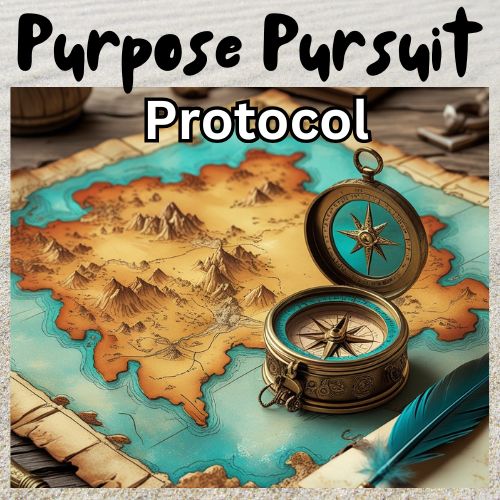
The Purpose Pursuit Protocol – if you want to discover your life purpose, this course will provide you with the clarity, motivation and direction you need to manifest your next chapter – in both your personal and professional life. Get immediate access
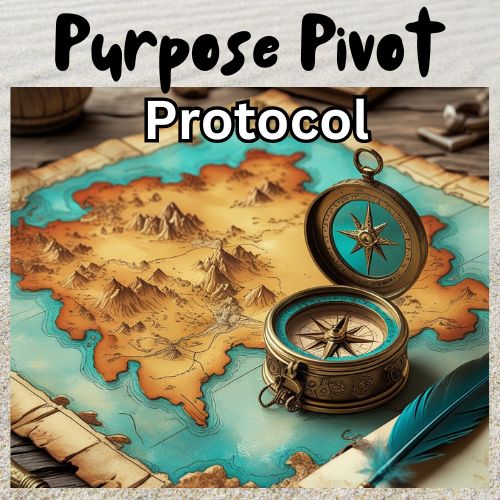
The Purpose Pivot Protocol – drawing inspiration from the Camino de Santiago, this transformative course guides you through a proven framework to recalibrate your authentic purpose and create a meaningful and fulfilling next act. Get immediate access

Spoiler alert: If you watch this month’s recommended TED talk, you’ll get an idea of where I’m going with this.
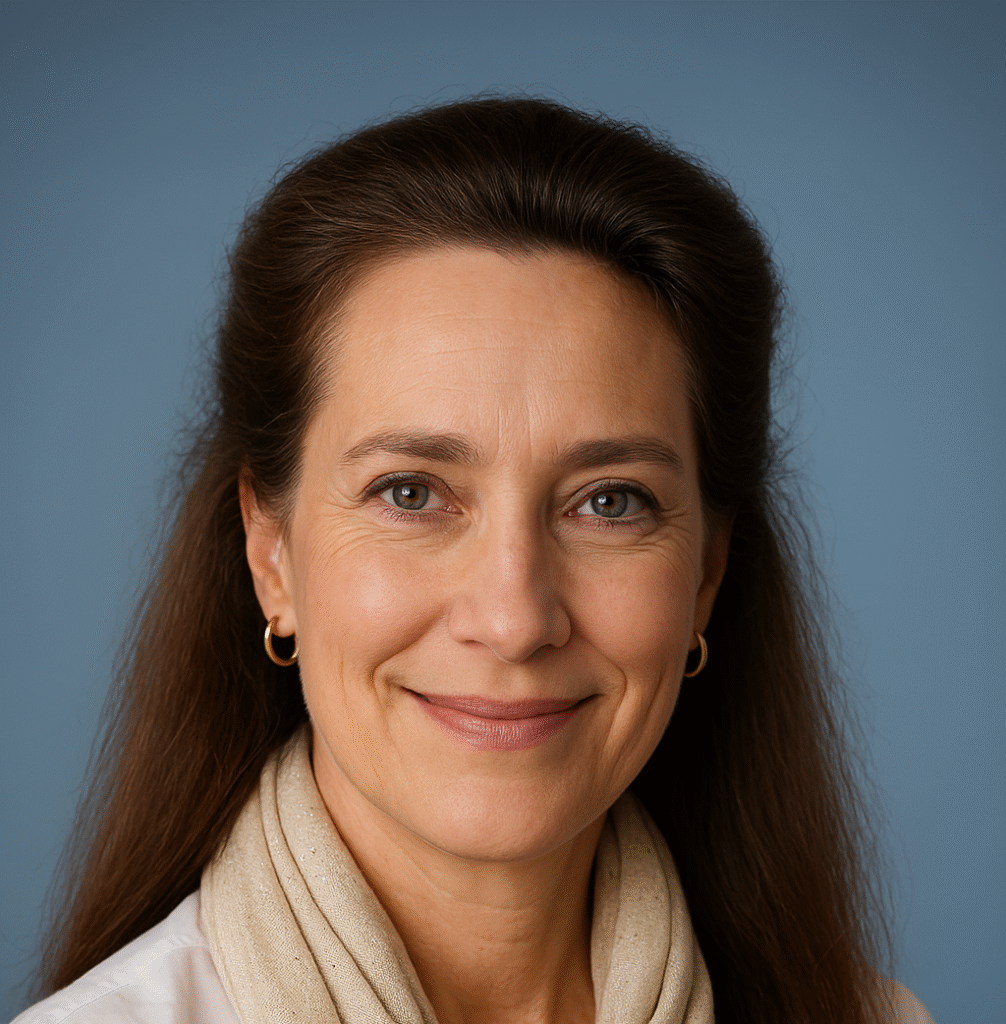
“I am an experienced medical doctor – MBChB, MRCGP, NLP master pract cert, Transformational Life Coach (dip.) Life Story Coach (cert.) Stress Counselling (cert.) Med Hypnotherapy (dip.) and EAGALA (cert.) I may have an impressive number of letters after my name, and more than three decades of professional experience, but what qualifies me to excel at what I do is my intuitive understanding of my clients’ difficulties and my extensive personal experience of managing major life changes using strategies I developed over many years.” Dr M Montagu

How to Detect Burnout At Work

How to detect Burnout at work

In Yourself and In Others

Burnout:
A psychological bonfire where your passion, patience, and sense of purpose all roast marshmallows together until nothingโ€™s left but crispy sarcasm

Introduction

“I just need a break.”

Often, when people write to me to make enquiries about my stress management retreats, either online or onsite here in the south of France, this sentence features prominently in their email, most often in the last paragraph. I have learned to sit up and take notice when I come across this sentence, as it is often said by people who are either burnt out already or on the verge of burning out.

Have you said that to yourself or to others recently? Did someone else say this to you?

Take notice, especially if you are an employer and you heard one of your employees say this.

People who are suffering from burnout at work, sometimes without realising it, often make statements that give away their state of mind. Depending on their individual experience and circumstances, they may say:

“I just can’t keep going anymore.” – Burnout can leave people feeling physically and emotionally exhausted, making it difficult to cope with their personal and professional responsibilities.

“I feel like I’m just going through the motions.” – Burnout can make people feel disconnected from their work, and from the people around them, causing them to feel as if what they do has no purpose or meaning.

“I don’t care anymore.” – Burnout can lead to a sense of apathy or detachment, causing people to lose interest in things that used to be important to them.

“I feel completely overwhelmed.” – Burnout can cause people to feel incapable of completing even small tasks, making it difficult to do what they are getting paid to do.

“I can’t handle this anymore.” – Burnout can make people feel like they’ve reached their breaking point, causing them to feel like they can’t deal with stress or any additional pressure.

“I don’t feel like myself anymore.” – Burnout can cause people to lose their sense of identity and which can result in a significant loss of self-esteem.

“I’m so frustrated.” – Burnout can lead to an intense sense of frustration, especially if people feel like they’re not making progress or reaching their targets.

“I feel like I’m stuck in a rut.” – Burnout can cause people to feel trapped, making it difficult to move forward or make changes in their personal or professional lives.

“I’m uber-stressed, all the time.” – Burnout can cause chronic stress, which can cause serious physical and psychological diseases.

“I canโ€™t sleep. I either lay awake for hours before I fall asleep or I wake up early. Or I wake up twenty times during the night.” – Burnout can cause insomnia, which increases exhaustion and decreases performance.

Statements that allow us to detect burnout at work early are not always made using these exact words, everyone expresses themselves differently and everyone’s experience of burnout is unique. People may also make any of the above statements without having burnout.

If you have been reading my posts for a while, you are probably thinking: Where’s the story?

Well, here it is:

The Great Burnout Bake-Off

By the time Claraโ€™s smartwatch told her to โ€œstand up and breathe,โ€ sheโ€™d already done both โ€” twice, aggressively. It was 10:07 a.m., and sheโ€™d hit her burnout peak for the third time that week.

Her company, Zenyth Synergy Solutions, had recently launched a โ€œWellness Initiativeโ€ to โ€œcombat burnout with mindful productivity.โ€ This translated to more meetings about burnout, which burned everyone out faster.

Last Tuesdayโ€™s meeting had been a PowerPoint titled โ€œThe Power of Powering Down.โ€ The irony was so thick you could spread it on toast.

But Clara wasnโ€™t alone. Across the country, employees everywhere were losing it. The world had become a giant pressure cooker powered by caffeine and โ€œurgentโ€ Slack notifications.

So when HR announced the Great Burnout Bake-Off, the internet collectively sighed, โ€œOh no.โ€

According to the company email โ€” which began with โ€œHey Team!โ€ and ended with โ€œStay grateful!โ€ โ€” everyone was encouraged to โ€œchannel your stress into baking!โ€

Clara hadnโ€™t baked since the banana bread era of 2020, but she was desperate. Maybe, just maybe, flour therapy would save her sanity.

The day of the competition arrived. Clara, surrounded by chaos in her kitchen, decided to make a โ€œBurnout Cakeโ€ โ€” three layers: exhaustion, existential dread, and frosting made of tears. She even wrote โ€œIโ€™m Fine :)โ€ on top in icing that determinedly kept melting off.

Meanwhile, her coworker Brad went all out. He made a gluten-free, sugar-free, joy-free โ€œCorporate Carrot Cakeโ€ decorated with an inspirational quote like โ€œHustle Harder!โ€

When everyone logged onto Zoom for the judging, HRโ€™s Becky appeared in a sunlit room holding a kale smoothie. โ€œWelcome, team!โ€ she chirped. โ€œRemember, this is about fun and community!โ€

Clara, who hadnโ€™t slept since Wednesday, smiled like a malfunctioning robot.

Each person presented their cake. Karen from accounting revealed a tiramisu shaped like a resignation letter. Dave from ITโ€™s cheesecake simply read: โ€œ404: Motivation Not Found.โ€

Then came Claraโ€™s turn.

โ€œThis,โ€ she said, gesturing to the half-collapsed tower of frosting, โ€œis my burnout cake. It represents the modern workerโ€™s spiritual decay under late-stage capitalism.โ€

There was silence. Then Becky clapped. โ€œOh my gosh, thatโ€™s so relatable! Youโ€™re so authentic, Clara.โ€

Clara won first place. Her prize? A mindfulness journal and an unpaid afternoon off โ€œto rest and recharge.โ€

She used it to take a nap. It lasted 11 hours.

When she woke up, her inbox had 247 new emails. One was from Becky.

Subject: โ€œFollowing up on your rest day โ€” hope youโ€™re feeling reenergised!โ€
Body: โ€œQuick reminder that we have a meeting tomorrow to discuss burnout prevention. Mandatory attendance. ๐Ÿ˜Šโ€

Clara stared at the screen for a long moment, closed her laptop, and went back to bed.

Unpacking Burnout

Burnout (n.):
A modern affliction where enthusiasm goes to die quietly behind a glowing screen.

It starts innocently enough. Youโ€™re motivated. Youโ€™re driven. You say things like โ€œIโ€™ll just finish this one last thing.โ€ Then โ€œone last thingโ€ multiplies like rabbits hopped up on espresso, and before you know it, youโ€™ve forgotten what weekends are for and why your shoulders feel like theyโ€™re made of bricks.

Burnout isnโ€™t just tiredness โ€” tiredness can be cured with a nap and a burrito. Burnout is existential fatigue. Itโ€™s when your brain says, โ€œI literally cannot,โ€ and your body says, โ€œSame.โ€ Itโ€™s the point where you start fantasising about quitting society to raise goats somewhere with poor Wi-Fi.

Corporate America loves to talk about โ€œpreventing burnout,โ€ usually by adding more meetings about burnout. Youโ€™ll hear phrases like self-care, work-life balance, and resilience โ€” all wonderful words that mean nothing when your boss emails you at 10:43 p.m. asking for โ€œjust a quick update.โ€

The burned-out person becomes a paradox: hyperproductive yet barely functional, overconnected yet emotionally unplugged. They sip iced coffee like medicine and say things like โ€œliving the dreamโ€ with the dead eyes of someone who hasnโ€™t seen daylight since Q2.

Burnout is not laziness; itโ€™s the bill your body sends after years of overdrafting your energy account.

The cure? Maybe itโ€™s boundaries. Maybe itโ€™s therapy. Maybe itโ€™s throwing your laptop into the sea and walking away in slow motion. Whatever it is, burnout is your body-mind’s polite way of saying: โ€œYou canโ€™t keep doing this, champ.โ€

And deep down, you know itโ€™s right.

Seriously though, how do you detect bunrout at work?

FAQ: Detecting Burnout at Work

1. What’s the difference between regular tiredness and actual burnout?

Regular tiredness improves with restโ€”a good night’s sleep or a weekend off helps you recharge. Burnout, however, is a state of chronic exhaustion that doesn’t improve with typical rest periods. You’ll notice it persists even after vacations, affects multiple areas of your life, and comes with emotional detachment or cynicism about your work. If you find yourself dreading work constantly, feeling emotionally numb, or thinking “what’s the point?” even about tasks you once enjoyed, that’s a red flag for burnout rather than simple fatigue.

2. What are the early warning signs I might miss while they’re developing?

The earliest signs are often subtle shifts in behavior: needing an extra coffee to get through the morning, procrastinating on tasks that used to be routine, or feeling irritable with colleagues over minor issues. You might notice yourself working longer hours but accomplishing less, or withdrawing from workplace social interactions you previously enjoyed. Physical symptoms like tension headaches, digestive issues, or disrupted sleep patterns can appear before you consciously recognize burnout. Many people also experience a creeping sense of detachmentโ€”going through the motions without feeling connected to their work’s purpose or impact.

3. How can I tell if it’s burnout or just a bad project/period at work?

A bad project creates temporary stress with a clear endpointโ€”once it’s done, you feel relief and can bounce back. Burnout feels pervasive and doesn’t lift when specific stressors end. Ask yourself: Does this feeling extend beyond one project to color how I view my entire job? Am I still finding satisfaction in any aspect of my work? Have I lost my sense of accomplishment even when completing tasks successfully? If negative feelings persist across multiple projects, affect your attitude toward work in general, and don’t improve during easier periods, you’re likely experiencing burnout rather than situational stress.

4. Can burnout affect my physical health, and what symptoms should I watch for?

Yes, burnout significantly impacts physical health because chronic stress keeps your body in a prolonged state of alert. Watch for persistent fatigue that doesn’t improve with sleep, frequent headaches or muscle tension (especially in the neck and shoulders), weakened immune function (catching every cold that goes around), digestive problems, changes in appetite, and disrupted sleep patterns including insomnia or sleeping too much. Some people experience heart palpitations, chest tightness, or increased blood pressure. These physical symptoms often appear alongside emotional exhaustion and shouldn’t be ignoredโ€”they’re your body’s way of signaling that stress levels have become unsustainable.

5. What’s the “Sunday Scaries” test, and why is it useful for detecting burnout?

The “Sunday Scaries” test refers to examining your emotional response as the weekend ends and the workweek approaches. Occasional mild anxiety about Monday is normal, but if you experience intense dread, physical symptoms like nausea or insomnia every Sunday night, or find your entire weekend overshadowed by thoughts about returning to work, this suggests burnout. The test is useful because it reveals whether your work stress has become chronic rather than episodic. When work anxiety colonizes your personal time and you can’t mentally disconnect even during days off, it indicates your relationship with work has become unsustainableโ€”a hallmark of burnout that requires intervention.

Possible Burnout at Work Solutions

It is my lifeโ€™s mission, first as a medical doctor and now as a retreat host, to help people manage stress, so they can avoid the permanent damage stress can cause.

Journaling Prompt to help you determine if you suffer from burnout: The “Past You” Conversation

Set aside 15 minutes in a comfortable spot. Imagine you could have a conversation with yourself from one year agoโ€”before things felt this heavy.

Write a letter to the person you were a year ago, starting with:
“Hey, it’s me from the future. Here’s what I need you to know about where we are now…”
Tell them honestly: What’s different about how you feel at work? What have you lost along the wayโ€”maybe it’s enthusiasm, creativity, patience, or the ability to leave work at work? What would surprise them about who you’ve become in your job?
Now, flip the perspective. Let that past version of you respond:
What would they ask you? What would concern them? What advice would they give you, knowing what mattered to you back then?
The powerful question:
If your past self could see you now, would they recognize you? Or have you compromised so much of what made work meaningful that you’ve become someone you didn’t set out to be?
Here’s your permission slip:
The person you were a year ago had wisdom. They had boundaries, dreams, and standards for how they deserved to be treated. You don’t have to abandon who you’ve become, but you can reclaim what you’ve lost. Write one thing you want to bring back from who you used to be.

This isn’t about regretโ€”it’s about remembering who you are beneath the exhaustion.

The Burnout to Breakthrough – a Roadmap to Resilience Protocol

The burnout epidemic has motivated me to create a 2-day online course called the Burnout to Breakthrough – a Roadmap to Resilience course. It is designed so that you can burnout-proof yourself during a weekend, by devoting four hours a day to the course two in the morning and two in the afternoon. It has gotten excellent reviews so far, so I am hoping that it will serve as my contribution to reducing burnout worldwide.

Worldwide.

Isnโ€™t that awe-inspiring? That I can now reach hundreds or even thousands of people online, instead of just the few that come to my Camino de Santiago Walking retreats. Reaching people is so much easier since the pandemic.

The Camino de Santiago Crossroeds Retreats

My retreats focus on helping people who are going through life transitions, or who have to make important decisions, by walking the Camino de Santiago de Compostela.

More often than not, my onsite retreat guests arrive burnt out by the stress they had to endure trying to cope with the life transition they are stuck in, whether it is an empty nest, retirement, redundancy, losing a loved one, changing careers, starting a business etc.

Conclusion

We can detect burnout at work early, merely by paying attention to what others are saying, and to what we are saying to ourselves.

The warning signs whisper before they shoutโ€”in the colleague who suddenly goes quiet in meetings, in our own internal dialogue that shifts from “I can handle this” to “I can’t do this anymore.” When we notice the cynicism creeping into conversations, the exhaustion that no longer lifts with rest, or the growing disconnection from work that once mattered to us, we’re receiving vital information. This awareness isn’t weakness; it’s wisdom. By listening closely to these signalsโ€”both in ourselves and in those around usโ€”we give ourselves the chance to course-correct before burnout takes root. Early detection means early intervention, and early intervention means we can reclaim our energy, our boundaries, and our sense of purpose before they’re completely depleted. The power to prevent burnout begins with the simple, courageous act of paying attention.

โ€œJust because you take breaks doesnโ€™t mean youโ€™re broken.โ€
โ€• Curtis T. Jones

If youโ€™re feeling overwhelmed, exhausted, or on the edge of burnout, you need immediate support. The Road Map to Resilience: Burnout to Brilliance online course (with the option of adding coaching sessions) is designed for exactly that: a practical, step-by-step course to help you regain control, rebuild your energy, and find clarity in the chaos. This isnโ€™t a quick fixโ€”itโ€™s about proven strategies to calm your nervous system, shift your mindset, and create sustainable resilience. No need to cope with this on your ownโ€”letโ€™s get you back on track.

“I am an experienced medical doctor – MBChB, MRCGP, NLP master pract cert, Transformational Life Coach (dip.) Life Story Coach (cert.) Stress Counselling (cert.) Med Hypnotherapy (dip.) and EAGALA (cert.) I may have an impressive number of letters after my name, and more than three decades of professional experience, but what qualifies me to excel at what I do is my intuitive understanding of my clients’ difficulties and my extensive personal experience of managing major life changes using strategies I developed over many years.” Dr M Montagu

Burnout Destroys Creativity

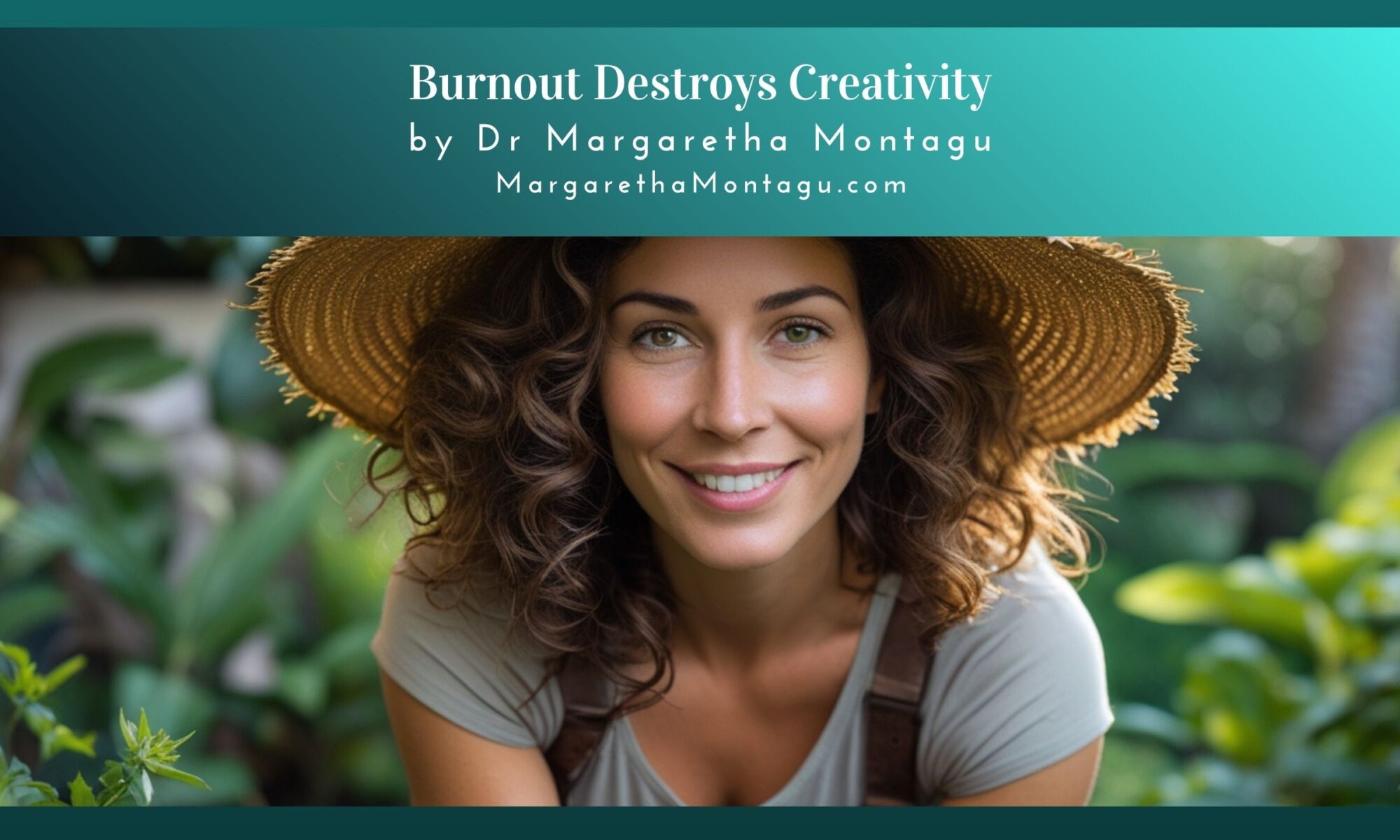
Burnout destroys creativity. Woman in straw hat surrounded by plants.

Recommended TED-talk of the Month duration 5 minutes

Early this morning, when I should have been getting out of bed to go and feed the horses, the -3ยฐC reading on the thermometer and crackling frost on the fields was so discouraging that I resisted my coffee cravings to watch one more TED talk: Rahaf Harfoush’s talk “Burnout makes us less creative. “

I am in the process of creating an online course called Burnout to Breakthrough/Road Map to Resilience, so I read everything I can lay my hands on about “burnout.” I actually hadn’t thought about the effect that burnout has on our creativity, but I should have because the more creative we are, the greater our ability to problem-solve. I reflected on my own experience and realised just how detrimental an effect burnout has on my own creativity – when I am stressed, I write to reduce stress, but burnout gives me complete writer’s block.

I thought I would share this talk with you here. It’s excellent, if you have 5 minutes, I recommend you watch it. Twice, if you have time, it makes so much sense. According to Rahaf Harfoush, a digital anthropologist (that sounds like an amazing job,) “Our obsession with productivity — to-do lists, life hacks, morning routines — is making us less productive. We need to redesign our workday around creativity – not just efficiency. She says the average American takes only half of their allocated leave…

Burnout Inhibits Creativity: When Your Inner Fire Burns Out, So Does Your Spark

Burnout doesn’t just make you tiredโ€”it murders your creativity, strangles your innovation, and leaves you staring at blank pages, wondering where your brilliance went. As a medical doctor who’s been there, survived it, and now guides others through it on Camino retreats, I’m sharing why your brain stops producing when you’re running on fumes, and more importantly, how to get your creative mojo back. If you’ve ever felt like a shell of your former imaginative self, keep reading.

5 Key Takeaways

  1. Burnout literally rewires your brain’s creative centres: Chronic stress shrinks the prefrontal cortex (your innovation hub) whilst enlarging the amygdala (your fear centre). You’re not lazyโ€”you’re neurologically compromised.
  2. Rest isn’t optional; it’s the prerequisite for creativity: Your best ideas don’t come from pushing harderโ€”they emerge in the spaces between effort. Walking, silence, and doing “nothing” are actually doing everything.
  3. Storytelling rewires burnt-out brains: Sharing narratives in safe circles activates different neural pathways than analytical thinking, offering your exhausted executive functions a genuine break whilst reconnecting you to meaning.
  4. Physical movement unlocks mental movement: Rhythmic walking (especially pilgrimage-style) synchronises both brain hemispheres, creating the conditions where creative insights spontaneously arise.
  5. Community heals what isolation destroyed: Burnout thrives in loneliness. Creativity flourishes in connection. You cannot think your way out of burnoutโ€”you must walk, talk, and feel your way through it with others.

Introduction: Empty is Expensive

Burnout doesn’t just steal your energy. It pickpockets your imagination, burgles your curiosity, and leaves you holding an empty bag where your creativity used to live.

I know because I’ve lived it. As a medical doctor, I spent years believing that exhaustion was simply the price of excellence, that running on empty was a badge of honour, and that my worth was measured in productivity. Then one morning, I sat down to write a simple patient letter and couldn’t find the words. Not medical jargonโ€”I had plenty of that. But the connecting tissue, the creative phrasing, the human touch that makes medicine an art as much as a science? Gone.

That’s when I realised: burnout doesn’t just dim your light. It fundamentally alters how your brain processes possibility itself.

The relationship between burnout and creativity isn’t just correlationโ€”it’s causation. When your nervous system is perpetually flooded with cortisol, when your prefrontal cortex is starved of resources because your amygdala is screaming danger signals, when every ounce of cognitive energy is devoted to simply surviving the next email, the next meeting, the next demand… there’s nothing left for imagination.

Creativity requires spaciousness. Burnout is the ultimate space invader.

But here’s the good news I discovered walking the Camino de Santiago: creativity isn’t dead. It’s dormant. And with the right conditionsโ€”movement, community, story, and restโ€”it comes roaring back to life.

Tina’s Story: The Marketing Director Who Lost Her Spark

Tina Pyper arrived at a Camino de Santiago Crossroads Retreat carrying a leather portfolio she never opened and a smartphone she checked every seven minutes. Her fingers twitched constantly, as though typing invisible emails on invisible keyboards. When I asked what brought her to the Camino, she laughedโ€”a brittle, humourless sound like ice cracking.

“I used to be brilliant,” she said, staring at the limestone path stretching ahead. “Now I’m just… functional.”

Tina had spent fifteen years building her reputation as the creative director everyone wanted on their team. The woman who could walk into a room and spin three campaign concepts before coffee arrived. Who dreamed in metaphors and saw connections nobody else noticed. Who made clients weep with the beauty of her brand stories.

Then came the promotion. More responsibility, more budget, more visibility. And with it, more meetings, more stakeholders, more nights working until 2 AM because someone in New York had “just one quick question.” More mornings waking with her heart already racing, mentally triaging the day’s disasters before her feet touched the floor.

The first sign was small: she stopped noticing things. The way autumn light slanted through her office window. The smell of rain on hot pavement. The particular green of new leaves in spring. Details that used to spark ideas now barely registered. Her world had narrowed to screens and deadlines.

Then the ideas stopped coming. She’d sit in brainstorming sessions, her team looking at her expectantly, and find… nothing. Just a vast, echoing blankness where her imagination used to live. She’d panic, reach for old formulas, and regurgitate what worked last year. Nobody complainedโ€”her execution was still flawless. But Tina knew. The magic was gone.

“I felt like a fraud,” she told me on our second day walking, her voice barely audible above the crunch of gravel beneath our boots. “Like everyone would eventually realise I was empty inside. Just going through the motions.”

On the third morning, during our storytelling circle, I asked each person to share a childhood memoryโ€”nothing work-related, no lessons, just pure recollection. The group sat in the dappled shade of an ancient oak, and when Tina’s turn came, she hesitated so long I thought she might refuse.

Then she began: “I was seven. My grandmother had this garden…”

Her voice changed as she spokeโ€”softened, warmed, came alive. She described the weight of tomatoes in her small palms, sun-warm and heavy. The sharp, green smell of tomato leaves that stuck to her fingers. Her grandmother’s soil-stained hands guiding hers, teaching her to pinch off suckers. The taste of cherry tomatoes eaten straight from the vine, still hot from the sun, bursting sweet and acid on her tongue.

As she spoke, I watched the others lean forward. Watched their faces soften. And I watched something shift in Tina’s eyesโ€”a light flickering back on after a long darkness.

“I’d forgotten,” she whispered when she finished. “I’d completely forgotten how that felt. How alive everything was.”

That evening, she borrowed paper from my notebook. Not to make lists or plansโ€”she’d been doing that compulsively since arrivalโ€”but to write. Just to see what came. She sat on a stone wall overlooking the valley as the sun set, and her hand moved across the page in a way I recognised: the unselfconscious flow of someone reconnecting with a lost part of themselves.

Later, in our final storytelling circle, she shared what she’d written: a piece about gardens and grandmothers and the particular quality of light through tomato leaves. It wasn’t marketing copy. It wasn’t strategic or targeted or optimised for anything. It was simply beautiful. Several people cried.

“I thought creativity was something I did,” Tina said, her eyes bright with tears and laughter both. “But it’s something I am. I just needed to remember how to be quiet enough to hear it again.”

She left the retreat with her portfolio still unopened and her phone notifications permanently silenced. Six months later, she sent me a message: she’d taken a sabbatical, was consulting part-time, and had started writing againโ€”not for clients, but for herself. “The ideas are back,” she wrote. “Better than before. Because I’m back.”

In my storytelling circles, I’ve witnessed this resurrection countless times. When we create space for people to share without agenda, without performance, without the pressure to be productiveโ€”something fundamental shifts. The stories we tell reconnect us to the stories we’re living. And in that reconnection, creativity doesn’t just return. It transforms.

The Neuroscience of Burnout and Creativity: Why Your Brain Can’t Do Both

Let’s talk about what’s actually happening in your brain when burnout and creativity collide. This isn’t woollinessโ€”it’s biology.

Your prefrontal cortex, the sophisticated CEO of your brain, handles executive functions: planning, problem-solving, and creative thinking. It’s where innovation lives, where you make unexpected connections, where your best ideas emerge. But here’s the catch: it’s an energy hog. When resources are scarce, your brain has to make choices.

Enter burnout. Chronic stress floods your system with cortisol, triggering your amygdalaโ€”your brain’s alarm systemโ€”into overdrive. Your amygdala doesn’t care about your brilliant marketing campaign or your novel’s plot twist. It cares about survival. And when it’s screaming “danger!” your brain diverts resources away from that expensive prefrontal cortex and towards immediate threat response.

Studies using brain imaging have shown that chronic stress literally shrinks the prefrontal cortex whilst enlarging the amygdala. You’re not imagining itโ€”your creative capacity is being structurally diminished.

But there’s more. Creativity requires what neuroscientists call the “default mode network”โ€”the mental state you enter when you’re not focused on external tasks. It’s the wandering mind, the daydreaming state, the shower-thoughts phenomenon. This is where your brain makes those unexpected connections that feel like genius.

Burnout kills the default mode network. When you’re in constant fight-or-flight, your brain never gets to wander. You’re always on task, always vigilant, always scanning for the next threat (email, deadline, criticism). There’s no mental space for the mind to meander, to play, to stumble upon something new.

This is why forcing creativity when you’re burnt out is like trying to grow tomatoes in concrete. It’s not about willpower or discipline. Your brain literally lacks the conditions necessary for creative thought to emerge.

The Creativity-Burnout Cycle

Here’s where it gets particularly cruel: for many professionalsโ€”entrepreneurs, leaders, creativesโ€”your creativity is your livelihood. Losing it isn’t just personally devastating; it’s professionally catastrophic. So what do you do? You work harder. You push more. You try to force the ideas to come.

Which, of course, worsens the burnout. Which further inhibits creativity. Which increases panic. Which drives you to work harder still.

I see this cycle constantly in the corporate professionals and entrepreneurs who come to my retreats. They arrive believing they need to “fix” themselves quickly so they can get back to producing. They’re treating their burnout like a software glitchโ€”reboot and resume.

But burnout isn’t a glitch. It’s a message. Your nervous system is essentially staging an intervention, saying: “We cannot continue like this.”

Why Rest Isn’t Enough (But It’s Essential)

“Just rest” sounds simple. And yes, sleep matters enormouslyโ€”the glymphatic system that clears metabolic waste from your brain works primarily during deep sleep. But here’s what I’ve learned both personally and professionally: passive rest alone doesn’t restore creativity.

You need active recovery. You need experiences that engage your senses, that connect you to something beyond your inbox, that remind your nervous system what safety and pleasure feel like.

This is where walking comes in. Rhythmic bilateral movementโ€”the left-right, left-right of walkingโ€”has been shown to integrate both brain hemispheres and reduce amygdala activation. There’s a reason so many philosophers and writers throughout history were dedicated walkers. The physical rhythm creates a mental rhythm. Ideas don’t come from thinking harder; they emerge from the steady pace of feet on earth.

Pilgrimage-style walkingโ€”walking with intention but without rigid destinationโ€”adds another layer. You’re moving, but you’re not rushing. You’re going somewhere, but you’re fully present to where you are. This paradox is precisely what burnt-out brains need: forward momentum without pressure, purpose without performance.

The Power of Sensory Awakening

Remember Tina’s tomatoes? That wasn’t nostalgiaโ€”it was neurological rehabilitation.

Burnout narrows our sensory aperture. We stop noticing. Everything becomes instrumentalโ€”this thing to get through to reach that thing. Food becomes fuel. Walks become transportation. Conversations become transactions.

Creativity requires the opposite: a wide-open sensory engagement with the world. When you truly taste your food, feel the sun on your skin, smell the particular scent of pine after rainโ€”you’re not just being mindful. You’re giving your prefrontal cortex novel sensory data to play with. You’re reminding your brain that the world is full of interesting inputs worth paying attention to.

In our Camino retreats, I watch this awakening happen gradually. Day one, people barely notice their surroundingsโ€”they’re too busy managing their anxiety about being away from work. By day three, someone stops the group to point out a spider’s web jewelled with dew. By day five, we’re pausing to taste wild blackberries, to press our palms against sun-warmed stone, to listen to the specific quality of birdsong at dusk.

This isn’t frivolous. This is medicine. You’re retraining your nervous system to perceive abundance instead of scarcity, wonder instead of threat. And from that shifted state, creativity doesn’t have to be forced. It simply bubbles up, natural as breathing.

Storytelling Circles: The Unexpected Antidote

One of the most powerful tools I’ve discovered for healing burnout and restoring creativity is also one of the oldest: storytelling in community.

In my storytelling circles, there’s no agenda. No workshopping. No critique. Just humans sharing stories and other humans listening intently. It’s deceptively simple. And profoundly transformative.

Here’s why it works: storytelling engages completely different neural pathways than the analytical, problem-solving thinking that dominates most professional environments. When you tell a story, you’re not in your prefrontal cortex trying to optimise and strategise. You’re in a more embodied, emotional, intuitive space.

Moreover, storytelling is fundamentally creative. Even if you’re sharing something that “really happened,” you’re making creative choices: where to begin, which details matter, how to convey emotion, what the story means. You’re exercising your creativity without the pressure of it having to be “useful.”

And here’s the magic: when you tell your story and someone truly listensโ€”not to respond, not to fix, but simply to receiveโ€”something in you relaxes. You remember that you matter beyond your productivity. That your experiences have value beyond their professional utility. That you are interesting simply because you are human.

For women especiallyโ€”and I see this repeatedly in my circlesโ€”this permission to take up space, to be heard without having to prove value, to share without apologising, is revolutionary. So many professional women have internalised the message that their worth equals their output. Storytelling circles disrupt that equation.

One member of my circles, Sarah, shared this insight: “For the first time in years, I experienced something without immediately thinking about how to monetise it or what it could teach me. I just… experienced it. And then I shared it. And people cared. Not because it was useful. Because it was true.”

That shiftโ€”from instrumental to intrinsic, from performing to beingโ€”is where creativity lives.

Your Body Keeps the Score

There’s a reason burnout recovery requires physical intervention, not just cognitive reframing. Your body has kept meticulous records of every threat, every stressor, every time you overrode your needs for productivity. Those records are stored in your nervous system, your muscles, your fascia.

You cannot think your way out of burnout because burnout isn’t just a thought problem. It’s a whole-body experience of depletion and dysregulation.

This is why our Camino retreats combine walking with mindfulness and meditation practices specifically designed for stress management. We’re not trying to relax your mind whilst your body remains clenched. We’re helping your entire nervous system recalibrate.

The walking provides bilateral stimulation and rhythmic regulation. The mindfulness practices teach interoceptionโ€”the ability to notice and interpret bodily signals. The meditation cultivates the parasympathetic “rest and digest” response. Together, they create the conditions for genuine recovery.

And here’s what happens when your nervous system finally feels safe: creativity returns. Not as something you have to chase, but as something that simply emerges. Ideas arise on the walk. Insights appear during meditation. Connections spark in conversation.

Because creativity was never gone. It was just waiting for you to come home to yourself.

Further Reading: Three Unconventional Books

1. The Body Keeps the Score by Bessel van der Kolk

Why this book: Van der Kolk’s groundbreaking work on trauma provides the neurological framework for understanding why burnout can’t be resolved through positive thinking alone. His research on how trauma (and chronic stress) physically reshapes the brain and nervous system validates what burnout sufferers intuitively know: this isn’t “all in your head.” More importantly, his exploration of body-based healing modalitiesโ€”from theatre to yoga to EMDRโ€”offers concrete pathways to recovery. For creative professionals, his chapter on how trauma silences the “watching” part of the brain (the area that notices and creates meaning) is particularly illuminating.

2. Women Who Run with the Wolves by Clarissa Pinkola Estรฉs

Why this book: Estรฉs, a Jungian analyst and storyteller, explores how women’s creative lives are destroyed not by lack of talent but by the systematic severing of their connection to their wild, instinctual selves. Her analysis of fairy tales reveals archetypal patterns of how women lose themselves to overwork, perfectionism, and the demands of othersโ€”and how they find their way back through story, ritual, and reconnection to their deeper knowing. For burnt-out professional women who’ve sacrificed their creativity on the altar of success, this book is both mirror and map. It’s not a business book, which is precisely why it’s essential reading for anyone whose business has consumed them.

3. Braiding Sweetgrass by Robin Wall Kimmerer

Why this book: Kimmerer, a botanist and member of the Citizen Potawatha Nation, weaves together indigenous wisdom and scientific knowledge to explore humanity’s relationship with the natural world. Her central thesisโ€”that reciprocity, not extraction, is the basis of sustainable relationshipโ€”applies as much to our relationship with our own creative energy as it does to the earth. For those recovering from burnout, her writing models a different way of being: attentive, grateful, reciprocal, and deeply creative. Reading her prose is itself a lesson in how creativity emerges not from forcing but from careful attention to what’s already present. Every page reminds you that abundance, not scarcity, is the truth of thingsโ€”you just have to slow down enough to notice.

Real Voices: Testimonials from the Path

From a First-Time Camino Walker

“I came to Dr Montagu’s Crossroads Retreat in pieces. I’d spent three years building my startup, convinced that burnout was just weakness I needed to push through. I couldn’t remember the last time I’d had an original ideaโ€”I was just recycling the same strategies, hoping something would stick. The concept that I needed to stop working to start creating again felt dangerous, even irresponsible.

Walking the Camino changed everything. Not instantlyโ€”I spent the first two days mentally composing emails I couldn’t send. But something about the rhythm of walking, the mindfulness practices, the complete absence of wifi and demands… my brain finally exhaled. By day four, I was noticing things: bird patterns, stone walls, the way light moved through leaves. By day six, I was having ideas again. Not forced, not strained. They just… appeared.

The mindfulness and meditation exercises Dr Montagu taught us weren’t fluffy nonsenseโ€”they were practical tools for regulating my nervous system. And the storytelling circles showed me that I’d become so focused on strategic messaging I’d forgotten how to simply share a human experience. I left with more than rest. I left with a completely different relationship to my work, my creativity, and my worth as a human beyond what I produce.

Six months later, I’m still walking every morning. My business is thrivingโ€”not because I’m working harder, but because I’m finally creative again.” โ€” Emma R., Tech Entrepreneur

From a Storytelling Circle Member

“Joining Dr Montagu’s storytelling circle was terrifying. I’d never travelled alone before, never put myself in a space where I had to speak without a professional reason. As a corporate consultant, I was used to having all the answers, being the expert in the room. The idea of just… sharing a personal story with strangers? Vulnerable doesn’t begin to describe it.

But that vulnerability was exactly what I needed. In the circle, nobody wanted my expertise. They just wanted me. My actual experiences, my real reactions, my honest struggles. For the first time in my professional life, I wasn’t performing. I was just being.

What surprised me was how this transformed my confidence about travelling alone. When you’ve sat in a circle and shared something true and been met with genuine attention and careโ€”not judgement, not critique, just presenceโ€”something shifts. You realise you’re not as fragile as you thought. That connection is possible even with strangers. That you have intrinsic worth beyond your utility.

Now I travel alone regularly. And I’ve started writing againโ€”not reports, but actual creative writing. The circle didn’t just help me overcome travel anxiety. It helped me remember I’m more than my job title. That the stories I have to tell matter simply because they’re mine.” โ€” Patricia L., Strategy Consultant

FAQs: Your Burning Questions Answered

Q: Can’t I just take a holiday and recover from burnout that way?

No, and here’s why: burnout isn’t simple exhaustion that resets with time off. It’s a profound dysregulation of your nervous system that requires active intervention. A typical holidayโ€”especially one where you’re still checking emails, planning the itinerary, managing logisticsโ€”keeps you in the same hypervigilant state. Recovery requires experiences that fundamentally shift your nervous system from sympathetic (fight-or-flight) to parasympathetic (rest-and-digest) activation. The combination of pilgrimage-style walking, mindfulness practices, storytelling, and genuine disconnection creates conditions a beach holiday simply cannot.

Q: How do I know if I’m burnt out or just tired?

Fatigue responds to rest. Burnout doesn’t. If you’re burnt out, you’ll notice: emotional exhaustion that sleep doesn’t fix, cynicism or detachment from work you once cared about, reduced sense of accomplishment despite working harder, inability to concentrate or create, physical symptoms like insomnia or tension, and feeling trapped with no way out. Most tellingly, if creative tasks that used to energise you now feel impossible, you’re likely beyond simple tiredness into genuine burnout territory.

Q: I can’t afford to take time off work. What then?

I understand this fear intimatelyโ€”I felt it myself as a doctor. But here’s the harder truth: if you don’t take time off to recover now, burnout will eventually take the choice away from you through illness, breakdown, or such profound performance decline you’re forced to stop. Burnout is expensiveโ€”to your health, your relationships, your career longevity, and yes, your creativity. The question isn’t whether you can afford time off; it’s whether you can afford not to recover. Even a long weekend retreat can provide the reset that prevents months of dysfunction.

Q: Does walking really make that much difference to creativity?

Yes, and the research backs this up. Stanford University studies found that walking increases creative output by an average of 60%. The bilateral movement synchronises both brain hemispheres, reduces amygdala activation, and allows the default mode network to engageโ€”precisely the conditions creativity requires. But not all walking is equal: walking in nature, at a comfortable pace, without screens or podcasts, provides maximum benefit. The Camino’s pilgrimage context adds another dimension: you’re walking with intention but without the pressure of productivity, which is exactly the paradox burnt-out brains need.

Q: I’m not naturally creative. Is this still relevant to me?

Absolutely. Creativity isn’t just for artistsโ€”it’s fundamental to problem-solving, strategic thinking, relationship-building, and finding meaning in your life. If you’re an entrepreneur, you need creativity to innovate and adapt. If you’re a leader, you need it to inspire and navigate complexity. And as a human, you need it to craft a life worth living. Burnout steals creativity from everyone, regardless of job title. And everyone, regardless of profession, deserves to get it back.

Conclusion: The Fire You Tend, Not the One You Smother

Burnout doesn’t just inhibit creativityโ€”it fundamentally severs your connection to the part of yourself that imagines, innovates, and dreams. But here’s what I’ve learned from walking hundreds of kilometres on the Camino, from sharing stories in circles, from guiding others through recovery, and from my own journey back from the edge: creativity isn’t something you lost. It’s something that’s been waiting, patiently, for you to create the conditions where it can return.

You cannot force creativity any more than you can force a seed to grow by shouting at it. But you can tend the soil. You can provide water, sunlight, and space. You can remove the rocks choking its roots. You can wait, with faith, for the green shoots to emerge.

That’s what genuine recovery from burnout looks like: not a quick fix, but a fundamental reorientation towards what makes you human. Rest, yes. But also movement. Connection. Story. Sensation. Beauty. The permission to exist beyond your productivity.

Your creativity isn’t gone. It’s dormant. And winter, as any gardener knows, is not deathโ€”it’s preparation for spring.

The fire that creates, that imagines, that makes meaning from chaos? It’s still in you. It’s just waiting for you to stop adding fuel to the wrong flamesโ€”the flames of pressure, perfectionism, and endless productivityโ€”and instead tend the quiet ember of your essential self.

That ember is enough. Given the right conditions, it will become a blaze again.

But first, you must stop. You must walk. You must remember. You must come home to yourself.

And then? Then the creating thing happens on its own.

Begin Your Journey Back to Yourself

If these words resonated in your chest like a bell that’s been silent too long, perhaps it’s time to consider something radical: actually stopping.

Not collapsing. Not failing. Stopping with intention.

My Camino de Santiago Crossroads Retreats in the beautiful south-west of France aren’t your typical hiking holidays. They’re carefully designed recovery experiences for burnt-out professionals and entrepreneurs who’ve forgotten they’re human beings, not human doings.

Picture this: walking ancient pilgrimage paths through landscapes that have witnessed countless journeys of transformation. Not the full Caminoโ€”these are carefully curated sections chosen for their beauty, significance, and capacity to restore. The rolling hills of Gers, the medieval villages where time moves differently, the paths through oak forests where the only sound is your footsteps and birdsong.

Each day combines mindful walking with meditation and mindfulness practices specifically designed for stress managementโ€”not the kind that feels like another task on your to-do list, but embodied practices that help your nervous system remember what safety feels like. We move slowly enough to actually notice things: the quality of light, the scent of wild herbs, the feeling of your feet on earth.

In our evening storytelling circles, you’ll discover what happens when you share your experience without having to prove anything, fix anything, or turn it into a professional development opportunity. Just stories. Just listening. Just the profound recognition that your lifeโ€”exactly as it is, with all its contradictions and complexitiesโ€”matters.

These retreats are small by design. Intimate enough that you’re genuinely seen, large enough that you’re not carrying the social weight of one-on-one intensity. You’ll walk with others who understand what it means to have given everything to your work and found yourself empty. And you’ll discover that you’re not alone in thisโ€”not in the struggle, and not in the journey back.

The south-west of France offers spaciousness. The villages are quiet. The paths are uncrowded. The pace of life itself is different hereโ€”slower, richer, more sensual. The food is extraordinary (because recovery also requires pleasure). The sunlight has a particular golden quality that makes everything feel like a painting.

But more than the location or the practices, what makes these retreats transformative is this: they’re led by someone who’s been where you are. I understand the particular exhaustion of high-functioning professionals. I know what it’s like to believe rest is weakness and pushing through is strength. I’ve experienced firsthand what happens when your body finally forces you to stop. And I’ve found my way backโ€”not to who I was before, but to someone more whole, more creative, more alive.

You don’t need to walk the full Camino to experience transformation. You just need to begin. To take a few days away from the noise and remember what your own voice sounds like. To walk without destination and discover that you have everything you need already within you.

Your stories matter.

10 Powerful Life Lessons Learned While Walking the Camino de Santiago a free guide filled with 10 not just “quaint anecdotes” or Instagram-worthy moments (though there are plenty of those) but real transformations from real people who walked the same insight-giving trail you might want to walk one day – Subscribe to my monthly newsletter to Download the Guide

“I am an experienced medical doctor – MBChB, MRCGP, NLP master pract cert, Transformational Life Coach (dip.) Life Story Coach (cert.) Stress Counselling (cert.) Med Hypnotherapy (dip.) and EAGALA (cert.) I may have an impressive number of letters after my name, and more than three decades of professional experience, but what qualifies me to excel at what I do is my intuitive understanding of my clients’ difficulties and my extensive personal experience of managing major life changes using strategies I developed over many years.” Dr M Montagu
All content of this website is copyrighted. You cannot copy the content of this page