
Why High-Performers Are Trading Meditation Apps for Walking Boots
Summary
Executives are having nervous breakdowns in business class. Not the dramatic kind—the silent erosion where you’re crushing quarterly targets while forgetting what joy feels like. The solution isn’t another productivity hack. It’s a simple stress reset: walking. Specifically, walking ancient paths where your smartphone becomes gloriously irrelevant and your nervous system finally exhales. Welcome to the micro-recovery revolution meets medieval pilgrimage—where stress management gets its hiking boots on.
5 Key Takeaways
- Micro-recovery beats macro-meditation: Your nervous system doesn’t need hour-long interventions; it needs 60-90 second pressure-release valves throughout your day that you’ll actually use.
- Walking meditation synchronises your three brains: Extended walking creates neural coherence between your head (cognition), heart (emotion), and gut (intuition)—something no boardroom ever achieved.
- Stress accumulates in the body, not the mind: You can’t think your way out of chronic stress because it’s stored in your fascia, breath patterns, and muscle memory. Movement metabolises it.
- The Camino effect is real: Multi-day walking on historic pilgrimage routes triggers measurable changes in brain wave patterns, cortisol levels, and decision-making clarity that persist for months.
- Recovery isn’t reward—it’s strategy: High-performers who integrate intentional pauses outperform those who glorify grinding by every meaningful metric: creativity, longevity, leadership presence, and life satisfaction.
Introduction: The Question Nobody’s Asking
Here’s what I’ve learned after 20 years as a GP specialising in stress management and a decade guiding executives through walking retreats on the Camino de Santiago: the people who most need to stop are the ones most convinced they can’t.
We’ve built entire industries around helping people manage stress while remaining stressed. Meditation apps deliver mindfulness between meetings. Wellness programs offer yoga at lunch. Executive coaches teach resilience as if stress were simply a matter of mental fortitude.
But here’s the uncomfortable truth: stress isn’t pressure that needs managing. It’s pressure that needs releasing.
Your body knows this. Your nervous system is screaming it. But your mind—that brilliant, ambitious, achievement-addicted mind—keeps overriding the signals.
What if I told you that the fastest way to reset during a hectic workday isn’t another breathing technique, but remembering how to walk like you mean it? Not walking to your next meeting. Not walking while checking your phone. Walking, as THE point.
And what if the most sophisticated leadership development tool available isn’t in Silicon Valley—it’s a 1,200-year-old footpath across Europe where pilgrims have been sorting out their souls since Charlemagne was crowned?
I love stories, so let me tell you about Marcus.
The Man Who Forgot How to Sleep
Marcus Henshaw’s assistant called me on a Tuesday in March. “He won’t admit it,” she said quietly, “but I think he’s in trouble.”
Marcus was 47, CFO of a mid-sized tech firm, married with two teenagers he saw mainly at breakfast, if breakfast happened. He’d been assesed by his cardiologist after presenting with chest pain that turned out to be nothing—and everything. Clean arteries. Perfect cholesterol. Textbook ECG. But a resting heart rate of 94 and the kind of tension radiating from his shoulders that made the doctor ask, “When did you last take a full breath?”
When Marcus consulted me via Zoom three weeks later, I noticed his hands first. They couldn’t settle. Drumming the chair arm, adjusting his watch, checking his phone even though he’d just checked it. His eyes had that particular glaze of someone running on fumes and caffeine, the pupils slightly dilated, the blink rate too fast.
“I don’t sleep,” he said, before I’d asked anything. Not as confession—as fact. “Two, maybe three hours. I lie there doing Monte Carlo simulations in my head. My wife says I’ve stopp breathing sometimes. I downloaded apps. Tried the magnesium. Read the Matthew Walker book.” He laughed—sharp, bitter. “Knowing why you can’t sleep doesn’t help you sleep.”
I asked him to describe a typical day. He stood up to answer, unable to remain seated, and began pacing his office like a captive animal.
“I wake at 4:47. Don’t know why that exact time, but it’s always 4:47. Lie there until 5:30, then gym. Emails during cardio. Shower at the gym. Protein shake in the car. Office by 7:15. Meetings until lunch, which I eat at my desk while on calls. Afternoon’s the same. Home by 7:30 if I’m lucky, but I’m checking my phone through dinner, which pisses off my wife, and then I work until midnight.” He stopped, looked at me. “That’s a good day.”
“What does your body feel like?” I asked.
He stared at me as if I’d asked him to translate Sanskrit. “My body?”
“When’s the last time you felt your feet on the ground?”
The question stopped him mid-pace. He opened his mouth. Closed it. Opened it again. “I… I don’t know what you mean.”
And there it was. The complete disconnection between the man and the nervous system carrying him around. Marcus’s breath was shallow and high in his chest. His jaw was clenched so tight I could see the muscle working. His shoulders sat somewhere near his ears. When I asked him to take a deep breath, he inhaled sharply through his nose and held it, as if breathing were another task to optimise.
“Marcus,” I said gently, “your body thinks it’s being chased by a bear. Every moment of every day. That’s what’s happening physiologically. You’re not broken. You’re not weak. You’re just stuck in a nervous system state that was designed for acute danger, not chronic pressure.”
Something shifted in his face. Not relief exactly—recognition.
“I’m going to suggest something that will sound insane,” I continued. “I want you to walk across part of France with me. No laptop. No phone signal for most of it. Just walking. Eight days. On an ancient pilgrimage route where millions of people have walked for over a thousand years.”
He laughed. “I can’t just disappear for eight days.”
“That’s what every single person says. And then they do. And then they come back and realize they should have done it three years earlier.”
Three months later, Marcus stood in the town square of Eauze in southwest France, looking mildly terrified. His backpack was too heavy—first-timer mistake, despite the packing list. His hiking boots were broken in but his face wasn’t. He kept reaching for the phone I’d asked him to leave in the locked safe at our accommodation.
“What do I do if there’s an emergency?” he’d asked the night before.
“Your assistant has my number. Your wife has my number. The company has backup protocols. And here’s the radical truth, Marcus: the world will turn without you checking your email for a week. If that’s not true, you’ve built something too fragile.”
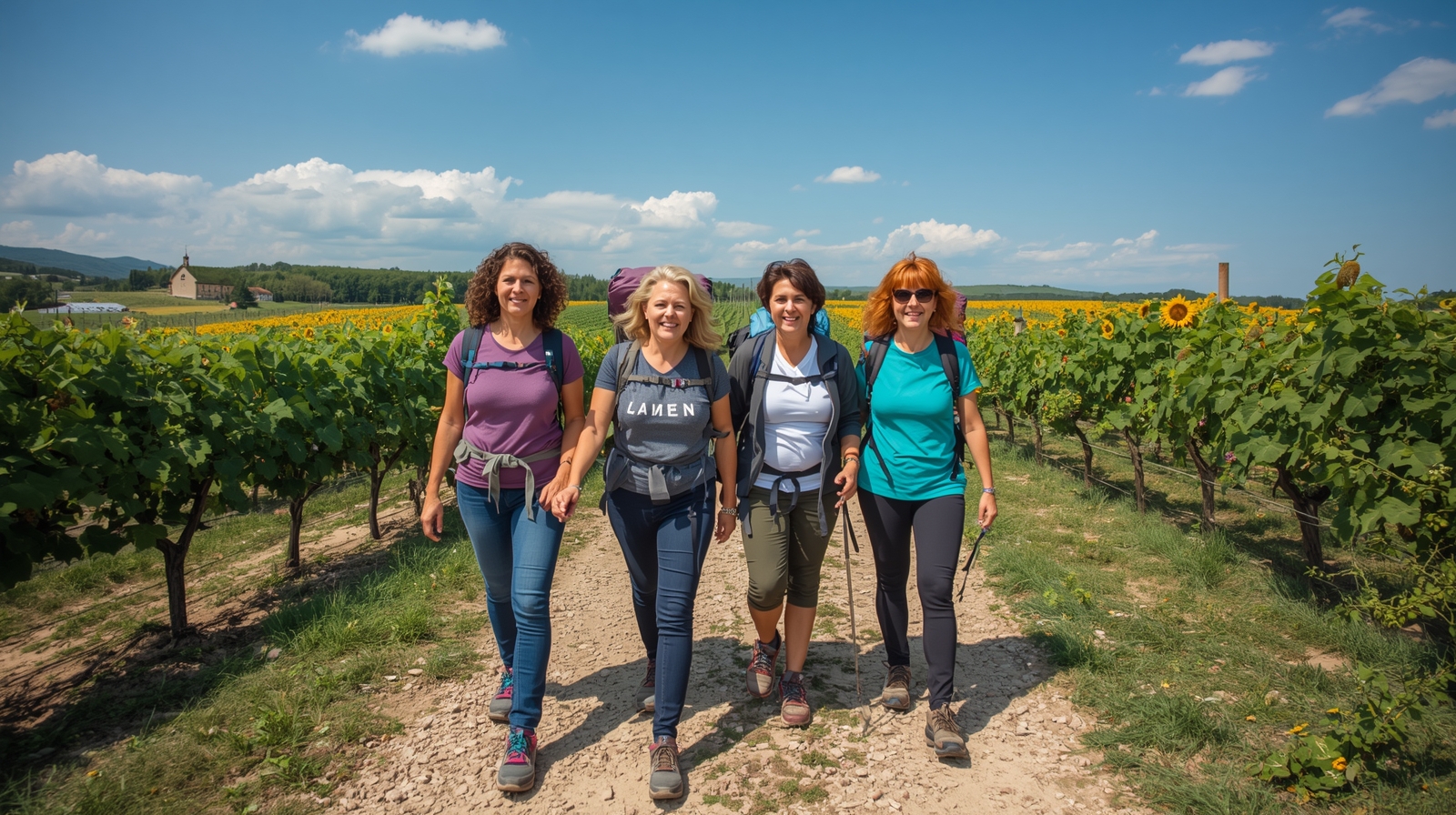
Day One was brutal—not physically, but psychologically. He walked the Chemin de Saint-Jacques between Eauze and the next village, roughly 15 kilometres through rolling vineyards and sunflower fields. Marcus walked like he was late for a meeting, pushing ahead, breathing hard, not looking at anything.
By the afternoon, his feet hurt. Not catastrophically, just enough that he couldn’t ignore them. “I don’t think my boots are right,” he muttered.
“Your boots are fine. You’re walking like you’re trying to outrun something.”
“I need to make good time.”
“Why?”
He had no answer. There was nowhere to get to. No meeting waiting. Just another village, another meal, another bed. The pointlessness of rushing confronted him, and I watched his face cycle through confusion, frustration, and something like grief.
We stopped at a stone wall overlooking a valley where autumn light turned the vineyards bronze. I made him sit. “Close your eyes. Tell me three things you can hear.”
“This is touchy-feely nonsense.”
“Humour me.”
He sighed. Closed his eyes. Thirty seconds passed. “Birds. Some kind of bird. Wind in the… I don’t know, the leaves. And… tractors? Somewhere far away.”
“Now, three things you can feel.”
“The stone. It’s warm. Sun on my face. And my feet. They’re throbbing.”
“Now, three things you can smell.”
His face changed. Softened. “Earth. Something sweet, like… honey? And mint, maybe?”
When he opened his eyes, they were different. Present. “I haven’t done that since I was a kid,” he said quietly. “Just… noticed things.”
That night, he slept six hours straight.
By Day Three, his pace had changed. He’d stopped checking the time. Stopped asking how much further. He walked beside me instead of ahead, and we fell into the rhythm that happens when humans walk together—a kind of silent agreement between bodies and breath.
On Day Four, something broke open. We’d walked through morning mist that clung to the fields, our boots wet with dew, and Marcus started talking. Not the rehearsed executive summary version of his life—the real thing. The deal that haunted him. The promotion he’d sacrificed his marriage for. The moment he realised his daughter was afraid to interrupt him. How he’d become someone he didn’t recognise and couldn’t figure out how to stop being.
“I’m so tired,” he said, and started crying. Just standing there on a dirt path between sunflower fields, crying like the world was ending. “I’m so fucking tired.”
I let him cry. Handed him water. We sat on our packs in the middle of the path, and I said, “That’s your body finally talking to you. Listen to it.”
By Day Seven, Marcus walked differently. His shoulders had dropped. His breath had deepened. He’d started noticing things—a hawk circling, the way light moved through oak leaves, how morning tasted different from evening. At dinner that night, he said, “I don’t know who I’m going to be when I go back. But I can’t be who I was.”
The final morning, he turned to me and said, “Thank you for making me do this.”
“You made yourself do it. You just needed permission to stop.”
Six months later, Marcus sent me an email. Subject line: “Still sleeping.” He’d restructured his role, hired a deputy, implemented no-meeting Wednesdays, and taken his family to Greece for two weeks—phone off. “My wife says I’m back,” he wrote. “My daughter actually talks to me now. And I sleep. Not perfectly, but most nights I get six solid hours. Turns out my body just needed me to stop treating it like an inconvenience.”
The Science of Why Walking Works: Your Nervous System Needs Movement
Here’s what happens neurologically when you’re under chronic stress: your sympathetic nervous system—the gas pedal—stays down. Your amygdala becomes hypervigilant. Your prefrontal cortex, which handles rational decision-making, gets partially shut down. Blood flow diverts from your digestive system and reproductive organs to your large muscles, preparing you to fight or flee from threats that never materialise.
You can’t think your way out of this state. You have to move your way out.
Walking—specifically, sustained, rhythmic walking—does something remarkable: it activates your parasympathetic nervous system, the brake pedal. The repetitive motion, combined with time in nature and distance from digital stimuli, creates what neuroscientists call “transient hypofrontality”—a temporary quieting of your planning, judging, always-analysing prefrontal cortex.
This is why solutions appear on walks that never emerge in meeting rooms. Your brain waves shift from beta (active, anxious thinking) to alpha and theta (creative, integrative states). Problems that seemed insurmountable at your desk suddenly have obvious answers on a forest path.
But it’s not just your brain that changes—it’s your entire nervous system. Extended walking recalibrates your vagal tone, the measure of how well your body recovers from stress. High vagal tone means you can shift from activated to calm quickly. Low vagal tone means you’re stuck in overdrive, which is where most high-performers live.
The Camino specifically adds another layer: it’s a pilgrimage route. Something about walking where millions have walked before you, carrying their own burdens and questions, creates a sense of being part of something larger than your quarterly targets. There’s humility in following ancient footsteps. And humility is often the gateway back to yourself.
Guest Testimonial: Sally M., Marketing Director
“I came to Dr. Montagu’s retreat thinking I’d get some exercise and clear my head. I left with my life back on track. For three years, I’d been in constant fight-or-flight mode, powering through exhaustion with coffee and willpower. Within four days of walking, my body finally felt safe enough to rest. I slept through the night for the first time in months. But the real gift was remembering what it felt like to be present—not planning the next thing or reviewing the last thing, just HERE. That shift has stayed with me. I still walk every morning before work, and when stress builds, I know how to release it now instead of white-knuckling through it. This retreat didn’t just change my stress management—it changed how I show up in the world.”
Three Micro-Stress-Reset Practices You Can Start Today
You don’t need to walk across France tomorrow (though I highly recommend you do eventually). You can begin retraining your nervous system right now with these practices I teach all my clients:
1. The Doorway Reset (30 seconds)
Every time you walk through a doorway today—any doorway—pause completely. Take three full breaths: in for four counts, hold for four, out for six. That’s it.
Why doorways? They’re natural transition points. You’re already moving from one space to another. This practice simply makes the transition intentional. Within a week, your nervous system will begin associating doorways with micro-recovery. You’re essentially installing pause buttons throughout your environment.
The extended exhale is crucial—it activates your vagus nerve, which runs from your brainstem to your abdomen and is the primary brake pedal for your stress response. Six seconds out signals safety to your body in a way no amount of positive thinking can match.
2. The Calendar Compassion Buffer (2 minutes)
Stop scheduling back-to-back meetings. I know this seems impossible. Everyone says it’s impossible right before they do it and realise it was their sanity.
Your brain needs 120 seconds to process what just happened and prepare for what’s next. Without this buffer, you carry emotional residue from one interaction into the next. That tension in your jaw? That’s unmetabolized stress from three meetings ago, compounding.
Schedule 28-minute meetings instead of 30. Use those two minutes to stand, stretch, look out a window, shake your body literally—shake your hands, roll your shoulders, do anything that moves stuck energy. This isn’t luxury. This is basic nervous system hygiene.
3. The 3-5-7 Breath (90 seconds)
When pressure spikes and you feel panic rising, use this pattern: breathe in through your nose for 3 counts, hold for 5, exhale through your mouth for 7. Repeat three times.
Why this works: when you’re stressed, your breath becomes shallow and rapid, which signals danger to your amygdala, which releases stress hormones, which makes your breath more shallow. It’s a vicious cycle. The extended exhale breaks the cycle by activating your parasympathetic nervous system faster than any other technique.
I’ve watched executives go from the edge of panic attacks to functional presence in under two minutes using this breath. Keep it in your back pocket for difficult conversations, presentations, or moments when you feel control slipping.
Journaling Prompt: Where Are You Running To?
Take 15 minutes with your journal and explore these questions without editing yourself:
- If I could stop running, what would I be afraid I’d discover?
- What does my body feel like right now? (Actually scan from your feet to your head—where is there tension, pain, numbness?)
- When was the last time I felt truly rested, not just “not working”?
- What would change in my life if I treated rest as strategy, not reward?
- If my body could speak to me right now, what would it say?
Don’t rush this. Write messily. Write honestly. This isn’t about solutions—it’s about finally listening.
The Perfect Quote for This Moment
“In every walk with nature, one receives far more than he seeks.”
— John Muir
I chose this quote because it captures the essential paradox of walking retreats: you come seeking solutions, strategies, or stress relief, and you receive something far more valuable—yourself back.
Muir, the Scottish-American naturalist who founded the Sierra Club, understood that nature doesn’t give you what you think you need. It gives you what you’ve forgotten you needed. When you walk with intention through landscape—especially ancient landscape—you don’t extract value like it’s another resource to optimise. You receive. You soften. You remember that you’re not separate from the natural world but part of it, subject to the same rhythms of exertion and rest, growth and dormancy.
The Camino operates on this principle. You don’t conquer it. You walk it. And in walking it, it walks you back to your essential self—the one that existed before the job titles and quarterly targets, the one that still knows how to be awed by sunset and humbled by blisters.
Why I Host These Retreats: A Personal Note
After 20 years as a doctor, I’ve seen every presentation of chronic stress: the executive with mysterious chest pain, the lawyer with IBS that no medication touches, the entrepreneur who hasn’t slept properly in three years. I’ve written prescriptions, referred to specialists, and taught breathing techniques.
But something shifted when I walked the Camino for the first time. 10km, more or less in my backyard. I realised that we’re trying to solve a body problem with mind tools. Stress lives in your tissues, your fascia, your breath patterns, your muscle memory. You can’t cognitive-behavioural-therapy your way out of a dysregulated nervous system.
Walking—particularly extended, intentional walking on sacred ground—does what therapy can’t and medication won’t: it gives your body permission to release what it’s been holding. The rhythm of footsteps becomes meditation. The physical exhaustion becomes catharsis. The distance from normal life becomes perspective.
For the past decade, I’ve been hosting small groups on the French Way of the Camino de Santiago, specifically the section between Eauze and Nogaro in southwest France. This isn’t the tourist Camino—it’s quieter, less crowded, undeniable agricultural. You walk through working vineyards and sunflower fields, past Romanesque churches that have stood for 800 years. The landscape holds you differently here.
I’ve watched CEOs cry on day three. Seen lawyers sleep for ten hours straight by day five. Witnessed the exact moment when someone’s shoulders finally drop and their breath deepens and they look around and notice they’re alive, not just productive.
This work—combining my medical training with NLP mastery and hypnotherapy, all delivered through the ancient technology of walking—is the most meaningful thing I do. Because I’m not fixing people. I’m walking beside them while they remember how to be whole.
Further Reading: Five Books That Changed How I Think About Stress and Recovery
1. “Why Zebras Don’t Get Ulcers” by Robert Sapolsky
Sapolsky, a neuroendocrinologist at Stanford, explains brilliantly why humans are uniquely terrible at managing stress. Zebras get chased by lions, experience acute stress, then it’s over. Humans experience chronic psychological stress that our bodies can’t distinguish from physical danger. This book will help you understand what’s happening in your body when you’re “just stressed.” It’s dense but accessible, and it changed how I practice medicine.
2. “The Body Keeps the Score” by Bessel van der Kolk
Van der Kolk demonstrates that trauma and chronic stress aren’t just psychological—they’re physiological. Your body literally stores unprocessed stress. This groundbreaking work explains why talk therapy alone often isn’t enough and why movement-based practices (like walking meditation) can access healing that cognitive approaches can’t reach. Essential reading for anyone serious about understanding the mind-body connection.
3. “In Praise of Walking” by Shane O’Mara
O’Mara, an Irish neuroscientist, makes the scientific case for walking as humanity’s superpower. He covers everything from how walking shapes our brains to why it enhances creativity and mood. This book will make you want to cancel your gym membership and just walk. It’s also delightfully readable—O’Mara clearly loves his subject, and it shows.
4. “The Untethered Soul” by Michael Singer
This isn’t a scientific book—it’s a spiritual one. But Singer’s exploration of how we get trapped in our own mental patterns, and how to observe rather than identify with our thoughts, is profound. The chapter on pain alone is worth the price. I recommend this to clients who intellectually understand stress management but can’t seem to actually implement it. Sometimes the barrier isn’t information—it’s identity.
5. “Burnout: The Secret to Unlocking the Stress Cycle” by Emily Nagoski and Amelia Nagoski
The Nagoski sisters explain the crucial difference between stressors (the things that cause stress) and stress itself (the physiological response in your body). You can eliminate every stressor and still have stress trapped in your system. They offer practical, evidence-based strategies for “completing the stress cycle”—and walking is one of the most effective. This book is particularly helpful for high achievers who think they can think their way out of burnout.
Five Frequently Asked Questions
Q1: “I can’t possibly take a week off. How do I know this retreat is worth it?”
The question itself reveals the problem. If you can’t take a week off, you’ve built something fragile—either a business model that depends entirely on your constant presence, or an identity that can’t tolerate rest.
Here’s what I tell everyone who asks this: the people who “can’t get away” are exactly the people who most need to. Your work will be there when you return. The emails will wait. And if your entire organisation collapses without you for eight days, that’s a structural problem that deserves urgent attention.
What you get from this retreat isn’t just stress relief—it’s pattern interruption. You can’t see the system when you’re in it. Distance creates perspective. Every single participant has told me they wish they’d done it sooner. Not one person has regretted the investment of time.
Q2: “I’m not spiritual or religious. Is this stress reset retreat for me?”
Absolutely. The Camino is a pilgrimage route, yes, but what you’re pilgrimaging toward is entirely personal. Some people walk for spiritual reasons. Others walk to solve a business problem or process grief or simply prove to themselves they can.
I’m a medical doctor. I approach this work through neuroscience and physiology, not mysticism. The “magic” of walking is actually just biology functioning as designed. Your nervous system resets. Your brain waves shift. Your body metabolises stored stress through movement.
That said, there’s something profound about walking where humans have walked for over a millennium, carrying their own burdens and questions. You don’t have to believe in anything supernatural to feel connected to something larger than yourself. That sense of humility and perspective is often what high-performers have lost—and desperately need back.
Q3: “What if I’m not fit enough? I don’t want to hold the group back.”
The retreat is designed for humans, not athletes. We walk 10-12 kilometres per day—roughly 6-7 miles. Yes, you’ll be tired. Your feet might hurt. But we’re not racing. There’s no prize for arriving first.
I’ve hosted people from their 30s to their 70s, from marathon runners to people who haven’t exercised in years. The only requirement is that you can walk continuously for an hour at your own pace. If you can do that, you can do this.
Also, struggling a bit is part of the point. When your feet hurt and your legs are tired, your carefully constructed identity as “senior executive” or “industry leader” becomes irrelevant. You’re just a person, walking. There’s deep wisdom in that reduction.
Q4: “What’s different about your retreats versus just walking the Camino on my own?”
Three things:
First, structure without rigidity. I handle all logistics—accommodation, meals, route planning, and emergency protocols. You just walk. But there’s also flexibility built in for rest days, shorter walking days, or private processing time when needed.
Second, medical and therapeutic expertise. I’m not just a host—I’m a doctor and trained therapist who specialises in stress and nervous system regulation. If someone has a physical or emotional breakthrough (or breakdown), I have 20 years of clinical experience to support them appropriately.
Third, intentional community. Walking alone is powerful. Walking with a small group of people on similar journeys—all high-performers, all reckoning with the cost of success—creates a container for transformation that solo walking doesn’t. The conversations that happen around dinner tables after a long day of walking are often as valuable as the walking itself.
Q5: “What happens after the retreat? How do I maintain this when I’m back in the chaos?”
This is the most important question, and why our final two days include integration work. We don’t just walk and hope the benefits stick—we explicitly practice translating the experience into sustainable daily rhythms.
You’ll leave with a personalised micro-recovery protocol: specific practices that fit your schedule and personality. We work through likely obstacles and plan for them.
But here’s the deeper truth: you won’t be able to go back to exactly how you were. Once your nervous system remembers what true rest feels like, it won’t tolerate chronic activation the same way. Once you’ve experienced presence, busy-ness feels different. You’ll naturally make different choices—not through willpower, but because your system now has a reference point for what regulation feels like.
Most participants report that six months later, they’re still walking daily, still implementing the practices, and most importantly, still sleeping. That’s not me being a great host—that’s nervous system change that persists because it’s physiological, not just psychological.
Conclusion
Here’s what I’ve learned after guiding hundreds of high-performers through this journey: the walk doesn’t change you. It reveals the real you.
Underneath the job title and the quarterly targets and the endless optimisation, there’s a person who once knew how to rest. Who could feel joy without needing to justify it. Who understood that life isn’t a problem to solve but an experience to have.
That person didn’t disappear. They just got buried under layers of stress, performance, and the relentless pressure to prove themselves valuable through productivity.
Walking—particularly walking on ancient paths where millions have carried their own burdens—strips away those layers. Not through forced introspection or therapeutic processing, but through the simple, repetitive rhythm of one foot in front of the other. Through exhaustion that’s earned rather than chronic. Through silence that isn’t empty but full.
Marcus found himself again between Eauze and Nogaro. So have dozens of others. Not because the Camino is magic, but because it creates conditions where your nervous system can finally do what it’s been trying to do all along: release, restore, remember.
You don’t need to walk across all of France to begin this journey. Start with the doorway reset. Try the 3-5-7 breath. Take a 15-minute walk without your phone tomorrow morning.
But if you’re reading this and thinking, “This sounds nice, but I can’t get away,” pay attention to that thought. That’s not wisdom—that’s fear. Fear that if you stop, you’ll discover you’re not as essential as you think. Fear that rest might reveal how tired you actually are. Fear that pausing means losing ground in a race you’re not even sure you want to win anymore.
The people who most resist this work are the ones who most need it. I know because I was one of them.
Your Invitation: The Rediscover Your Natural Rhythm Retreat
If this article resonated, you’re exactly who this retreat is designed for.
I host small groups (maximum 4 people) on the French Way between Eauze and Nogaro in southwest France—a quiet, beautiful section of the Camino de Santiago that holds you differently than the tourist routes, walking through vineyards and medieval villages, supported by 20 years of my medical expertise and a decade of guiding people back to themselves.
This isn’t a vacation. It’s not a networking event. It’s a stress reset for people who’ve forgotten how to rest and are ready to remember.
👉 Learn more and see testimonials from 40+ past participants
The retreats fill quickly—not because I’m a brilliant marketer, but because people who’ve walked with me can’t stop talking about it. That’s the only metric that matters.
Your nervous system is waiting for you to listen. The path is already there. You just need to take the first step.
Dr. Margaretha Montagu
MBChB, MRCGP, NLP Master Practitioner, Medical Hypnotherapist
Founder, Camino de Santiago Stress Reset Walking Retreats
P.S. Still not sure? Send me an email at MargarethaMontagu@gmail.com. I’m happy to answer questions, discuss whether this stress reset retreat is right for you, or simply share more stories of transformation. The investment isn’t just time and money—it’s giving yourself permission to be human again. That’s priceless.







What Life Lessons Can You Learn While Walking the Camino de Santiago? – a free guide filled with 10 not just “quaint anecdotes” or Instagram-worthy moments (though there are plenty of those) but real transformations from real people who walked this insight-giving trail – Subscribe to my monthly newsletter to Download the Guide

“I am an experienced medical doctor – MBChB, MRCGP, NLP master pract cert, Transformational Life Coach (dip.) Life Story Coach (cert.) Stress Counselling (cert.) Med Hypnotherapy (dip.) and EAGALA (cert.) I may have an impressive number of letters after my name, and more than three decades of professional experience, but what qualifies me to excel at what I do is my intuitive understanding of my clients’ difficulties and my extensive personal experience of managing major life changes using strategies I developed over many years.” Dr M Montagu
Research
Bahrami, F. (2025). Walking farther and more: learning from long-distance walkers in London. Mobilities, 1–18.
Ding, Ding et al. Daily steps and health outcomes in adults: a systematic review and dose-response meta-analysis The Lancet Public Health, Volume 10, Issue 8, e668 – e681
Ungvari Z, Fazekas-Pongor V, Csiszar A, Kunutsor SK. The multifaceted benefits of walking for healthy aging: from Blue Zones to molecular mechanisms. Geroscience. 2023 Dec;45(6):3211-3239.