
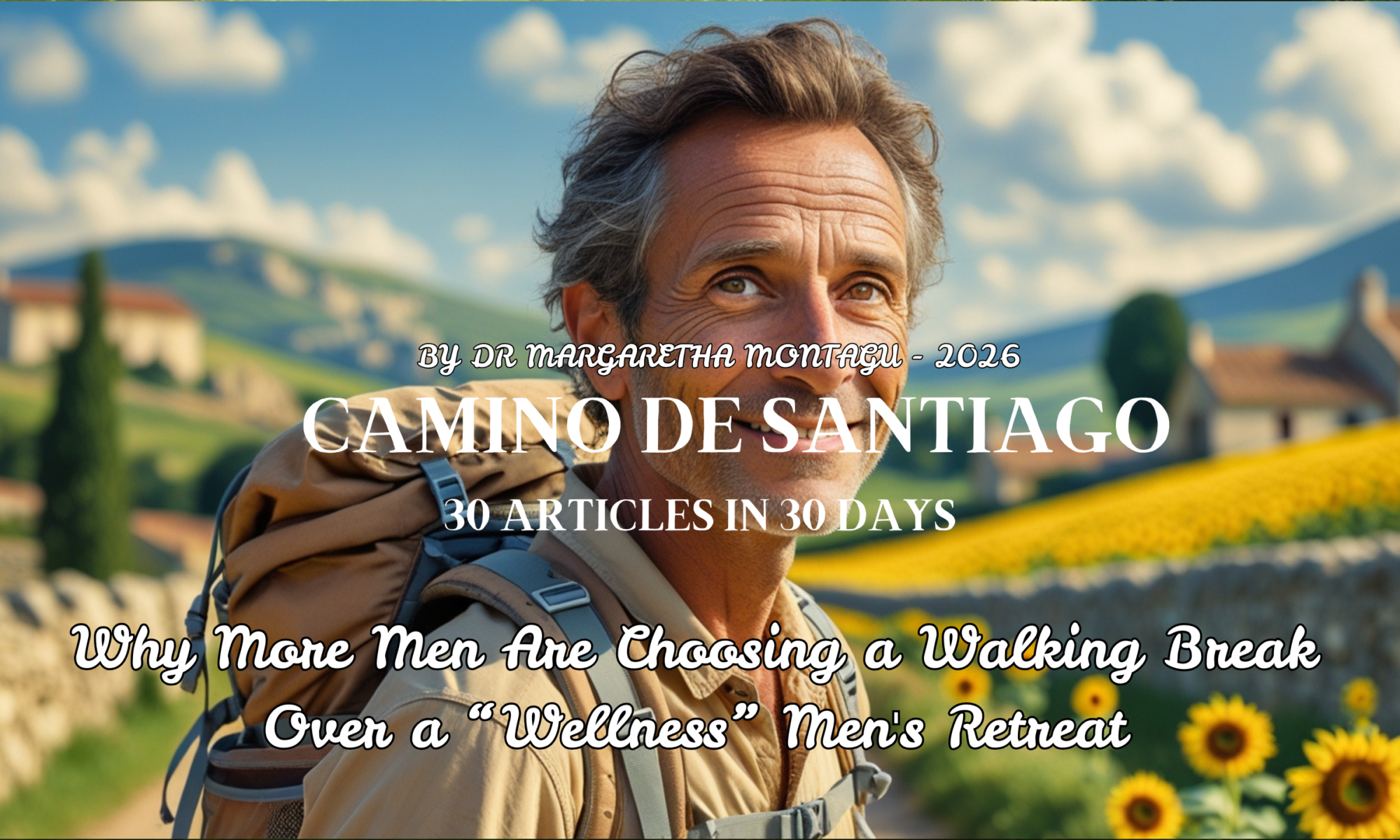
(And why short nature immersion Camino de Santiago breaks in France are so popular)
No man has ever said yes to a “healing men’s retreat.” Plenty have said yes to a hard week of walking through France with three other guys and no phone signal.
Take Mark, for example. Mark had told his wife it was a hiking holiday. He told his business partner the same thing. It took until day three, halfway up a hill in the French countryside, for him to find out it was something else entirely.
There’s a particular kind of silence that falls over a group of men on the second morning of a walk. It isn’t awkward. It isn’t tense. It’s the sound of nobody quite needing to fill it yet. Boots on gravel. A buzzard somewhere overhead. The occasional grunt about whose pack is heavier. And then, somewhere around kilometre eight, one of them says something he has never, ever, said out loud before.
This is not a new phenomenon, and it isn’t unique to the Camino de Santiago. But it is, increasingly, what men are seeking out — and deliberately avoiding calling by its real name. Ask a roomful of men if they’d like to go on a “healing men’s retreat” and watch the silence turn a different colour. Ask them if they fancy a week of hard walking through French countryside and several hands shoot up.
“Most men know they are stressed. They know they are sleeping poorly. They know they have gained weight. They know they are exercising less than they should. They know that their energy levels are not what they once were.” Dr Cijith Sreedhar, Naturopathy Doctor at Prakriti Shakti Clinic of Natural Medicine
The Global Wellness Institute’s Men’s Wellbeing Initiative reports that mental wellbeing is no longer the unmentionable topic at the men’s table. The old “grin and bear it” model of strength is finally losing its grip. Slowly, the old rulebook is being rewritten: replacing outdated notions of masculinity with a broader understanding of what it means to thrive physically, mentally and emotionally. Which is, in a way, exactly what a week on the Camino de Santiago gives a man room to do.
“Increasingly, men are seeking spaces that allow them to slow down, reconnect, restore balance and step away from constant performance and pressure.” Laura Montesanti, Founder of Synergy – The Retreat Show.
Key Takeaways
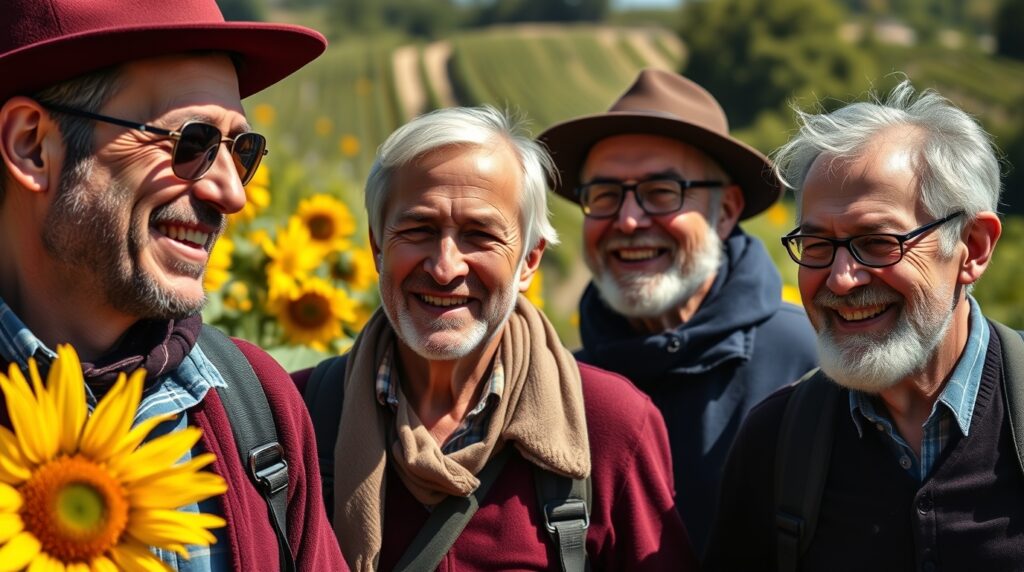
- Men tend to open up through shared activity rather than face-to-face conversation — what’s often called “shoulder-to-shoulder” connection, and walking is ideal for this sort of connection.
- Burnout, identity strain, and the absence of an “instruction manual” for modern manhood are now widely cited by retreat leaders as the top drivers behind men seeking out retreat experiences.
- The description matters enormously. Retreats marketed around wellness or healing see lower uptake from men than retreats marketed around challenge, the outdoors, and perspective — even when the experience itself is similar.
- A multi-day walk, like walking sections of the Camino de Santiago, removes the pressure of direct confrontation, lets conversation happen at its own pace, and builds the kind of unforced trust that therapy rooms often spend months trying to manufacture.
- Small groups, several days on foot, and distance from daily roles all appear to matter more than any single “activity” — it’s the sustained rhythm of walking together that does the work.
Mark’s Third Day
Mark’s calves were still cramping from the day before when he zipped his pack and stepped outside at six. Cold enough that his breath showed. The kind of grey light that makes a stone farmhouse look like it’s been carved out of the hill rather than built on it. He hadn’t told his wife the real reason he’d booked this. He’d told his business partner it was “just a walking thing.” Four nights, France, get some air. Nothing that needed explaining.
By day three, his legs had found a rhythm his head hadn’t caught up to yet — and that gap, the half-step between body and mind, was where everything started to go sideways. No emails landing. No calls to dodge. Just gravel, the crunch of his own boots, and three other men who didn’t ask him anything he didn’t want to answer.
Day three broke the pattern. Twenty kilometres, a brutal climb out of the valley, cloud sitting low enough to taste. Forty minutes in, his lungs were burning and his legs felt like they belonged to someone else. He liked that. The pain gave him somewhere to put his attention that wasn’t the thing he’d been avoiding for eighteen months.
It was the other man’s breathing that got him talking — short, hard, right beside him on the climb, the two of them matching pace without ever deciding to. Somewhere past the worst of the gradient, with his heart going harder than the hill alone justified, the other man said it flat, no windup: “I haven’t slept right since my dad died.” No eye contact. Both of them staring at the track six feet ahead, breathing like men who’d earned the right to say something true.
Mark didn’t say anything back. Not then. But that night, in a stone gîte that still smelled of woodsmoke from a fire lit hours earlier, lying in the dark with someone’s snoring rattling down the hall, the thing he’d been carrying for a year and a half started moving on its own. The eighteen months since the company had nearly gone under. The year he’d told no one — not his wife, not his partner, not one person — because admitting how close it had come felt like admitting he wasn’t built for this after all.
The next climb was worse. Steeper, longer, the kind that turns conversation into grunts. And it was exactly there — gasping, legs gone, sweat stinging one eye — that Mark heard his own voice say it out loud for the first time. Not a confession. More like something finally given enough rope to hang itself.
Nobody stopped walking. Nobody made it a moment. One of the others reached over, put a hand flat on his shoulder for two seconds, kept moving, and said the only thing that needed saying: “Yeah. That’s heavy. Keep walking.”
So he did. And by the top of that climb, for the first time in eighteen months, the weight in his chest had lifted — not gone, but carried by more than one man for the first time since it settled there.
Why Walking Works When Talking Doesn’t
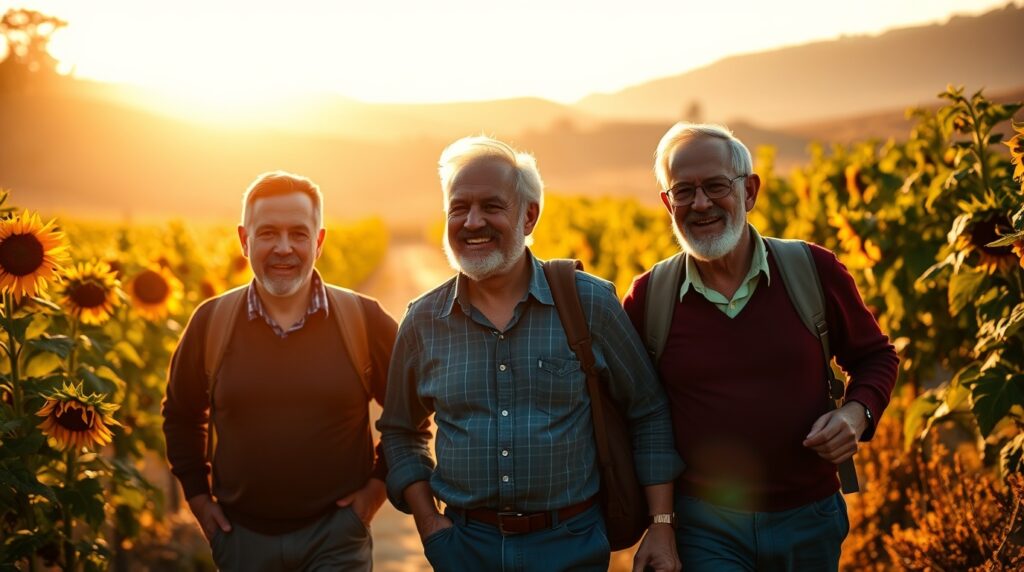
There’s a reason that moment happened on a hillside and not over coffee. Researchers studying interpersonal coordination have found that when two people physically synchronise their movement — walking in step, matching pace, sharing rhythm — they report greater connection, trust and cooperation with each other afterwards, and the effect appears to be mediated by the same hormonal pathways involved in social bonding more broadly.
None of this requires a confession circle or a facilitator with a flip chart. It requires distance, pace, and enough hours on foot so that the usual social armour gets too heavy. This is, in essence, the entire design principle behind a good Camino de Santiago walking retreat for men: the walking does the work that conversation alone can’t.
A lot of men who’d never sign up for “self-care” are deep into stress management, longevity protocols, sleep tracking, cold plunges, and zone-two cardio. Performance optimisation has become an acceptable, even admirable, male pursuit. The appeal is partly the data (men like a number they can improve) and partly the framing: optimising your body for the coming decades sounds a lot more palatable than “working on yourself.” A week of sustained walking through hill country fits neatly into that same logic — real exercise, real recovery, real sleep.
There’s a quieter strain running underneath all of this, and it rarely gets named directly: the identity question. For a lot of men, the sense of who they are has been welded for decades to what they do — provider, fixer, protector, leader. That works well right up until career plateaus, kids stop needing rescuing, bodies stop performing the way they used to, and the welds start to show. Researchers studying men’s psychosocial health describe this less as an individual weakness than as a predictable response to a culture that hands men one script — succeed, provide, stay strong — and very little guidance on what to do when that script becomes obsolete. A week of walking doesn’t hand a man a new identity. But it does something almost as useful: it strips away the roles for long enough that he can feel, even briefly, who he is underneath.
There’s also something to be said for what the walk takes away rather than what it adds. Recent research tracking loneliness across the U.S. and Europe found that midlife adults — broadly the demographic most likely to be running a business, raising teenagers, and quietly wondering where the last decade went — are experiencing rising and sustained loneliness that researchers now describe as endemic rather than episodic, a steady undertow rather than a passing phase. Five days on the Camino doesn’t solve that on its own. But it interrupts it, in a way that few other experiences manage, by putting a small group of men in physical proximity, on foot, for long enough that the usual scripts run out.
What a Men’s Camino de Santiago Retreat in southwest France Retreat Actually Looks Like
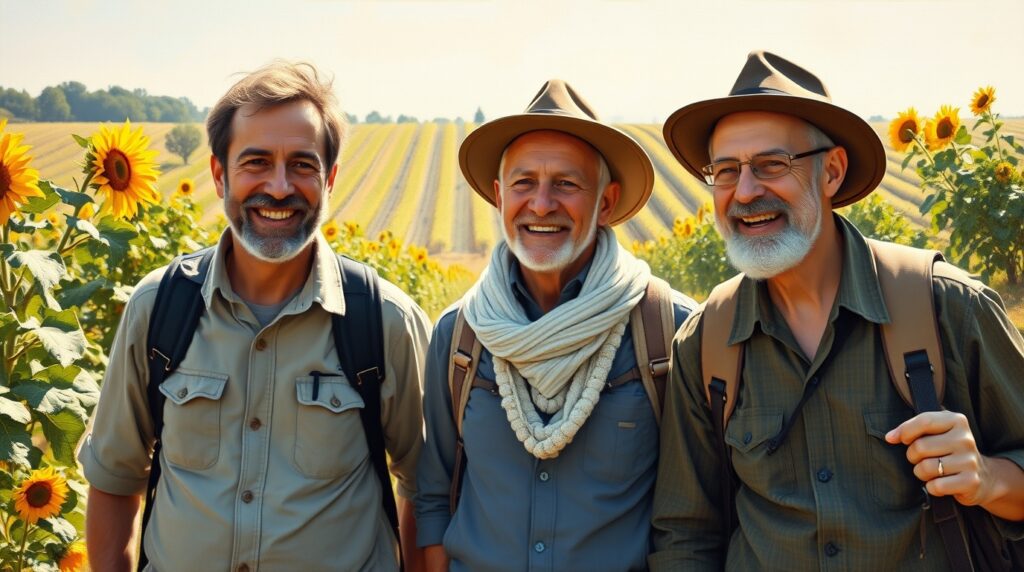
This isn’t the crowded, infrastructure-heavy Camino Francés of guidebook fame, with its thousands of pilgrims and packed albergues. My 5-day hiking breaks run along one of France’s own pilgrim routes, the Voie du Puy. The Voie du Puy is quieter and, in many ways, more atmospheric than its Spanish counterpart. These are the original medieval roads that pilgrims walked for centuries before ever reaching Spain: stone farmhouses, Romanesque churches, sunflower fields in summer and amber woodland in autumn, and a profound, working quiet that’s becoming increasingly rare to find.
I keep groups deliberately small — a maximum of four guests at a time — because the dynamic that lets men actually talk to each other doesn’t survive a crowd. There’s no facilitator standing over the group narrating the experience back to them, and there’s no language of “healing” anywhere in the itinerary. There’s solid, medically informed advice about stress management, good food, comfortable lodging on a working farm each night, daily walking through genuinely beautiful countryside, and the kind of unstructured time that, as it turns out, men tend to fill with exactly the conversations they didn’t know they wanted to have.
Mistakes Men Make When Choosing (or Avoiding) a Break Like This
- Waiting for a crisis to justify it. Most men who eventually book this sort of break say they wish they’d done it two or three years earlier. You don’t need to be in freefall to benefit from stepping off the treadmill — burnout builds quietly, long before it becomes undeniable.
- Choosing intensity over rhythm. A handful of men gravitate toward the most extreme version of a retreat available — multiple cold plunges a day, breathwork sessions stacked back to back — assuming more intensity equals more transformation. In practice, sustained, moderate physical effort over several days tends to do more for genuine connection than any single dramatic moment.
- Going in expecting an instant breakthrough. The most meaningful conversations on a walking break rarely happen on day one. They happen once the body has settled into the rhythm and the small talk has run its course — usually day three or four. Expecting day one to deliver the goods, and feeling disappointed when it doesn’t, can sour the whole experience unnecessarily.
- Underestimating the role of distance from home. A long weekend close to home, with phone signal and the option to “just check one email,” rarely produces the same shift as a week somewhere genuinely removed. The unplugging isn’t incidental — it’s structural.
- Assuming the location matters more than the format. Plenty of men assume the spiritual or historical weight of Spain’s Camino Francés is what makes the experience powerful. In truth, it’s the format — walking, small group, multiple days, away from daily roles — that does most of the heavy lifting, which is exactly why the quieter French routes work just as well, if not better.
Frequently Asked Questions
Is a Camino de Santiago walking break in France different from walking the Camino in Spain?
Yes, meaningfully so. The French routes — the Via Turonensis, Via Lemovicensis, and Voie du Puy — are the historic approach roads that pilgrims walked for centuries before ever crossing into Spain. They’re quieter, less crowded, and arguably more atmospheric, with the same rhythm and reflective quality but without the high-season crowds of the Camino Francés.
Do I need to be fit to do this?
A reasonable, steady walking fitness is helpful, but this isn’t a forced march. Days are paced to allow conversation, rest, and genuine enjoyment of the countryside, not punishing distances for their own sake.
Will there be any pressure to “open up” or share personal things?
None at all. There’s no facilitated sharing circle and no expectation that anyone discusses anything they don’t want to. What tends to happen, happens because the walking creates the space for it — not because anyone is asked to perform vulnerability.
Why keep the group so small?
Four guests maximum keeps the dynamic genuinely conversational rather than performative. It’s the difference between having a real conversation and having an audience.
What time of year do these retreats run?
Retreats run from spring to autumn, when the French countryside is at its most walkable and most beautiful — golden light, manageable temperatures, and the harvest season in full swing through much of the route.
If any of this sounds like something you — or a friend who’s been “fine” for slightly too long — might need, you’ll find more information on my website. No wellness jargon used.
Research Notes & Sources
On synchronised movement and social bonding
Vuust, P. et al. Oxytocin improves synchronisation in leader–follower interaction. Scientific Reports / PMC, 2016. Found that interpersonal synchronisation — such as walking in time with another person — promotes liking, cooperation, and trust between participants.
On midlife loneliness trends
Study reported via ScienceDaily, 2026 (Arizona State University / American Psychologist). Found that loneliness among midlife adults (45–65) in the U.S. and Europe is rising across generations and increasingly endemic rather than episodic.
On men’s midlife crises
Midlife Crisis in Men: Psychosocial Dimensions and Mental Health Implications. Research review, 2025. Frames midlife identity strain in men as a predictable psychosocial response to cultural expectations around masculinity, career, and provider roles — not an individual weakness — and notes that these norms often hinder men’s ability to recognise vulnerability or seek support.
On why men respond differently to retreat marketing language
Montesanti, L. Why Men Are Turning to Retreats: Connection, Brotherhood and the Search for Something More. Synergy — The Retreat Show, 2026. Interviews with retreat leaders Mark Hodgson (Mind & Body Travel), Scotty Johnson (Explore What Matters), Rob Williams (Nordic Wellness), and Steve Hodgson (Beyond The Noise Collective) on burnout, identity, and the role of challenge-based design in men’s retreats.