

As you may know, I host Camino de Santiago walking and writing retreats and belong to a delightfully creative band of scribblers called the Wordweavers in the southwest of France writing group, and at one of our meetings, held on Friday the 13th of February 2026, which felt appropriately theatrical—I read the story you’re about to finish reading.
This is part 4 of the story of a doctor who spent years teaching other people how to breathe… and only much later discovered that she herself had forgotten how. Dr. Anna Vermeer was a competent, respected, thoroughly overworked physician who could diagnose stress in her patients within minutes and prescribe sensible solutions with great confidence. Every day people arrived in her office with tight chests, racing thoughts, insomnia, and the quiet sense that life had become a little too much.
Anna listened carefully, reassured them, and encouraged them to slow down.
Meanwhile, she ran through her own life at a pace that suggested the building might catch fire at any moment. She believed this was normal. Responsible people carried heavy loads. Dedicated professionals stayed busy. Doctors, after all, were supposed to take care of everyone else.
Until the afternoon she discovered—quite unexpectedly—that when she told a patient to take a deep breath… she couldn’t.
What followed was not a dramatic collapse or a sudden bolt of enlightenment. It was something quieter: a retreat in the countryside, a sunrise she almost missed, and a phone that, for the first time in years, was switched off.
Part 4
The clinic, it turned out, had been running perfectly well without her constant supervision. This was not a conclusion she had expected to reach. For years Anna had operated under a very sensible professional assumption: that if she relaxed her grip on things — even slightly — the entire system might unravel like a badly knitted sweater.
Patients would suffer.
Charts would multiply.
Emails would form colonies.
Civilisation itself might disintegrate.
Yet here she was, driving home through the quiet countryside after seven days of what could only be described as not doing very much, and the world appeared remarkably intact.
The retreat had been strange in the best possible way. Not dramatic. No thunderbolts. No profound revelations delivered by mysterious gurus wearing linen trousers. Just small things. Walking slowly through fields while mist rose from the grass. Listening to birds whose entire job description appeared to consist of singing enthusiastically for hours on end.
And breathing.
At first, the breathing had been slightly awkward, like reconnecting with an old acquaintance you hadn’t spoken to in years. But by the second morning, Anna had discovered something astonishing. Her lungs were perfectly capable of filling to full capacity.
The real miracle, however, had happened in her mind. When she switched off her phone that first morning and walked into the fields, something curious occurred. Nothing happened. No emergencies. No frantic messages. No patients collapsing dramatically in supermarket aisles because their doctor had dared to take a sunrise walk.
The world continued rotating in a pre-ordained, planetary manner. And Anna discovered a quiet but radical truth: stress had never been proof of responsibility. It had simply been a habit. A very persistent one.
The real test, of course, began on Monday morning. Anna arrived at the clinic at her usual time. The building looked exactly the same. The faint scent of disinfectant still floated in the corridors. The coffee machine still sounded mildly dyspeptic. And the waiting room was already filling with patients who carried the familiar invisible backpacks of modern life. For a moment Anna stood in the hallway. Her old routine tugged at her immediately — open email, check messages, rush. Her brain had already begun its familiar morning sprint.
But then she remembered the valley at sunrise. The quiet. The long, slow breath that had reached all the way down to her ribs. So she did something unusual. She stopped, right there in the hallway, just for a moment. She took a slow breath.
Inhale.
Exhale.
The clinic did not collapse.
Encouraged by this evidence, she tried something even more radical. She did not open her email immediately. Instead, she walked to her consulting room, set down her bag, and sat for thirty quiet seconds before the first patient arrived. It felt vaguely rebellious, like skipping school. The patient knocked and entered — a young man with headaches and fatigue. Anna listened carefully, asking questions the way she always had. But something about her presence had shifted. She was not leaning forward toward the next task. She was actually there. Fully. Listening. The consultation lasted the usual fifteen minutes, but when the patient left he looked noticeably calmer. Anna noticed something else. She did not feel drained.
Over the next few weeks, Anna conducted a series of highly sophisticated personal experiments.
The first: stop answering emails after 8 p.m. This initially caused mild psychological distress. Her fingers would hover near the phone around 10:30 p.m., wondering whether an extremely urgent message might be hiding there. But after several evenings of not checking, she discovered something extraordinary. Almost none of the emails required attention at 10:30 p.m. In fact, many problems had mysteriously solved themselves by morning.
The second experiment: eat lunch sitting down. This was revolutionary. Previously, lunch had consisted of coffee and possibly a biscuit consumed while standing near a printer. Now Anna took twenty minutes — actual minutes. She sat outside when the weather allowed and noticed things. Trees. Clouds. Occasionally a pigeon with radical opinions about breadcrumbs. Her nervous system seemed to appreciate this development enormously.
The third experiment: one deep breath between patients. Just one, before the next knock on the door. Inhale. Exhale. At first it felt like inserting a tiny pause in a machine that had been running nonstop for years, but gradually those breaths became small islands of calm scattered through the day.
Her colleagues began noticing subtle changes. “You look different,” one of them said over coffee.
Anna considered this. “Different how?”
The colleague shrugged. “Less… like you’re about to solve ten problems simultaneously.” Anna smiled. Progress.
The most significant change, however, appeared in her consultations. Patients with stress and burnout were still arriving in steady numbers — modern life had not yet improved its scheduling policies — but Anna now spoke to them with a slightly different authority. When she said “your body is asking for rest,” she meant it. When she said “try slowing your breathing,” she had tested the method herself. And occasionally she told them a story. Not a dramatic one. Just about a doctor who once discovered she had forgotten how to breathe properly.
Patients usually laughed.
Then they tried the breathing exercise. Sometimes the room would grow very quiet.
Of course, Anna did not become a perfectly serene human being overnight. She was still a doctor. Her days still contained urgent situations, difficult diagnoses, and the occasional administrative form that seemed designed by philosophers interested in suffering. But something fundamental had shifted. Stress no longer sat permanently in the driver’s seat. Instead, it appeared occasionally — like an overly enthusiastic backseat driver. When that happened, Anna knew what to do. She paused. Breathed. Stepped outside if necessary. The clinic garden, she discovered, contained a surprisingly charming apple tree she had never noticed before. It had probably been there for decades.
One evening, several months later, Anna left the clinic just before sunset. The sky glowed in shades of amber and rose. She stood beside her car for a moment, breathing in the cool air. Her phone buzzed in her pocket. Old reflexes stirred briefly — check the message, respond immediately.
But Anna simply smiled. The message could wait. Instead she looked up at the sky. Birds crossed the fading light in loose, unhurried formations. Somewhere nearby someone was cooking dinner, and the warm scent of garlic drifted faintly through the air. Anna took a long, slow breath.
It occurred to her that freedom was a curious thing.
For years, she had imagined it required immense courage, dramatic changes, escaping responsibilities, running away to remote islands, writing philosophical books about balance. Instead, it had arrived quietly, through small decisions — turning off a phone, taking a breath, walking outside to watch the sun rise. The secret, she now realised, had been surprisingly simple.
Freedom was not about doing less important work. It was about carrying less unnecessary tension while doing it. Stress had once felt like proof of dedication. Now it looked more like excess baggage.
And Anna had finally discovered the courage to let it go.
The End ©Margaretha Montagu
Sometimes people read Anna’s story and smile a little ruefully, because they recognise something of themselves in it. The constant pressure. The quiet exhaustion. The strange feeling of always being busy and yet never quite arriving anywhere. Modern life has a remarkable way of filling every available space in our days, until breathing deeply begins to feel like a luxury instead of something essential.
But every so often, someone decides to step out of that current for a few days. They come here, to this quiet corner of southwest France, where the Camino winds through vineyards and open fields, and where mornings begin not with notifications but with birdsong and pale gold light spreading slowly across the hills.
And something very simple happens. People walk. They talk a little. Sometimes they write. Sometimes they sit under a tree and do absolutely nothing at all. Their phones stay mostly quiet. Their breathing becomes deeper. Their thoughts begin to settle like dust after a long journey.
By the time they leave, many of them carry something home that Anna discovered that morning in the valley: the quiet understanding that freedom is not something you chase. It is something that appears when you finally give yourself permission to pause, breathe, and let the unnecessary weight fall away. And sometimes, all it takes to begin is a few quiet days on the Camino.
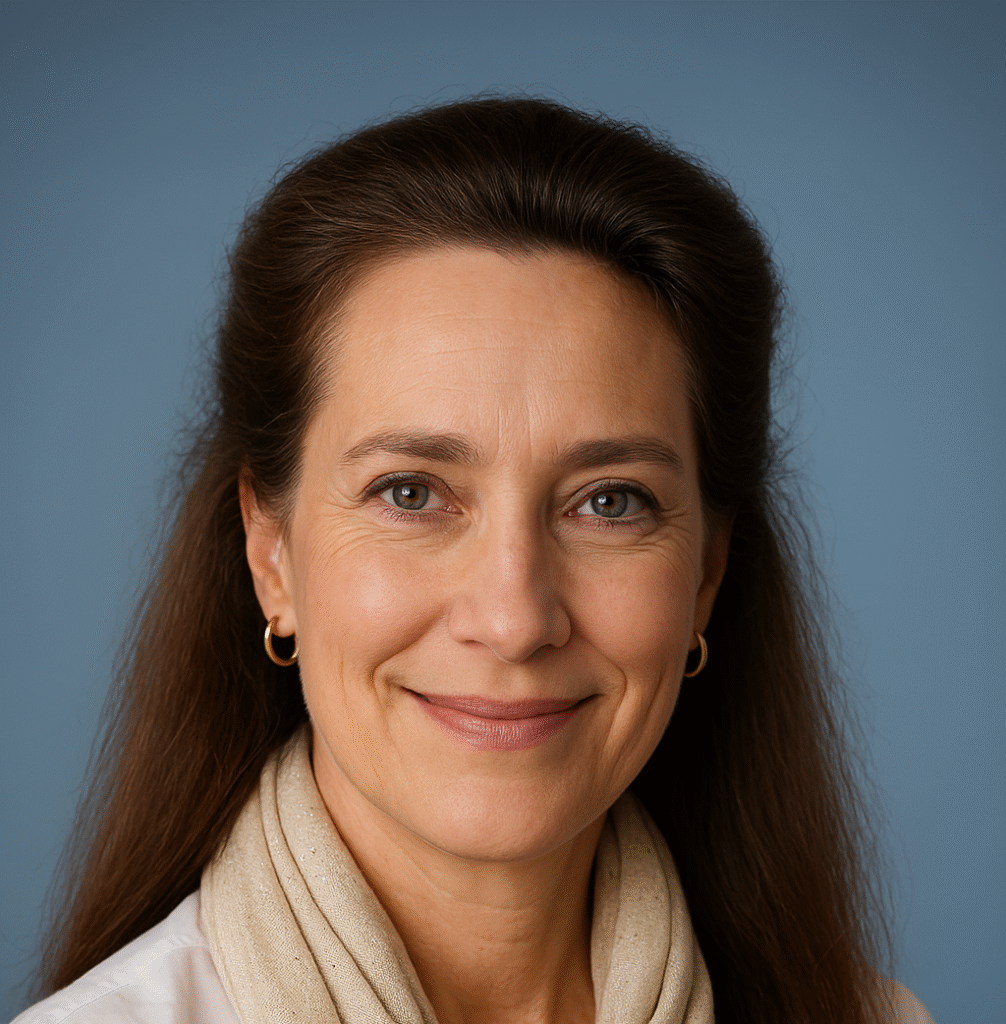
“I am an experienced medical doctor – MBChB, MRCGP, NLP master pract cert, Transformational Life Coach (dip.) Life Story Coach (cert.) Stress Counselling (cert.) Med Hypnotherapy (dip.) and EAGALA (cert.) I may have an impressive number of letters after my name, and more than three decades of professional experience, but what qualifies me to excel at what I do is my intuitive understanding of my clients’ difficulties and my extensive personal experience of managing major life changes using strategies I developed over many years.” Dr M Montagu