
.
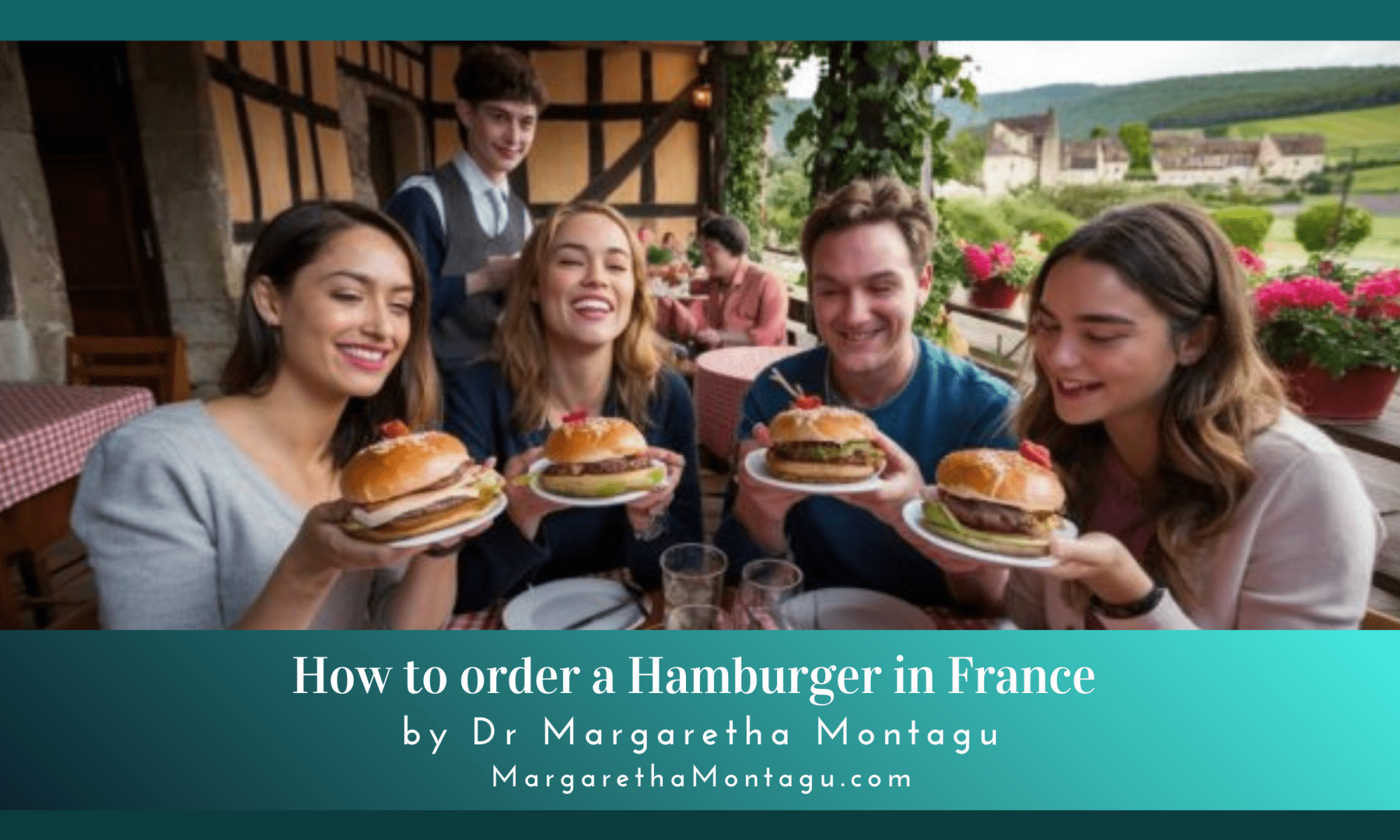
Every Tuesday evening, my Camino de Santiago retreat guests and I go to a local bistro to support the still-flagging local economy, post-Covid. Most of the options on the menu include duck, in some form or another, but the most popular choice invariably is a HAMBURGER, done à point.
I have often heard, “How to order a Hamburger in France?”
Take Sandra’s predicament as an example. Sandra NEEDED a hamburger. Not a symbolic hamburger. Not a “trust the process” hamburger. A real one. Warm. Squishy. Comforting. Ideally smelling faintly of familiarity and poor life choices.
She pushed open the heavy wooden door of a small village café. It creaked like it had opinions. Inside, the air was thick with the smell of espresso, garlic, and something slow-cooked that had clearly been simmering since breakfast—or possibly since Easter. A radio hummed softly in the background, interrupted only by the clink of cutlery and the occasional sigh of contentment.
“I would like a hamburger,” Sandra announced brightly.
Her words landed with a thud.
The café fell silent. You could hear the faint hiss of fat sizzling in the kitchen. A fly stopped mid-flight. Somewhere, a chair creaked in judgment.
The waiter squinted at her, head tilted, as if trying to hear the word differently.
“Un… Gascon?” he asked cautiously.
“No, no,” Sandra said, smiling harder now. She drew a circle in the air with her hands. “Ham-bur-ger.” She added a hopeful chewing motion. Mmm. Confidence tasted like optimism.
The waiter inhaled deeply. A woman at the bar paused mid-sip, the aroma of red wine hanging in the air like a warning. Someone muttered something that sounded suspiciously like a prayer.
After a heated exchange in rapid Gascon—full of shrugs, sighs, and the unmistakable sound of culinary pride being challenged—the waiter nodded gravely and vanished into the kitchen.
Time stretched.
Sandra listened to the crackle of a pan, the rhythmic chop of a knife, the low murmur of debate. The smells intensified: buttery potatoes, cured meat, eggs meeting hot oil. Her stomach growled, traitorously loud.
Finally, the waiter returned.
He placed a plate in front of her with a flourish.
On it sat:
- one thick slice of magret de canard, glossy and fragrant
- a slab of bread with a crust so hard it had opinions
- a fried egg, edges crisp, yolk trembling like it knew its destiny
- a wilted green thing that had once been lettuce
- and potatoes—golden, sizzling, audibly proud—fried in duck fat, butter, and at least three generations of family tradition
“This,” the waiter said, voice rich with authority, “is our hamburger.”
Sandra stared.
The plate radiated heat. The smell was intoxicating—salty, rich, deeply comforting. She touched the bread. It was warm. Serious. Unapologetic.
She took a bite.
The crunch of crust. The silkiness of yolk. The deep, savoury hum of ham. The potatoes crackled softly as she chewed, whispering promises of naps and forgiveness.
It was magnificent.
Sandra learned two things that day:
- In Gascony, ordering a hamburger is not a request—it is a philosophical question.
- You never argue with people who can make potatoes taste like love and history.
She never ordered a mere hamburger again.
She ordered a Gascon hamburger and whatever else is good today—and let the smells, sounds, and flavours of Gascony take care of the rest.
You may be surprised to hear that the humble hamburger is so popular in Gascony – a region renowned for its stunning Atlantic coastline, charming villages, and delectable Cuisine Gascon – but this part of France has always been a melting pot of culinary influences. The region has always embraced a variety of flavours and ingredients. The hamburger, adaptable and versatile, fits perfectly into this environment.
In recent years, there has been a global trend towards gourmet burgers, and culinary innovative Gascony is no exception. High-quality ingredients, artisanal buns, and creative toppings have elevated the humble hamburger to gourmet status. Local chefs have embraced this trend, offering gourmet burgers that appeal to both locals and visitors. These burgers often feature regional specialities such as truffle mayonnaise, caramelised onions, and even foie gras.
Our brilliant chefs have even invented a Burger Gascon, which consists of a magret de canard with a slab of foie gras on top smothered in a sweet fig sauce (confit de figue.)
How to order a hamburger here in southwest France?
Firstly, I explain they need to drop the “H,” and ask for an AMBURGER. It usually comes with frites (fries) but you may want to make sure, and add “avec frites.” Next, you will be asked how you want the meat done. Do not make the mistake of thinking that all hamburger patties will, by definition, be well-cooked. No so. Unless you specifically specify “bien cuit”, or even “très bien cuit, s’il vous plait”, you end up with a nearly raw, definitely bleeding hamburger, done “saignant.” Opt for “à point,” if you want something in between.
Next, you choose ze cheese and ze sauce. A slice of local cheese is always a good choice, or maybe a mushroom sauce. Cèpes? Yes, great, get yourself some of our favourite mushrooms in your sauce. Raw egg? Uhm, no, rather not. Their very best made-fresh-today mayonnaise? Bon d’accord, you might well want to try that.
The good news is that many of the younger generation speak quite a bit of English these days, so as long as you keep your questions simple and speak slowly, how to order a hamburger in France should be fairly straightforward. Or you can use an app to translate the menu for you, and even to communicate directly with your friendly – this is the Gascony, not Paris, we mostly welcome tourists here – rugby-playing waiter.
One thing that hasn’t changed though, is the fact that Gascons tend to shun soft drinks, and prefer, in addition to the tap water/eau plate already on the table, a bottle of wine, a Cotes de Gascogne – a dry, white or a fruity rosé or even a feisty Madiran. The easiest is to opt for a “quart” (250ml) or a “demi” (500ml) carafe of vin de table/du pays.
When you’re ready to leave, ask for the bill by saying, “L’addition, s’il vous plaît.” You may pay at the table or be shown your table number and be directed towards the counter. Tipping is not obligatory in France, but it is appreciated. Leaving a few euros or rounding up the bill is a much appreciated gesture. At our local bistros, prices vary from 11-15 euros, including toppings and frites. Adding foie gras will double the price. Most of our local bistros make their own patties with high-quality mince meat, bought from local farmers, that tastes quite different from those of the fast-food outlets. Most restaurants around here now specify exactly where they buy their meat.
The dining culture in Gascony is laid-back and casual, especially during the long, warm summers. Hamburgers blend seamlessly with the region’s rich culinary traditions and vibrant lifestyle. Whether it’s the influence of tourism, the allure of gourmet ingredients, or the casual dining culture, burgers have become a beloved part of the southwest of France’s food scene. So, next time you find yourself in this picturesque region, don’t be surprised to find a delicious, locally-inspired hamburger on the menu. Now you know how to order a hamburger in France, so all that’s left is to wish you Bon appétit!

In addition to the Camino de Santiago retreats that I host at my little French farm southwest of Bordeaux, I have also created 7 online courses, ex. The Purpose Protocols, The Roadmap to Resilience – from Burnout to Brilliance Protocol and The Change Careers without Starting from Scratch – each course is available with or without one-to-one support. To stay in contact, I invite you to subscribe to my newsletter, you’ll get immediate access to my free life crisis quiz.