
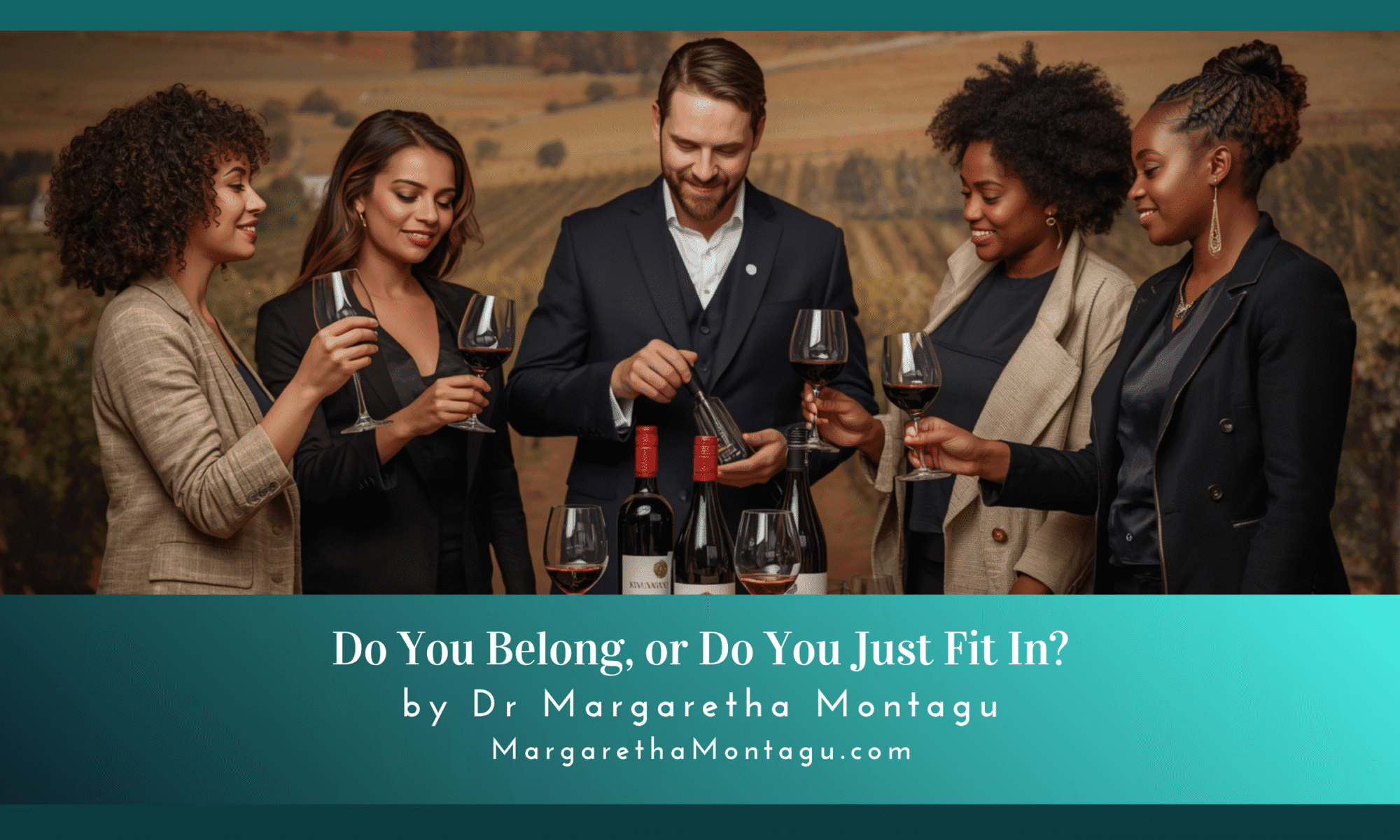
One of my favourite (and best!) stories in this one!
Ever found yourself nodding enthusiastically at someone’s opinion about the “best” holiday destination whilst internally screaming that you’d rather spend a fortnight in your garden shed? Congratulations, you’ve been fitting in. This article explores the exhausting difference between genuinely belonging somewhere and simply shape-shifting yourself into whatever configuration gets you through the door. We’re talking about why successful women keep performing this particular parlour trick, what it costs us, and how to finally, graciously, stop.
5 Key Takeaways
- Fitting in requires constant performance; belonging requires presence. One exhausts you, the other energises you.
- The “successful woman” archetype often becomes an expert at fitting in, having spent decades reading rooms and adjusting accordingly.
- Belonging means being valued for who you actually are, not for how well you’ve mastered the art of becoming what others need.
- The midlife years are your permission slip to stop auditioning for roles you never wanted in the first place.
- True belonging feels like coming home to yourself, not like winning a place on someone else’s guest list.
Being Almost Ourselves
Success often requires becoming exceptionally good at fitting in. We learn to read the room before we enter it, to calibrate our laughter, to edit our opinions, to become fluent in the unspoken language of whatever space we’re trying to occupy. By the time we reach midlife, we’ve become such accomplished chameleons that we’ve forgotten what colour we actually are.
The irony is tragic. We spend our twenties and thirties climbing, achieving, succeeding, and arriving at various destinations, only to discover in our forties and fifties that we’ve been wearing someone else’s shoes the entire time. They pinch. They’ve always pinched. But they looked the part, didn’t they?
The difference between fitting in and belonging is the difference between holding your breath and breathing freely. One you can maintain for impressive lengths of time. The other is sustainable for, oh, the rest of your life.
Alicia Moore and the Great Wine Tasting Charade
Alicia Moore had perfected the art of fitting in by the age of forty-two. She could walk into any room, any situation, any social configuration, and within approximately eight minutes, she’d have calibrated herself to match the frequency of everyone around her. It was, she often thought, her superpower. Also possibly a curse, but she tried not to think about that part.
The wine tasting incident happened on a humid Saturday evening in July. Alicia had been invited by a potential client, a woman named Cordelia who wore statement necklaces that looked like modern art installations and spoke about “notes of tobacco and leather” as though wine were a sentient being with a wardrobe.
The tasting room smelled of expensive oak and the kind of air conditioning that costs more per month than most people’s mortgages. Eighteen women sat around a gleaming table, each with five crystal glasses arranged before them like tiny, pristine soldiers. The glasses caught the recessed lighting and threw small rainbows onto the white tablecloth. Alicia could hear the soft clink of jewellery, the whisper of silk against silk, the low murmur of women who’d never had to raise their voices to be heard.
She’d dressed carefully. Not too casual, not too formal. The Goldilocks zone of fitting in. Her navy dress was expensive enough to belong but understated enough not to intimidate. She’d practised her wine vocabulary in the car: “complex,” “structured,” “mineral notes.” Words that sounded like she knew things.
The first wine arrived. Alicia lifted the glass, swirled it as she’d seen others do, brought it to her nose. It smelled like… wine. Expensive wine, presumably, but mostly just wine. Around the table, women were making soft appreciative noises, their eyes closed as though in prayer.
“Blackcurrant,” someone murmured reverently.
“Definitely some vanilla,” another agreed.
“Is that… cedar?” Cordelia asked, looking around the table with the expression of a teacher pleased with her students.
Alicia’s mouth opened. Here was her moment. Here was where she’d join the chorus, add her own adjective to the collective appreciation, cement her place in this particular tribe. The word “earthy” was right there, waiting on her tongue. Easy. Safe. Appropriate.
Instead, what came out was: “It tastes like that feeling when you’ve been holding in a sneeze all through a meeting and you finally get to your car and just explode.”
The silence that followed had texture. You could have knitted with it. Alicia felt her face flush hot, then cold, then hot again. Her heart performed gymnastics. The fluorescent lights suddenly felt very bright, very exposing. She’d done it now. Blown it. All that careful calibration, destroyed by one moment of catastrophic honesty.
Then something unexpected happened.
A woman three seats down, someone Alicia hadn’t even noticed before, threw her head back and laughed. Not a polite titter. A full, snorting, uncontrollable laugh that made her mascara start to run. “Oh my God,” she gasped between laughs, “YES. That’s exactly what it’s like. I’ve been sitting here pretending I can taste tobacco for twenty bloody minutes.”
Another woman started giggling. Then another. Within seconds, the entire table had dissolved into laughter. Someone admitted she’d been copying wine descriptors from Instagram all week. Cordelia herself confessed that she mostly just liked wine because it made her feel pleasantly fuzzy and couldn’t actually tell Merlot from Shiraz half the time.
The evening transformed. Conversations became real. Women who’d been performing expertise started sharing actual stories. Someone talked about drinking cheap wine from a mug at university. Someone else admitted to preferring beer. Alicia found herself in a genuine conversation with three women about completely unrelated topics: divorce, teenage children, the strange grief of watching your parents age.
Driving home, windows down, the evening air tasting of cut grass, Alicia realised something fundamental had shifted. For forty-two years, she’d been fitting in. Adjusting, calibrating, performing. And in one ridiculous, unrehearsed moment, she’d accidentally belonged instead.
That was three years ago. These days, in my storytelling circles, Alicia tells this story herself. She’s learned that the moments when we stop performing are often the moments when we finally find our people. The ones who don’t need us to be anyone other than exactly who we are, sneeze metaphors and all.
The Psychology of Fitting In vs. Belonging
Let’s get serious for a moment (but not too serious, we’re not writing a dissertation). Fitting in and belonging are not synonyms, despite what we’ve been led to believe. In fact, they’re almost opposites.
Research in social psychology consistently shows that fitting in is about assessing a situation and adjusting ourselves to meet its requirements. It’s transactional. Performance-based. Conditional. We fit in by becoming what we think others want us to be. It requires constant vigilance, emotional labour, and a rather impressive amount of cognitive bandwidth.
Belonging, on the other hand, is about being accepted for who we actually are. It’s relational rather than transactional. It doesn’t require editing, performing, or shape-shifting. When we belong, we can exhale. We can be messy, authentic, occasionally ridiculous. We can use sneeze metaphors at wine tastings.
For successful professionals, this distinction becomes particularly poignant. We’ve spent decades mastering the art of fitting in, reading professional situations, social dynamics, family expectations. We’ve become fluent in dozens of different versions of ourselves. But fluency isn’t the same as authenticity, and performance, no matter how polished, is exhausting.
The cost of chronic fitting in is substantial. Research links it to increased anxiety, depression, and that peculiar feeling of being disconnected from your own life. It’s like being a very convincing hologram of yourself, impressing everyone who sees you whilst you slowly fade from your own experience.
Brené Brown, who’s made a career of studying this exact phenomenon, puts it beautifully: “True belonging doesn’t require you to change who you are; it requires you to be who you are.” Simple words. Revolutionary implications.
Why This Is Your Permission Slip
Here’s the good news: midlife is when many people finally give themselves permission to stop fitting in and start belonging. There’s something about reaching your forties and fifties that clarifies things. Perhaps it’s hormones. Perhaps it’s wisdom. Perhaps it’s simply the accumulated exhaustion of decades of performance.
Whatever the cause, midlife often brings a delightful inability to care quite as much about what others think. The internal dialogue shifts from “What do they need me to be?” to “What do I actually think about this?” It’s liberating and slightly terrifying in equal measure.
This is when we start leaving book clubs we’ve attended for years but never enjoyed. Start declining invitations to events that drain rather than energise them. Start speaking up in meetings even when our opinion isn’t popular. Start, in short, by belonging to ourselves first.
The irony is that when we stop trying so hard to fit in, we often find our actual people. The ones who were looking for exactly who we are, not who we thought we should be. These relationships, forged in authenticity rather than performance, tend to be deeper, more satisfying, and considerably less exhausting.
How to Know the Difference
So how do you distinguish between fitting in and belonging? Here are some clues:
Fitting in feels like holding your breath. You’re monitoring yourself constantly, editing in real-time, performing a carefully calibrated version of yourself. It’s vigilant, tiring, unsustainable.
Belonging feels like breathing. You can relax. Be silly. Disagree. Share unpopular opinions. Express uncertainty. You’re not worried about saying the wrong thing because the relationship can handle your full humanity.
Fitting in requires you to hide parts of yourself. Your weird sense of humour. Your unconventional opinions. Your vulnerabilities. Anything that might not match the expected profile stays carefully concealed.
Belonging means showing up whole. Quirks, flaws, contradictions, and all. You don’t need to edit yourself down to a palatable version because the people you’re with actually like the full, complicated, occasionally ridiculous person you are.
Fitting in feels fragile. One wrong move, one authentic reaction, and the whole carefully constructed facade might crumble. You’re always one sneeze metaphor away from exposure.
Belonging feels resilient. It can withstand disagreement, disappointment, and messiness. It’s not conditional on your performance. It’s based on a genuine connection, which is considerably harder to break.
The Courage to Stop Fitting In
Making the shift from fitting in to belonging requires courage. It means risking rejection. It means accepting that not everyone will appreciate your authentic self, and that’s actually fine. Better than fine. Necessary.
It also means developing a stronger relationship with yourself. You can’t belong anywhere externally until you belong to yourself internally. This means knowing what you actually think, feel, value, and believe, underneath all those layers of social conditioning and performance.
In my storytelling circles, this is the work we do. We create spaces where we can practise belonging. Where the goal isn’t to craft the perfect story but to share the true one. Where we learn that our messy, complicated, authentic experiences are exactly what connect us to each other.
Stories have this remarkable quality: they can’t be performed in the same way that conversations can. A genuine story, told from the heart, reveals who we actually are. It’s vulnerable, risky, and profoundly connecting. When we share our real stories, we give others permission to share theirs. We create belonging by practising authenticity.
The Ripple Effect
Here’s what happens when you stop fitting in and start belonging: other people notice. Your authenticity gives them permission to be authentic. Your willingness to be vulnerable creates space for others to be vulnerable. Your refusal to perform becomes an invitation for others to stop performing too.
This is how cultures change. Not through grand gestures or formal programmes, but through people deciding they’re done with the exhausting work of fitting in. Done with holding their breath. Done with shape-shifting to meet others’ expectations.
It starts small. A genuine response instead of the expected one. A boundary stated clearly. An invitation declined without elaborate excuses. A sneeze metaphor at a wine tasting. These small acts of authenticity accumulate. They ripple outward. They change the atmosphere of rooms, relationships, organisations.
Further Reading
“The Gifts of Imperfection” by Brené Brown
Yes, she’s everywhere, one of my favourite authors, and there’s a reason for that. Brown’s work on authenticity and belonging is foundational, but this particular book focuses on the courage required to show up as yourself. It’s practical without being prescriptive, warm without being saccharine. I chose this because Brown understands that belonging isn’t about finding the right people; it’s about being the right version of yourself.
“Women Who Run With the Wolves” by Clarissa Pinkola Estés
This isn’t your typical psychology book. It’s mythology, storytelling, and feminine psychology woven together into something rather magical. Estés explores the “wild woman” archetype, the part of us that’s been socialised into submission. She argues that true belonging requires reclaiming our instinctual nature, the parts we’ve learned to hide to fit in. I chose this because it approaches belonging through story, which is how we actually make meaning of our lives.
“The Power of Vulnerability” by Brené Brown (Audio Collection)
Another Brown recommendation, but this audio collection captures something her books sometimes miss: the humour and humanity in her delivery. She’s funny, self-deprecating, and deeply wise. The stories she shares about her own struggles with fitting in and belonging are remarkably relatable. I chose this because sometimes we need to hear a voice reminding us that we’re not alone in this particular struggle, and Brown’s voice does that beautifully.
A Word from A Circle
“I spent eighteen years in a career I’d chosen because it looked successful, not because it felt meaningful. I attended networking events where I performed ‘professional.’ I joined committees to look community-minded. I exhausted myself fitting into spaces that were never meant for me. In the storytelling circle, I told a story about my childhood love of making things with my hands, something I’d dismissed as ‘not serious’ decades ago. The response was immediate and warm. Someone asked if I still created. I admitted I’d stopped, that it didn’t fit the person I was supposed to be. That conversation changed everything. I started making again. I left the committees. I redefined success. I stopped fitting in and started belonging to my own life. That story, that authentic sharing, gave me permission to finally come home to myself.” — Sarah, storytelling circle participant
Frequently Asked Questions
What if belonging to myself means not belonging anywhere else?
This is the fear that keeps many of us fitting in long past its expiration date. Here’s the truth: when you belong to yourself, you become magnetic to people who appreciate exactly who you are. You’ll belong in fewer places, certainly, but those places will actually sustain you rather than drain you. Quality over quantity isn’t just a cliché; it’s the path to relationships that actually matter.
How do I start if I’ve been fitting in for decades?
Start embarrassingly small. Share one genuine opinion. Decline one invitation you’d normally accept out of obligation. Wear something you love that doesn’t quite match the expected dress code. Tell one true story. The shift from fitting in to belonging isn’t a dramatic transformation; it’s a series of tiny, authentic choices that accumulate over time.
What if I lose relationships when I stop performing?
You will. Some relationships are based entirely on who we’re performing being, not who we actually are. Losing these relationships, whilst painful, creates space for connections based on authenticity. It’s grief and relief in equal measure. The relationships worth keeping will survive your authenticity. Actually, they’ll deepen because of it.
Isn’t fitting in sometimes necessary for professional success?
There’s a difference between professional competence and chronic self-editing. You can be professional, appropriate, and effective without abandoning your authentic self. The question isn’t whether to have professional boundaries, but whether those boundaries require you to fundamentally betray who you are. Many women discover that their authentic selves are actually more professionally effective than their performed selves.
How do I know if I’m belonging or just fitting in with a different group?
Pay attention to your body. Fitting in feels like tension, performance, vigilance. Belonging feels like relaxation, ease, and presence. If you’re constantly monitoring yourself, editing in real-time, and worried about exposure, you’re fitting in. If you can be silly, vulnerable, disagreeable, and still feel accepted, you’re belonging. Your nervous system knows the difference even when your mind doesn’t.
Conclusion: Finally Coming Home
Here’s what I know after years of facilitating storytelling circles and watching people move from fitting in to belonging: the journey isn’t about finding where you fit. It’s about discovering you don’t need to fit anywhere except inside your own skin.
That’s the revolution midlife offers. Not youth, not perfection, not endless energy, but something infinitely more valuable: permission to finally, gloriously, stop performing. To exhale. To take up space as exactly who you are, sneeze metaphors and all.
The people who belong to themselves are recognisable. They laugh differently, speak their minds more freely, carry themselves with a particular kind of ease. They’ve stopped auditioning for roles in other people’s productions. They’re no longer available for relationships that require them to be smaller, quieter, more palatable.
They’ve discovered what Alicia discovered that Saturday evening at the wine tasting: the moments when we risk being authentic are often the moments when we finally find our people. The ones who don’t need us to be anyone other than exactly who we are.
Your people are out there. They’re not looking for a performance. They’re looking for you. The real, complicated, occasionally ridiculous, wonderfully authentic you.
Stop fitting in. Start belonging. Today.
Discover Your Authentic Purpose
If this article resonated with you, if you’re tired of fitting in and ready to belong to yourself, my Purpose Protocol online courses offer a structured path home. Through storytelling, reflection, and practical exercises, you’ll uncover what you actually value beneath all those layers of expectation and performance. You’ll learn to recognise your authentic voice and give yourself permission to use it. These courses combine psychology, storytelling, and spiritual practice to help us reclaim ourselves. It’s not about becoming someone new; it’s about remembering who you’ve always been beneath the performance. Join people from around the world who are choosing belonging over fitting in, authenticity over approval, and presence over performance. Your most authentic life is waiting. All you have to do is come home to yourself.

The Purpose Pursuit Protocol – if you want to discover your life purpose, this course will provide you with the clarity, motivation and direction you need to manifest your next chapter – in both your personal and professional life. Get immediate access

The Purpose Pivot Protocol – drawing inspiration from the Camino de Santiago, this transformative course guides you through a proven framework to recalibrate your authentic purpose and create a meaningful and fulfilling next act. Get immediate access

“I am an experienced medical doctor – MBChB, MRCGP, NLP master pract cert, Transformational Life Coach (dip.) Life Story Coach (cert.) Stress Counselling (cert.) Med Hypnotherapy (dip.) and EAGALA (cert.) I may have an impressive number of letters after my name, and more than three decades of professional experience, but what qualifies me to excel at what I do is my intuitive understanding of my clients’ difficulties and my extensive personal experience of managing major life changes using strategies I developed over many years.” Dr M Montagu