
Don’t Fake It Until You Make It, Face It Until You Make It
The Case for Authenticity in Leadership and Life
What this is: A compassionate dismantling of the most overused advice in business, written by someone who learned the hard way (from horses, no less) that pretending to be confident when you’re terrified doesn’t just fail, it actively sabotages your success and your sanity.
What this isn’t: Permission to wallow in self-doubt or an excuse to avoid challenging situations. This is about the profound difference between performing competence and building it, between masking anxiety and transforming it.
Read this if: You’re exhausted from maintaining a facade of having it all together, you’ve noticed people can sense your uncertainty no matter how well you perform, or you’re wondering why “fake it till you make it” leaves you feeling hollower the higher you climb.
Five Key Takeaways
- Authenticity creates trust, performance destroys it. People, like horses, sense incongruence between your internal state and external projection, and that mismatch erodes credibility faster than admitting uncertainty ever could.
- “Faking it” teaches you to perform, not to grow. When you mask incompetence rather than confronting it, you never develop the actual skills you’re pretending to have, creating a precarious house of cards.
- Vulnerability is the foundation of resilience. Facing challenges honestly, acknowledging what you don’t know, and actively learning builds genuine capability that performance can never replicate.
- The cognitive load of maintaining a facade is crushing. Constantly monitoring what you say, how you appear, and whether your mask is slipping drains the mental resources you need for actual problem-solving and creativity.
- Authentic leadership creates psychological safety that allows teams, families, and communities to thrive, whilst performative leadership breeds anxiety, distrust, and a culture of pretence.
Introduction: The Expensive Illusion of Certainty
Here’s what nobody tells you about “fake it till you make it”: it works brilliantly, right up until the moment it catastrophically doesn’t.
I’ve spent 20 years as a GP watching high-achievers collapse under the weight of their own performances. Executives who projected unwavering confidence whilst their bodies screamed warnings through insomnia, digestive issues, and mounting anxiety. Entrepreneurs who’d rather risk their businesses than admit they didn’t have all the answers. Professionals who built entire careers on the exhausting premise that vulnerability equals weakness.
And then I moved to the south of France and started working with horses.
If you want to understand why “faking it” is fundamentally flawed advice, try it with a 600-kilogram Friesian who can detect your heart rate from across a field. Horses are biofeedback machines wrapped in muscle and intuition. They respond not to what you’re projecting, but to what you’re actually feeling. The incongruence between your confident stance and your racing pulse? They feel it immediately. And they don’t trust it.
Over 15 years of hosting stress management retreats along the Camino de Santiago, I’ve watched this play out hundreds of times. The most successful people are often the most committed to their performances, and the most shocked when those performances stop working.
The alternative isn’t lowering your standards or abandoning ambition. It’s something far more radical and, paradoxically, far more effective: facing it until you make it.
Stress destroys Lives. To find out what you can do to safeguard your sanity by taking my insight-giving quiz, subscribe to my mailing list.
Sandra’s Story: When the Mask Cracks at the Worst Possible Moment
Sandra Pepper had perfected the art of looking like she had everything under control. At 42, she’d built a boutique consulting firm that advised multinational corporations on digital transformation. Her LinkedIn profile gleamed with recommendations. Her keynote presentations at industry conferences were polished to a mirror shine. Her team of twelve believed she knew exactly what she was doing at all times.
The truth was rather different.
Standing in the wings at the Tech Innovation Summit in Amsterdam, Sandra felt the familiar clench in her stomach. The auditorium held 800 people. Her presentation on AI integration strategies was loaded and waiting. She’d rehearsed it seventeen times. Every slide, every pause, every moment of calculated humour was choreographed.
She pressed her palm against the cool concrete wall backstage, steadying herself. The fabric of her charcoal suit felt suddenly too tight across her shoulders. Someone had turned up the heating, surely. Her mouth tasted metallic, that distinctive flavour of adrenaline she’d learned to associate with these moments.
“Sandra Pepper, everyone!” The applause rolled towards her like a wave.
She walked into the lights, her heels clicking against the stage floor with false confidence. Smiled. Clicked to the first slide. Opened her mouth.
Nothing came out.
Not stage fright, exactly. Something worse. A sudden, crystalline moment of clarity where she realised she didn’t actually believe a word of what she was about to say. She’d built this entire presentation on frameworks she’d borrowed from other thought leaders, theories she’d never properly tested, confident assertions about technologies she’d only read about in briefing documents.
She was a fraud. A very well-dressed, highly paid fraud. And 800 people were waiting.
The silence stretched. Someone coughed. Sandra felt sweat prickle along her hairline, could smell her own fear mixing with the expensive perfume she’d applied that morning. The stage lights were too bright, too hot. Her hands trembled slightly as she gripped the clicker.
“I’m sorry,” she heard herself say. Her voice sounded strange, unfamiliar. “I need to tell you something before we begin.”
What happened next surprised her more than anyone. Instead of the polished presentation she’d prepared, Sandra began speaking from a place of honesty she’d been suppressing for years. She talked about the gaps in her knowledge. The questions that kept her awake. The uncertainties inherent in emerging technologies. The consultants who pretended to have answers when the truth was we’re all figuring this out together.
The audience leaned forward. Someone started taking notes.
By the time Sandra finished, 45 minutes later, she felt hollowed out and somehow lighter. The applause was different this time, warmer, more genuine. Three CEOs approached her afterwards, not because she’d impressed them with certainty, but because she’d given them permission to be uncertain too.
In the taxi back to her hotel, Sandra’s hands still shook slightly. But the metallic taste was gone. She’d spent fifteen years building a fortress of competence, and in forty-five minutes she’d discovered that vulnerability was actually a door, not a weakness.
The real work, she realised, was just beginning.
The Neuroscience of Pretending: Your Brain Knows You’re Lying
Here’s what happens when you fake confidence you don’t feel: your brain registers the incongruence. The prefrontal cortex, responsible for executive function, becomes occupied with two tasks simultaneously: solving the actual problem and maintaining the performance of confidence. This cognitive splitting drains mental resources you desperately need for creative thinking, problem-solving, and genuine connection.
Research in neuroscience shows that authenticity activates the ventromedial prefrontal cortex, associated with self-referential processing and decision-making aligned with core values. When we perform rather than embody, we create what psychologists call “self-concept discrepancy”, the gap between who we are and who we’re pretending to be. This discrepancy doesn’t just feel uncomfortable. It manifests as chronic stress, decision fatigue, and what I’ve seen countless times in my medical practice, a cascade of stress-related health issues.
During my years hosting retreats along the Camino de Santiago, I’ve witnessed this transformation repeatedly. Participants arrive performing competence, maintaining careful control over how they’re perceived. Then something shifts. Maybe it’s the rhythm of walking. Perhaps it’s the raw honesty that emerges in our storytelling circles. Often, it’s the horses.
Twiss, my oldest Friesian, is particularly gifted at spotting incongruence. She’ll refuse to move for someone projecting false confidence, then follow like a shadow when that same person drops the performance and admits their fear. She’s not being difficult. She’s responding to authenticity, which in the animal world is synonymous with trustworthiness.
The “fake it till you make it” philosophy emerged from a genuine insight, that behaviour can influence emotion. But it’s been catastrophically misapplied. Amy Cuddy’s research on power posing, often cited to support this approach, actually showed that physical stances can temporarily affect hormone levels, not that pretending to have skills you lack is an effective development strategy.
What we actually need is the courage to “face it until we make it”, to confront our genuine capabilities, acknowledge our limitations, and build real competence rather than its performance. This isn’t about lowering standards. It’s about raising them. A performed expertise crumbles under pressure. Built expertise becomes unshakeable.
I’ve worked with dozens of high-achievers trapped in this performance cycle. The pattern is consistent: the higher they climb whilst maintaining the facade, the more terrified they become of being discovered. The energy required to maintain the illusion grows exponentially, leaving less capacity for actual growth, genuine connection, or sustainable success.
The alternative requires courage, but it’s the difference between a career built on sand and one built on bedrock. When you face your limitations honestly, you can actually address them. When you admit what you don’t know, you create space to learn. When you show up authentically, you give others permission to do the same, creating cultures of genuine innovation rather than performative certainty.
This shift, from performance to presence, from facade to facing, transforms not just individual lives but entire organisations and communities. Authentic leadership creates psychological safety. Teams stop wasting energy managing impressions and redirect it towards solving actual problems. Innovation flourishes because people feel safe admitting when approaches aren’t working. Trust deepens because congruence, that alignment between internal experience and external expression, is the foundation of all genuine connection.
Your body already knows this. That’s why maintaining the performance creates such physical toll: the elevated cortisol, the disrupted sleep, the digestive issues, the muscle tension. You’re asking your nervous system to sustain a state of vigilant monitoring, constantly scanning for threats to your carefully constructed image. It’s exhausting because it was never meant to be sustainable.
The Ripple Effect: How Authentic Leadership Transforms Communities
When one person chooses authenticity over performance, the effects radiate outward in ways that are difficult to overstate. I’ve documented this pattern across fifteen years of retreat work and through eight books exploring life’s most challenging transitions, divorce, loss, unexpected illness, and crisis.
Sandra’s moment of transparency on that Amsterdam stage didn’t just change her trajectory. Three of her team members later told her that her honesty gave them courage to admit their own knowledge gaps, leading to collaborative problem-solving that had been impossible when everyone was performing expertise. Her clients, relieved to work with a consultant who acknowledged uncertainty, brought her deeper into strategic conversations they’d previously handled internally. Her marriage improved because she stopped performing “having it all together” at home too.
This is the paradox of vulnerability in leadership: it’s simultaneously terrifying and magnetic. People are desperately hungry for permission to be human, to acknowledge complexity, to admit they don’t have all the answers. When you model that courage, you create space for others to drop their own exhausting performances.
In my medical practice, I saw this repeatedly. One executive’s decision to openly address their stress and anxiety gave their entire leadership team permission to prioritise wellbeing. One entrepreneur’s honesty about nearly burning out led to company-wide policy changes around working hours and mental health support. The ripple effects extended to families, as children watched parents model authentic vulnerability rather than brittle perfectionism.
This is why the work we do in our storytelling circles is so transformative. When people share their authentic experiences, witnessed without judgment, they discover that their “shameful secrets” are often universal struggles. The isolation that comes from performing competence dissolves. Connection deepens. Genuine resilience, the kind that doesn’t crack under pressure, begins to develop.
Excavating Your Authentic Self
Take 20 minutes with this powerful exploration. Find a quiet space where you won’t be interrupted.
Part One (10 minutes): Write freely about a situation where you’re currently “faking it.” What are you pretending to know, feel, or be capable of? What would happen if you admitted the truth? What are you actually feeling beneath the performance? Don’t edit, just write.
Part Two (10 minutes): Now write about what you’d need to feel safe dropping the facade. What support? What skills do you need to build? What conversations need to happen? What’s one small step toward facing rather than faking?
Keep this writing private. It’s not for sharing, it’s for seeing clearly. Sometimes the act of witnessing our own truth on paper is enough to begin shifting from performance to presence.
Further Reading: Five Unconventional Books on Authenticity and Growth
1. “The Gift of Failure” by Jessica Lahey Not your typical business book, but profoundly relevant. Lahey explores how protecting children from failure creates adults terrified of appearing incompetent. For high-achievers who learned early to perform perfection, this book excavates the roots of that pattern and offers a compassionate alternative.
2. “Immunity to Change” by Robert Kegan and Lisa Lahey This brilliant work reveals why we resist changes we genuinely want to make. The competing commitments framework explains why “fake it till you make it” feels safer than authentic vulnerability, and provides practical tools for genuine transformation.
3. “The Gifts of Imperfection” by Brené Brown Yes, Brown is well-known now, but this earlier work remains her most useful for high-achieving professionals. She dissects the difference between belonging (which requires authenticity) and fitting in (which requires performance) with surgical precision.
4. “Thinking in Bets” by Annie Duke Duke, a professional poker player, makes the compelling case for expressing uncertainty and probabilistic thinking rather than false confidence. In business and life, she argues, admitting what you don’t know is strategically superior to performing certainty. Revolutionary for decision-making.
5. “The Wisdom of Insecurity” by Alan Watts Written in 1951, still devastatingly relevant. Watts explores our addiction to the illusion of security and control, and what becomes possible when we face life’s inherent uncertainty with presence rather than performance. Dense but transformative.
P.S. If you’re ready for structured support in shifting from performance to presence, my two-day online course “Road Map to Resilience: From Burnout to Breakthrough” provides practical frameworks, guided exercises, and community support for building genuine resilience rather than its performance.
Camino Retreat Guest Testimonial:
“I arrived at Dr. Montagu’s retreat absolutely terrified but determined not to show it. I’d spent twenty years in corporate law perfecting the art of looking confident when I was drowning. On day two, working with Kashkin, one of the Friesian horses, everything shifted. He simply wouldn’t move when I was performing confidence. The moment I admitted out loud that I was scared and didn’t know what I was doing, he walked straight to me. That horse taught me what five executive coaches couldn’t: authenticity isn’t weakness, it’s the only foundation strong enough to build a real life on. Three months later, I’d left the partnership that was killing me and started a practice aligned with my actual values. Best decision of my life, and it started with a horse who refused to believe my lies.” — Rachel M., London
Virtual Storytelling Circle Testimonial:
“The storytelling circle gave me something I didn’t know I was missing: permission to be human. For eighteen months, I’d been the CEO everyone looked to for answers during the pandemic. I couldn’t show fear or uncertainty, or so I thought. In the circle, sharing my authentic story about nearly collapsing from the pressure, I discovered I wasn’t alone. Other participants shared their own struggles with maintaining facades. Dr. Montagu held space for all of it with such compassion. Now I lead differently. I still have high standards, but I’ve stopped pretending I have all the answers. My team is more innovative, more honest, and frankly, more loyal because they trust me now in a way they never did when I was performing infallibility.” — Simone K., Amsterdam
Five Razor-Sharp FAQs
Q: Isn’t “fake it till you make it” just another way of saying “act as if” or “grow into the role”?
A: No, and the distinction matters enormously. “Acting as if” or “growing into a role” assumes you’re building genuine capability whilst stretching into new responsibilities. “Faking it” implies maintaining a performance instead of developing skills. One is aspirational growth, the other is sustained pretence. Your nervous system knows the difference, and so does everyone around you.
Q: Won’t admitting uncertainty undermine my authority as a leader?
A: The opposite is true. Research on leadership consistently shows that leaders who acknowledge knowledge gaps whilst demonstrating commitment to learning them inspire more trust and loyalty than those who perform omniscience. Authority isn’t about knowing everything, it’s about being trustworthy, competent in your actual areas of expertise, and honest about your limitations. People respect authentic confidence far more than performed certainty.
Q: What’s the difference between healthy confidence and “faking it”?
A: Healthy confidence emerges from genuine capability and self-knowledge. You’re confident because you’ve actually developed skills, faced challenges, and learned from failures. “Faking it” is performing confidence you don’t feel about capabilities you don’t have. One feels grounded and sustainable. The other requires exhausting vigilance and creates mounting anxiety about being “found out.”
Q: How do I transition from performing to being authentic without losing professional credibility?
A: Start small. Instead of claiming expertise you don’t have, say “That’s outside my current knowledge, but I’ll research it and get back to you.” Instead of pretending problems don’t exist, acknowledge them whilst showing your commitment to solutions. You’ll discover that honesty about limitations, paired with competence in your actual areas of strength, builds credibility faster than performing perfection ever could.
Q: What if my entire career is built on “faking it”? Is it too late to change?
A: It’s never too late, though the transition requires courage. Many of my retreat participants arrive at exactly this realisation. The key is viewing it not as “I’ve been living a lie” but as “I’m ready to build something more sustainable and authentic.” Start by acknowledging one small area of uncertainty. Build genuine capability there. Let people see your learning process. You’ll be surprised how quickly authentic confidence replaces performed certainty, and how much lighter you feel.
Conclusion: The Courage to Be Real
The irony of “fake it till you make it” is that it keeps you perpetually performing instead of actually making it. You become so skilled at the facade that you never develop the substance behind it. You climb higher and higher on a ladder you’re increasingly certain is leaning against the wrong wall entirely.
Facing it until you make it requires different courage: the courage to be seen as you actually are, to admit what you don’t know, to build genuine capability rather than its performance. It’s harder at first. Vulnerability always is. But it’s the only path to sustainable success, authentic connection, and the kind of resilience that doesn’t shatter under pressure.
Your body is already trying to tell you this. The stress, the anxiety, the exhaustion, these aren’t weaknesses to be hidden. They’re messages that the performance has become unsustainable. The question isn’t whether to listen, but whether you’ll hear the whisper or wait for the scream.
The horses taught me something profound: authenticity isn’t a luxury, it’s a prerequisite for genuine connection, effective leadership, and sustainable success. They don’t respond to performance. Neither, ultimately, do people.
You don’t need to fake it. You never did. You just need the courage to face it, the compassion to be human, and the faith that genuine growth, however challenging, will always serve you better than performed perfection.
The real work isn’t learning to fake it better. It’s learning that you don’t have to.
An Invitation to Walk a Different Path
If this article has resonated with you, if you’re exhausted from maintaining facades and ready to build something more authentic and sustainable, I’d like to invite you to something genuinely different.
Our Camino de Santiago walking retreats in the south-west of France offer something you won’t find in conventional stress management programmes: space to drop the performance entirely. Over several days of guided walking along ancient pilgrimage routes, mindfulness and meditation practices, and profound encounters with my Friesian horses, you’ll discover what emerges when you stop performing and start being.
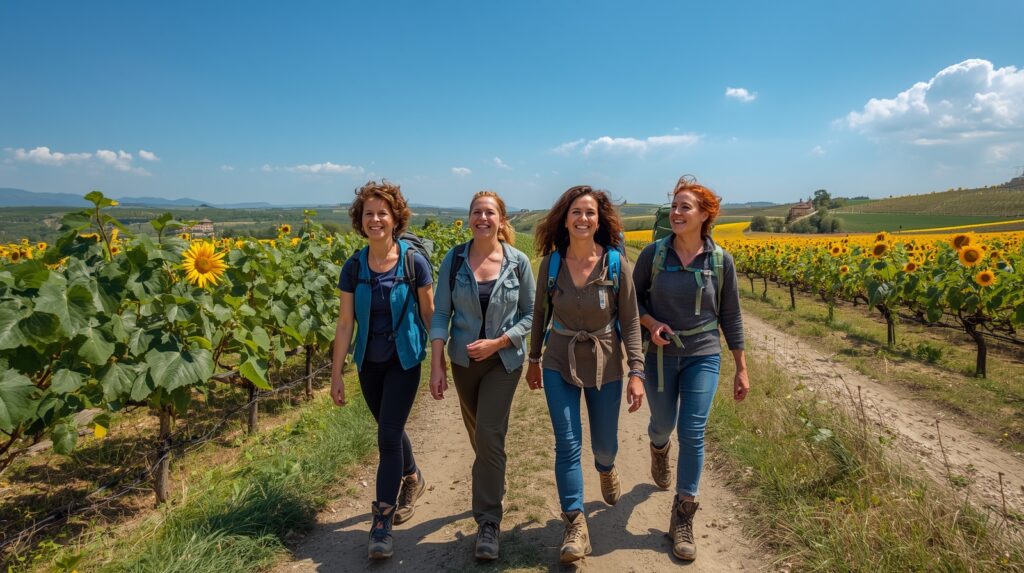








This isn’t another corporate retreat where you’re expected to network and impress. This is genuine sanctuary. The horses don’t care about your title, your achievements, or your carefully curated professional image. They respond only to who you actually are, beneath all that. In our storytelling circles, you’ll discover the liberating power of sharing your authentic experience with others doing the same.
The walking itself becomes meditation, the rhythm slowly dissolving the layers of performance you’ve accumulated. The landscape of rural France holds you whilst you shed what no longer serves. The horses mirror back your genuine state, teaching you the difference between presence and performance. And in the community of fellow travellers, you’ll discover you’re not alone in this exhaustion, or in the courage it takes to choose differently.
I keep the groups deliberately small. The pace is humane. The focus is on genuine transformation, not impressive takeaways for your LinkedIn profile. This is where burned-out executives become human again. Where entrepreneurs remember why they started. Where leaders discover that their vulnerability might be their greatest strength.
If you’re ready to stop faking it and start facing it, to build resilience that doesn’t require performance, to discover what becomes possible when you bring your whole, authentic self to your life and work, we’d be honoured to walk alongside you.
“Facing it” fosters a growth mindset—the belief that abilities and skills can be developed through dedication and hard work. Rather than fixating on external validation, a growth mindset enables us to view challenges as opportunities for learning.
A “Faking it until you make it” mentality can cause imposter syndrome, the fear that we will be exposed as frauds if we don’t maintain the facade of success. To truly thrive in today’s fast-paced and unpredictable world, we must embrace authenticity and increase our resilience. By facing challenges head-on, acknowledging our weaknesses, and committing to continuous growth, we can cultivate the inner strength needed to navigate life’s trials and tribulations. So, rather than faking it until you make it, have the courage to face it until you make it—the journey may be challenging, but the rewards are infinitely more fulfilling.
“Cultivating authenticity isn’t just about being genuine with others; it’s also about being genuine with ourselves. When we embrace vulnerability and face our fears with honesty, we forge deeper connections and achieve greater success in all aspects of life.” Brené Brown, a research professor at the University of Houston and the author of several bestselling books, including “The Gifts of Imperfection” and “Daring Greatly.”
©MMontagu

Author Bio: Dr Margaretha Montagu – described as a “game changer”, “gifted healer”, “guiding light” and “life-enriching author” – is an experienced medical doctor, a certified NLP practitioner, a medical hypnotherapist, an equine-assisted psychotherapist (EAGALAcertified) and a transformational retreat leader who guides her clients through life transitions – virtually, or with the assistance of her Friesian and Falabella horses, at their home in the southwest of France.
For more insight-giving articles
- How to Know When NOT to Take Decisive ActionSometimes Standing Still Is the Most Courageous Step You Can Take . We tend to admire people who take decisive action. The person who quits the corporate job to sail around the world. The couple who sell everything and move to Tuscany. The entrepreneur who launches a new business at sixty-five. These are the stories …
Continue reading “How to Know When NOT to Take Decisive Action”
- What Horses Can Teach Us About Authentic LeadershipFor years, whenever someone asked me about leadership, I gave the answer I thought I was supposed to give. I talked about vision. I talked about decisiveness. I talked about the importance of being the one in the room who makes the call. It was a perfectly serviceable answer, and it was also, I now …
Continue reading “What Horses Can Teach Us About Authentic Leadership”
- What If I Don’t Want to Be Transformed on a Walking Retreat?What if you don’t want to discover your life purpose, reinvent yourself, release your limiting beliefs, become your best self or emerge from the Gascon countryside at dawn knowing exactly what you’re going to do with the next thirty years? What if you would simply like to walk somewhere beautiful, eat something delicious, sleep properly …
Continue reading “What If I Don’t Want to Be Transformed on a Walking Retreat?”
- Is it Possible To Rebuild Trust After Betrayal?Rebuilding Trust After Betrayal in Friendships – more indepth article I was in the middle of one of the hardest weeks of my life when a friend of over a decade simply stopped being there for me. Not dramatically — there was no argument, no angry text, no falling out I could point to. She …
Continue reading “Is it Possible To Rebuild Trust After Betrayal?”
- What Horses Can Teach Us About Setting Healthy BoundariesI used to think setting healthy boundaries had to be dramatic to count. That you needed a raised voice, or a slammed door, or at the very least a strongly worded text, for a boundary to register. Turns out I only believed this because I’d never before watched Loki work a paddock. Loki is the …
Continue reading “What Horses Can Teach Us About Setting Healthy Boundaries”