
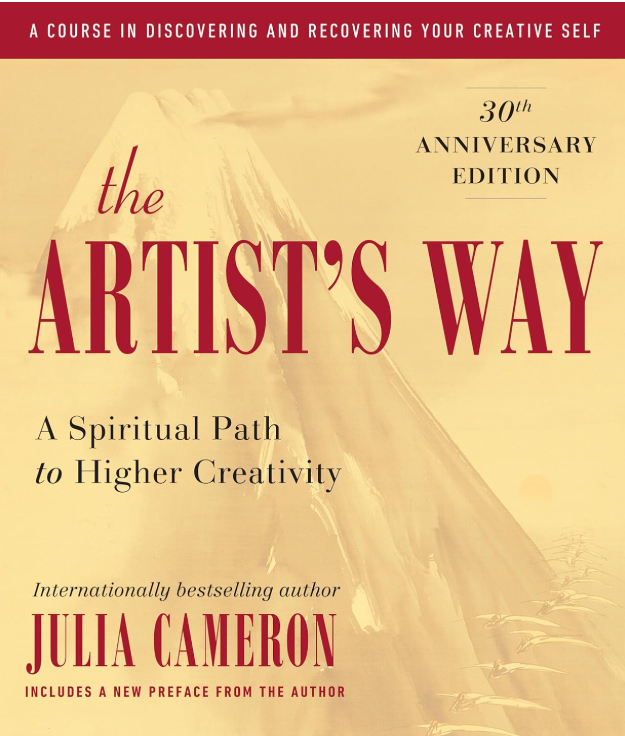
Author: Julia Cameron
Rating: ⭐⭐⭐⭐⭐ (5 out of 5 stars)
Read if: You’ve been telling yourself “I used to be creative” for longer than you’d like to admit.
The Backbone of the Book
According to Julia Cameron, your creative self isn’t dead—it’s just buried under years of self-criticism, practical concerns, and that one time your third-grade teacher said your drawing looked “interesting.” The Artist’s Way promises that in just 12 weeks of structured exercises, you can excavate your inner artist from beneath the rubble of adult responsibility and rediscover the joy of creating without the nagging voice that insists everything must be profitable, perfect, or LinkedIn-worthy.
The book’s central thesis is refreshingly straightforward: creativity is a spiritual practice, creative blocks are essentially spiritual blocks, and recovery is possible through consistent, gentle effort. Cameron presents creativity not as a rare gift bestowed upon the chosen few, but as a natural human function that’s been beaten out of most of us by well-meaning parents, budget-conscious partners, and our own merciless inner critics. You’re not uncreative—you’re just creatively injured, and Cameron has written you a 12-week rehab program complete with exercises, pep talks, and the kind of earnest spiritual optimism that somehow doesn’t feel cloying.
Useful Take-aways
Morning Pages: This is the book’s cornerstone practice, and honestly, it’s genius in its simplicity. Every morning, before you do anything else, you write three pages of longhand, stream-of-consciousness rambling. It doesn’t matter what you write—grocery lists, complaints about your commute, anxiety spirals about that email you need to send. The point isn’t to produce good writing; it’s to drain the mental static so your actual creative thoughts can surface. What makes this different from regular journaling is the non-negotiable “before anything else” timing and the “absolutely no one will read this” freedom. I was sceptical about the longhand requirement, but there’s something about the slower pace of handwriting that really does short-circuit your internal editor. It’s like a daily brain dump that prevents your mental trash from contaminating your creative well.
Artist Dates: Once a week, you take yourself on a solo expedition to do something that delights or intrigues you. Not networking, not research for a project, not something productive—just play. Cameron is adamant that these must be solo because you need to learn to trust and enjoy your own company, to hear your own creative whispers without someone else’s agenda drowning them out. The beauty of this practice is that it trains you to notice what genuinely appeals to you, not what you think should appeal to you. Maybe you spend an hour in a hardware store marvelling at paint chips, or you go to a matinee of a terrible action movie, or you visit a pet store with no intention of buying anything. These dates refill your creative reservoir with images, textures, experiences, and joy—the raw materials of art.
The Concept of Creative Recovery: Cameron reframes creative blocks not as laziness or lack of talent, but as wounds that need healing. She identifies specific “creativity monsters” like perfectionism, comparison, and the internalised voices of people who discouraged you. There’s something deeply liberating about understanding that the voice saying “who do you think you are?” isn’t actually you—it’s your fourth-grade teacher, or your practical father, or the culture that insists art is only legitimate if it pays the bills. The book offers targeted exercises to identify whose voice you’re really hearing and permission to gently tell them to shut up. This psychological archaeology approach resonated far more than generic “believe in yourself!” platitudes because it acknowledges that creative blocks have specific, often painful origins.
Less Useful Suggestions
Cameron writes from a place of considerable privilege that occasionally shows. The assumption throughout is that you have mornings available for lengthy writing sessions (where does one find 30 minutes every morning?), afternoons free for artist dates, and the financial breathing room to potentially quit your soul-crushing job to pursue art full-time. For the single parent working two jobs, the suggestion to “take yourself to a museum mid-week” lands differently than for someone with a flexible schedule and disposable income.
The spiritual language can be a barrier for some readers. Cameron uses terms like “the Great Creator” and frames creativity as fundamentally spiritual work, which is beautiful if you’re on that wavelength but potentially alienating if you’re not. She does say you can substitute whatever higher power concept works for you, but the book is pretty consistently “woo-woo” in a way that might make hardcore sceptics roll their eyes hard enough to sprain something.
Some of the exercises feel dated or oddly specific to Cameron’s own creative wounds. There are tasks about calling people who discouraged you (anxiety-inducing and sometimes impossible) and multiple exercises involving making collages (not everyone’s jam). The book was published in 1992, and occasionally you can feel it—the cultural references, the assumption that everyone has access to physical art supplies, the pre-Internet framework for how creative careers work.
The 12-week program is genuinely demanding. Morning Pages alone require about 30-45 minutes daily. Add the artist dates, the weekly tasks, and the reading, and you’re looking at a serious time commitment. Cameron is somewhat dismissive of excuses here, which can feel harsh when your excuses are actually called “children” or “chronic illness.”
Who This Book Is For
Perfect for you if:
- You used to draw/write/dance/make music and have no idea when you stopped or why
- You’re a recovering perfectionist who needs permission to make bad art
- You find yourself saying, “I’m not creative” while simultaneously envying people who are
- You’re willing to engage with spiritual/metaphysical language about creativity, or at least not be bothered by it
- You have enough life stability to commit to a daily practice (even if imperfectly)
Maybe skip it if:
- You’re looking for technique-specific instruction (this isn’t about how to paint or write—it’s about unblocking yourself)
- Spiritual or New Age-y language makes you physically recoil
- You’re currently in crisis mode and barely keeping your head above water (maybe come back to this during a calmer season)
- You need creativity advice that’s explicitly tailored to balancing art-making with caregiving, disability, or financial precarity
The One Thing You’ll Remember in Six Months
You probably won’t maintain the full Artist’s Way program with religious devotion forever, but Morning Pages has converted enough people to become a legitimate cultural phenomenon. Six months from now, you’ll likely still be doing some version of brain-dump writing most mornings, and you’ll notice how much clearer your thinking is on days when you do it versus days when you skip. The specific weekly tasks will blur together, but the permission to be a beginner, to make bad art, to create just for the joy of it—that shift in mindset tends to stick.
“Perfectionism is not a quest for the best. It is a pursuit of the worst in ourselves, the part that tells us that nothing we do will ever be good enough.”
“Creativity is not a business, though it may generate business. It is not a career, though it can lead to a career. Creativity is a spiritual experience.”
Bottom Line
The Artist’s Way is the rare self-help book that has earned its classic status. Yes, it asks a lot of you, and yes, some parts feel dated or privileged, but the core practices are genuinely transformative if you commit to them. Cameron writes with the conviction of someone who has walked this path herself and guided thousands of others down it, and that authority comes through on every page.
Recommendation: Buy it if you’re serious about creative recovery, borrow it if you want to test the waters, read a summary if you just want the Morning Pages concept.
Personal Note on Artist’s Way
I picked this up after years of calling myself a “recovering creative”—which is a very pretentious way of saying I stopped making things and felt sad about it. I expected either magic-bullet thinking or tedious art therapy exercises. What I got instead was something more like a firm, loving friend who refuses to let you keep talking shit about yourself while also not accepting your excuses.
The Morning Pages practice genuinely changed my mental landscape. It turns out that when you pour out all your petty resentments and anxious thought loops onto paper every morning, there’s actually space left over for ideas, wonder, and the quiet voice that says “hey, what if we tried making something today?” I abandoned most of the weekly exercises, but the core practices of Morning Pages have stuck with me for decades now.
Did I become a wildly successful artist? No. But I started writing things again without the crushing weight of “is this good enough?” constantly on my shoulders. I write terrible first drafts. I take blurry photos. Somehow, after years of creative constipation, things are moving again. That’s worth considerably more than the price of the book.
- The Stories We Tell Ourselves: How to Rewrite the Narrative That’s Making You Miserable
 What this is: A practical, warm-hearted exploration of why your inner narrative might be your biggest source of stress, and what you can actually do about it, starting today. What this isn’t: Another “just think positive!” pep talk. No toxic positivity. No worksheets asking you to “visualise your best self living your best life.” Read …
 - The Loneliness Epidemic: Why Do I Feel Lonely Even When I’m Surrounded by People?
 The Loneliness Nobody Talks About: When You’re Never Alone But Always Lonely One crisp spring night, somewhere along the Camino de Santiago, in the southwest of France, a small group of reading retreat guests sits in a clearing around a fire. By the time Lisa speaks, both hands wrapped around her mug, her tea has …
Continue reading “The Loneliness Epidemic: Why Do I Feel Lonely Even When I’m Surrounded by People?”
- Overthinking Can Make You Blind to Opportunities
 The mental habit that keeps smart, capable people stuck, and the surprisingly simple shift that changes everything. What this is: A candid, research-informed look at how overthinking, especially during times of stress and uncertainty, actively blinds you to the opportunities that could change your life. Practical, warm, occasionally irreverent. What this isn’t: A collection of …
Continue reading “Overthinking Can Make You Blind to Opportunities”
- Why a Reconnect with Nature Retreat in the southwest of France Might Be the Smartest Thing You Do This Year
 An Esprit Meraki Stress-Reducing Retreat Could Be Your Most Powerful Reset in These Uncertain Times What this is: A grounded, honest look at why attending a stress-reducing retreat during a period of sustained political uncertainty is genuinely useful, not indulgent. We’re talking neuroscience, narrative, and the particular magic of walking the Camino de Santiago in …
 - The Doctor Who Couldn’t Breathe Part 4
 As you may know, I host Camino de Santiago walking and writing retreats and belong to a delightfully creative band of scribblers called the Wordweavers in the southwest of France writing group, and at one of our meetings, held on Friday the 13th of February 2026, which felt appropriately theatrical—I read the story you’re about …
Book Review Disclaimer
These book reviews represent my personal reading experience and interpretation. Your mileage may vary—and that’s not only okay, it’s expected.
What these reviews are:
- One reader’s honest take on books that made me think, feel, or occasionally throw things across the room
- A blend of summary, analysis, and subjective response
- An attempt to help you decide if a book is worth your time and money
- Written with warmth, wit, and the occasional tangent
What these reviews are not:
- Professional literary criticism or academic analysis
- Comprehensive summaries of every concept in the book
- A substitute for reading the actual book (though sometimes they might save you the trouble)
- Sponsored content—I buy my own books and all opinions are genuinely mine
About Self-Help Books Specifically
- These reviews discuss psychological concepts as they appear in books, not as professional advice
- If you’re struggling with mental health issues, please seek support from qualified professionals
- Books can be powerful tools for self-reflection, but they’re not replacements for therapy
- I bring my own background, experiences, and biases to every book I read. I do my best to recognise when my perspective might limit my understanding, but I’m sure I miss things. If you notice gaps in my perspective or feel I’ve misrepresented something, I’m always open to thoughtful discussion.
About recommendations:
- When I suggest a book might help with certain issues, I’m sharing what resonated with me—not making clinical recommendations
- Everyone’s healing journey is different; what works for one person may not work for another
- Some books can be triggering or emotionally difficult—please practice self-care in your reading choices
I don’t use affiliate links.
Copyright and Fair Use
Reviews may include brief descriptions of concepts and ideas from books, but I never reproduce substantial excerpts or copyrighted material. All paraphrasing is in my own words. If you’re the author or publisher and have concerns about a review, please contact me at margarethamontagu@gmail.com
The Bottom Line
These reviews are written in good faith to foster conversation about books and ideas. Take what resonates, leave what doesn’t, and always apply your own judgment about what you choose to read.