
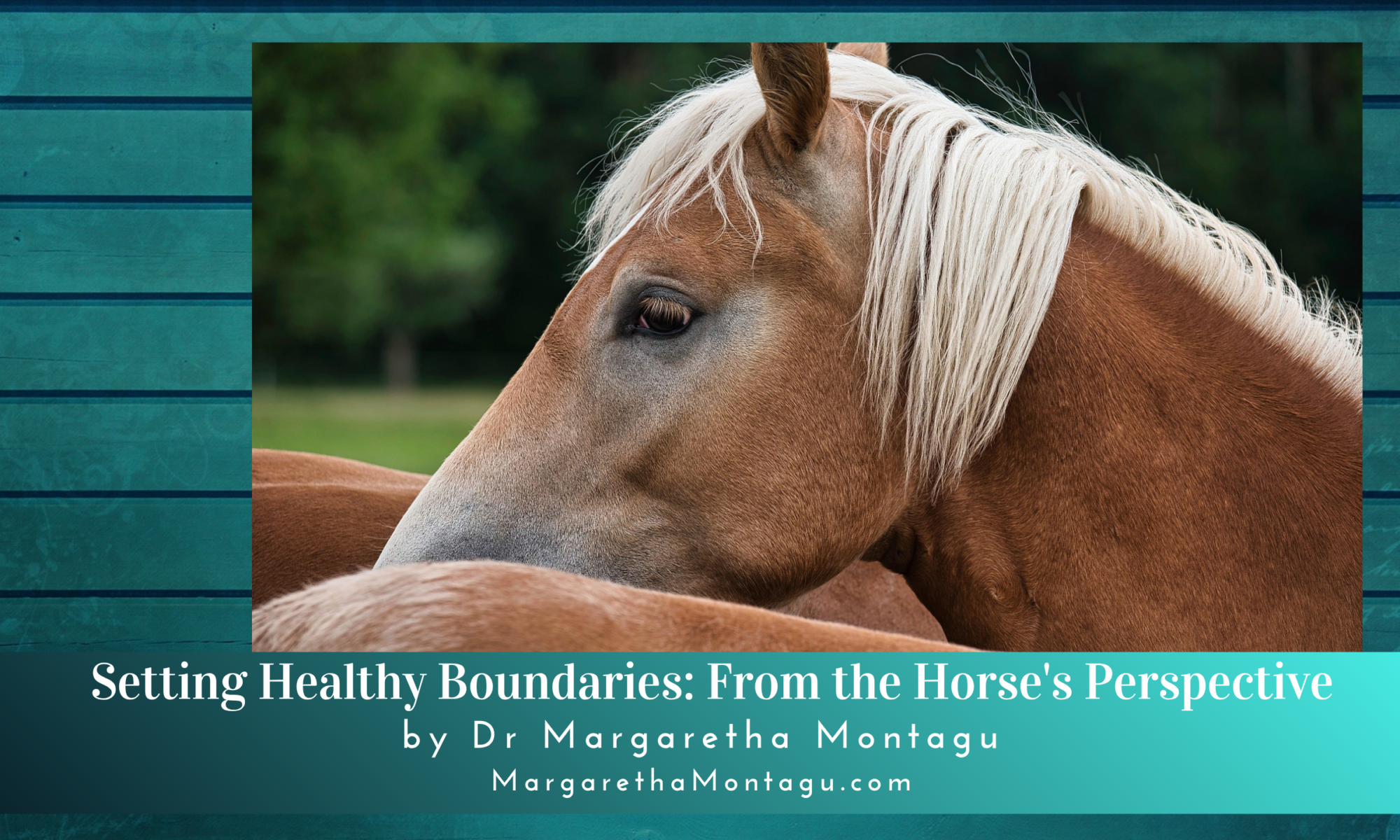
I used to think setting healthy boundaries had to be dramatic to count. That you needed a raised voice, or a slammed door, or at the very least a strongly worded text, for a boundary to register. Turns out I only believed this because I’d never before watched Loki work a paddock.
Loki is the smallest horse in my herd and, without question, the one most firmly in charge. He weighs, generously, about as much as a large dog. And yet he moves horses three times his size out of his space with nothing more than a flattened ear and a warning look, the equine equivalent of a raised eyebrow. No drama. No chasing. No prolonged negotiation. Just: not here, thank you. And the other horse simply adjusts its approach.
I’ve spent a good portion of my adult life doing the opposite of this.
The Smallest Horse is in Charge
When I first brought the herd together, I expected the boundary-setting to look like conflict — pinned ears, some kicking, a bit of chaos while everyone worked out the pecking order. There was a little of that, briefly. But what actually settled the herd wasn’t aggression. It was consistency. Loki doesn’t get louder every time someone tests his space. He does the same small thing, every single time, at exactly the same intensity, whether it’s the first offence or the fiftieth. No warning shots that escalate into something bigger because the first attempt didn’t land. Just the same clear signal, repeated, until everyone learns it’s reliable enough to believe.
What struck me most was how little residual tension there was afterwards. If Loki indicates Valentino should move off his hay, Valentino moves off the hay, and thirty seconds later they’re standing companionably in the shade together like nothing happened. Because, to Loki, nothing did happen. A boundary was communicated and respected. That’s the whole event. No grudge attached, no story added on top about what it meant that Valentino had crowded him in the first place.
Compare that to how most of us handle it. We tolerate the crowding — at work, in a friendship, in our own families — well past the point of comfort, saying nothing, being terribly accommodating, and then when we finally do say something, it comes out sideways. Too big, too late, wrapped in weeks of resentment that had nowhere else to go. We treat boundary-setting like a last resort instead of routine maintenance, which is exactly backwards. Loki never waits until he’s furious to move someone along. He does it the moment he needs space, at the smallest necessary size, before resentment has any chance to build.
Firm Is Not Necessarily Aggressive
I think this is the piece most of us skip past: a clear boundary and an aggressive one are not the same instrument, even though we tend to reach for aggression because we’ve let things go on so long that a gentle correction no longer feels like enough. Loki never needs to escalate, because he never let the first small crossing slide in the way that makes escalation necessary later. His boundaries are firm precisely because they’re small and immediate — not because they’re forceful.
I noticed this most clearly in myself, oddly, while grooming Aurore. She’s a wonderfully affectionate horse who will happily stand right on top of you if you let her, which is charming for about four seconds and then genuinely a safety issue when you’re holding hoof clippers. My first instinct, always, was to just absorb it — shuffle over, make myself smaller, accommodate the crowding rather than address it. It took real practice to instead put a flat hand on her shoulder the moment she leaned in, firmly, without apology, without a running commentary about how sorry I was to be asking. She’d step back. We’d carry on. No harm done, because I’d said something before there was a problem.
I’d spent two decades in clinical practice watching this same dynamic play out among staff, and plenty more years failing to apply it to my own working relationships. The people who set boundaries well rarely got angry. They were the ones who made small, clear objections early, calmly, and meant it consistently enough that they rarely had to raise their voice at all.
Practising the Flattened Ear
You don’t need to master some elaborate boundary-setting script to get better at this. Loki’s entire toolkit is a look and a small shift of weight. What makes it effective isn’t sophistication — it’s that he uses it immediately, every time, without escalating drama into the exchange. The lesson isn’t to become more assertive in some general sense. It’s to say the small true thing the moment you notice you need to, before it has time to compound into something that requires a much bigger, angrier version of the same message.
Start smaller than feels sufficient. A “that doesn’t work for me” said early is worth infinitely more than the perfectly composed essay you’ll eventually deliver after six months of silent resentment. Loki never writes essays. He just moves his ears.
Attend a Master Class in Setting Healthy Boundaries
If you’d like to see this in practice rather than just read about it, my retreats include unhurried time simply being around the herd — and there’s no faster way to notice your own boundary habits than standing next to a horse who has absolutely no interest in your people-pleasing tendencies. Come spend a few days with us on your own or with a small group and let Loki show you how it’s done. He’s very patient with slow learners, provided you don’t crowd the hay.
© Dr. Margaretha Montagu, Esprit Meraki

5-day/4-night “Press Pause” Camino de Santiago Walking Retreat – If your soul is craving fresh air, meaningful movement, and a chance to reconnect with nature and connect with horses, join me on a powerful, natural reboot for your body, mind, and spirit. Same content as the 3-day retreat, spread over 5 days. And an extra day of walking. No extreme fitness requirements. No forced bonding. No pressure to have a breakthrough. For one or two guests travelling together.
Do you dream of escaping your stressful life to raise a herd of goats or grow sunflowers in the south of France? Then you may be ready for an Esprit Meraki retreat. Get access to this “very serious” quiz to help you figure out how urgent your need for a change of scenery is, when you subscribe to my monthly newsletter.

“I am an experienced medical doctor – MBChB, MRCGP, NLP master pract cert, Transformational Life Coach (dip.) Life Story Coach (cert.) Stress Counselling (cert.) Med Hypnotherapy (dip.) and EAGALA (cert.) I may have an impressive number of letters after my name, and more than three decades of professional experience, but what qualifies me to excel at what I do is my intuitive understanding of my clients’ difficulties and my extensive personal experience of managing major life changes using strategies I developed over many years.” Dr M Montagu
.