
.
What years of hosting Camino de Santiago walking retreats in France taught me about connection on the trail
Crossroads Conversations
When I first started hosting Camino de Santiago walking retreats in rural Gascony, the French Tuscany, I assumed I would be the one doing most of the teaching.
I couldn’t have been more wrong.
Over the years, dozens of people have arrived at my farmhouse carrying backpacks, walking boots, and lives that had gradually become much too heavy. Some were still working. Some had retired. Some were rebuilding after loss, illness or divorce. Others simply couldn’t explain why they felt so restless.
They thought they had come to walk a couple of sections of the Camino.
In the end, they became MY teachers. The CrossRoads Conversations blog post series explores what my guests have taught me over the last twenty-odd years.
.
I’ve watched a lot of icebreakers fail in my time. Name games, “two truths and a lie,” the earnest go-round where everyone shares what they’re hoping to get from the retreat — I’ve tried most of them, back when I still believed conversation was the fastest route to connection. It isn’t. Not even close.
The fastest route, I’ve learned, is a hill. Preferably a slightly steep one, ideally somewhere between Eauze and Manciet, with the wind doing something unhelpful and everyone’s calves quietly registering complaints.
What Actually Happens on the Climb
Here’s the thing nobody tells you about shared physical effort: it strips away performance almost instantly. On day one, over dinner, guests are still curating themselves a little — the polished version of their job, their reason for coming, their opinions delivered with the faint carefulness of people who’ve just met. Entirely normal. Entirely human.
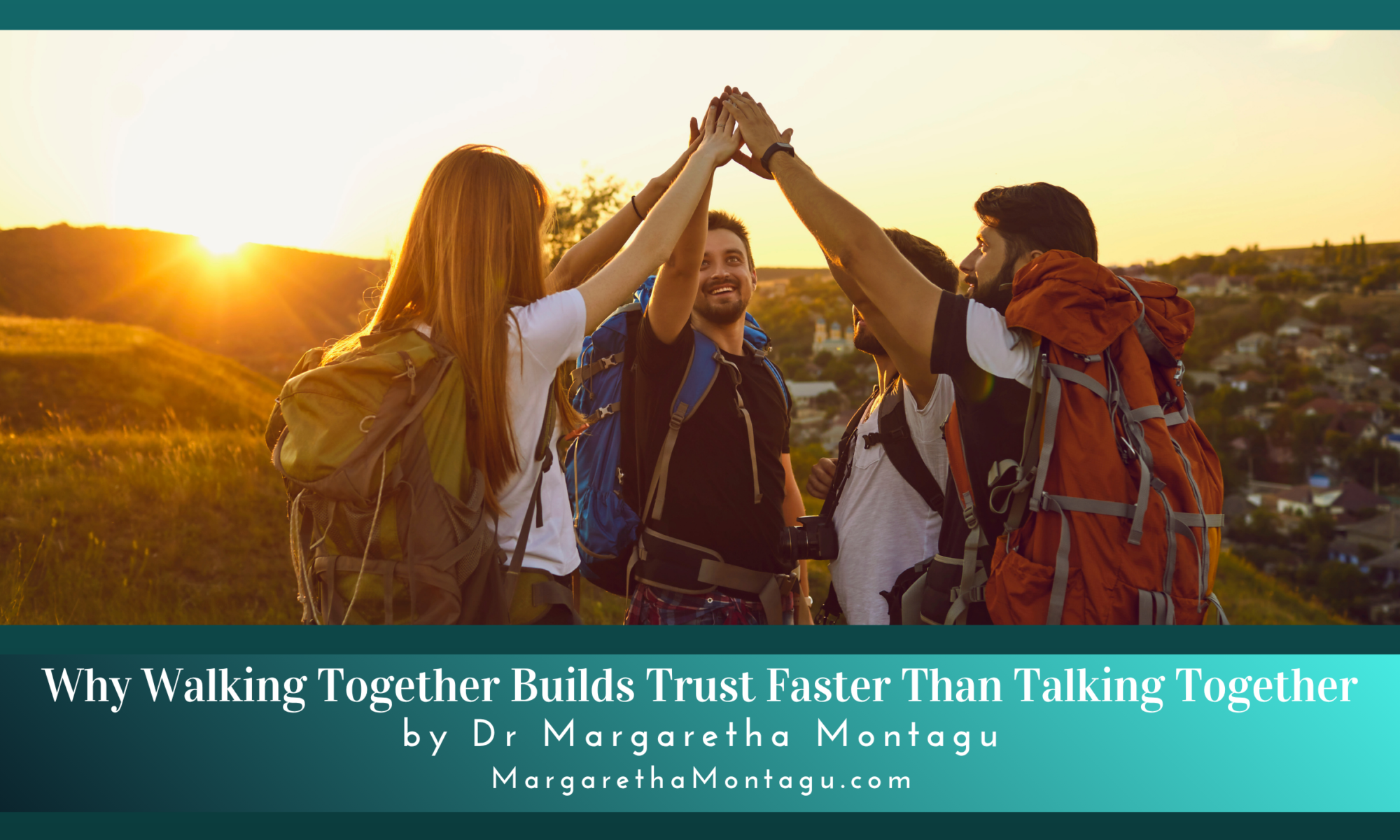
Then they hit a hill, and within about twenty minutes, all of that curation becomes logistically impossible. Nobody can maintain witty small talk while their lungs are working that hard. What replaces it is much better: short sentences, spontaneous laughter at nothing in particular, someone offering their water bottle to a stranger without a second thought. By the top, four people who were polite acquaintances at brunch have somehow become a small, slightly breathless unit.
I’ve come to think of it as the difference between telling someone who you are and being seen while you’re coping with a challenge. A dinner conversation is the former. An uphill stretch, taken together, is the latter — and it turns out the latter builds trust roughly ten times faster.
The Guest Who Surprised Me
I remember one retreat where a guest — a barrister, sharp, quite guarded on arrival — said almost nothing personal for the first day and a half. Then she hit a long, exposed stretch, not even particularly steep, and about halfway up she started laughing, apparently at her own expense, about how she’d trained for this “by walking briskly to meetings.” By the top, she was telling the group about her father, unprompted, the way you’d mention something to an old friend rather than three people you’d met the day before.
Nothing about that stretch was designed to produce that. It just made pretence too expensive to keep up.
Why I Stopped Over-Engineering the “Bonding”
In the early years, I tried to schedule connection — a reflective circle here, a shared journaling prompt there. Useful, some of it. But I’ve quietly learned to trust the terrain more than my own planning. The gentlest of hills do the work that my carefully worded prompts were only ever approximating. Struggle shared in silence, side by side, seems to build something that struggle discussed rarely manages on its own.
This is partly why I resist the urge to over-schedule our days. If guests spend an hour climbing together without a single planned “activity,” they usually leave that hour closer than they’d have gotten from an evening of structured conversation. The Camino, in this sense, does a fair bit of my job for me — which I’ve made peace with, mostly.
What I’d Tell Anyone Hosting a Retreat
If you’re building any kind of group experience, physical or otherwise, my honest advice is this: stop trying to talk people into closeness. Give them something moderately hard to do together instead, ideally something that makes conversation briefly impossible, and step back.
It won’t feel like it’s working, in the moment. It’ll just look like four people trudging up a hill, a little out of breath, not saying much.
If you’d like to know more about how walking sections of the Camino de Santiago together tends to unfold — hills included — I’d love to hear from you. Write to me directly at MargarethaMontagu@gmail.com and I’ll tell you honestly what to expect.
5-day/4-night “Press Pause” Camino de Santiago Walking Retreat – If your soul is craving fresh air, meaningful movement, and a chance to reconnect with nature and connect with horses, join me on a powerful, natural reboot for your body, mind, and spirit. Same content as the 3-day retreat, spread over 5 days. And an extra day of walking. No extreme fitness requirements. No forced bonding. No pressure to have a breakthrough. For one or two guests travelling together.
Do you dream of escaping your stressful life to raise a herd of goats or grow sunflowers in the south of France? Then you may be ready for an Esprit Meraki retreat. Get access to this “very serious” quiz to help you figure out how urgent your need for a change of scenery is, when you subscribe to my monthly newsletter.
What Life Lessons Can You Learn While Walking the Camino de Santiago? – a free guide filled with 10 not just “quaint anecdotes” or Instagram-worthy moments (though there are plenty of those) but real transformations from real people who walked this insight-giving trail – Subscribe to my monthly newsletter to Download the Guide

“I am an experienced medical doctor – MBChB, MRCGP, NLP master pract cert, Transformational Life Coach (dip.) Life Story Coach (cert.) Stress Counselling (cert.) Med Hypnotherapy (dip.) and EAGALA (cert.) I may have an impressive number of letters after my name, and more than three decades of professional experience, but what qualifies me to excel at what I do is my intuitive understanding of my clients’ difficulties and my extensive personal experience of managing major life changes using strategies I developed over many years.” Dr M Montagu