
★★★★★
Reviewed by Margaretha Montagu, host of the Book Lovers’ Binge Reading and Camino de Santiago Walking Retreats
There are books that make you smarter, and then there are books that make you feel like you have been walking around half-blind your entire life — not in a crushing, existential way, but in the most thrillingly disorienting way imaginable. Ed Yong’s An Immense World: How Animal Senses Reveal the Hidden World Around Us belongs, triumphantly and rather humblingly, in the second category. Published in 2022, it won the Royal Society Science Book Prize and has since done what only the very best popular science writing ever manages to do: it didn’t just change how I think. It changed how I walk.
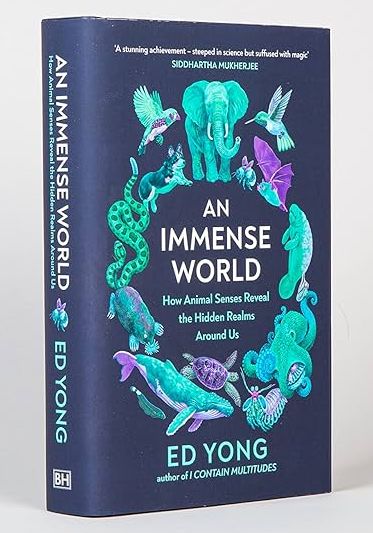
I first encountered this book the way I encounter most things that matter — sideways, and slightly by accident. A guest at one of my retreats pressed her copy into my hands on the last morning, with the particular intensity of someone who has just discovered fire. “Read this,” she said, in the tone of voice that is not really a suggestion. I read it on the train home, after a visit to Bordeaux, missed my stop, and did not mind one bit.
By the time I reached the chapter on echolocation, I was the sort of person who sits on trains making small involuntary noises of wonder. This is, I should tell you, not my usual comportment on public transport. But An Immense World is not a usual book.
“Every animal is enclosed within its own sensory bubble, perceiving but a sliver of an immense world.” — Ed Yong
So, what is it actually about? At its heart, An Immense World is an exploration of a single idea — one of those ideas so simple and so staggering that you wonder how you lived without it. The concept is the Umwelt: a term coined by the Baltic German biologist Jakob von Uexküll in the early twentieth century, meaning the unique sensory world that each animal inhabits. The tick that detects only warmth and the smell of butyric acid. The mantis shrimp with sixteen types of photoreceptors (we have three, and we are already insufferably pleased with ourselves about colour). The star-nosed mole navigating its entire universe through a nose ringed with twenty-two fleshy tentacles. The shark that can detect the electrical field of a heartbeat. The robin that quite possibly sees magnetic north, woven like a ghost image into its very field of vision.
Yong moves through these worlds — and dozens more — with the curiosity of a child and the rigour of the exceptionally good science journalist he is. Each chapter unfolds like a door opening onto a corridor you didn’t know existed. Electroreception. Magnetoreception. The lateral lines of fish, which sense pressure waves in water the way we might feel a draught in a dark room. The infrasound of elephants, communicating across distances that make mobile phone coverage look frankly limited. The ultraviolet patterns on flowers, invisible to us but blazing to a bee — a secret language written on the face of every garden, which we have never been equipped to read.
What Yong is really doing, beneath all this gorgeous biological detail, is asking us to practice a particular kind of humility. The world is not the world as we perceive it. The world is immense — layered with sensory realities we will never access, buzzing with information our bodies were simply not built to receive. Every animal is living in its own private universe, as real and as complete as ours, and we are all — every last one of us — experiencing only the narrowest possible sliver of what is actually there.
I have thought about this constantly since reading it. I thought about it walking the Camino, pausing on a hillside to look at the view — and wondering what the hawk circling above was seeing in that same landscape, what frequencies the grass and stone and sky were broadcasting that we would never, ever hear. I thought about it sitting with my Friesian horses in the field in the early morning, watching their ears swivel and track sounds from distances I couldn’t imagine, registering weather shifts in their skin that I was oblivious to. I thought about it standing in the garden at dusk, watching the bats emerge, and understanding — properly, for the first time — that they were not flying through darkness. They were flying through a world of their own exquisite making, every wall and wing and moth as clear to them as the landscape is to us.
“To understand the senses of other animals is to understand that there is no single correct way of experiencing the world.” — Ed Yong
The retreat guests who have read this book before arriving walk differently — I am quite sure of it. There is a quality of attention in them that I have come to recognise. They stop more. They crouch down more. They watch things — beetles, horses, the particular way a dog tilts its head before a storm — with a focused, interested patience that the non-readers often take a day or two longer to find. An Immense World seems to install a new piece of perceptual software: one that keeps whispering, what is it like to be that? A question that is, I would argue, one of the most valuable questions a human being can learn to ask.
Yong is a beautiful writer as well as a magnificent thinker. He wears his expertise lightly, moving between cutting-edge research and vivid, grounded storytelling with the kind of ease that looks effortless and certainly isn’t. His portraits of the scientists he meets — and their decades-long obsessions with obscure sensory phenomena — are warm and funny and often quietly moving. These are people who have spent their careers listening to things the rest of the world couldn’t hear, and Yong renders their dedication with unmistakable affection.
I read many books and recommend many books, but there are only a handful I have slipped into the reading list for my retreats with the private certainty that it will change something in the people who read it — permanently, quietly, and for the better. An Immense World is one of those books. Not because it is long or demanding (it isn’t — it moves like a river, fast and clear and irresistible). But because it trains a muscle we didn’t know was underdeveloped: the muscle of perceptual curiosity. Of wondering what the world looks, sounds, smells, and feels like to a creature that is not you.
On the Camino, we talk a lot about presence — about being here, now, in this particular body, on this particular path, under this particular sky. An Immense World adds a gorgeous layer to that practice. Because once you know that the world is infinitely richer than your senses can detect, the act of paying attention becomes not just a discipline but a kind of reverence. You are standing in the middle of something vast and layered and astonishing, and you are catching only the edge of it — and that, somehow, is enough to bring you fully awake.
My 10 key takeaways from An Immense World:
1. Every animal lives in its own sensory bubble — the Umwelt. Jakob von Uexküll’s concept of the Umwelt is the book’s beating heart: each animal perceives only the slice of reality its senses are built to detect. A tick’s world is warmth and butyric acid. A dog’s world is a landscape of smell. None of these worlds is more “real” than another — they are simply different.
2. Our human senses are not the gold standard — just one option among millions. We tend to assume our perception of the world is the complete version. Yong dismantles this quietly but thoroughly. We are, sensory-wise, fairly ordinary animals — impressive in some areas, startlingly limited in others.
3. Vision is far stranger and more varied than we imagine. Some animals see in ultraviolet. Mantis shrimp have sixteen types of photoreceptors to our three. Many fish and birds see colours we have no names for. The visual world of a bee moving through a flower garden bears almost no resemblance to what we see in the same space.
4. Sound shapes entire worlds — including ones we never knew existed. Elephants communicate in infrasound across vast distances. Whales sing in frequencies that once travelled across entire ocean basins. Bats build a precise three-dimensional map of their world purely from echoes. Hearing, Yong shows, can be as rich and complex a sense as sight — richer, in many cases.
5. Electroreception is a sense we can barely conceptualise. Sharks, electric eels, and the platypus can detect the faint electrical fields generated by living bodies. This sense — entirely absent in humans — allows them to “see” through murk, darkness, and solid ground. It is a reminder that there are entire sensory dimensions for which we have no frame of reference at all.
6. Many animals may navigate by sensing the Earth’s magnetic field. Migratory birds, sea turtles, and possibly dogs appear to have a built-in compass — perceiving magnetic north not as a concept but as a direct sensory experience, possibly woven into their vision as a kind of overlay. The precise mechanism is still debated, but the evidence is increasingly compelling.
7. Touch is vastly underrated and extraordinarily sophisticated. The star-nosed mole navigates its entire world through a nose ringed with twenty-two fleshy tentacles, each packed with nerve endings. The crocodile’s jaw is among the most sensitive touch organs in nature. Yong makes a strong case that we have systematically underestimated this sense — in other animals, and perhaps in ourselves.
8. Human activity is drowning out the sensory worlds of other animals. One of the book’s most urgent arguments: light pollution disrupts species that navigate by stars; noise pollution masks the acoustic signals animals depend on for hunting, mating, and communication; chemical pollution interferes with the scent trails that entire ecosystems run on. We are not just destroying habitats — we are scrambling the sensory fabric of the natural world.
9. Asking “what is it like to be that animal?” is a radical act. Yong returns repeatedly to the philosopher Thomas Nagel’s famous question — what is it like to be a bat? — and argues that genuinely trying to answer it, even imperfectly, is one of the most important things we can do. It is the foundation of both good science and genuine compassion toward other creatures.
10. Perceptual humility is the beginning of wonder. The book’s deepest takeaway is not a fact but an orientation: the world is unimaginably richer than any one creature can perceive. Accepting that — sitting with the sheer scale of what we are missing — does not diminish our experience. It expands it. The appropriate response to An Immense World is not inadequacy, but awe.
So read this book on the way here. Or pack it and read it in the evenings when your legs ache and the stars are out and everything feels open. And then go outside the next morning and pay attention differently.
You won’t regret it.
Ed Yong is a science journalist and staff writer at The Atlantic, where his work has earned him a Pulitzer Prize for Public Service — awarded for his landmark COVID-19 coverage. His first book, I Contain Multitudes (2016), explores the world of the microbiome: the trillions of microorganisms that inhabit our bodies and shape our health, mood, and even our behaviour. It is, if anything, equally mind-expanding — and pairs wonderfully with An Immense World for readers who want their sense of the world systematically dismantled and rebuilt, more spacious and more wonderful, from the ground up.
Join us for the Book Lovers’ Binge Reading Camino de Santiago Walking Retreat in the sun-drenched southwest of France: a journey where the trail and the story unfold together. Walk ancient paths at your own pace, then settle in each evening with a good book. This isn’t a fitness challenge — it’s a gentle rhythm — one step, one chapter, one honest conversation at a time. Rolling hills, quiet villages, golden light. No expectations, no drama, no agenda but your own unfolding.

Join us for the Book Lovers Binge Reading Camino de Santiago Walking Retreat in the sun-drenched southwest of France: a journey where the trail and the story unfold together. Walk ancient paths at your own pace, then settle in each evening with a good book. This isn’t a fitness challenge—it’s a gentle rhythm—one step, one chapter, one honest conversation at a time. Rolling hills, quiet villages, golden light. No expectations, no performance, no agenda but your own unfolding.










Do you dream of escaping your stressful life to raise a herd of goats or grow sunflowers in the south of France? Then you may be ready for an Esprit Meraki retreat. Get access to this “very serious” quiz to help you figure out how urgent your need for a change of scenery is, when you subscribe to my monthly newsletter.