
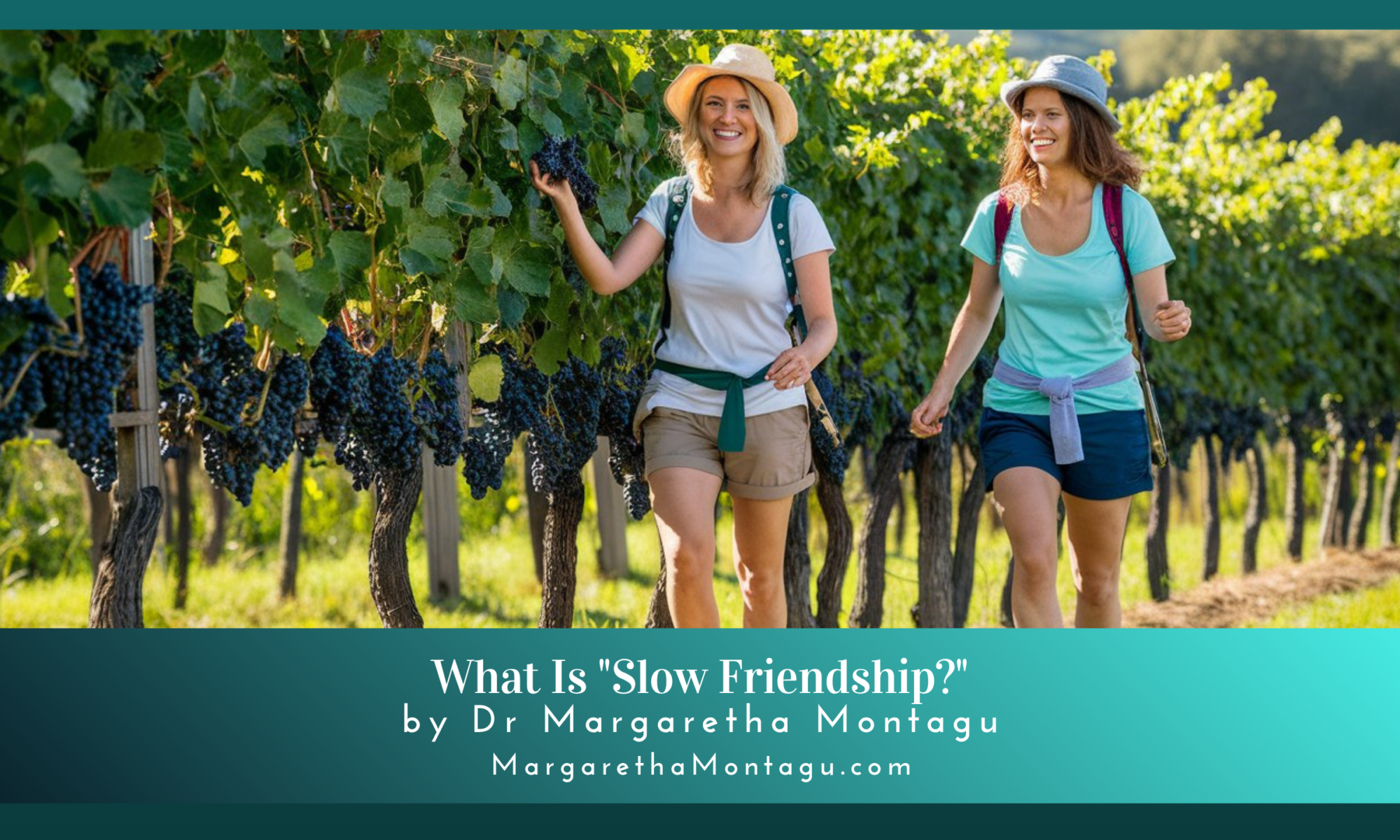
The science and soul of slow friendship — and how to cultivate it before you burn out completely
Slow friendship is a way of relating to others that prioritises depth, authenticity, and genuine presence over speed, intensity, or obligation. Rather than rushing into closeness or holding friends to unspoken expectations, it allows connection to unfold naturally over time, giving both people the freedom to show up as their full, imperfect selves without fear of judgment or abandonment. It’s less about constant contact and more about the quality of care — a kind of friendship that doesn’t demand perfection, weathers change and contradiction, and treats the bond itself as something sacred.
What this is: A thoughtful, insight-giving look at “slow friendship” — the quietly radical art of building reciprocal, gloriously unhurried connections in a world that has somehow decided relationships should function like a quarterly performance review. (Spoiler: they shouldn’t. You are not a KPI. Your friendships are not a pipeline. There will be no bonus for “exceeding expectations in emotional availability.”) This is about the kind of connection where someone remembers what you told them last time, asks the follow-up question, and — in a move so subversive it borders on scandalous — does not check their phone while you’re answering.
What this isn’t: A lecture about putting your phone down. (You know. I know you know. Your screen-time report knows. We are not here to reopen that particular wound.) It is also not a listicle of “5 easy ways to make friends as an adult,” illustrated with stock photos of improbably radiant people laughing at salad — the kind of advice that is both technically correct and spiritually unhelpful, and that makes you want to lie down in a darkened room with a cold cloth on your forehead and reconsider your subscription to modern life.
Read this if: You are exhausted — not just tired, but existentially, soul-deep tired — by the daily onslaught of world events you cannot fix and cannot stop refreshing. If you are vaguely, embarrassingly lonely despite being perpetually, aggressively connected. If you have recently looked at your phone, noted seventeen unread messages across four group chats, and felt not warmth but a low-grade administrative panic. If you suspect your closest friendships have been quietly downgraded to sporadic voice notes and the occasional heart-react, and that somewhere along the way you stopped being known and started being… managed.
And if — just if — you are willing to entertain the mildly inconvenient, deeply appealing possibility that the remedy might involve the French countryside, a stack of novels that do not improve your CV in any measurable way, a pair of walking shoes, and the company of a small, well-chosen group of humans who have absolutely no interest in optimising you.
5 Key Takeaways
- Slow friendship is not a lifestyle trend — it’s a biological necessity. Your nervous system is quite literally designed for face-to-face, unhurried connection. Anything less is a workaround, a short-term solution.
- Quality over quantity is not a consolation prize. Research consistently shows that two or three genuinely close friendships have a more profound effect on wellbeing than a crowd of pleasant acquaintances.
- Slow friendships are built in the margins — shared silences, shared meals, shared miles. You cannot rush them, and you absolutely cannot replicate them on a screen.
- The world feels less terrifying when you feel genuinely witnessed by another human being. Slow friendship is, among other things, an extraordinarily effective antidote to news-cycle anxiety.
- You don’t have to overhaul your entire life to experience this. Sometimes, one intentional week is enough to remind you who you are — and who you want to be close to.
Introduction: You Are Not Broken. You Are Just Under-Befriended.
You’re sitting with your phone in hand, having just scrolled through the news (mistake), then through social media (bigger mistake), then through three different WhatsApp group chats that are too busy and at the same time entirely devoid of anything you actually need to know. You are, by every modern metric, connected. You have notifications. You have followers. You have a contacts list so long it scrolls for what feels like several business days.
And yet.
There is a specific, hollow, slightly uncomfortable kind of loneliness that sits in the chest of people who are, technically, never alone. A loneliness that has nothing to do with being unloved and everything to do with never being truly known. Never sitting across from someone who looks at you, unhurried, and asks not “how are you?” but “no, really — how are you?“
That loneliness? It has a name now. And its antidote has one too.
Slow friendship is what happens when two people actually show up for each other — slowly, consistently, with attention and genuine interest. It is the opposite of the connection our culture has been selling us. And it is, it turns out, exactly what our overstimulated, under-nourished nervous systems are quietly screaming for.
I have been giving this a lot of thought, and for me, a slow friendship is a kind friendship. A friendship based on being kind to each other, must, it seems to me, have kindness as its foundation.
In this article, you’ll discover what slow friendship actually is, why it matters more than ever right now, and — no pressure — why a week walking an ancient pilgrim trail in the French countryside, surrounded by good books and excellent company, might be precisely the slow-friendship catalyst you didn’t know you needed.
The Story: How Sophie Marchand Accidentally Found Her Herself
Sophie Marchand was, by most external measures, doing extremely well.
She had a successful freelance consultancy, a flat she’d renovated herself in Toulouse, a book club that met monthly (mostly), and a social calendar that looked, from the outside, positively enviable. She had friends. Plenty of them. There was Camille, who she’d known since university and still texted on birthdays. There was the work crowd, perfectly nice, always up for a drink. There was the yoga group, the neighbours she waved to warmly, the LinkedIn connections she’d met at conferences and promised to “catch up with properly asap.”
Sophie, in other words, had the architecture of a rich social life. What she did not have, at the age of fifty-four, was anyone she could call at eleven o’clock on a Tuesday night when the news had done its worst and the walls were closing in.
She didn’t let herself think about that too hard.
Then the year turned particularly grim. The geopolitical situation, which she’d been monitoring with the anxious vigilance of someone who reads three newspapers a day, grew grimmer still. Her work, though steady, felt increasingly purposeless. And one evening, sitting in her beautiful renovated flat, eating reheated pasta alone and watching a documentary about a problem she neither cared nor could do anything about, Sophie Marchand had a very small, very quiet, very significant meltdown.
She didn’t sob dramatically. She simply put down her fork, looked at the wall, and thought: I am so tired of feeling like this, and I have no idea who to call. No one to talk to.
It was her sister who found the retreat. “You need to get out of your own head,” her sister said, in the way only sisters can, “and you need to do it somewhere beautiful, with books, and without your laptop.” She sent a link. Sophie looked at it for three days before booking.
The morning she arrived in southwest France, Sophie was still not entirely sure what she’d signed up for. She’d imagined something slightly awkward — enforced bonding, trust falls, sharing circles. She’d prepared herself with the resigned practicality of someone who has attended enough corporate team-building events to have lost all faith in group activities.
What she found instead was this: an ancient farmhouse scented with lavender and old wood, a stack of novels on every available surface, a long table set for dinner under the evening sky, and six women she had never met, all of whom had arrived carrying, she would later understand, a version of the same weight she was carrying.
They didn’t talk about their feelings on the first night. They talked about books.
Specifically, they talked about which fictional character had annoyed them most profoundly, who had cried at the end of A Little Life (everyone, immediately, no contest), and whether there is such a thing as a beach read that is also genuinely literary. The conversation ran past midnight. The wine was very good. Sophie laughed, properly — the kind of laugh that starts somewhere deep and a bit rusty — for the first time in longer than she could accurately remember.
The next morning, they walked.
The Camino de Santiago path here was not punishing — it was inviting. Sun on limestone. The smell of wild thyme released by their footsteps. The particular silence of countryside that has been walked for a thousand years and does not feel the need to explain itself. Sophie fell into step with a woman called Nadia, a secondary school teacher from Bristol who had the extraordinary gift of asking questions and then actually waiting for the answer.
“What do you miss?” Nadia asked, somewhere around the second kilometre.
Sophie opened her mouth to say something sensible and found, to her slight alarm, that what came out instead was the truth: “I miss feeling like I matter to someone. Not in a work way. In a person way.”
There was a pause. Nadia nodded. “Yes,” she said simply. “Me too.”
That was it. That was the whole conversation. But something unlocked.
Over the next four days, something remarkable happened — not loudly or dramatically, but in the way that real things tend to happen: slowly, cumulatively, in the spaces between. It happened over shared meals, where the food was simple and exceptional and no one looked at their phones. It happened on the trail, where conversations deepened naturally when you were walking side by side instead of facing each other across a table. It happened during the afternoon reading hours — that glorious, guilt-free stretch of time set aside specifically for sitting somewhere beautiful with a novel and absolutely no agenda — when someone would occasionally read a passage aloud and someone else would say “oh god, yes,” and something true would hang briefly in the warm air between them.
By the final evening, something had shifted. Not everything — Sophie still had the freelance consultancy, the flat, the world in its current state. But she had also, somehow, acquired three women whose WhatsApp messages she actually wanted to open. Women who, when they asked how she was, meant it. Women who had seen her, unhurried, over four days of walking and reading and bad puns at dinner, and had decided they liked what they saw.
She had, without quite meaning to, made slow friends.
So What Exactly Is Slow Friendship? And Why Does It Matter So Much Right Now?
The phrase “slow friendship” is relatively new but the concept, of course, is as old as humanity. For most of our existence, friendship was inherently slow. You knew people over years. You saw them regularly, in person, for extended stretches of time. You knew their kitchen and the way they laughed and what they looked like when they were sad and trying to hide it.
Then, somewhere between the industrial revolution, the internet, and the particular social upheaval of the last decade, friendship got optimised. It got faster, flatter, and significantly more scalable. We acquired hundreds of connections we couldn’t quite distinguish from friendships, and we began, slowly, to confuse activity for intimacy.
Slow friendship is the deliberate counter-movement to that. At its core, it is simply this: choosing quality over quantity. Prioritising the sustained, reciprocal, unglamorous, enormously rewarding work of truly knowing someone — and letting yourself be known.
The researcher Brené Brown has called deep human connection “the purpose of human existence.” The psychologist Robin Dunbar, whose famous “Dunbar’s number” suggests we can maintain meaningful relationships with only around 150 people (and genuinely close ones with far fewer, perhaps five), has argued that the quality of our close friendships is one of the most reliable predictors of both mental and physical health. Loneliness, meanwhile, has been declared a public health crisis in multiple countries, with effects on mortality comparable to smoking fifteen cigarettes a day.
None of this is small.
What makes slow friendship particularly urgent right now is the specific texture of modern anxiety. The world is genuinely frightening in ways that are hard to process alone. Climate change, political polarisation, economic uncertainty, the relentless algorithmic amplification of everything terrible — these are not small concerns, and the appropriate response to them is not, unfortunately, refreshing your news feed one more time.
The appropriate response, it turns out, is human connection. Specifically, the kind of loyal, trusting,lasting connection that makes you feel that whatever is happening out there, you are not facing it in a void. That someone knows you. That you matter to a specific set of people in a specific, irreplaceable way.
That, in its simplest form, is what slow friendship offers.
How Slow Friendship Ripples Outward
Here is what makes it particularly worth pursuing: the benefits of slow friendship do not stay contained within the friendship itself.
When Sophie returned to Toulouse, she was different. Not dramatically, not in ways she could have listed efficiently in a presentation — but different. She initiated a long-overdue honest conversation with Camille, who, it turned out, had also been feeling the distance between them and was quietly devastated by it. She started a small, informal neighbourhood supper club, six people, monthly, no phones at the table. She became, by her own account, a kinder and more present teacher in the workshops she ran.
This is not coincidence. When we feel genuinely connected, we become more generous, more patient, more courageous. The felt sense of being known and valued is, quite literally, regulating to the nervous system. It reduces cortisol, increases oxytocin, and makes us significantly more capable of showing up well for the other humans in our lives.
Slow friendship, in other words, is not a private luxury. It is, in the most practical sense, a contribution to the people around you.
5 Mistakes to Avoid on the Path to Slow Friendship
1. Treating depth as something that happens automatically with time. Years of knowing someone does not automatically produce closeness. Many people have long-term friends they have never been truly honest with. Slow friendship requires intentionality — the willingness to move beyond the surface, even when that feels uncomfortable.
2. Expecting it to look like your twenties. Adult friendship rarely involves spontaneous three-hour phone calls or staying up till four in the morning solving the world’s problems (lovely as that was). Slow friendship in midlife tends to look quieter — more deliberate, more scheduled, and no less meaningful for it.
3. Confusing digital contact with actual connection. Liking someone’s Instagram post, texting a birthday emoji, being “in touch” — is about maintenance, not nourishment. They are the difference between keeping a plant alive and actually tending a garden.
4. Waiting for the perfect moment to invest. The “I’ll reach out when things settle down” phenomenon is responsible for more slowly dying friendships than any falling-out. Things do not settle down. Reach out anyway.
5. Underestimating the power of shared physical experience. Walking together, eating together, reading in comfortable silence together — the body participates in friendship, not just the mind. Some of the most profound bonding happens not through talking about things but through doing things side by side. This is partly neurological: shared physical experience synchronises nervous systems and builds trust in ways that conversation alone cannot.
A Short Intention-Setting Exercise: The Friendship Inventory
Find a quiet ten minutes. Make tea. Sit outside.
Take a piece of paper and write down three names. Not your most popular friends, or your most useful ones — but the people with whom, if you’re honest, you most want to build or deepen a genuine slow friendship.
For each name, write one sentence: What specifically am I not giving this friendship that I could?
Then write one small, concrete action you could take in the next seven days.
That’s it. You are not reinventing your social life. You are planting three seeds.
Further Reading: Books Worth Bringing on the Trail
1. Big Friendship: How We Keep Each Other Close by Aminatou Sow and Ann Friedman A candid, generous exploration of what it actually takes to maintain a deep female friendship over many years and across distance. Chosen because it names the unspoken work of adult friendship without sentimentalising it — and because it will make you want to call your oldest friend immediately.
2. The Art of Gathering: How We Meet and Why It Matters by Priya Parker An extraordinary book about how the spaces and occasions we create shape the quality of our connections. Essential reading for anyone who wants to understand why some gatherings nourish and others merely fill time.
3. Lost Connections: Why You’re Depressed and How to Find Hope by Johann Hari Though broader in scope than friendship alone, Hari’s rigorous and compassionate examination of disconnection and its consequences is deeply relevant here. He argues, persuasively, that meaningful connection is not a luxury but a fundamental human requirement.
4. The Lonely Century: Coming Together in a World That’s Pulling Apart by Noreena Hertz A meticulously researched account of the loneliness epidemic and its wide-ranging consequences. It is sobering in the best possible way — and makes a powerful case for why slow friendship is not indulgence but necessity.
5. Braiding Sweetgrass: Indigenous Wisdom, Scientific Knowledge and the Teachings of Plants by Robin Wall Kimmerer Not about friendship in the conventional sense, but profoundly about connection — to nature, to community, to the slow and reciprocal relationships that sustain life. It will change the way you walk through the world. Which makes it perfect walking retreat reading.
P.S. If you are finding that the world’s current pace is making it genuinely hard to hear your own thoughts, let alone tend your friendships, you might also find Embracing Change – in 10 Minutes a Day a practical companion. It’s designed for exactly that: small, daily moments of intentional reflection that add up to something real.

If you are currently facing a major life transition or any other dramatic change in your circumstances, and you have no idea how you are going to cope, the good news is that the strategy presented in this book can help you, step by step, to improve your ability to handle the stress caused by change, even if you feel entirely powerless at the moment.
The reading retreats include, at no extra cost, access to the Reconnect with Nature: A Guided Journaling Course Inspired by Horses online course. Horses, it turns out, have a great deal to teach us about presence, about reading non-verbal cues, and about the kind of patient, attentive connection that slow friendship requires. (They are also, for the record, far less anxious about the news than we are, and there is something instructive in that.)

Reconnect with Nature: A Guided Journaling Course Inspired by Horses for anyone interested in increasing their emotional, physical and social resilience by starting a journal, but does not have much time to invest and is looking for a simple, easy-to-implement strategy that gives tangible and lasting results. Get immediate access
5 FAQs About Slow Friendship
Q: Is slow friendship just another name for having a best friend? Not quite. Slow friendship is more of a quality than a specific category — it describes friendships characterised by depth, reciprocity, and unhurried attention. You might have a best friend you’ve never been entirely honest with (common!) and a slow friendship with someone you see only once a year but with whom you go genuinely deep. The pace and intention matter more than the label.
Q: What if I’ve let my close friendships slide and it feels too late to recover them? It almost certainly isn’t too late. Research on “rekindled friendships” (yes, this is a studied phenomenon) suggests that reconnecting with a close friend after a long gap can re-establish emotional intimacy relatively quickly — because the foundation is already there. A handwritten note, a direct and honest message, an invitation to do something specific together — it takes courage, but rarely as much as we fear.
Q: Can you build slow friendships online? Partially. Digital connection can maintain and even deepen a friendship that has been established in person. What it struggles to do is create one from scratch — because so much of the neurobiological trust-building that underlies deep connection requires physical presence. Voice, eye contact, shared physical experience — these are not optional extras. They are how we are wired.
Q: I’m introverted. Does slow friendship work for me, or does it still require a lot of socialising? Slow friendship is arguably made for introverts. It is the opposite of exhausting surface-level networking. A small number of deeply known people, seen at a manageable frequency, in meaningful rather than performative contexts — this is introvert friendship done well. Many introverts find group retreats surprisingly natural precisely because the setting is structured, purposeful, and conducive to going deep rather than wide.
Q: How do I find potential slow friends as an adult when I’m not in an environment that naturally creates them? This is genuinely hard, and anyone who tells you otherwise is selling something. The most reliable approach is to seek shared experiences over shared interests — not a book club where everyone reads the same book and makes small talk, but an immersive, extended experience where people are stripped of their usual social performance and allowed to be real. (A five-day walking and reading retreat, for instance. Just as a completely random example.)
Conclusion: The World Is Rushing Blindly Ahead. Slow Down.
There is an old Celtic concept, anam cara, meaning “soul friend” — a companion who sees you fully, without judgement, and in whose presence you can be entirely yourself. The Irish poet and philosopher John O’Donohue described the anam cara relationship as one in which “all masks fall away and you can be as you really are.”
We are living in an era that specialises in masks. We perform busyness, optimism, resilience, curatedness. We perform being fine. And then we go home and feel quietly hollowed out by the performance.
Slow friendship is the counter-performance. It is the quiet act of saying: I am here. I am not rushing. I want to know you, and I am willing to be known.
As O’Donohue wrote: “When you really feel understood, you feel free to release yourself into the trust and shelter of the other person’s soul.”
Here’s a question worth sitting with: When did you last allow yourself to be truly known by someone — not your edited, coping, doing-fine version, but the real, unguarded, slightly-overwhelmed-by-it-all version? And who in your life might be waiting for the same invitation from you?
If something in this article landed — if you recognised that hollow, over-connected loneliness, or felt a flicker of longing for the kind of friendship where you don’t have to perform — then perhaps it’s time to try something different.
The 5-Day Booklovers’ Binge Reading and Camino de Santiago Hiking Retreat in southwest France is designed for exactly this. Walking an ancient path, reading without guilt, eating well, sleeping deeply, and spending unhurried time with a small group of thoughtful women who arrived, like you, carrying the weight of the world and ready to put some of it down. No agenda other than to read, walk, reconnect — with nature, with stories, and with the kind of slow, real friendship you didn’t know you were starving for. Your nervous system will thank you. So will your future self.

Join us for the Book Lovers Binge Reading Camino de Santiago Walking Retreat in the sun-drenched southwest of France: a journey where the trail and the story unfold together. Walk ancient paths at your own pace, then settle in each evening with a good book. This isn’t a fitness challenge—it’s a gentle rhythm—one step, one chapter, one honest conversation at a time. Rolling hills, quiet villages, golden light. No expectations, no performance, no agenda but your own unfolding.
Take the Quiz: Are You Ready for a Retreat?
Not sure if this is right for you? Sign up for the newsletter and take the Ready for a Retreat? Quiz — a short, surprisingly accurate self-assessment that will tell you exactly where you are, what you need, and whether a week in the French countryside might be it.
Do you dream of escaping your stressful life to raise a herd of goats or grow sunflowers in the south of France? Then you may be ready for an Esprit Meraki retreat. Get access to this “very serious” quiz to help you figure out how urgent your need for a change of scenery is, when you subscribe to my monthly newsletter.

Author Bio: Dr Margaretha Montagu – described as a “game changer”, “gifted healer”, “guiding light” and “life-enriching author” – is an experienced medical doctor, a certified NLP practitioner, a medical hypnotherapist, an equine-assisted psychotherapist (EAGALAcertified) and a transformational retreat leader who guides her clients through life transitions – virtually, or with the assistance of her Friesian and Falabella horses, at their home in the southwest of France.
References
- Holt-Lunstad, J., Smith, T. B., & Layton, J. B. (2010). Social relationships and mortality risk: A meta-analytic review. PLOS Medicine, 7(7), e1000316. Landmark meta-analysis of 148 studies demonstrating that adequate social relationships increase the likelihood of survival by 50%, directly supporting the claim that friendship quality is a health imperative.
- Dunbar, R. I. M. (2018). The anatomy of friendship. Trends in Cognitive Sciences, 22(1), 32–51. Dunbar’s synthesis of evolutionary and neurobiological research on human friendship, including evidence for the cognitive limits on meaningful relationships and the characteristics of close bonds.
- Cacioppo, J. T., & Cacioppo, S. (2018). The growing problem of loneliness. The Lancet, 391(10119), 426. A brief but authoritative commentary from the leading loneliness researchers, situating loneliness as a public health crisis and noting its physiological and psychological consequences.
- Kok, B. E., & Singer, T. (2017). Phenomenological fingerprints of four meditations: Differential state changes in affect, mind-wandering, meta-cognition, and interoception before and after daily practice across 9 months of training. Mindfulness, 8(1), 218–231. While focused on meditation, this study’s findings on the role of interoception and sustained attentional practice are directly relevant to the quality of presence required for deep interpersonal connection.
- Pressman, S. D., Cohen, S., Miller, G. E., Barkin, A., Rabin, B. S., & Treanor, J. J. (2005). Loneliness, social network size, and immune response to influenza vaccination in college freshmen. Health Psychology, 24(3), 297–306. A compelling demonstration that loneliness (rather than social network size alone) predicts immune response, illustrating the biological pathways through which the quality of connection affects physical health.