
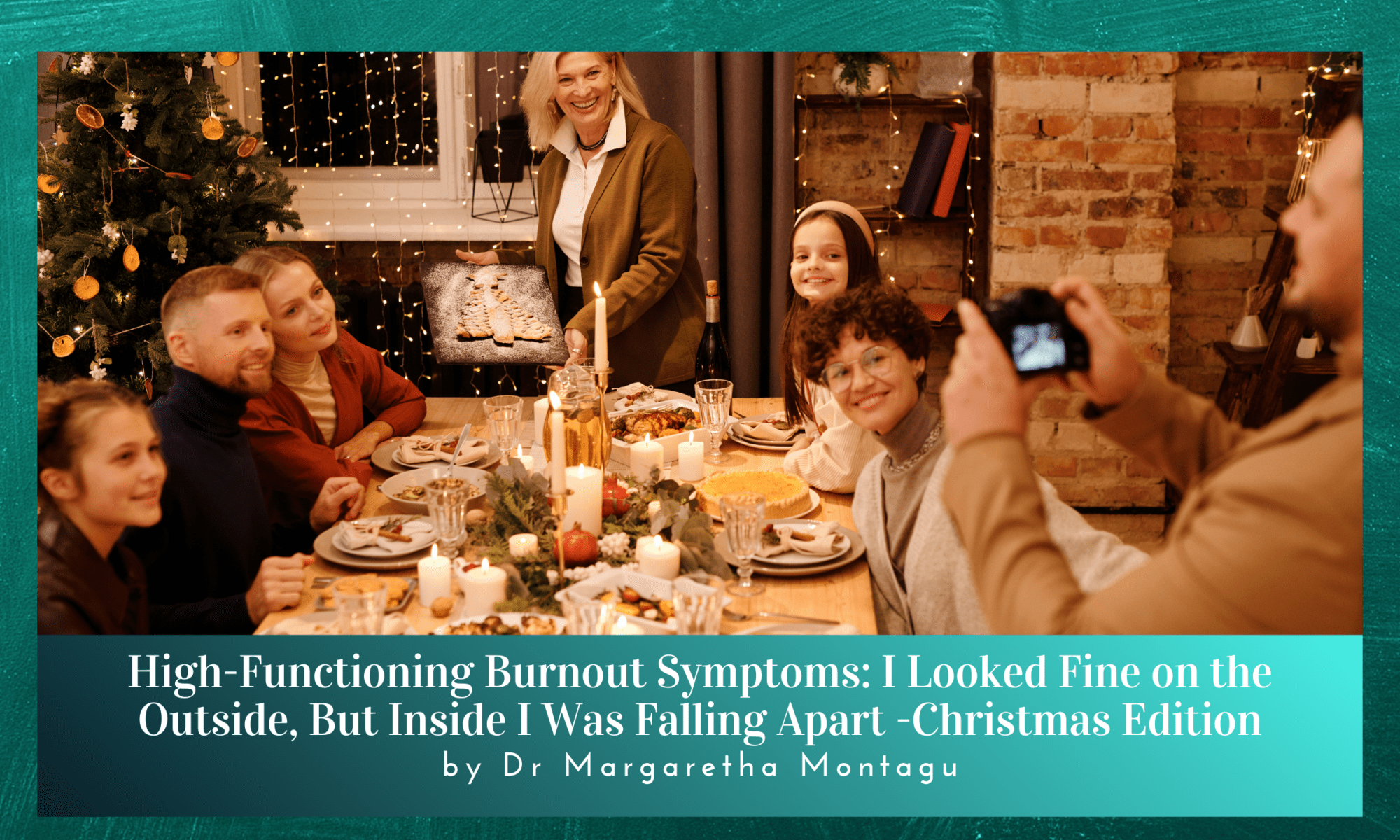
High-Functioning Burnout Symptoms Are Easy to Miss when you’re still “holding it together”: A doctor’s guide to rebuilding after burning bright for too long.
Additional feature: High-Functioning Burnout Symptoms at Christmas: Why this season reveals the cracks in your carefully constructed coping mechanisms
What this is: A clear-eyed look at the specific type of burnout that doesn’t announce itself with obvious breakdowns, the kind that lets you keep performing whilst quietly eroding your foundations. This is about recognising the whisper before it becomes a scream.
What this isn’t: A productivity hack disguised as self-care, a “push through it” pep talk, or another article telling you to take bubble baths and practice gratitude. This isn’t about doing more; it’s about understanding why you’ve been doing too much in the first place.
Read this if: You’re over 40/50/60, you’ve navigated a major life transition (divorce, loss, illness, career shift), and you’re intellectually ready for your next chapter but emotionally running on fumes. Read this if people tell you how “well you’re handling everything” whilst you secretly fantasise about disappearing to a remote island.
5 Key Takeaways
- High-functioning burnout is a slow-burning fuse, not an immediate explosion – You can appear successful, organised, and “fine” whilst your nervous system quietly accumulates debt that will eventually demand payment.
- Christmas doesn’t cause your burnout; it reveals it – The holiday season acts as a magnifying glass on already-strained capacity, exposing the gap between how you appear and how you actually feel.
- Your greatest strength became your greatest liability – The very resilience and capability that got you through your life crisis is now preventing you from recognising you need to rest, reset, and rebuild differently.
- Recovery isn’t about returning to your previous pace – It’s about designing a sustainable next chapter rather than simply resuming the patterns that depleted you in the first place.
- Burnout symptoms include unexpected emotional volatility – Crying at adverts, snapping at loved ones, and feeling inexplicably rage-filled at minor inconveniences aren’t character flaws; they’re your body’s late-stage alarm system finally getting your attention.
Introduction: When “Fine” Becomes a Four-Letter Word
When you are working your way through a major life crisis, the adrenaline that carries you through the acute phase has an expiration date. And when it runs out, you don’t gradually slow down. You hit a wall you didn’t even see coming.
If you’ve recently navigated divorce, bereavement, unexpected illness, redundancy, or any other seismic life shift, you probably became exceptionally good at functioning under pressure. You made decisions, handled logistics, showed up for work, kept your household running, and reassured worried friends that you were “absolutely fine.”
And you were. Until you weren’t.
This is for you if you’re intellectually ready to start your next chapter but emotionally feel like you’re treading water in wet concrete. You’ve done the hard work of getting through the crisis itself, but now you’re discovering that “getting through it” and “actually recovering from it” are two entirely different projects.
What you’re experiencing isn’t laziness, weakness, or a character defect. It’s high-functioning burnout, the achiever’s affliction. You’re still showing up, still delivering, still appearing remarkably capable to the outside world. But inside? You’re running on vapours, duct tape, and the muscle memory of competence.
The good news: recognising this is half the battle. The better news: recovery isn’t about returning to your old pace. It’s about designing something entirely more sustainable for the life you’re actually building now.
In this article, I’ll share what I’ve learned in 20 years as a doctor with a special interest in stress management, 15 years hosting transformational retreats where guests walk the Camino de Santiago, and through writing eight books about navigating life’s most challenging transitions. More importantly, I’ll help you understand whether high-functioning burnout is what’s standing between you and the next chapter you’re ready to claim.
The Story of Elena Hartfield: When Excellence Morphed into Exhaustion
Elena Hartfield woke at 5:47 a.m., thirteen minutes before her alarm, her heart already racing with the day’s to-do list scrolling behind her closed eyelids like ticker tape. The dawn light filtering through her bedroom curtains felt accusatory somehow, as though even the sun was disappointed she hadn’t managed to wake feeling refreshed.
She’d been divorced for eighteen months now. Eighteen months of proving to everyone, including herself, that she was absolutely fine. Better than fine, actually. Thriving.
The evidence was compelling: she’d been promoted at work, had taken up wild swimming, maintained her book club attendance, never missed her daughter’s rugby matches, and had recently started dating again. On paper, Elena was a case study in resilience. Her friends marvelled at how well she was handling everything.
So why, she wondered whilst forcing herself upright, did her bones feel like they were made of jelly?
The morning unfolded with its usual precision. Shower, efficient. Coffee, strong. Emails, answered. She chose her clothes carefully, a navy shift dress that conveyed competence, paired with the silver earrings her mother had given her. Armour disguised as accessories.
By 9:15 a.m., she was in her third meeting, nodding attentively whilst her colleague Marcus droned on about quarterly projections. The fluorescent lights hummed their eternal tuneless song. Someone had brought pastries; the smell of almond croissants made her stomach turn. When had she last been actually hungry? She couldn’t remember. She ate because her body required fuel, approaching meals with the same grim efficiency she applied to everything else.
“Elena? Your thoughts?”
She blinked. Seven faces turned toward her expectantly. She had no idea what the question was, but eighteen months of high-functioning survival had taught her the art of strategic vagueness.
“I think we need more data before committing to that approach,” she said smoothly. Heads nodded. Meeting continued. Crisis averted.
But her hands were trembling slightly as she reached for her water glass. She pressed them flat against her thighs, willing steadiness.
Lunchtime arrived, and Elena ate a sad desk salad whilst reviewing the presentation she’d give that afternoon. The lettuce tasted like wet paper. Everything lately tasted like wet paper. Or like nothing at all. Her taste buds had apparently joined the general rebellion her body was staging against her iron will.
The afternoon presentation went brilliantly. She knew this because people told her so. Elena herself felt like she was watching someone who looked remarkably like her deliver confident insights about market positioning. Dissociation, her therapist had called it. Elena preferred to think of it as efficiency. Why waste energy being fully present when autopilot worked just as well?
By 6:30 p.m., she was home, standing in front of her open refrigerator, staring blankly at its contents. Her daughter was at her father’s this week. The flat was quiet, which should have felt peaceful but instead felt like the walls were pressing in.
She should eat something. She should call her mother back. She should respond to that text from James, the nice man she’d had three dates with. She should do laundry, review tomorrow’s agenda, sort through that pile of mail accumulating on the counter.
Instead, Elena sat down on her kitchen floor, still wearing her coat and heels, and felt the first genuine emotion she’d experienced all day: a bone-deep exhaustion so profound it felt archaeological.
The tears came then, sudden and shocking. Not delicate, photogenic tears but ugly, gulping sobs that shook her entire frame. She cried for twenty minutes, possibly longer. Time felt elastic down here on the cold tile floor.
When the storm passed, she noticed three things: her chest hurt, her face was swollen, and she felt oddly lighter. As though crying had released some pressure valve she hadn’t known was jammed shut.
Elena pulled out her phone with shaking hands and googled “why am I so tired when I’m doing everything right.”
The top result read: “High-Functioning Burnout: When Success Becomes Survival.”
She read the article twice. Then three times. Each symptom felt like someone had been taking notes on her life: emotional numbness punctuated by sudden volatility, physical exhaustion despite adequate sleep, loss of joy in previously pleasurable activities, persistent anxiety coupled with achievement, feeling like an imposter in your own successfully functioning life.
The article explained that high-functioning burnout was particularly insidious because you didn’t collapse. You kept going. You kept delivering. But you were doing it all on borrowed reserves, and eventually, those reserves ran dry.
Elena sat on her kitchen floor until her legs went numb, reading about something she’d been living without having words for it. The relief of recognition was so intense it felt physical.
She wasn’t failing. She wasn’t weak. She wasn’t broken.
She was burned out. And she was finally ready to admit it.
The next morning, Elena sent her manager an email requesting to take two weeks of accumulated leave. She cancelled her social commitments for the following month. She booked an appointment with her doctor. And she stopped telling people she was fine.
The real recovery, she was learning, could only begin once you stopped performing it.
Understanding High-Functioning Burnout: The Achiever’s Invisible Crisis
High-functioning burnout is about succeeding whilst simultaneously disintegrating. It’s burnout in a tailored suit, burnout with a tidy inbox, burnout that shows up on time and delivers quality work whilst slowly eroding your capacity for joy, connection, and authentic presence.
In my two decades as a doctor, I’ve watched countless capable people, particularly those navigating major life transitions, mistake high-functioning burnout for simply “being busy” or “getting older.” They don’t recognise it because they’re still performing at a high level, still meeting their obligations, still appearing remarkably capable to everyone around them.
High-functioning burnout isn’t about what you’re still managing to do. It’s about what it’s costing you to do it.
The classic burnout narrative involves dramatic collapse, inability to get out of bed, and obvious decline in work performance. High-functioning burnout is far more insidious. You’re getting out of bed. You’re going to work. You’re handling your responsibilities. You’re just doing it all whilst running on fumes, feeling increasingly disconnected from your own life, and wondering why everything that used to bring you satisfaction now feels like you’re checking boxes on someone else’s list.
This type of burnout is particularly common after major life transitions because you’ve spent months, possibly years, in survival mode. You developed extraordinary coping mechanisms to get through your divorce, bereavement, illness, or career upheaval. Those mechanisms worked beautifully for the acute crisis. The problem is, you never downshifted. You’re still operating at crisis-management speed even though the crisis itself has passed.
Your body and mind are trying desperately to tell you something important: it’s time to stop just coping and actually recover. But if you’re a high-functioning person who prides themselves on resilience, that message feels like failure. So you override it. You push through. You tell yourself you’re fine.
Until one day, you’re sitting on your kitchen floor in your work clothes, ugly-crying for no apparent reason, and you finally understand: you’ve been fine for so long that you’ve forgotten what actually feeling good feels like.
This matters profoundly as you contemplate your next chapter. You can’t build something sustainable on a foundation of depletion. Whatever you create from this exhausted state will simply replicate the patterns that burned you out in the first place. Recovery isn’t a luxury or an indulgence; it’s the prerequisite for the life you’re trying to design.
The impact extends far beyond your personal wellbeing. When you’re running on empty, your relationships suffer. Your creativity diminishes. Your decision-making capacity narrows. Your ability to be present for the people and projects you care about erodes. You’re not showing up as your best self, you’re showing up as your most defended, depleted, dissociated self.
Recognising high-functioning burnout and choosing to address it rather than push through it can become a pivotal moment, not just for you but for everyone who orbits your life. When you model genuine recovery rather than performative resilience, you give others permission to do the same. When you acknowledge that strength includes knowing when to rest, you challenge the toxic productivity culture that convinced you burnout was simply the price of success.
Your burnout recovery can ripple outward, changing not only how you approach your next chapter but how your children, friends, colleagues, and community understand the relationship between achievement and wellbeing. This is how individual healing becomes collective transformation.
How Do I Know If I Have High-Functioning Burnout?
What Are the Key Symptoms I Should Look For?
High-functioning burnout symptoms are notoriously difficult to self-diagnose because they masquerade as personality traits or minor inconveniences rather than presenting as a coherent syndrome. Here’s what to watch for:
Physical symptoms that persist despite adequate sleep:
- Waking exhausted regardless of hours slept
- Frequent headaches or muscle tension
- Digestive issues that appeared seemingly from nowhere
- Susceptibility to every passing cold or virus
- Physical heaviness, as though moving through molasses
Emotional symptoms that feel out of character:
- Emotional numbing, feeling like you’re watching your life from outside
- Sudden tearfulness or rage at minor inconveniences
- Loss of enthusiasm for activities that previously brought joy
- Persistent low-level anxiety that colours everything
- Feeling like an imposter in your successfully functioning life
Cognitive symptoms that affect performance:
- Difficulty concentrating, even on important tasks
- Decision fatigue around trivial choices
- Memory lapses that weren’t previously an issue
- Reduced creativity or problem-solving capacity
- Reliance on external structures because internal motivation has vanished
Behavioural symptoms that signal withdrawal:
- Cancelling social plans at the last minute
- Numbing behaviours (excessive scrolling, drinking, shopping)
- Irritability with loved ones
- Perfectionism is intensifying as a control mechanism
- Inability to rest even during designated downtime
Why Does High-Functioning Burnout Feel Different from “Normal” Burnout?
The key differentiator is that you’re still performing. To outside observers, you appear successful, capable, organised, and on top of things. You’re meeting your deadlines, honouring your commitments, and showing up where you’re supposed to be. The crisis is entirely internal.
This makes high-functioning burnout particularly isolating because you can’t point to external evidence of struggle. Your life looks fine. You look fine. So why do you feel like you’re barely holding it together?
High-functioning burnout is what happens when your conscious performance exceeds your unconscious capacity. You’ve trained yourself so effectively to override your body’s signals that you’ve severed the connection between what you can technically do and what you can sustainably do.
Can I Recover Whilst Still Managing My Responsibilities?
Yes, but recovery requires fundamentally redefining what “managing responsibilities” means. You can’t recover by simply adding self-care tasks to an already overfull schedule. That’s not recovery; that’s performative wellness.
Genuine burnout recovery involves:
- Ruthless prioritisation: Identifying what truly matters versus what you’ve been doing because you always have
- Permission to be “good enough”: Releasing perfectionism as a coping mechanism
- Rebuilding rest capacity: Relearning how to actually rest rather than just collapsing
- Processing rather than bypassing: Actually feeling your feelings instead of managing them
- Redesigning your next chapter intentionally: Rather than defaulting to previous patterns
This isn’t about returning to your pre-burnout pace. It’s about acknowledging that pace was unsustainable and designing something entirely different.
Christmas and High-Functioning Burnout: When the Holidays Expose the Cracks
Why Does Christmas Push High-Functioning Burnout Over the Edge?
Christmas doesn’t cause your burnout; it reveals it. The holiday season acts as a stress test on systems that are already strained, exposing the gap between the capable person you’re presenting to the world and the depleted person you actually are.
Here’s why Christmas is particularly brutal for high-functioning burnout sufferers:
Expectation inflation: The cultural narrative around Christmas intensifies all existing pressures. You’re not just managing your regular responsibilities; you’re also expected to create magic, foster connection, purchase thoughtful gifts, attend social events, and radiate festive cheer. For someone already running on empty, this is gasoline on embers.
No permission to opt out: Unlike other social obligations, Christmas comes with moral weight. Declining participation feels like you’re being Scrooge, disappointing children, or failing at basic human connection. So you override your limitations and show up, even when showing up depletes your last reserves.
Forced proximity: The holidays often involve extended time with family, which can be wonderful but also requires enormous emotional energy, particularly if you’re navigating complex family dynamics, managing others’ expectations, or fielding questions about your life transitions.
Performance pressure: Christmas cards, social media posts, family gatherings, all invite comparison. High-functioning people already struggle with imposter syndrome; Christmas creates additional stages on which to perform being “fine” whilst privately falling apart.
Rest that isn’t restful: The holidays are theoretically time off, but for people managing households, organising gatherings, or coordinating family logistics, they’re often more exhausting than regular work weeks. You’re busy in different ways but not actually resting.
What Does Christmas Burnout Actually Look Like?
In my practice, I’ve seen Christmas-induced burnout crashes present in remarkably consistent patterns:
- Crying in the car park at the supermarket because they’re out of cranberry sauce
- Snapping at loved ones with a viciousness that shocks you
- Feeling inexplicable rage at festive music or decorations
- Fantasising about Christmas being cancelled entirely
- Physical illness that conveniently provides permission to withdraw
- Drinking more than usual to numb the overwhelm
- Going through all the Christmas motions whilst feeling completely disconnected
If you’re experiencing any of these, you’re not a terrible person who hates Christmas. You’re a burned-out person whose capacity has been exceeded, and Christmas simply made that undeniable.
How Can I Protect Myself During the Holiday Season?
Radical simplification: Choose three things that actually matter to you about Christmas and release everything else. Not reduce, release. Give yourself permission for “good enough” to be genuinely good enough.
Proactive boundary-setting: Decide in advance what you will and won’t do, then communicate those boundaries clearly before others have set expectations. “We’re doing a quiet Christmas this year” is a complete sentence.
Schedule actual rest: Block time in your calendar for genuine rest, and protect it as fiercely as you’d protect an important meeting. Rest is not the reward for completing everything; it’s the foundation that makes everything else possible.
Lower the performance bar: The goal isn’t Instagram-worthy magic. The goal is surviving this season without completely depleting yourself. If you achieve that, you’ve succeeded.
Seek support: If you’re navigating your first Christmas after divorce, bereavement, or other major loss, acknowledge that this season will be particularly challenging. Reach out for support rather than white-knuckling your way through alone.
Remember: protecting your wellbeing during Christmas isn’t selfish. It’s the prerequisite for actually being present for the connections that matter.
Five Critical Mistakes to Avoid During Burnout Recovery
Mistake #1: Treating Recovery Like Another Project to Excel At
High-functioning people approach burnout recovery the same way they approach everything else: with goals, metrics, and determination to do it perfectly. This is like trying to put out a fire with more fire.
Recovery isn’t about optimisation. It’s about permission. Permission to be messy, incomplete, uncertain, and ordinary. Your burnout was caused, in part, by your relentless drive to excel. Applying that same drive to recovery simply replicates the pattern that depleted you.
Instead: Approach recovery with curiosity rather than goals. Notice what helps without needing to systematise it immediately.
Mistake #2: Waiting Until You’ve “Earned” Rest
Many high-functioning people operate under the belief that rest must be earned through sufficient productivity. But when you’re burned out, you’ll never feel productive enough to have earned rest. The bar keeps moving because the problem isn’t productivity; it’s permission.
You don’t earn rest by completing tasks. Rest is a biological necessity, not a reward for good behaviour. Your body needs it whether or not you’ve checked everything off your list.
Instead: Schedule rest first, then build your commitments around it. Treat rest as non-negotiable infrastructure, not optional luxury.
Mistake #3: Isolating Because You’re “Too Much” for Others
Burnout often comes with shame. You’re ashamed you’re struggling when your life “isn’t that bad.” You’re ashamed you can’t handle what you used to handle effortlessly. So you withdraw, convinced you’re burdening others with your mess.
But isolation intensifies burnout. Connection is healing, even when, especially when, you feel like you have nothing to offer. The people who truly care about you want to support you. Letting them do so isn’t weakness; it’s trust.
Instead: Reach out to safe people and tell the truth. “I’m really struggling right now” is often met with relief and reciprocal honesty.
Mistake #4: Expecting Linear Progress
Recovery isn’t a straight line from burned out to recovered. It’s two steps forward, three steps sideways, one step back, then inexplicably better for a week before crashing again. This isn’t failure; it’s the nature of nervous system healing.
If you expect linear progress, every setback feels like evidence you’re not really recovering. This creates additional stress that compounds the original burnout.
Instead: Track overall trajectory rather than daily fluctuations. Are you slightly more resilient than you were three months ago? That’s progress, even if today is difficult.
Mistake #5: Returning to Exactly the Same Life That Burned You Out
The most seductive mistake is thinking recovery means getting back to “normal.” But if normal burned you out, why would you want to return to it? Your burnout is valuable information about the unsustainability of your previous patterns.
Recovery isn’t about restoration; it’s about redesign. The question isn’t “How do I get back to how things were?” It’s “What needs to change so I can sustain the next chapter I’m trying to create?”
Instead: Use this pause to examine which commitments, relationships, and patterns are life-giving versus life-draining. Design your recovery toward a different life, not your previous one.
Intention-Setting Exercise: Reclaiming Your Energy
Find a quiet space where you won’t be interrupted for ten minutes. You’ll need paper and something to write with.
Step One: Acknowledge What Is Write this sentence and complete it honestly: “Right now, my energy feels…” Don’t edit. Don’t make it sound better than it is. Just tell the truth.
Step Two: Identify Energy Drains List five things currently depleting your energy. Be specific. Not “work” but “attending meetings that don’t require my input.” Not “family” but “feeling responsible for managing everyone’s emotions during gatherings.”
Step Three: Claim One Boundary From your list, choose one energy drain you could reduce or eliminate in the next fortnight. Not five things. One. Write: “To protect my recovery, I will…” Complete this with one specific, actionable boundary.
Step Four: Design One Energy Source What genuinely restores you? Not what you think should restore you, what actually does. Even small things count. Write: “To rebuild my reserves, I will make time for…”
Step Five: Set Your Intention Complete this sentence: “I’m recovering from burnout because I want to…” This isn’t about returning to productivity. What do you actually want? Presence? Peace? Connection? Joy? Name it.
Place this somewhere you’ll see it daily. Your recovery has a purpose beyond simply “not being burned out anymore.” Keep that purpose visible.
From Surviving to Storytelling
“When I joined Dr. Montagu’s Rooted in Resilience online course, I was six months post-divorce and convinced I was managing beautifully. Everyone said how strong I was. Inside, I felt like I was performing strength whilst quietly dissolving. The storytelling circles were revelatory. For the first time in years, I wasn’t trying to have the right answer or appear capable. I was simply sharing my truth and hearing others share theirs. The other women in the circle held space for my mess without trying to fix it. Between the course modules and our weekly storytelling sessions, I finally understood that my burnout wasn’t failure, it was my body insisting I design a different life. Those circles gave me permission to stop performing recovery and actually experience it.” — Sue M., Virtual Storytelling Circle Participant
Further Reading: Books That Understand Burnout
1. Burnout: The Secret to Unlocking the Stress Cycle by Emily Nagoski and Amelia Nagoski I recommend this book because it brilliantly distinguishes between the stressor and the stress itself, explaining why you can remove the cause of stress but still carry the stress in your body. The Nagoskis provide practical, science-based strategies for completing the stress cycle, which is essential for high-functioning burnout recovery.
2. Rest Is Resistance: A Manifesto by Tricia Hersey This book reframes rest as a radical act rather than a luxury. Hersey’s work is particularly powerful for high-functioning people who’ve internalized capitalism’s message that our worth is tied to our productivity. Her perspective helps readers understand that choosing rest is political, personal, and revolutionary.
3. The Body Keeps the Score by Bessel van der Kolk Van der Kolk’s work illuminates how trauma and chronic stress live in our bodies, not just our minds. For people experiencing high-functioning burnout after major life transitions, this book explains why you can intellectually process your experiences but still feel physically depleted. Understanding the neuroscience is often the first step toward compassionate recovery.
4. Atlas of the Heart by Brené Brown Brown’s exploration of 87 different emotions and experiences helps readers develop the emotional vocabulary needed to understand what they’re actually feeling beneath the numbing fog of burnout. High-functioning people often excel at doing but struggle with feeling; this book bridges that gap beautifully.
5. How to Do Nothing: Resisting the Attention Economy by Jenny Odell Odell’s book challenges the very premise that our time must always be productive, optimised, and monetised. For high-functioning burnout sufferers who’ve lost the ability to simply be, this manifesto offers both philosophy and permission for reclaiming attention, time, and presence.
P.S. My book, Embracing Change, in 10 Minutes a Day, offers daily reflections and practices specifically designed for people navigating major life transitions. It’s structured to meet you where you are, even when where you are is exhausted, overwhelmed, and uncertain.
Five FAQs About High-Functioning Burnout
How long does it take to recover from high-functioning burnout?
There’s no universal timeline because recovery depends on how long you’ve been operating in deficit and how willing you are to fundamentally redesign your patterns rather than simply rest briefly before resuming. That said, most people notice initial improvements within 6-8 weeks of implementing real changes, with substantial recovery taking 6-12 months. The key is accepting that recovery is a process, not an event.
Can I experience burnout even if I’m not working full-time?
Absolutely. Burnout isn’t just about employment; it’s about chronic depletion exceeding your capacity to recover. Caregiving, managing a household, navigating a major life transition, processing grief, or any sustained high-stress situation can cause burnout regardless of employment status. High-functioning burnout particularly affects people who are managing multiple significant demands simultaneously.
Is high-functioning burnout the same as depression?
They can overlap and co-occur, but they’re distinct. Depression typically involves a pervasive low mood, loss of interest in nearly everything, and often includes feelings of worthlessness. High-functioning burnout is characterised by emotional exhaustion specifically related to prolonged stress, and people often retain the ability to function at high levels even whilst depleted. That said, untreated burnout can develop into clinical depression, so it’s worth consulting a healthcare professional if you’re unsure.
What’s the difference between self-care and actual burnout recovery?
Self-care often involves adding restorative practices (bubble baths, meditation, exercise) to an already overfull life. It’s necessary but insufficient for burnout recovery. Actual recovery requires examining and restructuring the systems that caused burnout: your workload, your boundaries, your relationship with productivity, and your capacity to disappoint others. Recovery is about saying no, releasing responsibilities, and redesigning your life, not just treating the symptoms with occasional yoga.
How do I know if I need professional help for burnout?
Seek professional support if you’re experiencing any of the following: persistent suicidal thoughts, inability to function in basic daily activities, physical symptoms that aren’t improving, substance use to cope, relationships deteriorating significantly, or you’ve tried implementing changes for several months without improvement. A doctor, therapist, or coach who specialises in life transitions can provide crucial support. You don’t have to recover alone.
Conclusion: The Gift Hidden in Your Burnout
Your burnout is telling you something important: the life you’ve been living is no longer viable. Not because you’ve failed, but because you’ve outgrown it.
The person who entered your major life transition is not the person who emerged from it. You’ve been changed by what you’ve survived. Yet you’ve been trying to slot your transformed self back into your previous life’s structures. No wonder you’re exhausted. You’re forcing a changed person into an unchanged container.
Your burnout is the friction of that mismatch. It’s your body’s wisdom insisting that what got you here won’t get you where you’re going.
As writer Mary Oliver asks, “Tell me, what is it you plan to do with your one wild and precious life?”
Not the life you had before. Not the life others expect. This life. The one you’re building now. The one your burnout is demanding you design differently.
Your next chapter is ready. But you can’t access it whilst running on empty.
Before you move forward, pause here for clarity. My Turning Point Quiz helps you assess your readiness for change and identify exactly where you are in your transition journey. Understanding your current position is the first step toward designing what comes next.
A Different Kind of Reset: Walk Toward Your Next Chapter
Sometimes recovery requires removing yourself from the machinery of your daily life entirely. Not to escape, but to create space for something new to emerge.
My 7-day Camino de Santiago Crossroads hiking retreats in the southwest of France offer exactly this: intentional space for people navigating life transitions. These aren’t fitness holidays or tourist experiences. They’re carefully designed containers for transformation.









You’ll walk ancient pilgrimage paths, surrounded by the timeless landscape of the Pyrenees foothills. The rhythm of walking creates what conversation cannot: permission for your nervous system to finally downshift. The physical movement completes stress cycles that have been stuck in your body for months, possibly years.
Each evening, we gather in intimate storytelling circles with my Friesian horses. There’s something profoundly healing about being witnessed by both humans and horses, creatures who respond only to authentic presence, not performed capability. In these circles, you’ll share your truth without needing to package it neatly or make it palatable.
The groups are small, maximum four people, ensuring genuine connection rather than performative sharing. You’ll be with others who understand the particular loneliness of high-functioning burnout: looking fine whilst falling apart, ready for the next chapter but too depleted to imagine it clearly.
This retreat isn’t about pushing yourself to complete another challenging thing. It’s about permission. Permission to rest deeply. Permission to speak honestly. Permission to imagine a next chapter designed around sustainability rather than just survival.
If your burnout has been asking you to stop, to listen, to redesign rather than just recover, this retreat might be your answer.
Find out the dates and details
What would become possible in your life if you gave yourself the same compassion you readily extend to others?
Stress destroys Lives. To find out what you can do to safeguard your sanity by taking my insight-giving quiz, subscribe to my mailing list.

If your soul is craving fresh air, meaningful movement, and a chance to reconnect with nature, join us on a Camino de Santiago Walking Retreat in the southwest of France. This isn’t just a scenic hike – it’s a powerful, natural reboot for your body, mind, and spirit. Imagine quiet paths, rolling hills, cozy evenings, and slow conversations. No fitness requirements. No forced bonding. No pressure to have a breakthrough. Just one foot in front of the other, and finding your way to a brighter future.

“I am an experienced medical doctor – MBChB, MRCGP, NLP master pract cert, Transformational Life Coach (dip.) Life Story Coach (cert.) Stress Counselling (cert.) Med Hypnotherapy (dip.) and EAGALA (cert.) I may have an impressive number of letters after my name, and more than three decades of professional experience, but what qualifies me to excel at what I do is my intuitive understanding of my clients’ difficulties and my extensive personal experience of managing major life changes using strategies I developed over many years.” Dr M Montagu