
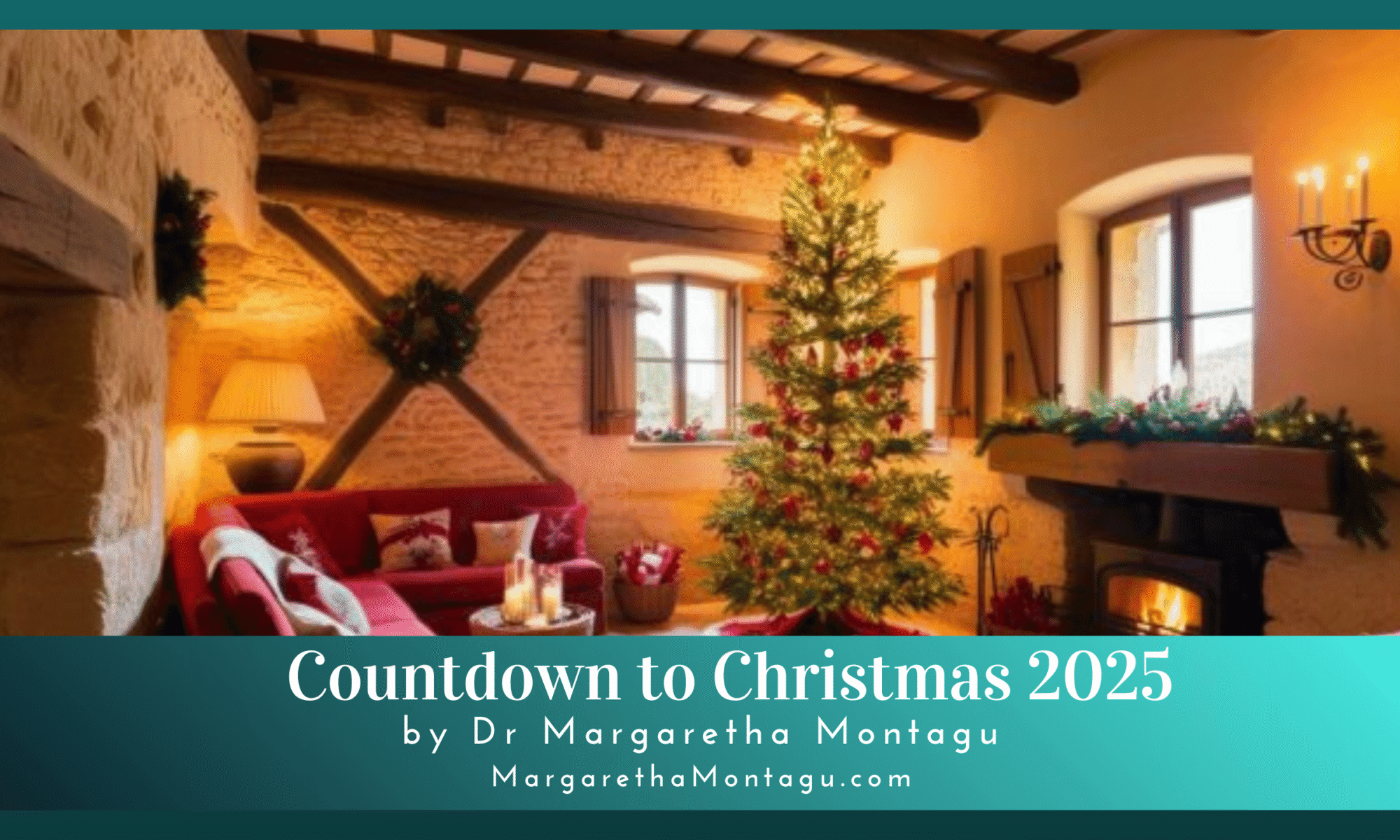
December 3, 2025 – 22 Days to Christmas
Today’s Story: Elsie’s “Mistake.”
Château de la Garde had rough-hewn limestone walls that rose from the damp earth like a sleeping giant. Elsie pulled her wool scarf higher, the fabric scratching her chin. Her instincts, which usually guided her safely to the nearest quiet corner with a book and a cup of tea, had screamed No, stay at home! ‘Christmas Carols at the Chateau’ is not your thing! But her neighbour, Madame Dubois, insisted with such determined, festive goodwill that Elsie had capitulated.
She followed a small stream of people—mostly couples in expensive, sensible outerwear—across the courtyard. The air smelled of cold stone, damp leaves, and woodsmoke. Above the heavy oak door hung a single, enormous wreath decorated with pinecones the size of her fist.
The Great Hall was a cavern of soaring ceilings and shadows. Gilded frames held portraits of long-dead dukes who looked perpetually annoyed, now flanked by towering, twinkling fir trees. The cold air of the entrance gave way to a dense warmth, thick with the scent of beeswax candles and the cloying sweetness of vin chaud.
Elsie found a seat near the back, against a wall that felt genuinely medieval, radiating a bone-deep chill that no amount of central heating could disperse. She was safe here, a lone island in a sea of rustling velvet and murmured French. She pulled out her phone, intending to check the weather, but the signal had clearly been sacrificed to preserve the chateau’s authentic atmosphere.
The choir filed in, a group of twenty-odd people in deep blue robes, their faces serious. The conductor, a man with a wild shock of white hair and a bow tie that seemed to vibrate with enthusiasm, raised his hands.
The first note of the carol—a low, powerful bass—hit the stone walls and rebounded, vibrating through the floor and up into Elsie’s chest. It wasn’t just music; it was a physical experience, a heavy blanket woven from sound.
It was during the third verse of a particularly complex French carol that Elsie felt a sharp, unexpected jab in her ribs.
“I’m ever so sorry,” a voice whispered, heavily accented, right next to her ear. “I think my elbow just committed a felony against your person.”
Elsie turned her head slowly. The woman next to her was small, with a riot of dark, curly hair that seemed to defy gravity and a pair of glasses perched precariously on her nose. She was holding a plastic cup of mulled wine with the intensity of someone guarding a national treasure.
“It’s fine,” Elsie whispered back, rubbing her side. “I think the chateau’s acoustics must have amplified the impact.”
The woman grinned, a quick, bright flash. “Ah, yes. The medieval echo chamber. Designed to make you feel spiritually uplifted. I’m Clara.”
“Elsie.”
“I’m here under duress,” Clara confided, leaning in slightly. “My husband is in the tenor section. He sings with the passion of a man who believes he is personally responsible for the salvation of the entire audience. It’s exhausting to watch.”
Elsie let out a small, involuntary puff of laughter. “Mine was a neighbour. Madame Dubois. She operates on a level of festive coercion I’ve never before encountered.”
“Ah, French women of a certain age. Forces of nature.” Clara took a careful sip of her wine. “Do you think this vin chaud is actually just port with a cinnamon stick? Because it’s suspiciously strong.”
“I suspect it’s a secret regional recipe,” Elsie replied, feeling a lightness she hadn’t anticipated. She hadn’t spoken more than three sentences to a stranger in a week, and here she was, dissecting the alcohol content of the local Christmas tipple.
The choir launched into a rousing, slightly off-key rendition of “Deck the Halls.”
“Fa la la la la,” Clara mouthed, rolling her eyes with theatrical flair. “I love the carols, I really do, but I swear my other half just went rogue on the ‘la’s.”
“He’s expressing his artistic freedom,” Elsie murmured, watching the husband in question, whose face was indeed a mask of intense, slightly pained devotion.
During the brief intermission, the crowd surged towards the refreshments table. Elsie and Clara, having established a comfortable proximity, moved together.
“So, you’re not from around here,” Clara stated, not as a question, but as a shared observation.
“Is it the way I flinch when someone speaks French too quickly?” Elsie asked, accepting a tiny, star-shaped mince pie.
“No, it’s the coat,” Clara said, tapping Elsie’s sleeve. “It’s too practical. Too sensible. Everyone here wears something that looks like it was woven from a rare alpaca and a thousand euros. In rebellion, I’m wearing a coat I bought in a panic at a motorway service station.”
They fell into an easy, meandering conversation that drifted far from the chateau and the carols. Clara was a graphic designer who had followed her historian husband to this corner of the world and was now trying to launch a business selling online journals to people who still used paper diaries. Elsie confessed her current state of professional drift—a quiet, post-burnout sabbatical she hadn’t yet told anyone about.
The conductor, now back on the stage, clapped his hands sharply, signaling the end of the intermission.
“We should probably go back,” Elsie said, feeling a pang of genuine disappointment.
“Wait,” Clara whispered. She reached into her small, impractical handbag and pulled out a slightly crumpled business card.
Elsie took the card as they returned to their seats. The choir began a slow, soaring piece, the voices weaving together like threads of silver and gold. This time, Elsie didn’t lean against the cold wall. She sat upright, her attention split between the music and the small, warm presence beside her.
The music was beautiful, undeniably so, but it was the quiet, shared moment after the final note—the collective sigh of the audience, the scrape of chairs, the sudden rush of cold air as the doors opened—that felt most significant.
Outside, the frost had thickened, turning the courtyard into a sheet of silver. Clara’s husband appeared, scarf wound haphazardly around his neck, still flushed with post-performance adrenaline.
“Ah, ma chérie, you survived!” he said, kissing Clara on both cheeks. “Did you hear the exquisite harmonies in the second piece, Noel Nouvelet? Magnifique, non?”
“Magnificent,” Clara agreed, with such sincere affection that Elsie felt a small pang of something she couldn’t quite name. Clara turned to introduce them, but her husband was already being pulled away by another choir member, deep into a passionate debate about the tempo of “Minuit Chétiens.”
“He’ll be another twenty minutes at least,” Clara said, pulling her ridiculous, fluffy hat down over her ears. “I’m going to need a proper coffee after this. A coffee that tastes like actual coffee, not a medieval spice rack.”
“I know a place,” Elsie heard herself say. “It’s tiny, but the coffee is excellent.”
Clara stopped, turning to face her. The chateau lights cast long shadows across the courtyard, but her expression was clear. “When?”
The directness of it caught Elsie off guard. Not maybe or we should, but when.
“Tomorrow?” The word came out tentative, as if testing whether it was real.
“Tomorrow,” Clara confirmed. “Text me the address. I’ll be the one who looks desperately grateful to be somewhere that isn’t a medieval monument to seasonal obligation.”
They stood there for a moment longer, breath clouding in the frozen air, as the last of the crowd dispersed around them. The chateau loomed behind them, its windows golden, the wreath above the door catching the light. Somewhere, a door closed with a heavy, final thud.
“I should let you find your husband,” Elsie said.
“He’ll find me eventually. He always does.” Clara smiled, then reached out and squeezed Elsie’s arm. “Thank you for making this bearable. Better than bearable, actually.”
Elsie walked to her car alone, her footsteps crunching on the gravel. She unlocked the door and sat for a moment in the cold interior, looking at the business card in her hand.
As she pulled out of the car park, she caught sight of Clara (aka Penny) in her rearview mirror, standing in a pool of light, waving with both hands above her head like someone signalling a rescue plane.
Elsie lifted one hand from the steering wheel and waved back.
The road home was dark and winding, but she knew the way. And tomorrow, she would know the way to somewhere else entirely—a small café, a proper cup of coffee, and a conversation that doesn’t have to end when the carols did.
Maybe Madame Dubois had been right after all.
The Make Friends and Maintain Friendships Masterplan
The invitations you’re most tempted to decline are often the ones you need most. Not because every event will be amazing (some will be terrible), but because isolating during life transitions feels safe until it becomes suffocating.
You don’t have to say yes to everything. You don’t have to become a social butterfly. You just have to say yes to one thing you’d normally decline.
Maybe it’ll be awkward. Maybe you’ll leave early. Maybe you’ll spend the whole time thinking about your couch.
Or maybe—just maybe—you’ll meet your person. The one who also wanted to leave early. The one who also felt awkward. The one who becomes your Tuesday dinner friend, your emergency contact, your “I need to complain about life” text thread.
You won’t know until you say yes.
| Today, say yes to one Christmas invitation you’d normally decline. The community Christmas carols sing-along, even though you don’t know the words past the first verse. The tree lighting ceremony in the town square when it’s definitely going to rain. That annual Christmas concert your overly enthusiastic neighbour won’t stop mentioning. What you’re risking: Frozen fingers and frozen toes. Making small talk with strangers about fruitcake. Pretending to enjoy mulled wine that tastes like liquid potpourri. One slightly embarrassing evening you would have forgotten all about by January. What you might gain: A moment when someone’s elbow digs into your ribs, and they apologise with the kind of quirky humour that makes you forget you actually want to be anywhere else. A conversation that starts with “I’m only here under duress” and ends with a business card in your pocket. The discovery that the person sitting next to you also thinks this is ridiculous, and suddenly, ridiculous not only becomes bearable, but the highlight of your season. |
Would you like to find out what type of friend YOU are? How well do you know your friends? If you and a new friend are really compatible? I have created a set of light-hearted quizzes, quotes and questions to help you do just that. Just fill in the form below and you’ll get immediate access to them all. I’ll also add you to my newsletter list, though you can unsubscribe from this list effortlessly and at any time.
Included:
– How well do you know your Friends? Quiz
– What is your Friendship Style? and Are your Friendship Styles compatible? Quiz
– 20 of the Most Inspiring Friends and Friendship Quotes and
– 20 lighthearted Questions you can ask to get to know a new Friend
Last Year’s Christmas Countdown Calendar post

Author Bio: Dr Margaretha Montagu – described as a “game changer”, “gifted healer”, “guiding light” and “life-enriching author” – is an experienced medical doctor, a certified NLP practitioner, a medical hypnotherapist, an equine-assisted psychotherapist (EAGALAcertified) and a transformational retreat leader who guides her clients through life transitions – virtually, or with the assistance of her Friesian and Falabella horses, at their home in the southwest of France.
- Why do I need to know what my Life Purpose is?
 Why bother figuring out your life purpose at all? Because a life without one runs on autopilot. Every decision, from which job to take to how to spend a Tuesday, starts to feel arbitrary, and that’s exhausting in a way that’s hard to pinpoint. You end up making the same choices over and over, not …
Continue reading “Why do I need to know what my Life Purpose is?”
- Walking Retreat vs Walking Holiday: What’s the Difference?
 If you love walking, you may have come across the term walking retreat and wondered how on earth it differs from an organised walking holiday. After all, both involve beautiful countryside, well-worn walking shoes, fresh air and a few days away from everyday life. There may even be a backpack involved, although hopefully not one …
Continue reading “Walking Retreat vs Walking Holiday: What’s the Difference?”
- AI Can Create a Course in Seconds. So Why Are People Still Buying Mine?
 AI has revolutionised online learning in ways we could never have imagined. These days, you can ask AI to create a course on almost anything—from astrophysics to how to keep your houseplants alive—and it will hand you a neatly structured programme in seconds. Want six modules? No problem. Learning objectives, worksheets, quizzes, reflection questions and …
Continue reading “AI Can Create a Course in Seconds. So Why Are People Still Buying Mine?”
- What Years of Farmhouse Hospitality Taught Me About What Actually Matters to Guests
 . For the first year or two of hosting Camino de Santiago walking retreats, I worried about the wrong things. I fretted over the towels. I agonised slightly over whether the guest rooms felt “smart” enough, whether the breakfast presentation looked sufficiently considered, whether I measured up to the polished retreat centres with their infinity …
 - What Horses Can Teach Us About Setting Healthy Boundaries
 I used to think setting healthy boundaries had to be dramatic to count. That you needed a raised voice, or a slammed door, or at the very least a strongly worded text, for a boundary to register. Turns out I only believed this because I’d never before watched Loki work a paddock. Loki is the …
Continue reading “What Horses Can Teach Us About Setting Healthy Boundaries”