
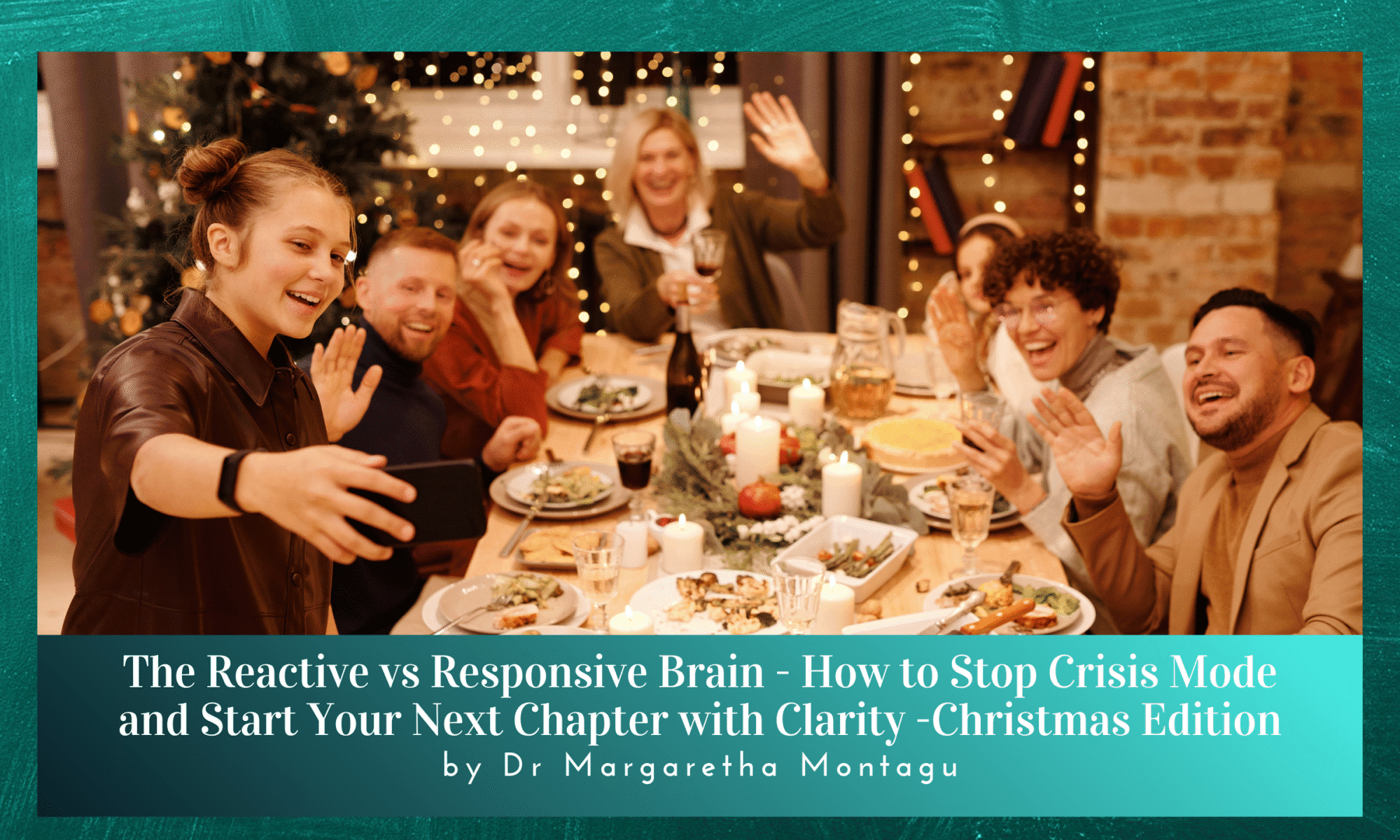
What this is: A practical exploration of how your brain responds to life’s curveballs, and why understanding the difference between reactive and responsive thinking is the single most important skill for anyone ready to write their next chapter (especially when your previous chapter ended in a way you didn’t choose).
What this isn’t: Another “just think positive” pep talk, a neuroscience lecture that requires a medical degree to understand, or a suggestion that you should suppress your very legitimate feelings about whatever storm you’ve just weathered.
Read this if: You’re tired of feeling hijacked by your own emotions, you want to make decisions you’ll still respect six months from now, or you’re simply done with the exhausting cycle of reacting to life instead of responding to it with intention.
5 Key Takeaways
- Your reactive brain kept you alive during the crisis, but it will sabotage your next chapter if you let it stay in charge. The same neural pathways that protected you when everything fell apart will keep you stuck in survival mode long after the danger has passed.
- The gap between stimulus and response is where your power lives. That pause, even if it’s just three seconds, is the difference between a life you’re proud of and a life that happens to you.
- Responsive thinking isn’t about being calm or zen, it’s about being choiceful. You can still feel all the feelings and choose what you do with them.
- Your brain’s default setting after trauma is hypervigilance, not wisdom. Understanding this removes the self-judgement when you find yourself overreacting to small things.
- Christmas (and other emotionally loaded occasions) is your annual training ground for building a responsive brain. Master the holidays, master your life transitions.
Introduction: The Chapter You Didn’t Choose
Here’s something nobody mentions in those “embrace change” Instagram posts: most of us don’t get to choose when our old life ends. Death doesn’t check your calendar. Illness doesn’t wait for a convenient moment. Redundancy letters arrive on Tuesday mornings. Relationships implode spectacularly, often just when you thought you’d finally got things sorted.
And then, after the initial shock wears off and the casseroles from well-meaning neighbours stop arriving, you’re left with this enormous question: Now what?
This article is for you if you’re over 40/50/60, you’ve been through something that fundamentally changed your life’s trajectory, and you’re ready (or at least ready-ish) to start your next chapter. Not because you’ve “moved on” or “got over it” or any of those other phrases people use when they’re uncomfortable with grief, but because staying stuck in the wreckage isn’t serving you anymore.
What you’re feeling, by the way, is completely normal. The confusion, the second-guessing, the 3am anxiety spirals, the days when you feel ridiculously hopeful followed by the days when you can barely get out of bed. Your brain is doing exactly what it’s supposed to do after massive disruption. The problem is, what kept you safe during the crisis will keep you small during your comeback.
Here’s what you’ll gain from the next 2,000 words: you’ll understand why your brilliant, capable brain keeps betraying you at crucial moments, you’ll learn the neurological difference between reacting and responding (and why it matters more than any other skill you’ll develop), and you’ll discover how to catch yourself mid-spiral and choose differently. Not perfectly. Just differently enough to matter.
The Story of Claire Hartwell: When Loss Rewires Everything
Claire Hartwell was 53 when her husband died. Not dramatically, not after a long illness that gave everyone time to prepare, but suddenly, on a Thursday, from a massive heart attack in the cereal aisle at Tesco. One moment he was debating between bran flakes and granola (bran flakes always won; he was that sort of man), and the next moment he was gone.
The first six months were a blur of paperwork and platitudes. Claire moved through the necessary rituals with impressive competence. She organised the funeral, sorted the life insurance, fielded the endless “how are you holding up?” questions with appropriate responses. Her adult children marvelled at how well she was coping.
But Claire wasn’t coping. Claire was reacting. Her brain had shifted into pure survival mode, and every decision, every interaction, every thought was filtered through her amygdala’s primitive binary: threat or safety? The problem with this mode is that it’s exhausting to maintain, and it results in terrible decisions about your future.
Eight months after David died, Claire’s daughter Emma announced her engagement. The wedding would be in June, eighteen months away. Plenty of time. Emma was glowing, talking about venues and flowers and guest lists, and Claire heard herself say, “I don’t think I can come.”
The silence in the room was spectacular.
“Mum,” Emma said carefully, “it’s not for another year and a half.”
“I know. But I can’t. I just can’t.” Claire’s chest was tight, her hands were trembling, and she could feel the tears coming. “How can I go to a wedding without your father? How can I watch you walk down an aisle he’ll never see? I can’t do it. Don’t make me do it.”
Emma left shortly after, confused and hurt. Claire sat in her kitchen, the same kitchen where she and David had shared thirty years of breakfasts, and felt something crack open inside her chest. Not grief this time. Something else. A terrible clarity.
This was the moment Claire realised her brain had been hijacked. For eight months, she’d been operating from her reactive brain, the part that perceives everything through the lens of threat and loss. The wedding wasn’t happening for eighteen months, but her amygdala was treating it like an immediate danger, flooding her system with cortisol and adrenaline as if she were being chased by a predator.
She could smell the coffee going cold in her mug, bitter and metallic. She could hear the clock ticking in the hallway, each second marking another moment David wasn’t there to hear. She could feel the worn wooden edge of the kitchen chair pressing into her thighs, the same chair where David used to sit and do the crossword every Sunday. The house felt too quiet and too loud simultaneously.
Claire picked up her phone and called her sister, Ruth, who’d been gently suggesting therapy for months.
“I need help,” Claire said. “I nearly missed my own daughter’s wedding because my brain is broken.”
“Your brain isn’t broken,” Ruth said. “It’s just stuck. There’s a difference.”
That phone call led Claire to a life transition coach (not immediately; first she tried three therapists who were lovely but wrong, which often happens). The coach introduced her to the concept of reactive versus responsive thinking. The reactive brain, Claire learned, is your body’s emergency broadcast system. It’s brilliant in actual emergencies. It makes you jump out of the way of speeding cars and grab children before they touch hot stoves. It kept Claire functioning during those first impossible weeks after David died.
But the reactive brain has no nuance. It treats Emma’s wedding announcement the same way it treats a smoke alarm. Everything is urgent, everything is dangerous, everything requires an immediate, protective response. It’s why Claire, who was normally thoughtful and measured, found herself saying “I can’t come” before her conscious mind even caught up.
The responsive brain, by contrast, creates space. It says, “I’m feeling triggered right now. That’s information. What do I actually want to do with this information?” It allows for complexity, for holding multiple truths simultaneously: I miss David desperately AND I want to celebrate Emma’s joy. This moment is painful AND it’s also an opportunity to show up for my daughter. I’m grieving AND I’m still living.
Claire started practising the pause. Three seconds. Just three seconds between stimulus and response. When Emma mentioned wedding details, instead of immediately reacting from her fear brain, Claire would breathe, count to three, and then choose her response. It felt mechanical at first, almost stupid. But gradually, incrementally, it changed everything.
By the time June arrived, Claire walked Emma down the aisle. She cried through the entire ceremony, yes. She had David’s photo in her bouquet, yes. She needed to step outside twice to breathe through panic attacks, yes. But she was there. Present. Responsive. Choosing her life instead of being steered by her fear.
Understanding the Reactive vs Responsive Brain: The Neuroscience of Next Chapters
Here’s what’s actually happening in your skull when life implodes: your brain’s threat detection system, the amygdala, goes into overdrive. This almond-shaped cluster of neurons is remarkably efficient at keeping you alive, but it’s catastrophically bad at helping you build a meaningful life after crisis.
The reactive brain operates from your limbic system, the ancient part of your brain that predates language and logic. When it perceives a threat (and after major life disruption, everything feels threatening), it triggers the sympathetic nervous system’s fight, flight, or freeze response. Your heart rate increases, your pupils dilate, your digestion shuts down, and your prefrontal cortex, the part responsible for rational decision-making, essentially goes offline. You’re operating on instinct, not insight.
This is magnificent if you’re escaping a burning building. It’s disastrous if you’re trying to decide whether to sell your house, change careers, or repair a damaged relationship.
The responsive brain, by contrast, engages your prefrontal cortex, the newest part of your brain in evolutionary terms. This is where executive function lives: planning, impulse control, emotional regulation, and the ability to consider long-term consequences. The responsive brain can hold paradox. It can acknowledge fear without being controlled by it. It can feel grief and still choose joy.
As a Life Transition Coach and NLP Master Practitioner with 15 years’ experience hosting transformational retreats on the Camino de Santiago, I have witnessed dozens of people make this crucial shift from reactive to responsive thinking. The pattern is consistent: those who learn to pause between stimulus and response, even for mere seconds, consistently make choices they’re proud of six months later. Those who remain stuck in reactive mode often report feeling like their life is happening to them, rather than being shaped by them.
This isn’t about positive thinking or suppressing legitimate emotions. The responsive brain doesn’t deny reality; it chooses how to engage with reality. It’s the difference between “this is terrible and I can’t cope” (reactive) and “this is terrible and I’m struggling, so what support do I need?” (responsive). Both acknowledge the difficulty. Only one opens a door.
The implications extend far beyond individual wellbeing. When you shift from reactive to responsive, you stop unconsciously spreading your stress to everyone around you. Your children, your colleagues, your friends, they all benefit from your increased emotional regulation. You become a stabilising presence rather than an amplifying one. In communities recovering from collective trauma, the presence of even a few responsive individuals can shift the entire group’s trajectory. Your personal healing becomes a form of service.
This matters because life transitions don’t happen in isolation. Your divorce affects your children’s sense of security. Your career crisis influences your partner’s stress levels. Your grief ripples out through your entire social network. When you develop a responsive brain, you’re not just changing your own life; you’re changing the emotional ecosystem of everyone who depends on you.
Why the Holidays Demand a Responsive Brain (And Why Christmas Is Your Annual Stress Test)
If you want to understand the difference between reactive and responsive thinking, spend Christmas with your family of origin. Nothing reveals your default neural pathways quite like navigating the emotional minefield of festive family gatherings, especially during your first major holiday season after a significant loss or life change.
Christmas triggers our reactive brain for several neurological reasons. First, it’s saturated with memory cues: specific songs, smells (cinnamon, pine, roasting chestnuts), visual triggers (twinkling lights, familiar decorations), and rituals that have been encoded in your neural pathways since childhood. When you’ve experienced a major loss, every single one of these triggers can activate your amygdala before your conscious mind even registers what’s happening.
Second, the holidays carry enormous social expectations. You’re “supposed” to feel joyful, grateful, and connected. When you’re actually feeling bereaved, anxious, or resentful, the gap between expectation and reality creates cognitive dissonance that your reactive brain interprets as threat. Your stress response activates not because anything is objectively dangerous, but because you’re failing to meet an imagined standard.
Third, family gatherings often involve people who knew you before your life changed, which means they’re relating to a version of you that no longer exists. Your reactive brain perceives this as invalidation, even when no harm is intended. Aunt Margaret asks about your husband at the Christmas dinner table, forgetting (or not knowing) that he left you six months ago. Your reactive brain wants to flip the table. Your responsive brain recognises this as an opportunity to gently update her and then redirect the conversation.
How Does a Responsive Brain Navigate Family Dynamics During Christmas?
A responsive brain practices what I call “strategic withdrawal.” You recognise that you have limited emotional bandwidth during this vulnerable season, and you budget it accordingly. You don’t attend every party. You don’t stay for every course of Christmas dinner. You create exit strategies before you arrive.
The responsive approach involves:
Acknowledging your triggers beforehand. You know that carol service will be difficult because you attended it with your late partner for 25 years. You prepare for this. You bring a trusted friend. You allow yourself to leave early. You don’t shame yourself for finding it hard.
Setting boundaries clearly and kindly. “I’m only staying until 3pm this year” is a responsive statement. “I suppose I should stay longer because it’s Christmas” is reactive thinking disguised as obligation.
Choosing your responses instead of defaulting to patterns. When your sister makes that comment she always makes about your life choices, your reactive brain wants to engage in the familiar argument. Your responsive brain thinks, “I’ve had this fight 47 times. It never goes well. What if I just smiled and changed the subject?”
Building in recovery time. The responsive brain knows that difficult interactions deplete your resources, so you schedule empty days after intense family gatherings. You don’t fill every moment of the holiday season with obligations.
What Happens When You Stay Reactive During the Holidays?
You snap at people you love. You drink too much to numb the discomfort. You commit to things you don’t want to do and then resent everyone for “making” you do them (even though nobody actually forced you). You end up creating the very drama you were trying to avoid. You start January exhausted and disappointed in yourself.
The Christmas season becomes a magnified version of whatever neural pattern you’re running. If you’re stuck in reactive mode, the holidays will amplify your stress, your grief, and your sense of being overwhelmed. If you’ve cultivated a responsive brain, the holidays become practice for the harder moments ahead. You learn that you can feel difficult emotions and still make wise choices. You discover that you’re more resilient than you thought.
5 Critical Mistakes That Keep You Stuck in Reactive Mode
1. Mistaking Intensity for Urgency
The mistake: Your reactive brain treats every uncomfortable emotion as an emergency requiring immediate action. You feel anxious about your financial future at 2am, so you start googling “sell house fast” and making major decisions from panic mode.
Why it sabotages you: Intensity and urgency are not the same thing. Most life transition decisions don’t require immediate action, even when the feelings about them are overwhelming. The responsive brain asks: “Is this actually urgent, or does it just feel urgent because I’m triggered?”
The fix: Implement a 48-hour rule for any major decision that isn’t genuinely time-sensitive. If it still feels right after two days, proceed. If it doesn’t, you’ve saved yourself from a reactive mistake.
2. Avoiding All Discomfort Because You’ve Already Survived Enough
The mistake: After a major crisis, your brain becomes hypervigilant about protecting you from any additional pain. So you start declining invitations, avoiding difficult conversations, and shrinking your life to only what feels completely safe. This seems like self-care, but it’s actually self-imprisonment.
Why it sabotages you: Growth lives just beyond comfort. The responsive brain distinguishes between unnecessary pain (which should be avoided) and necessary discomfort (which builds capacity). Your next chapter requires you to tolerate some discomfort, whether it’s the awkwardness of dating again, the vulnerability of starting a new career, or the grief that comes in waves at unexpected moments.
The fix: Practice distinguishing between danger (which requires protection) and discomfort (which requires courage). Ask yourself: “Is this situation actually unsafe, or does it just feel uncomfortable because it’s unfamiliar?”
3. Believing You Should Be “Over It” By Now
The mistake: You set arbitrary timelines for your healing based on what you think you “should” feel. Six months after the divorce, a year after the redundancy, two years after the death. When you’re still struggling past these imaginary deadlines, you add shame to your already heavy load.
Why it sabotages you: The reactive brain loves binary thinking: healed or broken, coping or failing, moving forward or stuck. Real life is messier. You can be healing and still have terrible days. You can be moving forward and still miss what you’ve lost. The responsive brain allows for complexity.
The fix: Eliminate the word “should” from your vocabulary about grief and healing. Replace it with “am”: I am where I am. This is where I am today. What do I need right now, from this place, not from where I think I should be?
4. Isolating Because Nobody Understands
The mistake: After major life disruption, many people retreat from their social connections because “nobody understands what I’m going through.” This feels protective but actually increases your brain’s threat response. Isolation signals danger to your nervous system, which keeps you stuck in reactive mode.
Why it sabotages you: You don’t need people who understand everything you’re experiencing. You need people who are willing to sit with you while you experience it. The responsive brain recognizes that connection, even imperfect connection, is regulating. Your nervous system literally calms down in the presence of safe others.
The fix: Lower your bar for connection. You don’t need deep understanding; you need consistent presence. A friend who shows up with coffee and doesn’t need you to perform “fine” is worth more than a dozen people offering advice.
5. Trying to Think Your Way Through a Body Problem
The mistake: Your reactive brain is a physiological state, not just a mental one. Yet most people try to manage it purely through cognitive strategies, reading books and setting intentions while their nervous system remains dysregulated. You can’t think your way into a responsive brain when your body is stuck in threat mode.
Why it sabotages you: As I observed over two decades of clinical practice, stress and trauma are stored in the body. Your racing thoughts are often a symptom of your activated nervous system, not the cause. Trying to calm your mind without addressing your body’s stress response is like trying to drain a bathtub without turning off the tap.
The fix: Engage your vagus nerve through embodied practices: walking in nature, deep breathing, cold water on your face, humming, gentle movement. Your body needs to feel safe before your brain can access responsive thinking.
Intention-Setting Exercise: Building Your Pause Practice
This exercise takes five minutes and can shift your entire day. Do it before situations you know will trigger your reactive brain (difficult phone calls, family gatherings, important decisions).
Step 1: Ground yourself physically. Place both feet flat on the floor. Feel the pressure of your feet against the ground. Notice the temperature of the air on your skin. This signals safety to your nervous system.
Step 2: Acknowledge what you’re feeling without judgment. “I’m noticing anxiety in my chest.” “I’m aware of anger in my shoulders.” “I’m feeling grief in my throat.” Name it, don’t fight it.
Step 3: State your intention. Not what you hope will happen, but who you want to be in this situation. “I intend to stay present even when this gets uncomfortable.” “I intend to respond rather than react.” “I intend to honour my boundaries without apologising for them.”
Step 4: Identify your pause trigger. Choose a physical anchor that will remind you to pause before responding. It might be pressing your thumb and forefinger together, taking one deep breath, or silently counting to three. This becomes your circuit breaker between stimulus and response.
Step 5: Grant yourself permission to be imperfect. Say this out loud: “I will probably get this wrong at some point today, and that’s part of the practice.” This removes the pressure of perfection, which is often what triggers the reactive brain in the first place.
Further Reading: Books That Actually Help
1. “The Body Keeps the Score” by Bessel van der Kolk
Why this one: Van der Kolk explains brilliantly why trauma lives in your body, not just your mind. If you’re wondering why you’re still reacting intensely months or years after an event, this book provides the neuroscience behind it without being overwhelming. Essential reading for understanding why thinking differently isn’t enough.
2. “Rising Strong” by Brené Brown
Why this one: Brown’s work on emotional resilience focuses on the “in-between” space after you fall and before you rise. This is exactly where most people get stuck after major life transitions. She provides a framework for processing difficult emotions without either suppressing them or being consumed by them.
3. “When Things Fall Apart” by Pema Chödrön
Why this one: This Buddhist nun writes about groundlessness, the terrifying sensation that nothing is stable anymore. Her approach is practical, not preachy, and she genuinely understands what it feels like when your entire life structure collapses. Particularly helpful for those who want depth without religious dogma.
4. “The Gifts of Imperfection” by Brené Brown
Why this one: After crisis, many people become perfectionistic about their healing, which creates a reactive cycle of shame and striving. Brown’s work on embracing imperfection is liberating for those who are exhausted from trying to “do recovery right.”
5. “Man’s Search for Meaning” by Viktor Frankl
Why this one: Frankl survived Nazi concentration camps and went on to develop logotherapy, a psychological approach based on finding meaning even in suffering. This isn’t light reading, but if you’re someone who needs to find purpose in your pain, Frankl provides a framework for doing exactly that.
P.S. If you want a practical, daily approach to navigating change, my book “Embracing Change, in 10 Minutes a Day“ provides short, accessible exercises designed specifically for people who are overwhelmed and time-poor but committed to moving forward. It distils 20 years of clinical experience into manageable daily practices. Available at
A Voice from the Circle
“I joined Dr Montagu’s storytelling circle as part of her Purpose Pivot Protocol course thinking I’d learn some narrative techniques for my business. What I actually learned was how to stop telling myself the story that I was broken. Each week, as we shared our experiences and witnessed each other’s struggles and victories, I realised my reactive brain had been narrating my life as a tragedy. The circle taught me to pause that narrative and choose a different story, one where I was the protagonist, not the victim. The combination of Dr Montagu’s gentle guidance and the collective wisdom of women who truly understood the terrain of loss changed not just how I tell stories, but how I live my life. Six months after finishing the course, I’ve started the business I’d been afraid to launch for three years.” — Jennifer M., Purpose Pivot Protocol participant
5 Frequently Asked Questions About Reactive vs Responsive Thinking
How Long Does It Take to Shift from Reactive to Responsive Thinking?
There’s no fixed timeline, and anyone who promises one is selling you something. However, most people notice a difference within 2,3 weeks of consistent practice. The shift isn’t binary; you don’t suddenly “become” responsive. Instead, you gradually catch yourself reacting and choose differently. Early wins are small: you pause before sending an angry text, you take three breaths before responding to a triggering comment, you notice your body’s stress response before it hijacks your decision-making. These micro-shifts accumulate into macro-changes. After about three months of practice, the responsive approach starts feeling more natural than the reactive default. But expect setbacks. Stress, exhaustion, and triggers will still activate your reactive brain. The difference is that you recover faster and with less collateral damage.
Can You Ever Really Stop Being Reactive After Major Trauma?
The goal isn’t to eliminate reactivity; it’s to reduce how long you stay in that state and how much control it has over your choices. Your reactive brain served a crucial protective function during your crisis. The neural pathways it created aren’t erased just because the immediate threat has passed. However, neuroscience tells us that brains are remarkably plastic, meaning new neural pathways can form throughout your life. Every time you pause and choose a response instead of defaulting to a reaction, you strengthen the responsive pathway. You don’t “get over” major life disruption, but you can build new capacity around it. Think of it less like curing a condition and more like building a muscle. The reactive tendency will always be there in extreme stress, but the responsive muscle gets stronger with use.
What If My Reactive Brain Is Protecting Me from Real Danger?
This is the crucial question. Sometimes your reactive brain is absolutely correct, and the responsive pause would be dangerous. If someone is behaving in genuinely threatening ways, your amygdala’s alarm bells deserve attention. The key is discernment: is this situation actually dangerous, or does it just feel dangerous because it’s activating old trauma? Ask yourself: “If I explained this situation to a trusted, objective friend, would they agree this requires an emergency response?” If you’re uncertain, err on the side of safety. The responsive brain isn’t about ignoring red flags; it’s about distinguishing between red flags and old triggers. A helpful rule: physical danger requires reactive speed. Emotional discomfort benefits from a responsive approach.
How Do You Develop a Responsive Brain When You’re Completely Alone in Your Crisis?
This is genuinely one of the hardest aspects of life transitions: developing regulation capacity when you have no external support. First, acknowledge that this is harder, not impossible. Your nervous system naturally regulates through connection, so doing this work in isolation requires more intentional effort. Start with very small practices: five minutes of walking outside daily (nature regulates your nervous system), writing three pages of uncensored thoughts each morning (externalising reduces rumination), or listening to guided meditations designed for trauma recovery. Consider online communities of people navigating similar transitions; they’re not substitutes for in-person connection, but they reduce the sense of being the only person who’s ever felt this way. If finances allow, even occasional sessions with a therapist or coach create an anchor of support. My Radical Renaissance Protocol exist precisely because isolation compounds crisis. You don’t need a large support network; you need one or two people (or even one online community) that feels safe enough to be honest with.
Designed for those navigating a life transition, the Radical Renaissance Protocol guides you through an identity reset, helping you reconnect with your purpose, realign your values, and reclaim the clarity you thought you’d lost. This isn’t about fixing what’s broken: through reflection, strategic reinvention, and soul-anchored mentoring, you’ll transform uncertainty into direction and dormant potential into meaningful impact.
Is There a Difference Between Being Responsive and Just Suppressing Your Emotions?
Yes, and it’s an enormous difference. Suppression is “I shouldn’t feel this way, so I’ll push it down and pretend it’s not happening.” Response is “I do feel this way, and I’m going to feel it fully, and then I’m going to choose what I do about it.” The responsive brain makes space for emotion without being controlled by it. You can acknowledge rage and not send the email. You can feel grief and still show up for your responsibilities. You can experience fear and still take the next step. Suppression creates pressure; eventually, the lid blows off and you react explosively. Response creates flow; emotions move through you rather than getting stuck or erupting. A helpful test: After an interaction, do you feel relieved (suppression often brings temporary relief followed by later eruption) or do you feel integrated (responsive choices often feel hard in the moment but aligned afterwards)? Your body knows the difference.
Conclusion: The Space Between
Here’s the truth that nobody tells you about life transitions: the hardest part isn’t the crisis itself. It’s the long, uncertain stretch afterwards when everyone else has moved on but you’re still figuring out who you are without the life you used to have. That’s where most people get stuck, caught between a past that no longer exists and a future they can’t yet imagine.
The difference between reactive and responsive thinking isn’t just a clever cognitive trick. It’s the skill that determines whether this chapter break becomes a breakdown or a breakthrough. Your reactive brain will keep you safe, but small. Your responsive brain will require courage, but it opens every door.
As Maya Angelou wrote: “There is no greater agony than bearing an untold story inside you.” The story of your next chapter is waiting to be told, not by your circumstances, but by the choices you make in the space between what happens to you and how you respond to it. That space, however narrow, is where your power lives.
What would become possible in your life if you paused for just three seconds before your next difficult decision?
Your Invitation
If you’re reading this and recognising yourself in these patterns, you’re already halfway to transformation. The other half requires more than reading; it requires experience, embodiment, and the kind of deep work that only happens when you step away from your daily triggers and into a space designed for emergence.
My 7-day Camino de Santiago Crossroads hiking retreats in the southwest of France exist precisely for people at your juncture: those who’ve survived the crisis and are ready to move from reactive survival to responsive living. These retreats combine the ancient transformative practice of walking the Camino with daily storytelling circles alongside my Friesian horses, whose presence alone regulates nervous systems in ways I’ve witnessed hundreds of times but still find quietly miraculous.
You walk the Camino, both literally and metaphorically. The physical movement releases what talk therapy alone cannot touch. The rhythm of daily hiking builds exactly the pause between stimulus and response that this article describes. The storytelling circles create the safe container where you practice crafting a responsive narrative about your life, supported by others who understand the geography of loss. And the horses, with their extraordinary capacity for presence, mirror back your emotional state without judgment, teaching you to recognise reactive patterns before they fully activate.









This isn’t a holiday. It’s a recalibration, a chance to reset your nervous system and rebuild your responsive capacity in an environment where every element, from the landscape to the horses to the group process, supports your emergence.
Your next chapter is waiting. But first, you need to learn how to direct it instead of letting it direct you.
Stress destroys Lives. To find out what you can do to safeguard your sanity by taking my insight-giving quiz, subscribe to my mailing list.

“I am an experienced medical doctor – MBChB, MRCGP, NLP master pract cert, Transformational Life Coach (dip.) Life Story Coach (cert.) Stress Counselling (cert.) Med Hypnotherapy (dip.) and EAGALA (cert.) I may have an impressive number of letters after my name, and more than three decades of professional experience, but what qualifies me to excel at what I do is my intuitive understanding of my clients’ difficulties and my extensive personal experience of managing major life changes using strategies I developed over many years.” Dr M Montagu
Research
Goldin PR, Manber T, Hakimi S, Canli T, Gross JJ. Neural Bases of Social Anxiety Disorder: Emotional Reactivity and Cognitive Regulation During Social and Physical Threat. Arch Gen Psychiatry. 2009;66(2):170–180.
Goldin PR, McRae K, Ramel W, Gross JJ. The neural bases of emotion regulation: reappraisal and suppression of negative emotion. Biol Psychiatry. 2008 Mar 15;63(6):577-86. Epub 2007 Sep 21. PMID: 17888411; PMCID: PMC2483789.
Ironside M, Browning M, Ansari TL, Harvey CJ, Sekyi-Djan MN, Bishop SJ, Harmer CJ, O’Shea J. Effect of Prefrontal Cortex Stimulation on Regulation of Amygdala Response to Threat in Individuals With Trait Anxiety: A Randomized Clinical Trial. JAMA Psychiatry. 2019 Jan 1;76(1):71-78. PMID: 30347011; PMCID: PMC6583758.
Alexandra Kredlow, M., Fenster, R. J., Laurent, E. S., Ressler, K. J., & Phelps, E. A. (2021). Prefrontal cortex, amygdala, and threat processing: Implications for PTSD. Neuropsychopharmacology, 47(1), 247-259.