
What this is: A practical, psychologically-grounded exploration of boundary-setting for empaths who feel everything, absorb everyone’s emotions, and then wonder why they’re perpetually knackered. This is your permission slip to protect your energy without guilt, backed by Jungian wisdom and my several decades of clinical experience.
What this isn’t: Another fluffy “just say no” article that ignores the genuine neurological and psychological wiring that makes boundary-setting feel like trying to learn Mandarin whilst juggling flaming torches. This won’t tell you to “just be less sensitive” (spoiler: that’s like telling water to be less wet).
Read this if: You routinely absorb your colleague’s anxiety like a sponge, feel guilty when you can’t solve everyone’s problems, regularly cancel plans because you’re emotionally depleted from other people’s dramas, or suspect your heart might actually be too big for your own good. Also read this if you’ve ever finished someone else’s sentence and read their emotional state simultaneously.
Five Key Takeaways for Uber-generous Empaths
- Boundaries aren’t walls; they’re filters: You can still be compassionate whilst protecting your emotional bandwidth from becoming everyone’s dumping ground.
- The Shadow knows: Carl Jung taught us that what we refuse to acknowledge in ourselves often manifests through others, meaning your boundary struggles might be mirroring something you need to heal within.
- Energy hygiene is real: Just as you wouldn’t wear someone else’s dirty clothes, you don’t need to carry their unprocessed emotions for them.
- Saying “no” is a complete sentence: Revolutionary concept, but you don’t need a doctor’s note, three character references, and a PowerPoint presentation to decline requests that drain you.
- Your sensitivity is a strength, it’s not pathological: The goal isn’t to become less empathic but to channel your gift wisely, like a lighthouse that illuminates without burning itself out.
Introduction: The Empathy Paradox
As an empath, you possess an extraordinary capacity to understand, feel, and connect with others in ways that border on the mystical. You’re the friend everyone rings at 2 AM, the colleague who senses tension in the office before anyone speaks, the family member who knows something’s wrong before the words “I’m fine” finish leaving someone’s lips.
But here’s the exhausting bit: that same gift often leaves you depleted, overwhelmed, and wondering why you feel responsible for fixing everyone’s emotional weather whilst your own internal climate goes ignored.
In my twenty years as a GP with a particular interest in stress reduction, I’ve witnessed countless empaths arrive in my surgery describing symptoms, physical exhaustion, unexplained anxiety, chronic fatigue, only to discover they’re essentially suffering from what I call “emotional osmosis”: the involuntary absorption of everyone else’s unprocessed feelings. They’re not ill; they’re drowning in other people’s emotional debris because nobody taught them how to install proper filters.
The question isn’t whether you should set boundaries. The question is: how do you honour your empathic nature whilst protecting the very sensitivity that makes you so valuable to others? How do you give without giving too much (especially of yourself)?
This article explores that delicate dance, drawing on Jungian psychology, neurological research, and the lived experiences of empaths who’ve learned to thrive rather than merely survive.
The Woman Who Felt Too Intensely: Sarah Bennett’s Story
Sarah Bennett stood in her kitchen at half past six on a grey Tuesday morning, staring at her mobile phone with the kind of dread usually reserved for tax audits or dentist appointments. Twelve unread messages blinked accusingly at her, and she hadn’t even finished her first coffee.
Her sister needed someone to listen to her latest relationship crisis. Again. Her colleague wanted advice about a work situation. Her neighbour wondered if Sarah could possibly mind her children this weekend because Sarah was “so good with kids” and “never seemed busy.” The school parent committee needed volunteers. Her mother required an immediate ring back about something “urgent” (which meant anything from a genuine emergency to her having opinions about Sarah’s haircut).
Sarah’s stomach twisted into a familiar knot. She could already feel the weight of their needs settling onto her shoulders like a heavy, damp coat she couldn’t quite shrug off.
The kitchen smelled of burnt toast, forgotten in her distraction. Through the window, morning light filtered weakly through the clouds, casting everything in that peculiar grey-gold that precedes proper daylight. She could hear the central heating clicking and humming, the sound somehow amplifying her sense of being trapped in a life where everyone else’s needs echoed louder than her own.
She touched the cool screen of her phone, then set it down. Her fingers trembled slightly. This was ridiculous. These were people she loved, people who trusted her, people who needed her. What kind of selfish monster felt resentful about that?
Sarah could barely admit to herself: she was chronically exhausted. Not the “I need a good night’s sleep” kind of tired, but the bone-deep depletion of someone who’d been running on fumes for so long she’d forgotten what a full tank felt like. Her own creative projects, abandoned. Her own needs, postponed indefinitely. Her own emotions, buried under everyone else’s.
Last month, she’d cancelled a pottery class she’d been excited about for weeks because her friend was having a crisis and needed her. The week before, she’d worked through lunch listening to a colleague’s problems, then stayed late finishing work she hadn’t completed because of it. She’d missed her own therapy appointment because her sister rang in tears. Again.
The pattern was so established it felt like destiny rather than choice.
That morning, something shifted. Perhaps it was the quality of light, or perhaps it was simply that her body and mind had reached a critical threshold. As she stood there, surrounded by the detritus of a life lived primarily in service to others, toast crumbs on the worktop, unwashed mugs in the sink, her own journal unopened for three weeks, Sarah had a revelation that felt simultaneously devastating and liberating.
She wasn’t actually helping anyone by burning out to keep them warm.
Her sister’s relationship patterns hadn’t changed despite hundreds of hours of Sarah’s emotional labour. Her colleague still made the same work mistakes despite Sarah’s constant advice. Her neighbour’s childcare emergencies happened with suspicious regularity, always when Sarah’s weekends were theoretically free. The parent committee had seven other members who somehow never volunteered.
Sarah picked up her phone again, feeling the smooth glass against her palm, the slight warmth of it. Her heart pounded. She typed a message to her sister: “I love you, but I can’t talk this morning. I’m taking some time for myself. Hope you understand.”
Her thumb hovered over the send button. The guilt rose like bile. What if her sister really needed her? What if this was the one time it was genuinely urgent? What if saying no made her a terrible sister, a bad friend, a selfish person?
But underneath the guilt, something else stirred: a small, fierce flame of self-preservation that whispered, “You matter too.”
She pressed send.
Then she poured herself another coffee, sat down at her kitchen table with the morning light strengthening through the window, and for the first time in months, she simply sat with her own thoughts, her own feelings, her own needs, allowing them space to exist without immediately prioritising someone else’s emotional emergency over her own quiet presence.
The coffee tasted better than she remembered. The silence, rather than feeling lonely, felt spacious. Sacred, almost.
It was only one message, one small boundary. But it felt like the first breath after nearly drowning.
Sarah didn’t know it then, but this moment, this trembling first step towards honouring her own needs, would ripple outward in ways she couldn’t yet imagine. Her sister would eventually learn healthier coping mechanisms. Her colleague would develop problem-solving skills. Her neighbour would find alternative childcare. And Sarah would discover that being less available to everyone else created space to become truly present to herself, and paradoxically, more genuinely helpful when she did choose to show up for others.
But that morning, all she knew was that her shoulders felt infinitesimally lighter, and the toast, though burnt, somehow tasted like freedom.
Understanding the Empath’s Dilemma: Why Boundaries Feel Impossible
Carl Jung understood something crucial about the human psyche that directly applies to empaths struggling with boundaries: we contain multitudes, including aspects of ourselves we refuse to acknowledge, what he termed the Shadow. For many empaths, the Shadow contains not just darkness but also the forbidden territory of self-interest, healthy selfishness, and the radical notion that your needs matter as much as everyone else’s.
Jung wrote that “the meeting with oneself is, at first, the meeting with one’s own shadow.” For empaths, this shadow often includes the parts of ourselves that want to say no, that feel resentful, that don’t want to be everyone’s emotional support animal. We’ve been socialised, often from childhood, to believe that our worth lies in our usefulness to others. Setting boundaries, therefore, feels like rejecting our core identity.
But here’s the paradox Jung illuminated: by refusing to acknowledge these self-protective impulses, we don’t eliminate them. Instead, they manifest as burnout, resentment, physical illness, and that peculiar exhaustion that no amount of sleep resolves. What we resist persists, and what we deny in ourselves often controls us from the unconscious.
From a neurological perspective, empaths aren’t imagining their heightened sensitivity. Research suggests that highly sensitive people, approximately twenty per cent of the population, have more active mirror neurones and heightened awareness in brain regions associated with empathy and emotional processing. Your nervous system genuinely processes emotional information more thoroughly than others. You’re not deficient; you’re wired differently.
The challenge emerges because this neurological talent operates without an “off” switch. You absorb emotional data constantly, like a radio that can’t change stations. Without conscious boundaries, you become overwhelmed by signal noise, unable to distinguish between your emotions and everyone else’s.
In my practice, both as a medical doctor, now retired, and through my work facilitating stress management retreats on the Camino de Santiago, I’ve observed that empaths typically fall into one of three patterns. The first is the “Emotional Sponge,” who absorbs everything and everyone, becoming so saturated they lose all sense of self. The second is the “Fortress Builder,” who, after years of depletion, erects such rigid walls they lose their empathic connection entirely. The third, and healthiest, is what I call the “Selective Lighthouse,” illuminating when appropriate, whilst maintaining their own stable energy stores.
The journey from Sponge to Lighthouse requires understanding a fundamental truth: boundaries aren’t about becoming less empathic. They’re about channelling your empathy sustainably, directing it consciously rather than allowing it to leak indiscriminately in all directions until you’re depleted.
This is where Jung’s concept of individuation becomes relevant. Individuation is the process of becoming your authentic self, integrating all aspects of your personality, including those shadow elements of healthy self-protection. For empaths, individuation means recognising that your capacity for deep feeling is precious precisely because it’s yours to steward, not everyone else’s to exploit.
Setting boundaries, therefore, isn’t selfishness. It’s the adult recognition that you cannot pour from an empty vessel, and that your sensitivity serves the world best when it flows from a place of fullness rather than depletion. It’s understanding that “no” is a complete sentence, but also that “yes” becomes infinitely more valuable when it comes from genuine choice rather than guilt-driven compulsion.
The empaths I’ve worked with who successfully navigate this transformation share common characteristics. They’ve learned to distinguish between empathy and enmeshment, between compassion and codependency, between being helpful and being used. They understand that other people’s emotions, whilst valid, are not their responsibility to fix. They’ve discovered that withdrawal of their unlimited availability doesn’t destroy relationships; it actually improves them by forcing others to develop their own emotional resources.
This transformation doesn’t happen overnight. It’s uncomfortable, often guilt-inducing, and requires confronting deeply held beliefs about your worth and purpose. But on the other side of that discomfort lies something extraordinary: the discovery that you can be both sensitive and disengaged, both generous and discerning.
Your empathy, when properly contained and directed, becomes not a burden but a superpower. And paradoxically, by giving less indiscriminately, you offer more genuinely.
The Ripple Effect: How Your Boundaries Protect More Than Just You
When Sarah Bennett sent that first boundaried text message to her sister, she couldn’t have anticipated the transformation that would follow, not just in her own life but in the lives of everyone around her.
Initially, there was resistance. Her sister felt hurt. Her colleague seemed confused. Her neighbour acted wounded. This is the stage where most empaths retreat, overcome by guilt, apologising profusely, and returning to their previous patterns of over-giving. But Sarah, supported by therapy and a growing understanding of her own worth, held steady.
Something remarkable happened. Her sister, no longer able to rely on Sarah’s unlimited emotional availability, began attending therapy herself. She developed coping strategies. She learned to sit with discomfort rather than immediately offloading it onto Sarah. Their relationship, initially strained, eventually deepened into something more balanced and authentic. They became equals rather than emotional vampires and willing victims.
Her colleague, forced to solve her own workplace challenges, discovered competencies she’d never developed, whilst Sarah was always available to rescue her. Her confidence grew. Her problem-solving skills sharpened. She eventually thanked Sarah for “not always having the answers,” recognising that Sarah’s helpfulness had inadvertently been keeping her stuck.
This pattern repeated across Sarah’s life. By establishing boundaries, she’d inadvertently created space for others to grow, to develop their own emotional resilience, to stop using her as a crutch for challenges they needed to face themselves.
But the transformation extended beyond her immediate circle. Sarah’s children, observing their mother finally prioritising her own needs, learned crucial lessons about self-respect and healthy boundaries. They saw that caring for yourself isn’t selfish but necessary. They witnessed that “no” doesn’t mean “I don’t love you” but rather “I love myself too.” These lessons would shape their own future relationships in ways Sarah wouldn’t fully appreciate for years.
Her workplace culture shifted as well. By refusing to consistently sacrifice herself for others’ poor planning, Sarah’s boundaries created natural consequences that encouraged colleagues to be more organised and respectful of everyone’s time. What started as her personal boundary became a healthier workplace norm.
This ripple effect is what I’ve observed repeatedly in my fifteen years facilitating retreats on the Camino de Santiago. When one person in a family system, a workplace, or a community begins honouring their boundaries, it creates a permission structure for others to do the same. Boundaries aren’t just personal; they’re cultural. They model possibilities for everyone observing them.
From a systemic perspective, empaths who refuse to set boundaries inadvertently enable dysfunction. By always being available to absorb others’ distress, fix their problems, or shoulder their responsibilities, you prevent them from experiencing the natural consequences that might motivate change. Your “helpfulness” becomes a barrier to their growth.
Jung understood this when he wrote about the wounded healer archetype. The wounded healer possesses deep compassion born from their own suffering, but effective healing requires boundaries. A doctor who becomes enmeshed in every patient’s trauma couldn’t function. A therapist who absorbs every client’s pain would quickly burn out. The effectiveness lies not in unlimited availability but in boundaried presence, in showing up fully for defined periods, then deliberately disengaging to restore oneself.
This is particularly relevant for empaths in helping professions, teaching, healthcare, social work, and counselling, where the temptation to give endlessly feels almost noble. But martyrdom serves no one. The most effective helpers are those who’ve learned to hold space for others’ pain without inhabiting it, to be present without being consumed, to care deeply whilst maintaining clear energetic separation between self and other.
I’ve seen the physical consequences when empaths fail to establish boundaries: chronic fatigue syndrome, fibromyalgia, autoimmune conditions, anxiety disorders, depression. The body keeps the score, as Bessel van der Kolk famously noted, and the score for boundary-less empathy is often devastating illness.
But I’ve also witnessed the healing that occurs when empaths finally honour their limits. Energy returns. Health improves. Relationships deepen into authentic connection rather than codependent entanglement. And paradoxically, their capacity to genuinely help others increases because they’re operating from fullness rather than depletion.
Your boundaries, therefore, aren’t just about you. They’re a compass to everyone in your orbit, an invitation for them to develop their own resources, to respect themselves and others, to engage in relationships characterised by mutual respect rather than exploitation. By honouring your limits, you model self-respect that gives others permission to do the same.
The empaths who thrive understand this: your sensitivity is precious, and anything precious must be protected. Not hidden away, but curated, offered selectively, shared from a place of strength rather than surrendered out of guilt. Your “no” creates space for a more meaningful “yes.” Your boundaries make your presence more valuable, not less.
Further Reading: Five Unconventional Books on How Empaths Set Boundaries
1. “The Empath’s Survival Guide: Life Strategies for Sensitive People” by Dr Judith Orloff. This is the definitive practical handbook for empaths, written by a psychiatrist who is herself an empath. Orloff doesn’t just validate your experience; she provides concrete, evidence-based strategies for protecting your energy in everyday situations, from dealing with energy vampires at work to creating a sanctuary at home. What sets this book apart is Orloff’s integration of conventional medicine with intuitive wisdom. She offers specific techniques for shielding yourself in crowded spaces, distinguishing your emotions from absorbed ones, and recognising the difference between genuine empathy and codependency. I’ve recommended this book to countless patients because it treats empathic sensitivity as a legitimate neurological reality requiring practical management, not a character flaw requiring correction.
2. “Women Who Run With the Wolves” by Clarissa Pinkola Estés. Estés explores the Wild Woman archetype through fairy tales and myths, but what she’s really teaching is how feminine sensitivity becomes domesticated and exploited by cultures that demand constant accommodation. Her chapter on Bluebeard, about recognising and fleeing predatory relationships, is essential reading for empaths who’ve been socialised to ignore their instincts. This book teaches you to honour your intuitive “no” when something feels wrong, even when you can’t articulate why.
3. “The Highly Sensitive Person: How to Thrive When the World Overwhelms You” by Dr Elaine Aron. Whilst not exclusively about empaths, Aron’s groundbreaking research on high sensitivity (affecting approximately 20% of the population) provides the scientific foundation for understanding empathic overwhelm. She was the first to identify sensory processing sensitivity as a measurable trait with a genetic and neurological basis, legitimising what many empaths had been told was “overthinking” or “being too emotional.” Her work validates that your nervous system genuinely processes stimuli more deeply than others, and this isn’t pathology but biological variation. The book includes self-assessment tools, strategies for managing overstimulation, and crucially, reframes sensitivity as an evolutionary advantage rather than a deficit. Understanding the neuroscience behind your empathy transforms shame into self-compassion and provides the foundation for effective boundary work.
4. “Dodging Energy Vampires: An Empath’s Guide to Evading Relationships That Drain You and Restoring Your Health and Power” by Dr Christiane Northrup. Northrup addresses the uncomfortable reality many empaths face: certain people specifically target empaths because of their giving nature. This book teaches pattern recognition, helping you identify the manipulative behaviours of narcissists, sociopaths, and chronic takers who deliberately exploit empathic generosity. What I appreciate about Northrup’s approach is her refusal to spiritualise abuse; she clearly names exploitation and provides strategies for extraction from toxic relationships. She also addresses the physical health consequences of these draining relationships, validating what many empaths experience but rarely discuss: chronic fatigue, autoimmune issues, and mysterious illnesses that resolve when the toxic relationship ends. This book is essential for empaths who’ve been told they’re “too sensitive” when actually, they’re in relationships with people who deliberately violate boundaries.
5. “The Body Keeps the Score” by Bessel van der Kolk. Van der Kolk’s groundbreaking work on trauma illuminates why empaths often struggle with boundaries: many developed their hypervigilance and people-pleasing as survival strategies in childhood. Understanding the neuroscience behind your empathic responses, how your nervous system processes emotional information differently, and transforms shame into self-compassion. This isn’t a character flaw; it’s a nervous system adaptation. And what the nervous system learned, it can unlearn.
Voices from the Circle: Emma’s Testimonial
“When I joined Dr Montagu’s virtual storytelling circle, I was initially sceptical that hearing about other people’s lives would offer anything substantial. I was wrong. Through the circle, I’ve learned something profound: my story matters, not just as a supporting role in everyone else’s drama. Sharing my experiences in a safe, boundaried space, knowing I had limited time to speak and wouldn’t be interrupted or expected to fix anyone else’s problems, was revolutionary. The other women’s stories illuminated my own patterns, the ways I’d been abandoning myself to care for others. Dr Montagu’s gentle facilitation helped me recognise that my empathy was both a gift and a burden, and that I needed to steward it more carefully. Between our monthly gatherings, I practised the boundaries we discussed, and honestly, it’s changed everything: my relationships, my work, my sense of self. I’m no longer drowning in everyone else’s emotions because I’ve finally learned to swim in my own waters first. The virtual format means I can participate from home, another boundary I’ve learned to appreciate, caring for myself by not over-extending physically whilst still connecting meaningfully with others.” — Emma T., Manchester
Frequently Asked Questions About Empaths Setting Boundaries
Q: Won’t setting boundaries make me less empathic or compassionate?
Absolutely not. Boundaries actually enhance your empathy by ensuring you have the emotional resources to show up genuinely when it matters. Think of it this way: a lifeguard who jumps in to save every swimmer, regardless of whether they’re actually drowning, will exhaust themselves and eventually be unable to save anyone who truly needs help. Boundaries allow you to discern where your empathy is genuinely needed versus where it’s being exploited. Sustainable compassion requires self-protection.
Q: How do I deal with the guilt when I say no to people I love?
Guilt is often a signal that you’re violating an old belief system, not necessarily doing something wrong. Many empaths were raised to believe their worth derives from usefulness to others, so saying no triggers guilt because it contradicts that programming. The question isn’t “how do I eliminate guilt” but rather “can I tolerate temporary discomfort for long-term wellbeing?” Over time, as you observe that relationships improve rather than disintegrate when you have boundaries, the guilt diminishes. Also, ask yourself: would I want someone I love to sacrifice themselves repeatedly for me, or would I want them to honour their limits?
Q: What if people stop liking me when I establish boundaries?
Here’s the uncomfortable truth: some people will be upset when you stop being limitlessly available, particularly those who’ve benefited from your lack of boundaries. But relationships built on your unlimited availability aren’t genuine relationships; they’re exploitation arrangements. People who truly care about you will respect your boundaries, even if they need time to adjust. And yes, you might lose some connections, but what you’re actually losing is people who valued you primarily for what you could do for them, not for who you are. That’s not loss; it’s liberation.
Q: How do I set boundaries without explaining or justifying them constantly?
This is a crucial skill: learning that “no” or “I’m not available” is a complete sentence. Empaths often over-explain because they’re trying to prevent others from feeling hurt or angry. But extensive justification actually undermines your boundary by suggesting it requires their approval. Practice simple, kind, firm statements: “That doesn’t work for me,” “I’m not available then,” “I need to focus on my own priorities right now.” You don’t need permission to protect your energy, and you don’t owe anyone a detailed explanation for your limits. The discomfort of not explaining passes; the pattern of needing everyone’s approval for your boundaries doesn’t.
Q: Can I be an empath with boundaries, or are they fundamentally incompatible?
Not only are they compatible, but boundaries are essential for empaths to thrive. Consider this: the most effective therapists, doctors, healers, and caregivers are boundaried empaths. They feel deeply but don’t become consumed by what they feel. They care profoundly but maintain a clear separation between self and other. Your sensitivity is most powerful when it’s contained and directed intentionally rather than leaking indiscriminately. Think of boundaries as the banks of a river: without them, the water dissipates uselessly into the surrounding landscape; with them, the river flows powerfully to its destination. Your empathy needs boundaries to flow effectively.
Conclusion: The Courageous Act of Honouring Yourself
If you’ve read this far, you already know the truth: continuing to operate without boundaries isn’t sustainable, noble, or even particularly helpful to anyone. Your depletion serves no one. Your exhaustion doesn’t demonstrate love. Your endless availability doesn’t prove your worth.
What Carl Jung understood, and what my twenty years in medical practice and fifteen years facilitating transformative retreats have reinforced, is that the journey towards wholeness requires integration of all aspects of yourself, including the parts that need rest, protection, and prioritisation. Your shadow contains not darkness but the neglected territory of self-respect, and bringing it into consciousness isn’t selfish; it’s necessary.
Setting boundaries as an empath is an act of profound courage. It requires confronting deeply held beliefs about your purpose, tolerating others’ disappointment, and trusting that your worth isn’t contingent on your usefulness. It means accepting that you can’t save everyone, fix everything, or be endlessly available, and that these limitations don’t make you inadequate but human.
But on the other side of that courage lies something extraordinary: the discovery that you can be both sensitive and boundaried, both compassionate and self-protective, both generous and discerning. You learn that withdrawal of unlimited availability often strengthens relationships by forcing authentic reciprocity. You discover that your empathy, when properly stewarded, becomes more valuable precisely because it’s offered selectively from a place of fullness.
Your sensitivity is a gift, but like all precious things, it requires protection. Not to diminish it but to honour it. Not to hide it away but to offer it wisely, to those who genuinely value and reciprocate it, in amounts you can sustain without losing yourself.
The empaths who thrive aren’t those who’ve eliminated their sensitivity but those who’ve learned to channel it consciously, to illuminate selectively, to care deeply whilst maintaining clear energetic boundaries between self and other. They’ve discovered that “no” creates space for more meaningful “yes,” that limits enhance rather than diminish love, and that self-protection is the foundation of sustainable service to others.
You deserve to live in a body and life that feel spacious rather than depleted, peaceful rather than perpetually overwhelmed. You deserve relationships characterised by reciprocity rather than one-directional emotional labour. You deserve to discover who you are when you’re not constantly performing the role of everyone’s emotional support system.
And here’s what I’ve witnessed repeatedly: when empaths finally honour their boundaries, they don’t become less; they become more. More present, more genuinely helpful, more capable of deep connection, more themselves. The world needs your sensitivity, but it needs it flowing from fullness, not drained from depletion.
Your “no” is sacred. Your limits are legitimate. Your rest is not negotiable. And your worth was never contingent on your capacity to absorb everyone else’s pain without protection.
May you find the courage to honour yourself as generously as you’ve always honoured others.
A Journey Towards Wholeness: Walking the Camino with Intention
If this article has resonated with you, if you recognise yourself in Sarah’s story, if you’re exhausted from years of boundaryless empathy and ready to reclaim yourself, I’d like to invite you to consider something transformative.
For fifteen years, I’ve been facilitating stress relief retreats on the Camino de Santiago in the southwest of France, specifically designed for empaths, caregivers, and sensitive souls who’ve given too much for too long. These aren’t typical walking holidays; they’re carefully curated journeys towards wholeness, combining the ancient practice of pilgrimage with modern understanding of nervous system regulation, trauma recovery, and boundary development.
Each day, you walk sections of this legendary route, moving at a pace that allows your body to release the accumulated stress your empathic nervous system has been holding. The rhythm of walking, the beauty of the French countryside, and the community of fellow travellers create a container for profound healing. We practice mindfulness and meditation exercises specifically designed for empaths, learning to distinguish between your emotions and those you’ve absorbed from others, developing the capacity to be present without being overwhelmed.
But here’s what makes these retreats particularly special: our evening storytelling circles with my Friesian horses. These magnificent, sensitive creatures possess an almost mystical ability to mirror our emotional states, offering immediate feedback about our energetic boundaries (or lack thereof). In their presence, pretence dissolves. You can’t fake boundaries with a horse; they respond only to authentic, grounded presence. Their wisdom, combined with the safe structure of our storytelling circles, creates a transformative space for empaths to practice new ways of being: boundaried yet open, protected yet connected.
The retreats are intentionally small, limited to just four participants, ensuring everyone receives individual attention and genuine connection without overwhelming stimulation. We gather in a centuries-old farmhouse, preparing nourishing meals together, sharing stories, and creating the kind of authentic community that honours both connection and healthy boundaries.
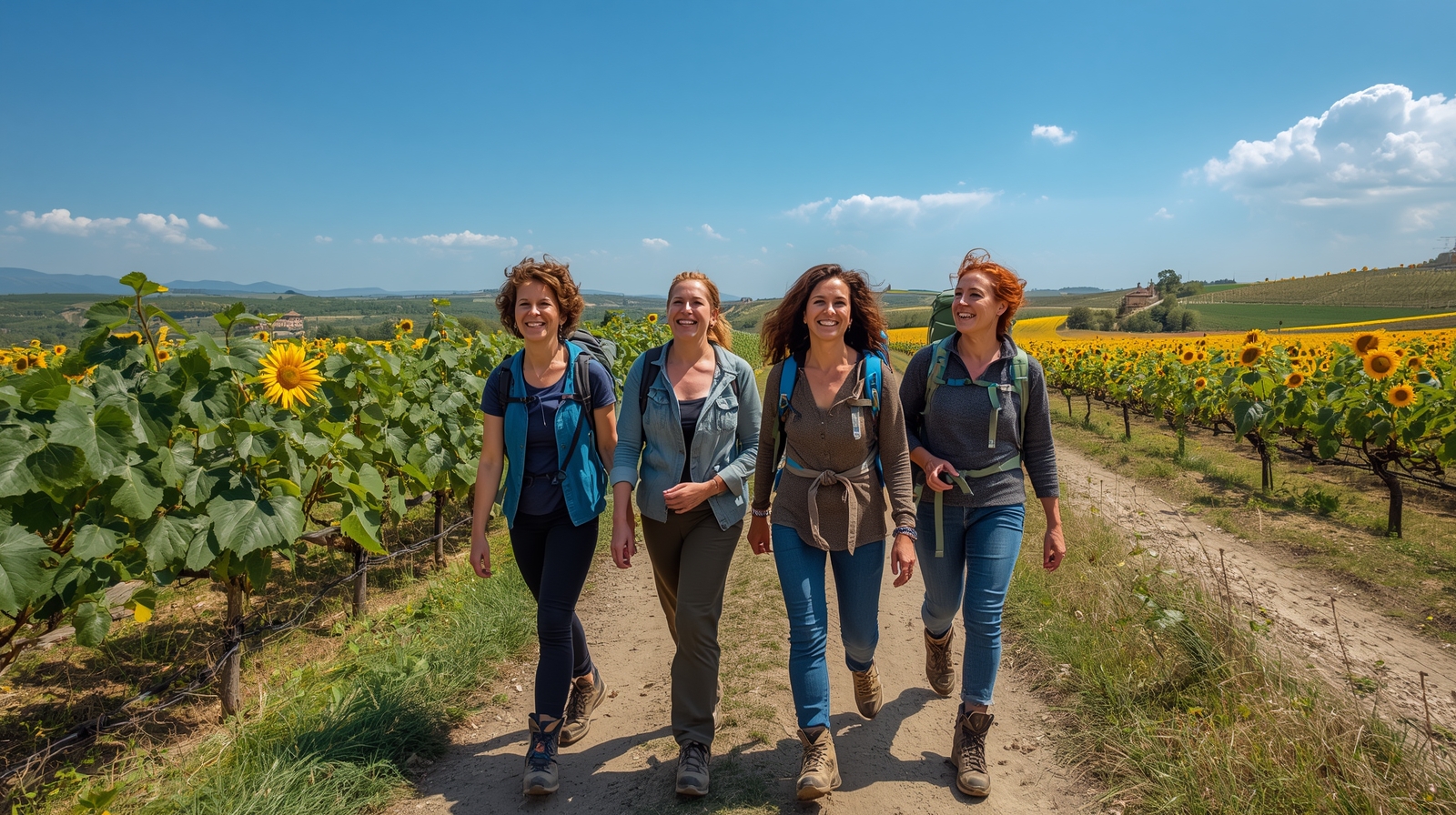








Many participants arrive depleted, sceptical that a week could genuinely shift patterns formed over decades. They leave lighter, clearer about their worth beyond their usefulness, equipped with practical strategies for maintaining boundaries, and connected to a community of fellow empaths who understand their journey. The testimonials speak of marriages saved, careers redirected, health restored, and most commonly, “I finally feel like myself again.”
If you’re ready to invest in yourself as generously as you’ve always invested in others, if you’re curious about discovering who you are when you’re not constantly available to everyone else, if the idea of walking ancient paths whilst reclaiming your own path appeals to you, I’d be honoured to guide you. You can discover more about these transformative experiences by clicking here.
Your journey towards boundaried, sustainable empathy doesn’t require suffering through it alone. Sometimes, the most courageous act is accepting support, walking alongside others who understand, and allowing yourself to be guided towards the wholeness that’s been waiting for you all along. The Camino has been calling sensitive souls towards transformation for over a thousand years. Perhaps it’s calling you now.

What Life Lessons Can You Learn While Walking the Camino de Santiago? – a free guide filled with 10 not just “quaint anecdotes” or Instagram-worthy moments (though there are plenty of those) but real transformations from real people who walked this insight-giving trail – Subscribe to my monthly newsletter to Download the Guide

Author Bio: Dr Margaretha Montagu – described as a “game changer”, “gifted healer”, “guiding light” and “life-enriching author” – is an experienced medical doctor, a certified NLP practitioner, a medical hypnotherapist, an equine-assisted psychotherapist (EAGALAcertified) and a transformational retreat leader who guides her clients through life transitions – virtually, or with the assistance of her Friesian and Falabella horses, at their home in the southwest of France.