Theme: Making Friends and Maintaining Friendships during Life Transitions
December 13, 2025 – 12 days to Christmas
Today’s Story: The Sorano Revival
For Sue T.
Sophia had been standing in front of the Christmas ornament stall at the Bordeaux Christmas market for seventeen minutes, staring at a glass angel with such intensity that the vendor was starting to look concerned.
She wasn’t actually seeing the angel. She was seeing her house in Caudéran: three floors of honey-colored stone, four bedrooms, a kitchen that still smelled faintly of the cinnamon rolls she’d made every December morning for eighteen years. Decorated to within an inch of its life because that’s what you did when you had children. Except she didn’t have children anymore. She had two university students who’d sent exactly three texts between them since September: “arrived safe,” “need money,” and “staying with friends for Xmas hope thats ok?”
It was not, in fact, okay.
The angel’s wings caught the light from the market stalls, sending little prisms across the cobblestones. Around her, Bordeaux was doing what Bordeaux does best in December: being effortlessly, infuriatingly beautiful. The Place Pey-Berland glowed with thousands of lights. The smell of vin chaud and roasting chestnuts and pain d’épices hung seductively in the cold air. Children shrieked with delight on the carousel. Couples held mittened hands.
“Are you buying that or planning to propose to it?”
Sophia turned. Philippe stood there holding two steaming cups of vin chaud, wearing a scarf so aggressively festive it looked like Christmas had mugged a pride parade and stolen its wardrobe. The scarf had bells. Actual bells.
“I’m having a moment,” Sophia said.
“You’re having a breakdown in public, chérie.” He handed her the wine. “Drink this before you do something regrettable.”
The wine was perfect—hot, spiced, the kind of warm that started in your hands and worked its way to your soul. Sophia took three large sips before answering. “How did you even know I was here?”
“Because you’ve been avoiding my calls for two weeks, your house has been dark every time I drive past—yes, I’ve been checking, don’t look at me like that—and the Marché de Noël is where sad people go to pretend they’re participating in the joy of the season while slowly freezing to death.” He sipped his own wine, eyeing her over the rim. “Also, Marie-Claire at the boulangerie on rue Sainte-Catherine said you’ve been buying single croissants every morning with the energy of someone contemplating throwing themselves into the Garonne.”
“I’m not—” Sophia gestured helplessly at the market, at the cathedral, at the impossible beauty of her city at Christmas, at her entire life. “I’m just adjusting.”
“Mm. So how’s that going?”
“Terribly.”
“Thought so.” Philippe linked his arm through hers with the confidence of someone who’d known her for thirty years and had written permission—notarised—to physically remove her from public spaces when necessary. “Come. I need your help with something catastrophically ambitious and possibly illegal.”
They wound through the Vieille Ville, past shop windows full of canelés and foie gras and bottles of wine that cost more than Sophia’s car down payment. Past the cathedral, where bells were ringing for evening mass. Past the bookshop where she used to buy bedtime story books and now wouldn’t know what to do with herself.
Philippe’s apartment was near the Place de la Bourse, in one of those buildings that looked stern from the outside and impossibly elegant inside—all exposed brick and original parquet floors and the kind of tall windows that made you understand why French people are so smug about their architecture. Music sheets covered every surface. A grand piano dominated the living room, black and gleaming and clearly expensive enough that Philippe’s teaching career was going significantly better than her current lifestyle of ornament-coveting and single-croissant purchasing.
“Sit,” Philippe commanded, already rummaging through a folder thick enough to be a doctoral thesis. “I’m making an executive decision about your life.”
“That’s concerning.”
He emerged with sheet music, a bottle of Sauternes, and the expression of someone who’d had an idea so good it might actually kill him. “Flash mob. Christmas Eve. After the evening performance at the Grand Théâtre. Lobby. Sixty-voice choir, four songs in four-part harmony, complete surprise. I’m organising. You’re directing.”
Sophia actually laughed—a real laugh, the first in weeks, the kind that came from somewhere deep and forgotten. “Philippe. Mon Dieu. I don’t sing anymore—”
“You don’t sing professionally anymore. Altogether a different kettle of—what’s the expression?”
“Fish.”
He sat at the piano, running his fingers over the keys like greeting old friends. “Point stands. You’re a soprano, you’ve always been a soprano and you’ll always be a soprano.”
“My voice is gone. Twenty years of not using it—”
“Singing,” Philippe interrupted, playing a chord—middle C, pure and clear and so familiar it hurt—”is like riding a bicycle. Or making love. You don’t forget, you just get nervous about starting again.” He looked at her expectantly. “Sing.”
“No.”
“Sing or I’m calling both your children and telling them you’re having a crisis and need them to come home immediately and deal with their mother’s breakdown. I have their numbers. I will do it. I have no shame.”
“That’s blackmail—”
“That’s motivation. Different thing. Now sing.”
Sophia opened her mouth. The note came out—rusty, uncertain, not the crystalline soprano she’d once commanded, but there. Present. Real. Hers.
Philippe played another chord. She matched it. Then another. Before she knew what was happening, they were halfway through “Ave Maria”—the Schubert, not the Gounod, because Philippe had always been pretentious—and she was crying, and Philippe kept playing like this was completely normal, which it probably was because he’d accompanied her through four pregnancies, two career crises, one divorce scare, and one extremely ill-advised attempt to dye her hair burgundy in 1998.
“Your voice,” he said when they finished, not looking at her because he was too kind to watch her cry, “is fine. Not performance ready, but flash-mob ready, which is what we need.” He handed her the folder. “Sixty people. Mix of ages, experience levels. Half can’t read music. Two are actively tone-deaf but very enthusiastic, and I didn’t have the heart to turn them away. One is ninety-three. You have five days to organise them into something that won’t make the Grand Théâtre ban me for life.”
“Philippe. This is insane—”
“Yes! Exactement!” He poured them both Sauternes in glasses that looked like they cost more than the wine. “You’ve spent two months sitting in your silent house feeling sorry for yourself, eating single croissants. Time to do something absolutely ridiculous that reminds you who you were before you became a mother.”
“I don’t know who that is anymore.”
“Moi, je sais. She’s a soprano who made grown men weep with Puccini. Who whipped a cathedral choir into shape in six days when the director had appendicitis during Easter week. Who once told Conductor Bernard he was ‘musically illiterate’ in front of the entire Orchestre National because he didn’t understand the concept of pianissimo.” Philippe grinned, raising his glass. “That woman is still in there. She’s just been buried under two decades of school runs and maternal guilt and convincing yourself you were done with music. Time to excavate her, ma belle.”
Sophia looked at the sheet music. At Philippe’s ridiculously hopeful face. At the alternative, which was going home to her silent house and staring at the ceiling until New Year’s.
“D’accord,” she said. “But if this goes badly, I’m telling everyone it was your idea.”
“Chérie, it is my idea. I’m counting on the credit.”
The rehearsals were glorious, exhausting, chaotic disasters.
Philippe had recruited from everywhere: his university students, the chorus from Sciences Po, a community choir that met in a church basement near Saint-Michel, random people who’d responded to a Facebook post that said “Can you sing? Want to ambush the bourgeoisie with Christmas joy? No experience necessary, enthusiasm mandatory.”
They met in a rehearsal space near the Chartrons—sixty people ranging from eighteen to seventy-five, crammed into a room that comfortably held thirty, attempting to learn four-part harmony while wearing winter coats because the heating was “temperamental,” which was French for “broken and no one’s fixing it until January.”
Sophia had forgotten what this felt like. The particular chaos of sixty people trying to sing the same thing at the same time. The acoustic mess of untrained voices finding their range. The moment when something clicked and suddenly, miraculously, it sounded like music.
She’d forgotten how good she was at this.
“Tenors!” she called, cutting them off mid-phrase. “You’re flat. You’re singing harmony, not melody. Think of it as lurking musically. You’re the mysterious stranger at the party.”
“I can do mysterious,” said a tenor who looked about nineteen and was wearing a beret unironically.
“Then lurk as if you mean it.”
The tenors lurked. It worked.
“Basses, more depth. You’re singing from your throat. Sing from here—” She gestured at her diaphragm. “Like you’re trying to knock down a wall with sound. Like you’re arguing with your mother-in-law. Passion.”
The basses knocked. The room vibrated. Someone’s coffee cup fell over.
“Parfait. Sopranos—” She paused, looking at the twelve women attempting the high part of “Les Anges dans nos Campagnes.” They were singing beautifully. Too beautifully. “You’re doing that thing where you’re singing pretty instead of singing true. Stop singing prettily. Be powerful. Be enormous. Shatter the windows.”
“But I thought sopranos were supposed to be—”
“Supposed to be what? Delicate? Feminine? Non. You’re the bells in the cathedral tower. You’re the cry of victory. You’re not decorative.” Sophia felt something old and fierce rising in her chest. “Sing like you’re calling down the heavens. From the top. Again.”
They sang again. The sound was enormous, thrilling, the kind of sound that made the hairs on your arms stand up.
By the third rehearsal, they sounded almost competent. By the fifth, they sounded good. By Christmas Eve afternoon—their final run-through in the Grand Théâtre’s upper lobby, sneaking in while the matinee performance of Handel’s Messiah was happening downstairs—they sounded like something worth hearing.
They sounded like magic.
“Bon,” Philippe said, addressing the group. He was wearing another catastrophic scarf, this one featuring embroidered reindeer. “Tonight. Eight-thirty PM. The main performance ends at eight-fifteen. Audience exits into the lobby—it’ll be packed, champagne everywhere, very Bordeaux, very self-satisfied. We’re scattered among them. Look like normal audience members. Try not to look terrified. When Sophia gives the signal, we start. No announcement, no introduction. Just music.”
“What’s the signal?” asked the ninety-three-year-old alto, who had the best voice in the section and the posture of a duchess.
“She’ll sing the first line of ‘Minuit Chrétien.'” Philippe looked at Sophia. “Can you do that? Walk into a lobby full of strangers and just… start singing? In public? Without warning? Like an unhinged pigeon?”
Sophia thought about her silent house. About her children spending Christmas elsewhere. About twenty years of not singing because there was always something more important—dinner to make, homework to check, permission slips to sign, laundry to fold, a life that had consumed her so completely she’d forgotten she used to be someone else.
“Bien sûr,” she said. “I can do that.”
“Bon.” Philippe grinned. “Alors—scatter. Reconvene at eight-fifteen. Try not to get arrested. I haven’t budgeted for bail.”
Eight-fifteen PM, Christmas Eve.
The Grand Théâtre sparkled with lights and nineteenth-century grandeur, all gold leaf and crystal chandeliers and the particular smugness of a building that knows it’s magnificent. The performance—Handel’s Messiah, very traditional, very Bordeaux—had just ended. The lobby filled with well-dressed audience members, champagne appearing on silver trays as if by magic, conversations about the soprano’s high notes and whether the conductor had been too slow and wasn’t the alto section divine, and where were they having dinner afterwards.
Sophia stood near the centre, wearing the black dress she’d bought for her daughter’s graduation and hadn’t worn since. Around the lobby, scattered invisibly among the crowd, were sixty people trying desperately to look casual while having private panic attacks.
She caught sight of Philippe across the lobby. He was pretending to admire a painting, champagne in hand, looking like any other cultured Bordelais enjoying a night at the theatre. He caught her eye. Winked. Nodded.
Sophia took a breath. Then another. Her heart was hammering so hard she could hear it in her ears.
Twenty years. Twenty years since she’d performed. Twenty years since she’d stood in front of people and opened her mouth and trusted that something beautiful would come out.
She took one more breath.
Then she opened her mouth and sang:
“Minuit, Chrétien—”
Her voice—her real voice, the one she’d abandoned twenty years ago—rang out into the lobby. Pure, clear, effortless. The voice that had made men cry and women fall silent and conductors forgive her for calling them musically illiterate.
It was still there. It had always been there.
The crowd went silent. Conversations stopped mid-sentence. Champagne glasses froze halfway to lips.
Then the basses joined, their voices rising from different corners of the lobby like something ancient and inevitable:
“C’est l’heure solennelle—”
Then the tenors, lurking magnificently. Then the altos, then the sopranos, sixty voices filling the Grand Théâtre lobby with “O Holy Night”—Minuit Chrétien—sung in French, in four-part harmony, building from pianissimo to fortissimo until the chandelier crystals were vibrating and every person in the lobby was either crying or filming or both.
Sophia conducted with small gestures—a hand indicating dynamics, a nod for tempo, her whole body communicating joy and power and the particular transcendence of perfectly executed choral music. The soprano she’d been. The woman she’d forgotten.
They moved through the set: “Minuit Chrétien,” then “Les Anges dans nos Campagnes” with its Gloria in excelsis Deo so joyful people started laughing, then a jazz arrangement of “Petit Papa Noël” that made the audience clap along, then finally “Douce Nuit“—Silent Night—sung so softly the lobby held its collective breath, everyone leaning in, afraid to miss a single note.
The final chord faded into silence.
For one perfect moment, no one moved.
Then applause—not polite concert applause, but the real kind, the standing ovation kind, people cheering and wiping their eyes and demanding to know who they were, where they were from, whether they were professionals, whether they were touring, whether they could possibly, please, do it again.
Sophia stood in the center of it all, sixty smiling faces around her, the sound of applause echoing off marble and gold leaf, and felt something she hadn’t felt in twenty years.
She was back.
Later, past midnight, at a brasserie near the theatre—Chez Baptiste, all zinc counters and red velvet and waiters who’d seen everything—sixty people crammed around tables pushed together, drinking wine and eating oysters and dissecting the performance with the obsessive detail of musicians who’d just pulled off something miraculous.
“The tenor section was flat in the second verse—”
“We were NOT flat, the altos were sharp—”
“The tempo was perfect, non, it was parfait—”
“Did you see that woman in the front row crying? I made someone cry—”
“The acoustics in that lobby, mon Dieu—”
Philippe slid into the seat beside Sophia, holding a glass of Sauternes that definitely wasn’t from the bar. “The theatre director cornered me. Wants to talk to you about directing their community outreach choir. Also, three people asked if you teach voice lessons. One asked if we’re doing this again next year. Another asked if we’re touring. I told him yes to all of it because I make terrible decisions when I’m happy.”
Sophia laughed—the real kind, from her belly, the way she used to laugh. “I don’t know if I can—”
“You just led a flash mob choir in the Grand Théâtre lobby on Christmas Eve. You can do literally anything.” He raised his glass, and around the table, sixty people fell silent and raised theirs too. “To Sophia, who discovered that empty nests can be launching pads. À la tienne!”
Sophia’s phone buzzed. Her daughter:
MOM. You’re all over Instagram. You’re SINGING??? In the GRAND THÉÂTRE???? Why didn’t you tell us? Also Jules and I are coming home for New Year’s, we want to hear EVERYTHING.
Sophia smiled, typed back: Long story.
The Making Friends and Maintaining Friendships Masterplan
Traditions carry a special kind of magic. They ground us in moments of joy and connection, and when shared with friends, they become even more meaningful. Whether it’s decorating a tree, baking cookies, or watching a favourite holiday movie, traditions are the glue that keeps relationships strong through life’s changes.
If you’re going through a life transition, revisiting old traditions—or creating new ones—can bring comfort and joy. It’s also a wonderful opportunity to invite friends into your world. Shared traditions become shared memories, and those memories create bonds that last far beyond the holiday season.
| When an identity loss makes you feel invisible, reach out to the friend who knew you before—and accept their ridiculous, ambitious plan to remind you who you are. Say yes to the flash mob, the project, the thing that terrifies you because it requires you to be the person you used to be before life transformed you into someone else. Worst case scenario: You spend a week organising chaos, remember that leading is exhausting, and discover your voice isn’t quite what it was twenty years ago. Best case scenario: Your best friend, who’s known you for thirty years, refuses to let you disappear into maternal grief and empty-house silence, organises sixty strangers into a choir, and makes you lead them in a Christmas Eve ambush of Bordeaux’s fanciest theatre. You discover your voice isn’t gone—it was just waiting for permission to come back, and that leading feels as natural as breathing once you remember how. You accidentally go viral on Instagram, get job offers, reconnect with your passion, and realize that your children leaving wasn’t an ending—it was finally having space to be yourself again, the self who made grown men cry with Puccini and told conductors they were musically illiterate, the self who can still command a room with one pure note and sixty people who trust you to make them sound like angels. You learn that identity isn’t something you lose when your children leave—it’s something you reclaim, one flash mob at a time, with friends who refuse to let you forget you were magnificent before motherhood and will be magnificent after. |
What’s a holiday tradition you love? How could you involve a friend in it this year, or start a new tradition together?
Newsletter Subscription
I’m still collecting subscriptions to my news letter with these post, so if you haven’t subscribed already and would you like to find out what type of friend you are, how well you know your friends or if you and a new friend really are compatible, subscribe my filling in your email address in the box below and I’ll send you a set of light-hearted quizzes, quotes and questions to help you do just that. Just fill in the form below and you’ll get immediate access to them all. You can unsubscribe from this list effortlessly and at any time. Included:
–How well do you know your Friends? Quiz
– What is Your Friendship Style? and Are your Friendship Styles compatible? Quiz
– 20 of the Most Inspiring Friends and Friendship Quotes and
– 20 lighthearted Questions you can ask to get to know a new Friend
Discover how to build meaningful, lasting friendships and create a support system that truly has your back—delivered straight to your inbox!
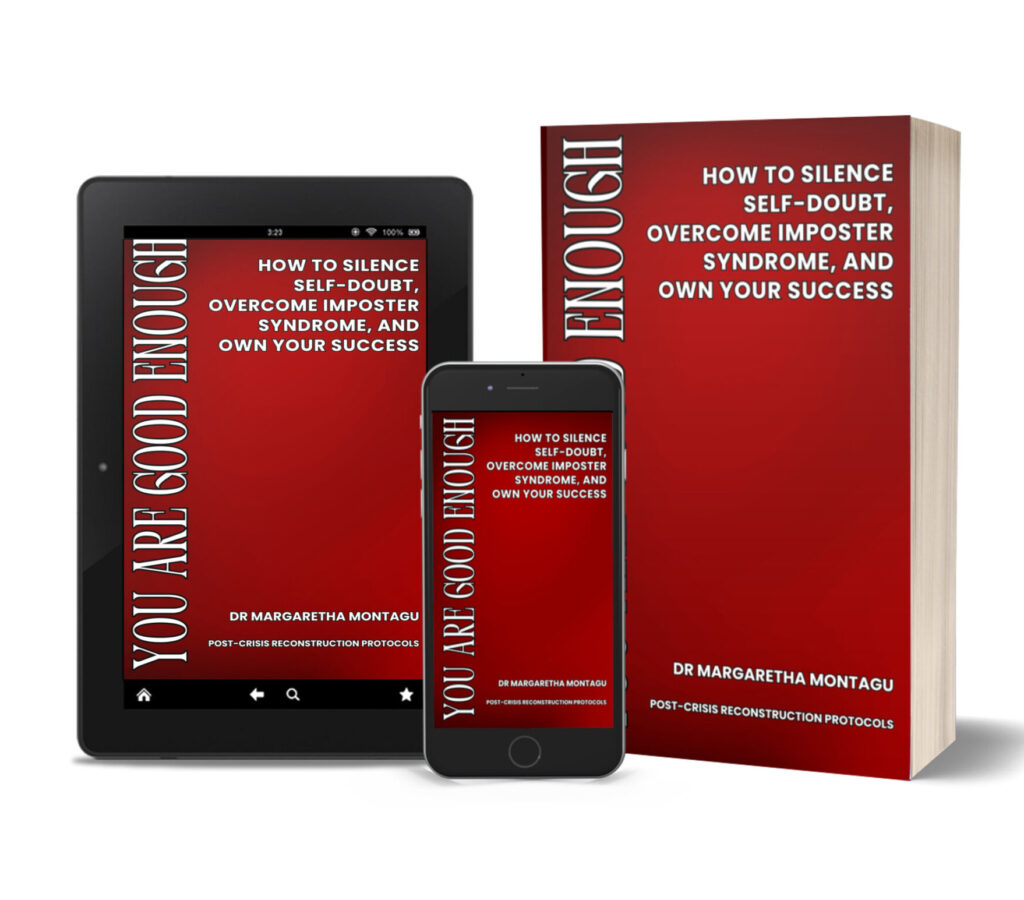
Stop second-guessing yourself. Start owning your success. This book gives you the step-by-step roadmap to break free from imposter syndrome, build unshakable confidence, and finally believe you deserve every bit of your success. You ARE Good Enough!

Designed for those navigating a life transition, the Radical Renaissance Protocol guides you through an identity reset, helping you reconnect with your purpose, realign your values, and reclaim the clarity you thought you’d lost. This isn’t about fixing what’s broken: through reflection, strategic reinvention, and soul-anchored mentoring, you’ll transform uncertainty into direction and dormant potential into meaningful impact.

“I am an experienced medical doctor – MBChB, MRCGP, NLP master pract cert, Transformational Life Coach (dip.) Life Story Coach (cert.) Stress Counselling (cert.) Med Hypnotherapy (dip.) and EAGALA (cert.) I may have an impressive number of letters after my name, and more than three decades of professional experience, but what qualifies me to excel at what I do is my intuitive understanding of my clients’ difficulties and my extensive personal experience of managing major life changes using strategies I developed over many years.” Dr M Montagu