When Your Perfect Plan Becomes Your Prison
What’s This About? You know that sinking feeling when you’ve invested so much in how things “should” turn out that you’d rather drive off a cliff than admit there might be a better route? This article explores why successful people often make spectacularly poor decisions, not because they lack intelligence, but because they’re clutching an expected outcome like a life raft, even as it’s filling with water. Expect uncomfortable truths, one woman’s hilarious descent into outcome-obsessed madness, and practical wisdom for making decisions that serve you rather than your ego.
Five Key Takeaways
- Attachment to outcomes creates tunnel vision, preventing you from seeing alternative paths that might actually serve you better
- The investment cost intensifies with success, making high achievers particularly vulnerable to throwing good money after bad
- Your identity becomes entangled with your plans, making it feel like personal failure when circumstances demand flexibility
- Making decisions from attachment rather than clarity often leads to outcomes far worse than the “failure” you were trying to avoid
- Cultivating outcome independence doesn’t mean not caring, it means caring about the right things in the right way
Introduction: The Tyranny of “Should”
There’s a particular flavour of suffering reserved exclusively for people who’ve tasted success. It’s not the suffering of not knowing whether you can do something, it’s the exquisite torture of needing to prove you can do it again, exactly the way you planned, or die trying.
I’ve watched this play out hundreds of times in my storytelling circles, where executives and entrepreneurs gather to make sense of their journeys through narrative. The stories that emerge aren’t typically about their victories. They’re about the times they knew, somewhere in their bones, that they were making decisions that didn’t make sense, yet they bulldozed forward anyway because the alternative felt like admitting defeat.
The question isn’t whether you’re capable of making good decisions. You’ve already proved that. The question is: when the universe offers you information that contradicts your expected outcome, do you have the courage to listen? Or do you double down, triple down, and then wonder why you’re exhausted, broke, or both?
Delia Jones and the Taste of Failure
Delia Jones had a vision, and that vision smelled like fresh basil, looked like reclaimed oak tables, and sounded like the gentle clink of wine glasses accompanied by appreciative murmurs. She could practically taste the signature burrata dish that would make her restaurant, Sage & Honey, the talk of Bristol.
The building she’d found was perfect. Almost. It needed work. Quite a lot of work, actually. But Delia had renovated properties before. She’d built a successful consulting business from nothing. She was, as her business coach frequently reminded her, a woman who made things happen.
The first contractor’s estimate made her throat tighten, but she’d already told everyone about the restaurant. Her father, who’d always said she lacked follow-through, had actually looked impressed when she’d described her plans over Sunday lunch. The deposit was paid. The vision was clear.
“The plumbing’s worse than we thought,” the contractor said three weeks in, wiping his hands on his jeans and avoiding eye contact. The acrid smell of exposed pipes and old buildings filled Delia’s nostrils as she stood in what was supposed to be her dream kitchen. The number he quoted made her skin prickle with cold sweat.
She refinanced her house.
When the structural engineer discovered issues with the foundation, Delia’s business partner, Marcus, suggested they might want to reconsider. The word “reconsider” landed in Delia’s chest like a stone. She could feel the weight of every conversation where she’d declared this restaurant would be her legacy, every LinkedIn post about taking bold action, every internal promise that this time, she wouldn’t quit when things got difficult.
“We’re not quitting,” she said, her jaw tight enough to crack walnuts. The damp smell of the basement where they stood seemed to seep into her clothes, her hair, her sense of certainty that was becoming harder to distinguish from stubbornness.
Marcus left the partnership. Delia barely noticed, so consumed was she with making this work, with proving that her vision wasn’t just ego dressed up as entrepreneurship. She could taste determination, metallic and bitter, every morning as she drank her coffee and reviewed the mounting invoices.
Six months after opening, Sage & Honey was beautiful. The reclaimed oak gleamed. The burrata was perfection. And Delia was sitting in an empty dining room at 7 PM on a Friday night, the silence broken only by the hum of industrial refrigerators she couldn’t afford to stock properly. The location, as three different consultants had gently suggested before she’d hired them, was wrong. Too far from the city centre. Difficult parking. The very things that had made the building affordable made the business unviable.
She’d known this. Some part of her had known this from the moment the first contractor’s face had crumpled with concern. But admitting it would have meant admitting that sometimes, the brave thing isn’t pushing forward, it’s having the wisdom to stop.
Delia closed Sage & Honey fourteen months after opening. She lost her house. Her relationship ended. Her father never said “I told you so,” which somehow made it worse.
When she finally joined one of my storytelling circles, eighteen months into rebuilding her life, she said something that made everyone in the room lean forward. “I wasn’t making decisions based on reality. I was making decisions based on who I needed to be to maintain the story I’d told myself and everyone else. Every choice was just me frantically trying to force the world to match my script.”
The room smelled like coffee and autumn rain. Someone laughed, that knowing laugh that says “I’ve been there too.” Delia’s eyes were bright, clear, unburdened. “The restaurant was never the point,” she continued. “The point was that I’d decided how success looked, and I was willing to destroy myself to create that picture, even when life kept handing me better options I refused to see.”
That’s when she told us about the café space that had become available three months in, perfectly located, requiring minimal renovation, offering almost everything she’d wanted on a scale that made sense. She’d dismissed it in under two minutes. Wrong aesthetic. Not grand enough. Didn’t match the vision.
“I could have fed people delicious food and built something sustainable,” she said, shaking her head with something that looked like fondness for her former, stubborn self. “But I was so attached to the specific outcome, the specific version of success, that I couldn’t recognise an actual opportunity when it was waving at me.”
The story Delia tells now, about resilience and wisdom hard-won, has helped more entrepreneurs than Sage & Honey ever would have. In my storytelling circles, we’ve discovered that the stories we’re most ashamed of, examined with compassion and honesty, often contain the wisdom we most need to share.
When Your Map Becomes More Important Than the Territory
Making decisions from a place of attachment to specific outcomes is like navigating with a map you drew before you understood the terrain. The map becomes sacred, and the actual landscape becomes an irritating obstacle to overcome.
Psychologists call this “cognitive commitment,” but entrepreneurs know it by the sick feeling in their stomach when someone suggests a pivot. You’ve told investors one thing. You’ve organised your entire identity around a particular vision of success. Changing course doesn’t feel like wisdom, it feels like weakness.
Yet the most successful people I’ve encountered in my decades of working with leaders share a curious quality: they hold their plans lightly. Not carelessly, but with open palms rather than clenched fists. They’ve learned to distinguish between commitment to purpose and attachment to a specific path.
Making decisions well requires us to be scientists rather than soldiers. Scientists update their theories when new evidence emerges. Soldiers dig in and defend their position regardless of changing circumstances. The irony is that soldiers often lose the very thing they’re fighting for through their unwillingness to adapt.
The sunk cost fallacy operates with particular viciousness in successful people because you’ve learned that persistence pays off. You’ve succeeded precisely because you didn’t quit when things got difficult. But there’s a universe of difference between persistent pursuit of a worthy goal and stubborn attachment to a plan that’s no longer serving you.
How do you know the difference? Check your body. Wise persistence feels like resolve, even when it’s uncomfortable. Attachment-driven persistence feels like grim determination, like you’re trying to convince yourself with every decision. Wise persistence responds to feedback. Attachment-driven persistence explains away feedback as other people’s lack of vision.
Making decisions from clarity rather than attachment means asking different questions. Not “how do I make this work?” but “what’s trying to emerge?” Not “how do I prove I’m right?” but “what does this situation require?” Not “what will people think if I change direction?” but “what would serve the highest good?”
This doesn’t mean abandoning goals at the first obstacle. It means staying committed to your why while remaining flexible about your how. It means recognising that sometimes the universe is trying to save you from your own limited imagination by closing doors you’re desperately trying to batter down.
Further Reading: Three Unconventional Books on Decision Making
“The Art of Possibility” by Rosamund Stone Zander and Benjamin Zander This isn’t strictly a book about making decisions, which is precisely why it’s essential reading on the subject. The Zanders teach you to approach life from a framework of possibility rather than scarcity, which fundamentally shifts how you evaluate choices. When you’re not defending a scarce resource (your self-image, your being-right-ness), you can see opportunities your attachment would have hidden. The chapter on giving an A transforms how you make decisions about people and partnerships.
“Finite and Infinite Games” by James P. Carse This philosophical gem distinguishes between playing to win (finite games) and playing to continue playing (infinite games). Attachment to specific outcomes is finite game thinking, it’s about winning this particular hand. But life and business are infinite games. Carse’s framework helps you recognise when you’re sacrificing the infinite game for the finite one, making decisions that win the battle but lose the war. Dense reading, but worth every reread.
“The Wisdom of Insecurity” by Alan Watts Watts addresses the fundamental human impulse to create certainty in an uncertain world. Our attachment to expected outcomes is really attachment to the illusion of control. This slim book gently dismantles that illusion whilst offering something better: the freedom that comes from accepting life’s fundamental fluidity. When you stop trying to force certainty, making decisions becomes lighter, more intuitive, more responsive to reality as it actually is rather than as you need it to be.
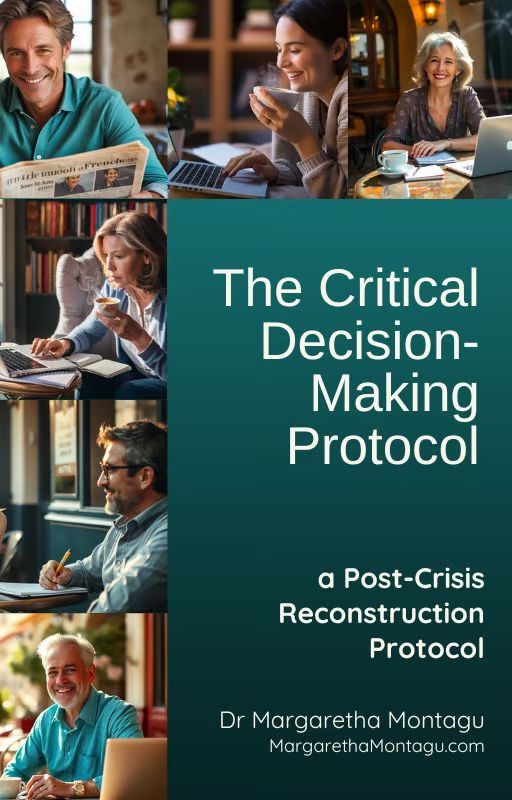
Bonusbook: “The Critical Desicion-making Protocol” by Dr Margaretha Montagu – This step-by-step system combines analytical clarity with emotional intelligence to help you make decisions you won’t regret, even during your most challenging transitions.
A Voice from a Circle
“I came to the storytelling circle carrying the weight of a failed merger I’d pushed through despite every signal that it was wrong. I’d been so convinced I knew how success should look that I’d ignored my team’s concerns, market feedback, and honestly, my own gut. Telling that story out loud, hearing it reflected back with such compassion and without judgement, helped me see the pattern I’d been repeating for years. I wasn’t making decisions, I was defending a narrative. Now I pause before major choices and ask: ‘Am I listening, or am I script-writing?’ It’s changed everything.” — Sarah M., CEO
Five Sharp FAQs
Q: How do I know if I’m being persistent versus being attached to the wrong outcome? A: Persistence feels open, curious, responsive. Attachment feels defensive, rigid, and requires constant justification. If you find yourself explaining away every piece of contradictory information rather than considering it, that’s attachment. Also, notice your body, persistence energises even when it’s challenging; attachment exhausts.
Q: But don’t successful people succeed precisely because they don’t quit? A: Successful people succeed because they don’t quit on their purpose, but they quit on failing strategies all the time. Steve Jobs quit NeXT’s hardware business. Starbucks quit selling coffee beans and focused on the café experience. Netflix quit mailing DVDs. They stayed committed to creating value whilst releasing attachment to how it had to happen. That’s wisdom, not weakness.
Q: What if changing direction looks like flakiness to investors or my team? A: Stakeholders respect leaders who respond intelligently to new information far more than leaders who drive confidently off cliffs. Frame pivots as strategic evolution based on market learning. The leaders who get labeled flaky aren’t the ones who pivot, they’re the ones who change direction reactively without clear reasoning or who chase every shiny object. There’s a difference between following the evidence and following your fear.
Q: How do I make decisions without attachment when I’ve invested so much? A: Acknowledge what you’ve invested, thank it for what you’ve learned, and then make decisions based on future value, not past cost. Ask: “If I were starting fresh today, knowing what I now know, would I make this choice?” That question cuts through the sunk cost fallacy and brings you back to reality. Your past investment doesn’t obligate your future.
Q: This sounds like giving up on dreams. Isn’t that just rationalising fear? A: Dreams are about the impact you want to create, the contribution you want to make, the person you want to become. Those are worthy attachments. But the specific vehicle, timeline, or method? That’s strategy, and strategy should adapt. You can stay fiercely committed to your dream whilst releasing death-grips on any particular path to it. In fact, that’s the only way dreams actually manifest, with space for life to surprise you with routes better than you imagined.
Conclusion: Releasing Your Grip
Making decisions from attachment to expected outcomes isn’t a character flaw, it’s a human tendency amplified by success, intelligence, and the very determination that got you where you are. The executives and entrepreneurs I work with aren’t struggling because they lack capability, they’re struggling because their capability has convinced them they should be able to force any outcome they decide upon.
But the most profound shift available to you isn’t about making better predictions or having more willpower. It’s about developing a different relationship with uncertainty, with outcomes, with the gap between your plans and reality’s offerings.
When you release your attachment to how things “should” unfold, you don’t lose your power to shape outcomes, you gain the flexibility to recognise which outcomes are actually worth shaping. You become available to opportunities your tunnel vision would have missed. You make decisions from wisdom rather than ego, from curiosity rather than fear of being wrong.
The executives who seem to move through their careers with unusual grace haven’t mastered certainty, they’ve mastered dancing with uncertainty. They’ve learned that making decisions is less about controlling outcomes and more about responding with integrity to life as it unfolds.
Your plans matter. Your vision matters. But they matter as guides, not as prison sentences. The moment you notice yourself making decisions primarily to prove you were right, or to avoid the discomfort of changing direction, or to maintain a narrative you’ve committed to publicly, that’s your invitation. That’s life asking: are you willing to be free?
Discover Your Purpose Before You Start Making Desicions
The Purpose Protocol isn’t another course about setting goals or achieving more. It’s a transformative journey into the difference between what you’ve decided you should want and what actually calls to you when you’re brave enough to listen. Through storytelling, reflection, and practices designed specifically for successful people ready to question their assumptions, you’ll learn to make decisions from alignment rather than attachment. Whether you’re contemplating a significant pivot, sensing there’s something more you’re meant to create, or simply exhausted from trying to force outcomes, this online course offers the frameworks and community to help you navigate with wisdom rather than willpower. Join entrepreneurs and leaders who’ve discovered that releasing the death-grip on expected outcomes isn’t giving up, it’s finally clearing space for something better to emerge. Learn more about how the Purpose Protocol can support your next chapter at [your website].
The Purpose Pursuit Protocol – if you want to discover your life purpose, this course will provide you with the clarity, motivation and direction you need to manifest your next chapter – in both your personal and professional life. Get immediate access
The Purpose Pivot Protocol – drawing inspiration from the Camino de Santiago, this transformative course guides you through a proven framework to recalibrate your authentic purpose and create a meaningful and fulfilling next act. Get immediate access
I put the essence of who I am, and everything I have experienced that makes me who I am, with great enthusiasm, into my retreats, courses and books. – Dr Margaretha Montagu (MBChB, MRCGP, NLP master pract (cert,) Transformational Life Coach (dip,) Life Story Coach (cert) Counselling (cert,) Med Hypnotherapy (dip) and EAGALA (cert)