
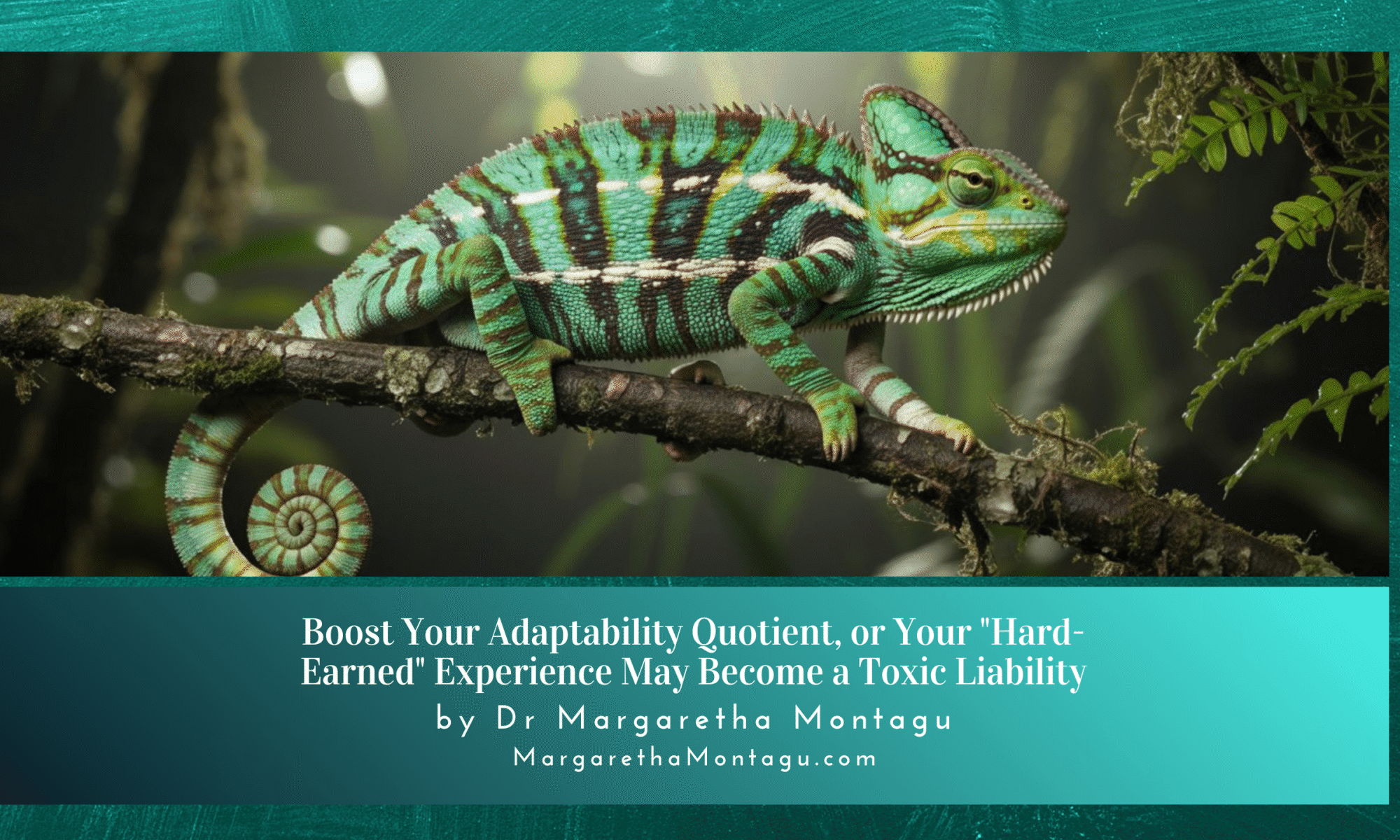
Forget IQ and EQ. In the age of constant disruption, your Adaptability Quotient (AQ) is the only metric that guarantees you won’t become a dinosaur in a digital age.
Overview
Natalie Fratto’s TED Talk 3 Ways to measure your Adaptability – and how to improve it made me think. Most of us know what EQ, SQ and IQ are. But AQ? And how crucial is a high AQ to people navigating life changes? Adaptability isn’t just about surviving the storm; it’s about learning to dance in the rain without slipping on the wet pavement. This article explores why your Adaptability Quotient (AQ) matters more than your IQ or EQ in today’s volatile market, offering actionable strategies to upgrade your mental software from “panic” to “pivot.”
5 Key Takeaways
- AQ Trumps IQ: In a rapidly changing world, the ability to unlearn and relearn is your most valuable currency.
- The ACE Framework: Adaptability relies on three pillars: Ability (skills), Character (traits), and Environment (context).
- Unlearning is Vital: Letting go of obsolete “best practices” is often harder, and more important, than learning new ones.
- Curiosity Kills Fear: Replacing anxiety with curiosity rewires your brain to see disruption as data rather than a threat.
- Environment Matters: You cannot be highly adaptable in a rigid, fear-based culture; psychological safety is a prerequisite for AQ.
Why The Old Rules Won’t Help You Win The New Game
Imagine playing a high-stakes game of chess where, every ten minutes, someone swaps the board for a poker table, then a tennis court. Frustrating? Absolutely. But this is modern business. For years, we have worshipped at the altar of IQ (intellectual horsepower) and EQ (emotional intelligence). While these remain vital, they are no longer sufficient. Enter Adaptability Quotient (AQ): the metric that measures how successfully you navigate the unknown. It is not just about resilience—bouncing back—but about “bouncing forward” into a new reality with grace and speed.
The Man Who Refused to Fold
Arthur sat in the circle, his posture rigid, hands gripping his knees as if he were bracing for a collision. The air in the old Gascon farmhouse was thick with the scent of dried lavender and the faint, smoky aroma of a wood fire burning in the hearth. Outside, the twilight settled over the rolling hills of the Gers, silencing the cicadas that had buzzed frantically all afternoon.
“I’m a fixer,” Arthur said, his voice cracking just enough to betray the exhaustion beneath his tailored exterior. “I fix companies. I fix bottom lines. But I can’t fix this.”
He was referring to the merger that had unseated him, but really, he was talking about the terrifying irrelevance he felt creeping into his bones. Arthur was sixty, a titan of analogue industry in a digital world that seemed to speak a language he refused to learn. He had come to my storytelling circle not because he wanted to share, but because his wife had insisted he needed to “find himself,” a phrase he uttered with visible disdain.
“Tell us about a time you were lost,” I suggested gently.
Arthur scoffed, shifting his weight on the wooden chair. “I don’t get lost. I have a GPS. I have a plan.”
“But what happens when the battery dies?” someone whispered from across the circle.
Arthur blinked. The silence stretched, heavy and expectant. He looked at his hands, weathered and strong, hands that had built a manufacturing empire now being dismantled by algorithms.
“I was twenty,” he began, the memory surfacing reluctantly. “Hiking in the Pyrenees. Fog rolled in. Thick as wool. I couldn’t see my boots. I froze. I had a map, but it was useless without landmarks.”
He described the cold seeping into his jacket, the metallic taste of fear in his mouth, and the disorienting silence of the whiteout. “I wanted to march forward, to force my way out. That’s what you do, right? You push.”
“And?” I asked.
“And I realised if I moved, I’d walk off a cliff,” Arthur confessed, his shoulders dropping an inch. “So I sat down. I waited. For hours. I had to admit that my strength, my speed, my plan—none of it mattered. I had to just… be still. I had to listen to the wind to know where the gap in the ridge was.”
A tear traced a path through the stubble on his cheek. In that storytelling circle, surrounded by strangers, the “fixer” finally broke. He realised that his rigidity—the very trait that made him a reliable CEO—was the anchor pulling him under. He didn’t need to fight the current; he needed to let go of the riverbank.
By the end of the week, Arthur wasn’t just telling stories; he was listening to them. He stopped trying to optimise the retreat schedule and started watching the way the light changed on the vineyards. He discovered that surrender isn’t defeat; it is the ultimate adaptation.
Decoding the Anatomy of Adaptability
Arthur’s breakthrough highlights the core of AQ. It is not a fixed trait but a muscle you can build. To truly understand it, we can look at the ACE Model, widely recognised in adaptability research (and championed by experts like Ross Thornley), which breaks AQ down into three dimensions:
Ability: The Skill Set
This is your “adaptability capability.” It includes grit (perseverance toward long-term goals) and mental flexibility (the ability to hold opposing ideas simultaneously). Crucially, it involves unlearning—the intentional act of discarding outdated methods. As the futurist Alvin Toffler famously predicted, the illiterate of the 21st century are not those who cannot read and write, but those who cannot learn, unlearn, and relearn.
Character: The Mindset
Your personality traits influence how you approach change. Are you defensive or curious? This dimension includes emotional range and hope. People with high AQ don’t just tolerate ambiguity; they are energised by it. They ask “What if?” instead of “Why me?” They view disruption as a puzzle to be solved rather than a personal attack.
Environment: The Context
You cannot bloom in a toxic soil. Even the most adaptable leader will struggle in a rigid bureaucracy that punishes failure. High AQ environments provide psychological safety, allowing teams to experiment, fail fast, and share information without fear of retribution. If your company culture prioritises compliance over creativity, you are actively suppressing your team’s AQ.
5 Strategies You Can Use to Boost Your AQ
Use these strategies to boost your Adaptability Quotient (AQ) today, without needing a sabbatical or a PhD in neuroscience:
1. Shock Your Autopilot
The Action: Change one small, daily routine. Drive a different route to work. Brush your teeth with your non-dominant hand. Order the item on the menu you’d never usually pick.
The Why: Your brain loves efficiency (habits), but efficiency kills adaptability. By introducing safe, low-stakes “novelty,” you desensitize your amygdala (fear center) to the feeling of “different,” making you calmer when high-stakes changes hit.
2. Play “The Anti-You”
The Action: In your next meeting, force yourself to argue against your own strong opinion for two minutes.
The Why: This builds Cognitive Flexibility. If you are a “details person,” look for the big picture. If you are a risk-taker, argue for caution. It forces your brain to forge new neural pathways and stops you from becoming rigid in your identity.
3. Ask “What If?” Instead of “WTF?”
The Action: When bad news hits (e.g., a client cancels, a project fails), immediately ask: “What if this is actually data, not a disaster?”
The Why: Fear constricts your vision; curiosity expands it. This simple reframe shifts you from a “Threat Response” (fight/flight) to a “Challenge Response,” allowing you to spot the pivot opportunity that panic would have missed.
4. The “Kill Your Darlings” Audit
The Action: Identify one “Best Practice” in your business that hasn’t changed in 2 years. Ask: “If I started my company today, would I still do it this way?” If the answer is no, kill it.
The Why: High AQ isn’t just about learning; it’s about unlearning. Holding onto obsolete success strategies is the fastest way to sink.
5. Focus on “Next,” Not “End”
The Action: Stop trying to predict the “end state” (which is impossible). Instead, just ask: “What is the single next right move?”
The Why: Adaptability is about motion, not perfection. Paralysis often comes from trying to see the whole map. High AQ leaders know they only need to see as far as their headlights.
Further Reading
To deepen your understanding, I recommend these three books:
1. The Adaptation Advantage by Heather E. McGowan and Chris Shipley
I chose this because it fundamentally reframes the future of work. The authors argue that we have moved from the “learn-to-work” era to the “work-to-learn” era. It is an essential guide for executives who need to stop hiring for past skills and start hiring for future potential.
2. Adaptability by Max McKeown
This is a classic that offers a strategic view. McKeown studies why some organisations (and civilisations) survive while others collapse. His rules for adaptability—like “Stability is a dangerous illusion”—are provocative and necessary for any leader clinging to the status quo.
3. Decoding AQ by Ross Thornley
Selected for its practical application of the ACE model. Thornley moves beyond theory to measurement, offering a scientific approach to quantifying adaptability. If you love data and want to know exactly how to measure your team’s flexibility, this is your manual.
Voices
“I came to the retreat convinced that ‘adaptability’ was just a buzzword for ‘working harder without complaining.’ I was resentful and burnt out. The storytelling circles changed everything. Hearing others share their struggles made me realize I was holding onto an identity that no longer served me. I left with a lower heart rate and a higher AQ.”
— Sarah J., Corporate Attorney & Camino Guest
Frequently Asked Questions
Can you actually measure AQ?
Yes, assessments based on the ACE model (Ability, Character, Environment) provide a score by evaluating dimensions like unlearning, resilience, and environmental support, giving you a baseline for improvement.
Is AQ more important than IQ?
In stable environments, IQ rules. In volatile, complex environments (like today’s), AQ is the stronger predictor of success because raw intelligence cannot solve problems it has never seen before.
Can I improve my AQ if I hate change?
Absolutely. Start with “micro-adaptations.” Take a different route to work, change your morning routine, or learn a useless skill. You need to desensitize your brain’s fear response to novelty.
How do I boost my team’s AQ?
Focus on the “Environment” pillar. Create a culture where “I don’t know” is an acceptable answer and where failed experiments are celebrated as learning opportunities rather than punished errors.
What is the biggest enemy of adaptability?
Success. When we succeed, we tend to codify what worked, creating rigid best practices. Ironically, your past success is often the biggest barrier to your future adaptation.
Conclusion
Boosting your Adaptability Quotient isn’t about becoming a chaotic shapeshifter who stands for nothing. It is about becoming like water—strong enough to carve canyons but flexible enough to move around obstacles. As you navigate the uncertain waters of your professional life, remember that the goal isn’t to predict the future. It is to build a vessel—your mind and spirit—that can sail on any sea.
Finding Your Footing on the Camino
If the story of Arthur resonated with you, or if you feel the creeping exhaustion of trying to force old maps onto new territories, it might be time to pause. You cannot rewire your brain while it is frying in cortisol.
I invite you to join me for the Camino de Santiago Crossroads Retreat in the lush, rolling heart of Gascony, France. This is not a boot camp; it is a sanctuary for the soul. Over five transformative days, we will walk the ancient paths of the Camino, not to race to a destination, but to rediscover the rhythm of our own thoughts.









Our days are anchored in mindfulness and meditation exercises designed to lower your stress baseline, giving your nervous system the safety it needs to unlearn and adapt. In the evenings, we gather for my signature storytelling circles—safe, warm spaces where, like Arthur, you can lay down the heavy armour of your “professional self” and reconnect with the human beneath.
There is no networking here. No judgment. Just good food, deep rest, and the kind of clarity that only comes from walking at 4km/h. Come find your new direction.
Find your Way at a Crossroads Retreat
Which old habit are you holding onto that might be blocking your next great adventure?
Stress destroys Lives. To find out what you can do to safeguard your sanity by taking my insight-giving quiz, subscribe to my mailing list.

“I am an experienced medical doctor – MBChB, MRCGP, NLP master pract cert, Transformational Life Coach (dip.) Life Story Coach (cert.) Stress Counselling (cert.) Med Hypnotherapy (dip.) and EAGALA (cert.) I may have an impressive number of letters after my name, and more than three decades of professional experience, but what qualifies me to excel at what I do is my intuitive understanding of my clients’ difficulties and my extensive personal experience of managing major life changes using strategies I developed over many years.” Dr M Montagu
References
Kam, C. C. S., Morin, A. J. S., Meyer, J. S., & Topolnytsky, L. (2016b). Are Commitment Profiles Stable and Predictable? A Latent Transition Analysis. Journal of Management, 42(6), 1462–1490.
Rudolph, C. W., Lavigne, K. N., & Zacher, H. (2017b). Career adaptability: A meta-analysis of relationships with measures of adaptivity, adapting responses, and adaptation results. Journal of Vocational Behavior, 98, 17–34.
Uhl-Bien, M., & Arena, M. J. (2018b). Leadership for organizational adaptability: A theoretical synthesis and integrative framework. Leadership Quarterly, 29(1), 89–104.
Van Steenbergen, E. F., Van Der Ven, C. M., Peeters, M. C. W., & Taris, T. W. (2018).Transitioning Towards New Ways of Working: Do Job Demands, Job Resources, Burnout, and Engagement Change? Psychological Reports, 121(4), 736–766.