
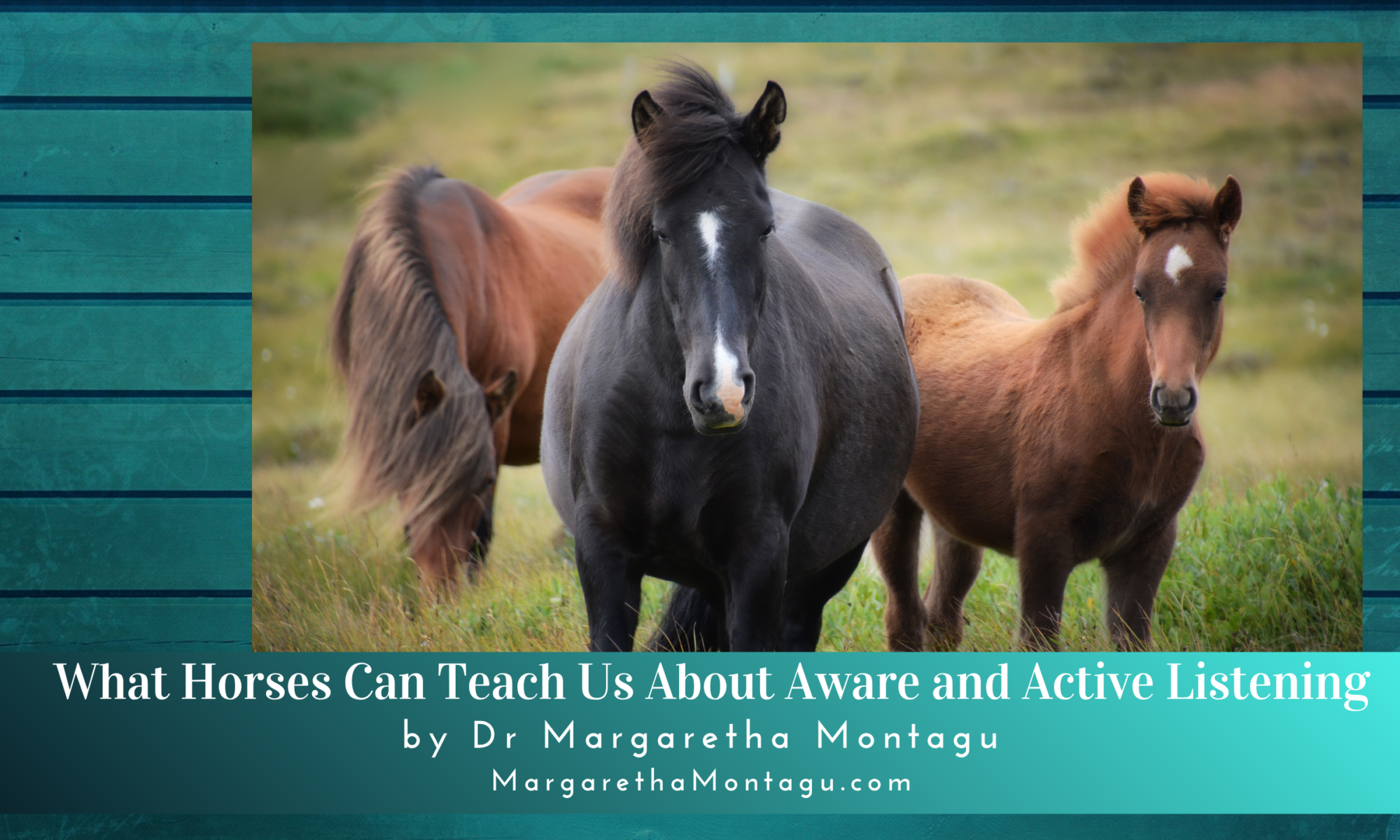
I used to think I was a good listener. Then I got a small herd of Falabellas who couldn’t care less about my medical degree, my life coaching certificates, or the very reasonable things I was trying to explain to them, and I found out I had a great deal to learn. Tess, my Friesian mare, in particular, has a way of pinning her ears at me that says “What a lot of hogwash!” Humbling.
In our hyper-connected, fast-paced modern world, communication has largely been reduced to words on a screen, quick voice notes, or hurried conversations over coffee. We are constantly talking, texting, and broadcasting, yet we rarely take the time to truly listen. We often listen merely to reply, rather than to understand.
Enter the horse. A 1,200-pound prey animal whose very survival has depended, for millennia, on its ability to read the subtlest shifts in its environment. Working with horses offers an in-depth masterclass in a skill we desperately need to reclaim: aware and active listening.
The Illusion of Verbal Communication
Most of us rely heavily on verbal language. We assume that if someone isn’t speaking, they aren’t communicating. However, psychologists and communication experts have long noted that a significant portion of human communication is non-verbal—encompassing tone of voice, facial expressions, posture, and micro-movements.
When you step into a round pen or a pasture with a horse, your verbal language becomes almost entirely irrelevant. You cannot explain your intentions to a horse using words. You cannot negotiate, rationalise, or debate. Instead, you are forced to engage in a completely different paradigm of communication. You must learn to “listen” with your eyes, your body, your perception and your intuition.
Reading the Equine Language
Horses are constantly broadcasting their internal state, but their language is a silent symphony of physical cues. A horse’s ears are perhaps its most expressive feature. Ears pinned flat against the neck often scream anger or extreme discomfort. Ears flicking back and forth can indicate divided attention or uncertainty. A relaxed, slightly drooped ear may suggest contentment and trust.
But it doesn’t stop at the ears. A horse communicates through the tension in its jaw, the swish of its tail, the shifting of its weight, and the softness—or pointedness—of its gaze. When a horse licks and chews, it processes information and releases tension. When it rests a hind leg, it is signalling relaxation.
To work safely and effectively with a horse, you must become an active observer. You cannot be distracted by your phone or lost in your own thoughts. You must be entirely present, actively “listening” to the continuous stream of non-verbal data the horse is providing. If you ignore a horse’s subtle signs of anxiety—a tightened lip, a slightly elevated head—you might soon find yourself dealing with a full-blown panic response. The horse teaches you that listening is not a passive state; it is an active, continuous engagement with the present moment.
Linking this Way of Listening to Human Relationships
The profound beauty of learning to listen to a horse is how seamlessly this skill translates back into our human relationships. When we train ourselves to notice the subtle physical cues of an animal, we inadvertently sharpen our awareness of the people around us.
Think about your last conversation with a colleague, a partner, or a child. Were you truly listening, or were you just waiting for your turn to speak? If you apply the “equine listening/absorbing” approach, the entire dynamic shifts. You begin to notice the unspoken narrative.
You might notice that while your colleague is saying “I’m fine with this project,” their crossed arms, tight jaw, and lack of eye contact are screaming the exact opposite. You might realise that your child’s sudden quietness and slumped shoulders are communicating a distress that they don’t yet have the vocabulary to articulate.
By becoming attuned to these non-verbal cues, we become better, more empathetic listeners. We stop taking words at face value and start listening to the whole person. We learn to read the room, to sense the underlying emotional currents, and to respond to what is actually being felt, rather than just what is being said.
The Gift of Being Heard
There is a profound psychological comfort in feeling truly heard and understood. When a horse realises that you are “listening” to its subtle cues—that you step back when it shows anxiety, or that you soften your posture when it seeks connection—it responds with immense trust. The horse relaxes, knowing it is safe with someone who understands its language.
We are no different. When we practice deep, active listening with the people in our lives, we create a safe space for vulnerability and authentic connection. When people feel that you are not just hearing their words, but truly seeing their emotions and understanding their unspoken needs, the quality of the relationship transforms. Trust deepens. Conflicts resolve more easily. Empathy flows.
A Practice for Everyday Life
You don’t need to own a horse to practice this, though it does help a lot if you can practice with a horse first. You can start today. In your next conversation, challenge yourself to listen like a horseman/woman. Silence your internal monologue. Put away your phone. Look at the person in front of you. Notice their posture, the tension in their face, the movement of their hands, and the cadence of their breathing.
Listen not just to reply, but to understand what the other person is trying to get across. In doing so, you honour the profound lesson that horses have been trying to teach us all along: that the most important things we say to one another are rarely spoken aloud.
If any part of you just went “well, that explains a few things,” I’d love to welcome you to a Rebooted and Realigned Retreat. It’s a bit of Camino de Santiago walking, listening to horses, and blessedly little talking — the kind of quiet that helps you actually hear what your inner critic has been drowning out. Come see for yourself.
Do you dream of escaping your stressful life to raise a herd of goats or grow sunflowers in the south of France? Then you may be ready for an Esprit Meraki retreat. Get access to this “very serious” quiz to help you figure out how urgent your need for a change of scenery is, when you subscribe to my monthly newsletter.
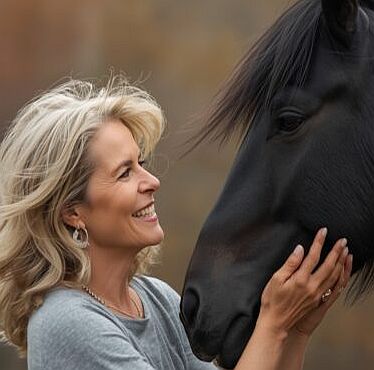
3-day/2-night Private “Press Pause” Retreat –this bespoke, one-on-one retreat on the Camino de Santiago in the sun-blessed southwest of France enables you to press pause, connect with a small herd of Friesian and Falabella horses, recalibrate your inner compass, and return to your life rested, rooted and realigned with who you are now.

“I am an experienced medical doctor – MBChB, MRCGP, NLP master pract cert, Transformational Life Coach (dip.) Life Story Coach (cert.) Stress Counselling (cert.) Med Hypnotherapy (dip.) and EAGALA (cert.) I may have an impressive number of letters after my name, and more than three decades of professional experience, but what qualifies me to excel at what I do is my intuitive understanding of my clients’ difficulties and my extensive personal experience of managing major life changes using strategies I developed over many years.” Dr M Montagu