
Mindfulness Can Turn Your Retreat into a Life-Changing Journey (Not Just a Holiday)
What this is: A practical guide to using mindfulness as the bridge between “going on a retreat” and actually experiencing transformation. This explores how present-moment awareness turns travel from escapism into a catalyst for the next chapter of your life.
What this isn’t: Another fluffy piece about “finding yourself” whilst sipping overpriced smoothies. No Instagram-worthy platitudes. No suggestion that a week away will magically solve everything.
Read this if: You’re done with surface-level solutions and ready to approach your retreat—and your transition—with genuine intention. You know that real change requires more than a change of scenery, but you’re curious whether mindful travel might be the missing piece.
5 Key Takeaways
- Mindfulness transforms retreat travel from escape to exploration, shifting your focus from running away to walking toward something new
- The journey itself becomes the practice, not just the destination, making every moment of travel an opportunity for awareness and growth
- Presence amplifies the retreat experience, helping you absorb insights more deeply and integrate them into daily life back home
- Mindful travel creates space for unexpected revelations, allowing your unconscious mind to surface what you’ve been too busy to notice
- The skills you develop while travelling mindfully become tools for navigating life transitions, building a practice that extends far beyond your time away
Introduction: The Journey Before the Journey
Here’s what nobody tells you about booking a retreat during a major life transition: the moment you click “confirm reservation” is when the real work begins.
Not the packing. Not the travel arrangements. The reckoning.
Because somewhere between purchasing your ticket and boarding the plane, you’ll likely experience at least three minor panic attacks, two moments of “what on earth am I doing,” and one serious consideration of cancelling the whole thing. The anticipation feels too big. The hope feels too fragile. What if you travel all that way and nothing changes?
I’ve spent twenty years hosting transformational retreats on the Camino de Santiago, and I can tell you this: the people who experience the deepest shifts aren’t necessarily the ones who arrive most broken or most desperate. They’re the ones who’ve learned to be present, not just at the retreat itself, but during every stage of the journey toward it.
What you’ll gain from reading this: A framework for approaching retreat travel with the kind of mindfulness that doesn’t just make the experience more pleasant, it makes it genuinely transformative. You’ll discover how to turn every aspect of travel—from airport queues to unfamiliar beds—into opportunities for the awareness and self-discovery you’re seeking.
The Story of Claire Brennan
Claire Brennan sat in Terminal 3 at Heathrow, watching her departure board with the kind of intensity usually reserved for cardiac surgeons monitoring vital signs.
Toulouse. Gate 42. Boarding 14:25.
Three hours and seventeen minutes until she’d be walking on French soil. Three hours and seventeen minutes until her “new life” could officially begin.
The divorce had been finalised four months ago. The house sold six weeks back. Her daughter was settled at university, her son thriving in his gap year travels. She’d done everything the books suggested: therapy, journaling, divorce recovery gatherings. And still, she felt like a photograph slowly fading, the edges of herself becoming less distinct with each passing day.
The retreat had seemed like the answer. Seven days walking the Camino, storytelling circles, transformation, rebirth. She’d paid the deposit on a particularly dark Tuesday, imagining herself striding purposefully along ancient paths, finally becoming the woman she was meant to be.
But sitting here now, watching businesspeople scroll their phones and families wrangling luggage, Claire felt nothing. Numb. Observing her own life from somewhere very far away.
Her coffee had gone cold. She hadn’t noticed. The Danish she’d purchased sat untouched, a small monument to her lack of appetite. Around her, the airport hummed with purpose—everyone going somewhere, being someone. Claire was just… waiting.
Just get there, she told herself. Once you arrive, everything will click into place.
Then a small child, perhaps three years old, dropped a stuffed elephant directly onto Claire’s shoe. The girl looked up, eyes wide with that particular toddler terror of having Done Something Wrong.
“Oh, darling, it’s perfectly fine,” Claire said, bending to retrieve the worn grey toy. Its left ear was missing, one eye hung by a thread. She could feel the child’s whole body tense, preparing to cry.
“Edward likes adventures,” Claire said softly, making the elephant do a little dance. “I think he was trying to explore my shoe. Is that right, Edward?”
The child’s face transformed. “He’s called Mr. Trunks!”
“My sincere apologies, Mr. Trunks.” Claire performed a small bow.
The mother appeared, flustered and apologetic, thanking Claire profusely whilst herding the child away. But something had shifted. Claire looked down at her hands—they were trembling slightly. She could feel her heartbeat. The airport sounds had suddenly acquired texture: the wheeled suitcases, the incomprehensible announcements, someone’s laughter three gates away.
She was here. Actually here.
Not in the future, imagining transformation. Not in the past, cataloguing failures. Here, in this uncomfortable chair, with cold coffee and an uneaten Danish, being smiled at by a stranger’s child.
Claire picked up her phone and cancelled the meditation app she’d been halfheartedly using. Instead, she opened her notes and wrote: “Mr. Trunks. Terminal 3. The feeling of coming back into my body.”
When her flight was called, she didn’t rush. She noticed the weight of her bag, the slight catch in her left knee, the scent of someone’s perfume, the quality of light through the terminal windows. She’d travelled dozens of times before, always in a fog of efficiency and mild irritation, treating airports as obstacles between herself and her destination.
This time, she paid attention.
On the plane, she observed the safety demonstration instead of scrolling. She felt the exact moment of takeoff, that brief suspension between earth and sky. She watched clouds through the window, their shapes constantly shifting, and thought about impermanence in a way that felt discovered rather than learned.
By the time she collected her rental car in Toulouse, Claire had accumulated seventeen small observations in her notes. Not profound ones. Just present ones. The way French sounds different when you’re actually listening. The texture of the steering wheel. How hunger feels when you’re paying attention to your body.
She drove toward the retreat centre slowly, windows down, letting unfamiliar air move through the car. She got slightly lost and instead of panicking, she pulled over, consulted her App, noticed the particular quality of late afternoon light on the Pyrenees in the distance.
When she finally arrived, walking through the gate to where I stood waiting with the horses, she looked different from most guests I meet. Not transformed—not yet. But aware.
“I think,” she said, her eyes bright with something like wonder, “I think the retreat might have already started.”
She was absolutely right.
The takeaway: The retreat doesn’t begin when you arrive at your destination. It begins the moment you decide to be present in your journey. Claire’s transformation wasn’t waiting for her in France—it was available to her in Terminal 3, on the plane, in the rental car. Mindfulness doesn’t make the retreat work; it recognises that travel itself can be the teacher if we’re willing to pay attention.
Why Mindfulness and Retreats Are Natural Travel Partners
What Happens When We Combine Awareness with Movement?
There’s a particular magic that occurs when you pair conscious awareness with a physical journey. As both a physician who’s spent two decades studying stress management and someone who’s hosted dozens of people on walking retreats, I’ve observed this alchemy repeatedly.
Travel inherently disrupts our patterns. New beds, unfamiliar food, different languages, altered schedules—all these disruptions can either increase our stress or create opportunities for awareness. Mindfulness is what determines which way it goes.
When you travel mindfully to attend a retreat, you’re essentially conducting a dress rehearsal for the life transition itself. Both involve:
- Moving from the known to the unknown
- Letting go of familiar routines
- Trusting the process despite uncertainty
- Being open to what emerges rather than controlling outcomes
- Building new neural pathways through novel experiences
The practice you develop navigating airports mindfully, sitting with discomfort on long flights, staying present through delays and disruptions—this same practice becomes your toolkit for navigating divorce, career changes, grief, illness, or any major life transition.
When you approach retreat travel with mindfulness, you’re not just preparing yourself for transformation. You’re modelling a different way of being that ripples outward. Your grown children notice you’re handling stress differently. Your colleagues see someone who returns from travel genuinely refreshed rather than needing a holiday from the holiday. Your community encounters someone who’s learned that presence is possible even in chaos.
This isn’t selfish or self-centred. When you learn to travel mindfully, you bring back more than photographs and souvenirs. You bring back a demonstrated truth: it’s possible to stay grounded whilst everything changes.
The research supports this, too. Studies on mindfulness and travel show that present-moment awareness during journeys increases positive emotions, reduces travel-related stress, enhances memory formation, and improves our ability to adapt to new situations. All skills that are desperately needed during major life transitions.
Moreover, there’s something about the liminal space of travel—being between one place and another—that mirrors the liminal space of life transitions. You’re not who you were, not yet who you’ll become. That uncomfortable in-between place becomes less frightening when you’ve practised being present within it.
Five Critical Mistakes to Avoid When Travelling Mindfully to Retreats
1. Mistaking Mindfulness for Achievement
You’re not trying to be the “best” at being present. Some moments you’ll be completely absorbed in worry about whether you locked the back door. That’s fine. Mindfulness isn’t about never having thoughts; it’s about noticing when you’ve drifted and gently returning. The woman sitting in the airport, catastrophising about the retreat, is having a mindful moment if she notices she’s catastrophising.
2. Waiting for Arrival to Begin Being Present
The retreat started when you booked it, perhaps even before. Every email confirmation, every item you pack, every goodbye you say—these are part of the journey. If you spend the entire travel day in “just get there” mode, you’ve missed precious opportunities for practice and awareness.
3. Treating Discomfort as a Problem to Solve
That uncomfortable aeroplane seat, the crying baby, the delay, the confusion about which bus to take—these aren’t obstacles to mindfulness. They’re the curriculum. Your retreat will include discomfort too (blisters, challenging weather, emotional breakthroughs that hurt). Learning to be present with travel discomfort is a foundational practice.
4. Over-Planning Every Moment
Yes, you need tickets and accommodation. But if you’ve scheduled every single moment, eliminated all space for spontaneity, you’ve essentially tried to control your way through a journey designed to teach you to let go. Leave gaps. Allow for detours. Trust that not everything needs to be figured out in advance.
5. Travelling as Escape Rather Than Exploration
There’s a vast difference between running away from your life and walking toward your next chapter. If you’re using the retreat to avoid dealing with something, that something will be waiting when you return, often with interest accumulated. Mindful travel means being honest about what you’re moving toward and what you’re temporarily leaving behind.
Intention-Setting Exercise: The Mindful Traveller’s Compass
Before you begin your journey, find a quiet moment to complete this brief but powerful exercise. You’ll need five minutes and something to write with.
Close your eyes and take three deep breaths.
Now, complete these sentences:
I am travelling toward: (not running from, but moving toward) Write one specific quality, feeling, or version of yourself you hope to encounter or develop.
During my journey, I will notice: (choose one sense to focus on) Sight, sound, smell, taste, or touch—commit to paying particular attention to one throughout your travels.
When I feel overwhelmed, I will: (create one simple grounding practice) This might be as simple as “count five breaths” or “notice three sounds.”
I’m leaving behind: (name one specific pattern or belief you’re ready to release) Be honest and specific.
I’m bringing with me: (name one strength that’s already yours) Something that’s already helped you through difficult times.
Fold this paper and keep it accessible during your journey. Read it during moments of transition: at the airport, before boarding, when you arrive. Let it be your compass rather than your map.
Further Reading: Books That Illuminate the Path
1. “The Art of Pilgrimage” by Phil Cousineau. Why this book: Cousineau distinguishes between tourism and pilgrimage beautifully, offering a framework for approaching any journey as a transformative practice. Perfect for understanding why retreat travel differs fundamentally from holiday travel.
2. “Walking Home” by Sonia Choquette. Why this book: A raw, honest account of walking the Camino during grief. Choquette doesn’t sugarcoat the difficulty or promise easy transformation, making it an antidote to spiritual bypassing.
3. “Wherever You Go, There You Are” by Jon Kabat-Zinn. Why this book: The foundational text on mindfulness meditation, Kabat-Zinn’s work is essential for understanding that presence isn’t about where you are but how you are.
4. “The Places That Scare You” by Pema Chödrön. Why this book: Chödrön’s compassionate approach to working with fear and uncertainty is invaluable for anyone navigating major transitions. Her teachings on “staying with” discomfort are particularly relevant for travel challenges.
5. “Wanderlust” by Rebecca Solnit. Why this book: A cultural history of walking that illuminates why moving through landscape on foot creates particular conditions for thinking, creativity, and transformation.
PS: My book, “Embracing Change, in 10 minutes a day,” offers practical daily practices for navigating life transitions. It’s designed specifically for people who are time-poor but change-rich, offering micro-practices that build genuine resilience. Many retreat participants work through it before, during, and after their journeys. Available here.*

If you are currently facing a major life transition or any other dramatic change in your circumstances, and you have no idea how you are going to cope, the good news is that the strategy presented in this book can help you, step by step, to improve your ability to handle the stress caused by change, even if you feel entirely powerless at the moment.
Frequently Asked Questions
How do I stay mindful when travel itself is inherently stressful?
Travel stress is actually the perfect mindfulness laboratory. Instead of trying to eliminate stress (impossible), practice noticing your response to it. When your flight is delayed, can you observe your frustration without being consumed by it? This skill—being with difficulty without being overwhelmed—is exactly what you need for life transitions. Start small: notice three breaths during moments of travel stress.
What if I’m travelling with others who aren’t interested in mindfulness?
Your practice doesn’t require anyone else’s participation or even awareness. You can be fully present whilst others scroll their phones, complain about delays, or rush through airports. In fact, practising presence whilst surrounded by distraction is advanced-level work. Your calm may even influence travel companions unconsciously.
Can I be mindful and still use travel time productively?
Mindfulness isn’t about doing nothing; it’s about being aware of what you’re doing whilst you’re doing it. You can read, work, or plan mindfully. The question is: are you present to the activity or going through motions whilst your mind spins elsewhere? There’s a difference between mindful productivity and anxious busyness disguised as productivity.
How is mindful retreat travel different from regular mindfulness practice?
The novelty of travel creates optimal conditions for awareness. Your usual autopilot patterns don’t work in unfamiliar environments, forcing you into presence. Plus, the act of physical journey mirrors internal journey beautifully. You’re literally and metaphorically moving from one place to another, making the practice more tangible and memorable.
What if I get to the retreat and realise I’ve been mindless the entire journey?
First, noticing this IS mindfulness. Second, there’s no such thing as a wasted journey. Every moment of “mindless” travel still disrupted your patterns, still moved you physically through space, still brought you to where you need to be. Start being present now, wherever “now” is. The retreat doesn’t judge your arrival state; it works with whoever shows up.
Conclusion: The Journey of a Thousand Miles Begins With a Single Breath
Here’s the truth about major life transitions: they don’t resolve neatly. There’s no final destination where everything makes sense and you’re fully transformed into your next-chapter self. But there are journeys—literal and metaphorical—that teach you how to walk through uncertainty with more grace, more awareness, more trust.
Mindful retreat travel isn’t about perfection. It’s about permission. Permission to be present to difficulty. Permission to find meaning in delays and detours. Permission to discover that transformation isn’t something you achieve at a destination; it’s something you practise in every moment of the journey toward it.
As the poet Rumi wrote: “Let yourself be silently drawn by the strange pull of what you really love. It will not lead you astray.”
Your pull toward retreat, toward travel, toward transformation—trust it. But trust it mindfully. Let every stage of the journey count. Let every uncomfortable aeroplane seat and confusing train station, and moment of doubt be part of the curriculum.
You’re not going on a retreat to escape your life. You’re travelling mindfully to learn how to be fully present for it.
Your Next Step: Walk the Camino With Intention
If this article has resonated with you, I invite you to consider something more than just reading about mindful retreat travel—experience it firsthand on my seven-day Crossroads Camino de Santiago walking retreat in the breathtaking south-west of France.
This isn’t a typical hiking holiday. It’s a carefully designed journey specifically for people at life’s crossroads—those navigating divorce, loss, career transitions, or simply the profound question of “what’s next?” Each day combines mindful walking on ancient pilgrimage paths with evening storytelling circles alongside my Friesian horses, creating space for both movement and reflection, companionship and solitude.
As a physician with twenty years in stress management, an NLP master practitioner and medical hypnotherapist, I’ve designed this retreat to address exactly what you’re experiencing: the need for genuine transformation, not escape. The walking provides rhythm and release. The stories shared in the circle provide connection and insight. The horses offer their particular wisdom—teaching presence simply through being with them.
This retreat teaches you to travel mindfully whilst you’re actually doing it, building skills that extend far beyond the Camino into your everyday life back home.
Discover more about the Crossroads Camino retreat here.
A Final Reflection
Think about this: What if the life you’re seeking isn’t waiting for you somewhere else, but is actually available right now, in this moment, in your awareness of reading these words?
And when you do travel—to a retreat, to a new chapter, to an unknown destination—what would change if you treated every step of the journey as sacred ground?
I’d love to hear your thoughts. Have you experienced mindful travel, or are you preparing for a journey? What’s one thing you’ll commit to noticing on your next trip?

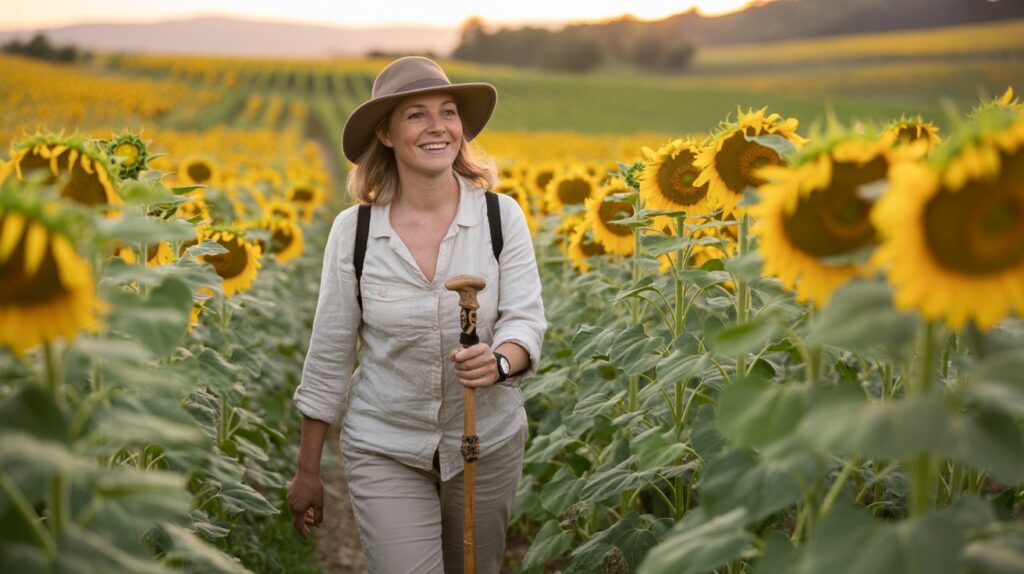




If your soul is craving fresh air, meaningful movement, and a chance to reconnect with nature, join us on a Camino de Santiago Walking Retreat in the southwest of France. This isn’t just a scenic hike – it’s a powerful, natural reboot for your body, mind, and spirit. Imagine quiet paths, rolling hills, cozy evenings, and slow conversations. No fitness requirements. No forced bonding. No pressure to have a breakthrough. Just one foot in front of the other, and finding your way to a brighter future.

What Life Lessons Can You Learn While Walking the Camino de Santiago? – a free guide filled with 10 not just “quaint anecdotes” or Instagram-worthy moments (though there are plenty of those) but real transformations from real people who walked this insight-giving trail – Subscribe to my monthly newsletter to Download the Guide

“I am an experienced medical doctor – MBChB, MRCGP, NLP master pract cert, Transformational Life Coach (dip.) Life Story Coach (cert.) Stress Counselling (cert.) Med Hypnotherapy (dip.) and EAGALA (cert.) I may have an impressive number of letters after my name, and more than three decades of professional experience, but what qualifies me to excel at what I do is my intuitive understanding of my clients’ difficulties and my extensive personal experience of managing major life changes using strategies I developed over many years.” Dr M Montagu
Research
Systematic reviews focused on mindfulness in tourism
Iacob, Jesus & Carmo (2021) — “A Systematic Review: Mindfulness Applied on the Field of Tourism” (Journal of Spatial and Organisational Dynamics). This review screened 517 records and included 16 empirical studies, summarising how mindfulness (including socio-cognitive mindfulness and mindfulness meditation perspectives) has been studied in tourism and what outcomes were reported.
Systematic reviews where mindfulness is central/explicit
Câmara, Pocinho, Agapito & Neves de Jesus (2023) — “Meaningful experiences in tourism: A systematic review of psychological constructs” (European Journal of Tourism Research). This systematic review (70 articles from Scopus/WoS) frames meaningful tourism experiences through positive psychology and explicitly includes mindfulness among the constructs assessed in the reviewed literature.