
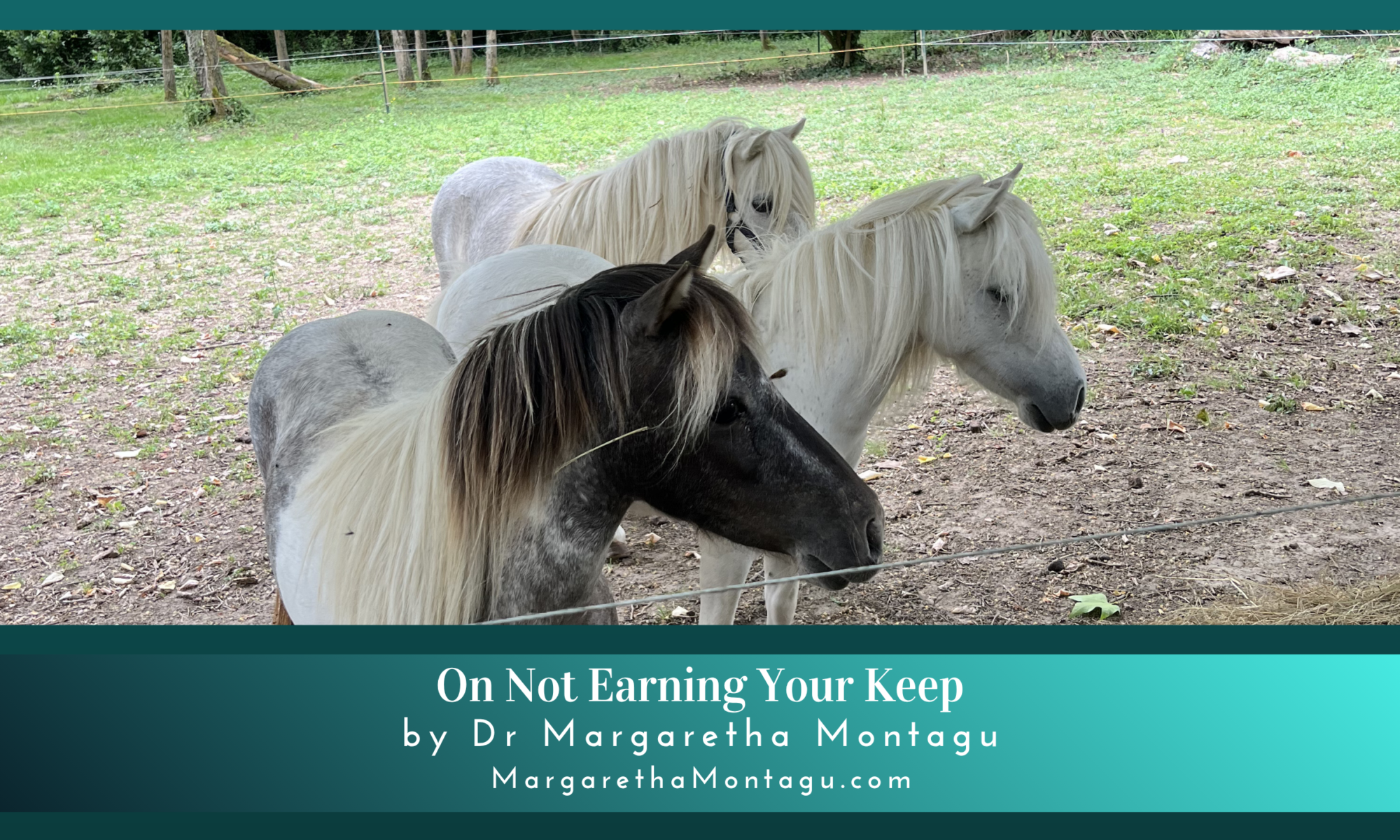
What a herd of small horses taught me about my worth
There is a particular kind of guilt that only strikes you while doing absolutely nothing, and I would like to report that I have perfected it. Lying in a hammock. Reading a novel at two in the afternoon on a Tuesday. Watching Loki doze in the sun with one back leg cocked like he’s modelling for a statue. And then, some small bureaucrat in my brain starts tapping his clipboard and asks, gently but with real menace: and what, exactly, are you contributing at the moment to life in general and to your life specifically?
I used to think this voice was just mine — a personality quirk, like disliking coriander. It took me an embarrassingly long time, several decades and one very patient miniature horse, to realise it isn’t personal at all. It’s cultural. We’ve all been issued the same clipboard.
The script we didn’t know we’d memorised
What do you do? What have you achieved? What are you doing for your personal growth? We ask these as polite small talk, but they’re a worth assessment in a trench coat. Most of us quietly translated “what do you produce” into “what am I worth,” and then, with a tragic flourish, into “if I stop producing, I stop existing in any way that counts.” I didn’t notice I’d swallowed this whole until I got sick a few years ago and had to properly stop — no retreats, no writing, no relentless five-year-plan for becoming a better version of myself. The panic that arrived wasn’t about my health. It was about my usefulness. Who was I, horizontal on the sofa, contributing nothing to anyone’s spreadsheet?
It took a horse — and not even a particularly philosophical one, just a small, food-motivated Falabella called Zofía — to show me how mad that groundless panic actually was.
Zofía does not have a LinkedIn profile!
Zofía has never justified her existence to a single living soul. She doesn’t compete. She doesn’t breed. By any productivity metric you’d care to apply, she is doing precisely nothing with her one wild and precious little life. And yet watch her in a field for ten minutes and the CV writes itself. She’s fertilising the soil with every dropping, which is more than I can say for my own contribution to local biodiversity this week. She’s spreading seed through that same dropping, feeding the insects that feed the swallows that have decided the herd is a sort of all-day buffet with legs. She’s holding her place in a social order that keeps her daughters calm and oriented without a single memo being issued. None of this is intentional. She isn’t striving for impact. She’s simply being a horse, completely, and the value radiates outward as a side effect of her bothering to exist at all.
We do the same, if we’d only notice. You breathe, and somewhere a plant uses the carbon dioxide you just discarded for free, without filling in a feedback form. You are, at this very moment, a five-star hotel for trillions of microorganisms who never leave a review. Your smile, badly timed but well meant, can lower another person’s heart rate before either of you has said a word. Your friendship has rerouted the entire shape of someone else’s life, and no invoice was ever raised for it. Eventually, your body will feed the earth, which is the least glamorous and the most generous thing any of us ever does, depending on your mood that day. None of this appears on a CV. All of it is real, and most of it was happening long before you’d achieved a single thing worth listing.
The trouble with our measuring tape
I’ll spare you the lecture on capitalism, partly because better minds than mine have written it, and partly because — let’s be honest — I still need the wifi to work and the hay bill to clear. This isn’t an anti-business manifesto. It’s a smaller observation: our measuring tape is superb at counting some things and hopeless at others. We can track revenue to the cent and have no instrument whatsoever for “made someone feel less alone today.” We obsess over growth charts and have never once put a number on what it costs, or what it’s worth, to sit quietly with a frightened friend in a hospital corridor. Comforting the grieving. Raising a child through the long, undocumented hours of toddlerhood. Caring for an ageing parent. Listening without already drafting your reply. Inspiring someone without meaning to. Making a frightened animal feel safe enough to put its head down. These aren’t footnotes to a meaningful life — for most of us, they are the meaningful life, they simply don’t fit the ruler we’ve been handed. Which is rather like declaring the ocean doesn’t exist because your ruler only goes up to thirty centimetres.
Why do so many of us feel we’re “not enough?”
This is the part that gets personal, because I suspect it’s the actual root of my hammock-guilt, and probably yours too. We don’t feel inadequate because we contribute nothing. We feel inadequate because our real contributions are invisible on the only scoreboard we were taught to read. The retiree who built an entire identity around a job title now feels unmoored — not because the wisdom evaporated, but because nobody’s scoring wisdom. The mother three sleepless years into raising small children quietly wonders whether she’s “doing anything” with her life, while doing the one thing civilisation actually depends on. The artist who hasn’t sold a canvas this year starts to doubt whether the painting itself was worth making, as if a thing’s worth were decided retroactively by a stranger’s bank transfer. And — this one’s close to home — horse owners whose ponies will never see a competition ring sometimes apologise for them, as though hay must be earned with a rosette.
It doesn’t. It never did. Zofía has never won so much as a participation ribbon and remains, by every measure that actually matters, magnificent.
What horses are spared from knowing
The single most enviable thing about animals is that they never lie awake at 3 am wondering if they’re falling behind. A horse does not compare its mane to another horse’s mane. It feels no pull whatsoever to optimise its personal brand before the next full moon. It has never once thought I’m not successful enough or I should be doing more with my life, which is either the dumbest or the wisest position available to a living creature, and I increasingly suspect it’s the latter. It simply continues being a horse, with total, unbothered commitment — and that isn’t laziness. It’s a kind of integrity we pay small fortunes on retreats trying to recover.
I’m not proposing we all quit our jobs and take up grazing, tempting as that sounds most Mondays. I’m proposing that this farm has quietly taught me something I keep needing to relearn: existence doesn’t require a defence lawyer. A friendship doesn’t only matter once it’s useful to you. A horse doesn’t only matter once it’s “for” something. And a person — tired, resting, between jobs, recovering, ageing, simply being — doesn’t only matter once they’ve produced something to show for the day. Can we value a being for who it is, rather than for what we can extract from it? That question, once you start asking it about horses, has an inconvenient habit of turning around and asking itself about you.
Strengthening a different muscle
I think of this as training, in the same patient, repetitive way you’d train a young horse — not one grand insight but small, deliberate reps. Noticing someone who isn’t being “productive” and resisting the urge to quietly file them as less interesting. Watching a horse graze and not asking what it’s “for.” Letting yourself rest on a Tuesday without drafting a justification for it in your head. Honouring old age instead of managing it. It’s an odd muscle to build, given the entire surrounding culture is a gym with exactly one machine in it. But — and I say this as someone who is, by nature, allergic to a tidy moral — it does get easier with use.
The thing I actually believe
I believe this most clearly at dusk, standing in a field being thoroughly ignored by five horses who have never once asked what I’m worth. A newborn has value before achieving anything. So does someone with dementia, who has lost the thread of every achievement they ever had. So does the very old, the very tired, the very lost, and the horse who will never wear a rosette. So, on the days when the most ambitious item on your list was exist, do you.
Every time I watch Zofía stand in the sun doing, by any official metric, nothing at all, I’m reminded that my own worth was never something I had to earn in the first place. It came with the breathing and the heartbeat, free of charge, before I’d done a single useful thing. Everything since has just been extra.
Sometimes the most productive thing you can do is wander down a quiet path, breathe deeply, and remember who you were before life convinced you that your value had to be earned.
If that sounds like something your heart has been quietly asking for, I’d love to welcome you to one of my Camino de Santiago walking retreats in southwest France. There are no performance targets, no pressure to transform into a shinier version of yourself, and no expectation that you have it all figured out.
Just good company, beautiful walks, plenty of space to think, and the rare luxury of discovering that you are enough, exactly as you are.
You don’t have to earn your place here. You simply have to decide it’s time to come.
Do you dream of escaping your stressful life to raise a herd of goats or grow sunflowers in the south of France? Then you may be ready for an Esprit Meraki retreat. Get access to this “very serious” quiz to help you figure out how urgent your need for a change of scenery is, when you subscribe to my monthly newsletter.

“I am an experienced medical doctor – MBChB, MRCGP, NLP master pract cert, Transformational Life Coach (dip.) Life Story Coach (cert.) Stress Counselling (cert.) Med Hypnotherapy (dip.) and EAGALA (cert.) I may have an impressive number of letters after my name, and more than three decades of professional experience, but what qualifies me to excel at what I do is my intuitive understanding of my clients’ difficulties and my extensive personal experience of managing major life changes using strategies I developed over many years.” Dr M Montagu